

In the modern technology ecosystem, cloud computing is not just a feature, it’s the foundation. Leading this global transformation is Amazon Web Services (AWS), the undisputed market leader, a fact consistently verified by industry analysis from firms like Gartner®. For tech professionals, this dominance means that AWS proficiency is one of the most critical and bankable skills. While hands-on experience is vital, a formal AWS certification acts as a powerful catalyst, accelerating career growth in numerous ways.
But what are the specific, tangible benefits that make the investment in certification worthwhile? Here, we explore the Top 10 AWS Certification Benefits, A complete career blueprint.
1. A Significant and Quantifiable Salary Increase
The most direct return on your investment is financial. Companies are willing to pay a premium for professionals with validated AWS skills. Industry data consistently shows that certification leads to a substantial pay increase. A Jefferson Frank survey, for example, found that 73% of AWS professionals saw a salary increase after getting certified, with the average raise being an impressive 27%. For many roles, like the AWS Certified Solutions Architect, average salaries in the US can soar above $150,000, making it one of the highest-paying IT credentials available.
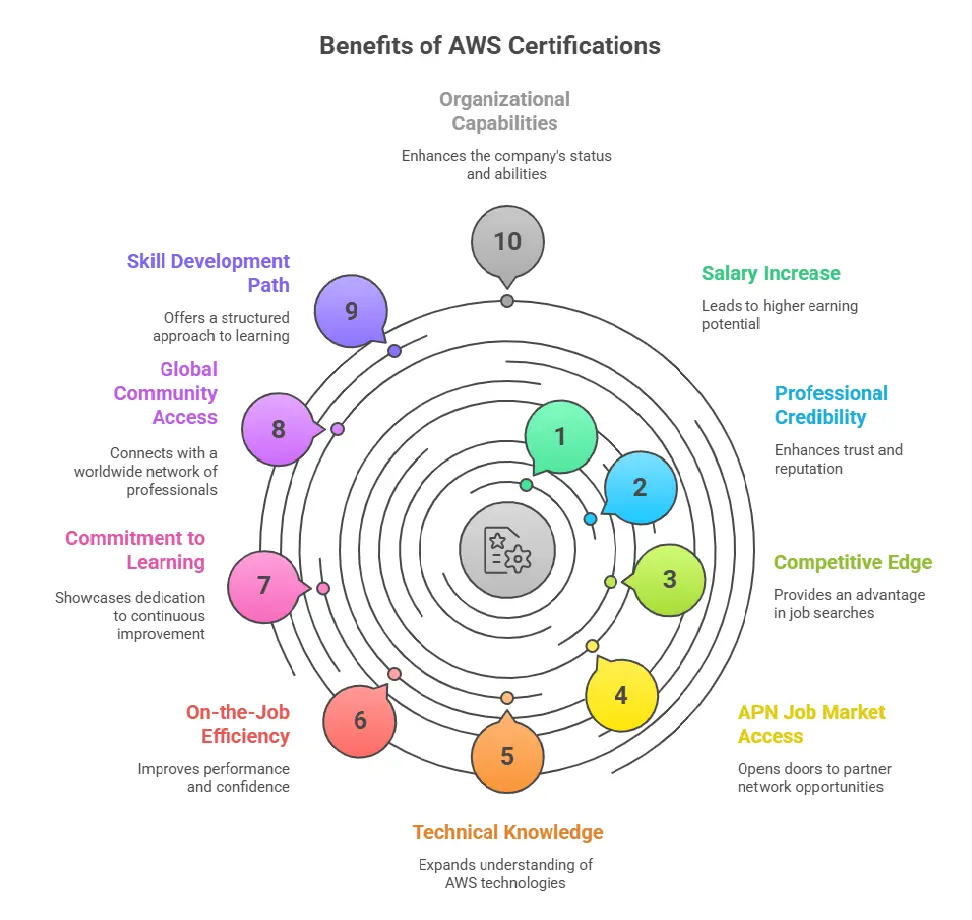
2. Enhanced Professional Credibility and Trust
A certification acts as a global benchmark for your skills. It is an official, third-party validation from Amazon that you possess a specific level of knowledge and understand industry best practices. This builds immediate trust with hiring managers, clients, and colleagues. For consultants or freelancers, it can be the deciding factor that wins a project. Within an organization, it positions you as a subject matter expert, giving your technical recommendations more weight and authority.
3. A Decisive Edge in a Competitive Job Market
In a crowded field of applicants, an AWS certification is a powerful differentiator. Many companies use Applicant Tracking Systems (ATS) to screen resumes, and “AWS Certified” is a high-value keyword that ensures your application gets seen by a human. When a hiring manager has two candidates with similar experience, the certified individual almost always has the edge. It signals a proactive approach to professional development and a serious commitment to the craft.
Insight from the Tech Community:
A user on Reddit’s r/ITCareerQuestions explained it this way: “Experience gets you the interview, but sometimes the certification is what gets your resume picked from the pile in the first place. It’s a tie-breaker. It proves you have the discipline to study and pass a rigorous exam, which is a valuable trait in itself.”
4. Access to the AWS Partner Network (APN) Job Market
This is a critical, often overlooked benefit. The AWS Partner Network (APN) is a massive global ecosystem of companies that build solutions on or provide services for AWS. To achieve and maintain their partner status (e.g., Select, Advanced, Premier), these companies are required to employ a minimum number of AWS-certified professionals. This creates a dedicated, high-demand job market where your certification isn’t just a “nice-to-have”—it’s a necessity for the employer.
5. Deeper and Broader Technical Knowledge
On-the-job training is often project-specific, exposing you to a narrow slice of the vast AWS ecosystem. The structured curriculum for a certification forces you to learn the breadth and depth of AWS services, from core compute and storage to networking, security, and databases. Crucially, it ingrains the principles of the AWS Well-Architected Framework, teaching you how to build solutions that are secure, reliable, efficient, and cost-effective—knowledge that makes you a far more capable engineer.
6. Increased On-the-Job Efficiency and Confidence
The comprehensive knowledge gained through certification study translates directly into improved performance. With a deeper understanding of the platform, you can troubleshoot complex problems faster, design more resilient architectures, and select the right service for the right job with greater confidence. Industry data supports this, with 49% of professionals reporting increased job efficiency after getting certified. This confidence empowers you to take on more complex challenges and drive innovation within your team.
7. A Clear Demonstration of Your Commitment to Learning
Technology evolves at a breakneck pace, and a commitment to continuous learning is one of the most valued traits in any IT professional. Investing your time and effort to earn a certification is a powerful signal to employers that you possess this growth mindset. Furthermore, with a three-year recertification requirement, you demonstrate an ongoing dedication to keeping your skills sharp and relevant.
8. Access to an Exclusive Global Community
Upon certification, you gain entry into the AWS Certified Global Community. This provides access to exclusive professional networking opportunities, such as the AWS Certified LinkedIn Community. Certified individuals also often receive perks at major industry events, like access to AWS Certification Lounges at AWS re:Invent, providing a unique chance to connect with peers and AWS experts from around the world.
9. A Structured Path for Skill Development
For those looking to transition into the cloud, the AWS ecosystem can feel overwhelmingly large. The AWS certification path provides a clear, structured roadmap for learning. It breaks down the complexity into manageable, role-based tiers, guiding you from fundamental concepts to specialized expertise. This guided path, from Foundational to Associate, Professional, and Specialty, provides clear goals and a tangible way to measure your progress.
| Certification Level | Ideal For | Key Objective |
|---|---|---|
| Foundational | Beginners, Non-technical roles | Understanding core AWS concepts and value proposition. |
| Associate | Practitioners with 1+ year of experience | Validating core technical skills for a specific role (Architect, Developer, SysOps). |
| Professional | Experienced pros (2+ years) | Proving advanced skills in designing and operating complex AWS environments. |
| Specialty | Subject matter experts | Validating deep expertise in a high-demand niche (e.g., Security, Networking). |
10. Boosts Your Organization’s Capabilities and Status
Finally, your certification doesn’t just benefit you—it benefits your employer. As mentioned, it helps your company meet its APN tier requirements. It also enhances the team’s collective skill set, leading to better, more innovative solutions for the business. A team of certified professionals can be a major selling point for a company, instilling confidence in their clients that their projects are being handled by qualified experts.
Conclusion: It’s More Than a Certificate—It’s a Career Catalyst
In 2025, an AWS certification is one of the most powerful investments you can make in your professional future. The benefits are multifaceted and profound: it provides a clear and often dramatic path to a higher salary, gives you a significant advantage in the competitive job market, and fundamentally enhances your technical skills, making you a more confident and effective cloud professional.
It is not merely a piece of paper. It is a validation of your expertise, a key to unlocking new opportunities, and a catalyst for long-term career growth in the dynamic and rewarding world of cloud computing.
Frequently Asked Questions (FAQs)
Which AWS certification should I get first?
For most technical professionals, the AWS Certified Solutions Architect – Associate is the recommended starting point as it covers a broad range of core services. If you are in a non-technical role or completely new to IT, start with the AWS Certified Cloud Practitioner.
Is experience more important than certification?
They are complementary. Experience is crucial for context and mastery, but certification validates your knowledge against a global standard and often gets you the interview where you can showcase your experience. The ideal candidate has both.
How long do I need to study for an exam?
This varies greatly. For an Associate exam, someone with a year of experience might study for 80-120 hours over 2-3 months. Beginners should plan for more. Professional exams often require 150+ hours of dedicated study. For quality preparation, using targeted resources like practice exams from PassITExams can be invaluable.
Do AWS certifications expire?
Yes, they are valid for three years. This policy ensures that your skills remain current. You must recertify by passing the latest version of the exam or a higher-level exam in the same path.
