

In the vast landscape of Microsoft Azure certifications, two of the most significant milestones for infrastructure professionals are the AZ-104: Microsoft Azure Administrator Associate and the AZ-305: Designing Microsoft Azure Infrastructure Solutions, which leads to the Azure Solutions Architect Expert certification. While they both focus on Azure infrastructure, they represent two distinct levels of expertise and career focus. For a broader overview of all Microsoft certifications, you can refer to this guide.
The AZ-104 is about implementation and management, the hands on “how.” The AZ-305 is about design and strategy, the high level “why” and “what.” Understanding the difference is crucial for anyone looking to build a successful and progressive career in cloud infrastructure. This guide will provide an exhaustive comparison, backed by real world data, to help you understand each path and choose your next step wisely. For those just starting, it’s also useful to understand the difference between foundational and associate-level certifications, such as the AZ-900 vs AZ-104.
At a Glance: Administrator vs Architect (AZ-104 vs AZ-305)
Before we dive deep, this table provides a quick reference for the key differences between the two exams. This highlights the fundamental shift from an operational role to a strategic one.
| Feature | AZ-104: Microsoft Azure Administrator | AZ-305: Designing Azure Infrastructure |
|---|---|---|
| Certification Level | Associate | Expert (Requires AZ-104 as a prerequisite) |
| Primary Role | You manage and implement the house (infrastructure). | You design the blueprint for the house. |
| Core Focus | Implementing, managing, and monitoring Azure resources. | Designing solutions for identity, governance, storage, and more. |
| Ideal For | IT Admins, System Engineers, Cloud Operations. | Experienced Admins, Cloud Consultants, aspiring Architects. |
| Key Verbs | Configure, Deploy, Manage, Monitor, Implement. | Design, Recommend, Evaluate, Plan, Govern. |
| Prerequisites | Recommended: 6+ months of hands-on Azure experience. | Mandatory: Must pass AZ-104 first. |
| Exam Cost | ~$165 USD (varies by region) | ~$165 USD (varies by region) |
| Renewal | Free, annually via online assessment. | Free, annually via online assessment. |
Deep Dive: The AZ-104 Azure Administrator Path (The Implementer)

The AZ-104 certification is the essential credential for professionals responsible for the day-to-day management of an Azure environment. An Azure Administrator is the person who keeps the lights on and they are responsible for the health, security, and scalability of the cloud infrastructure. This role is perfect if you have an IT operations background and excel at hands-on implementation. To understand if the AZ-104 certification is worth it for your career, consider the skills you’ll gain.
What You’ll Master with AZ-104
The AZ-104 exam is a practical test of your ability to perform administrative tasks, broken down into five key domains.
1. Manage Azure Identity and Governance (20-25%)
This is about implementing security and control. You’ll master Azure Active Directory (now Microsoft Entra ID), managing user accounts, groups, and application identities. A critical skill tested is applying Role Based Access Control (RBAC) roles to enforce the principle of least privilege. You’ll also use Azure Policy to enforce compliance rules defined by architects or security teams.
- Real world task: A new employee joins the finance team. You must create their user account, add them to the “Finance” group, and assign them the “Reader” role to a specific resource group.
2. Implement and Manage Storage (15-20%)
This domain covers the configuration and maintenance of Azure’s storage solutions. You must be proficient with Azure Blob Storage, Azure Files, and managing disks for virtual machines. This includes creating storage accounts, setting data access tiers (Hot, Cool, Archive) to manage costs, and configuring redundancy options like LRS, GRS, and ZRS to meet availability requirements.
- Real world task: A web application needs to store user uploaded images. You must create a storage account and a blob container, configure public access settings, and implement a lifecycle management policy to automatically move old images to cheaper storage.
3. Deploy and Manage Azure Compute Resources (20-25%)
This is the heart of Infrastructure-as-a-Service (IaaS). You will be tested heavily on deploying and scaling Azure Virtual Machines (VMs). This includes selecting the correct VM size, configuring its networking and storage, and implementing scalability using Virtual Machine Scale Sets (VMSS) to handle fluctuating workloads.
- Real world task: An e-commerce site expects a massive traffic spike for a holiday sale. You must configure a VMSS to automatically deploy new VM instances when CPU usage exceeds 75%.
4. Implement and Manage Virtual Networking (15-20%)
This domain tests your ability to build and secure the network. Mastery of Virtual Networks (VNets), subnets, and IP addressing is essential. You’ll need to demonstrate how to implement Network Security Groups (NSGs) to act as a firewall, filter traffic, and configure DNS for name resolution within your VNet.
- Real world task: You have a three-tier application. You must create a VNet with three separate subnets and configure NSG rules to ensure proper, secure traffic flow between the tiers, isolating the database from the web front-end.
5. Monitor and Maintain Azure Resources (10-15%)
An administrator’s job is proactive maintenance. This section focuses on your ability to use Azure Monitor to collect metrics and logs, use Log Analytics to troubleshoot issues, create alerts for performance degradation or outages, and implement backup strategies using Azure Backup.
- Real world task: You must configure an alert in Azure Monitor that sends an email notification to the on-call team whenever the average CPU utilization of a critical VM goes above 90%.
Deep Dive: The AZ-305 Azure Architect Path (The Designer)

The AZ-305 exam is the gateway to becoming a Microsoft Certified: Azure Solutions Architect Expert. This certification is for experienced professionals who translate business requirements into secure, scalable, and reliable cloud solutions. While an administrator knows how to configure a service, an architect knows which service to use, why to use it, and how it fits into the bigger picture.
What You’ll Master with AZ-305
The AZ-305 exam is focused entirely on design principles, evaluating trade-offs, and making recommendations based on business constraints.
1. Design Identity, Governance, and Monitoring Solutions (25-30%)
This is about designing a secure and well-governed environment from the top down. You won’t just apply RBAC roles; you’ll design an entire RBAC strategy for an organization. You’ll design a logging and monitoring strategy using Azure Monitor to meet business requirements for observability. You will also design governance solutions using Azure Policy and Management Groups to structure an enterprise’s subscriptions.
- Architectural task: A large enterprise with multiple departments needs to migrate to Azure. You must design a management group hierarchy that reflects their organizational structure and design a set of Azure Policies to enforce tagging, region restrictions, and cost controls across all subscriptions.
2. Design Data Storage Solutions (20-25%)
This domain tests your ability to choose the right storage solution. You will need to evaluate and recommend solutions for relational data (Azure SQL), semi-structured data (Cosmos DB), and unstructured data (Blob Storage). The focus is on designing for cost-effectiveness, performance tiers, and scalability based on application needs.
- Architectural task: A new application needs to store product catalog data and user session information. You must evaluate the requirements and design a solution that uses Azure SQL Database for the structured catalog and Azure Cache for Redis for the volatile session data to ensure high performance.
3. Design Business Continuity Solutions (10-15%)
This section is about designing for failure. You’ll design backup and disaster recovery solutions that meet specific business goals for Recovery Time Objective (RTO) and Recovery Point Objective (RPO). This involves designing solutions with Azure Backup and Azure Site Recovery and creating highly available solutions using availability zones and regions.
- Architectural task: A critical application must be able to failover to a secondary region with minimal data loss and downtime. You must design a disaster recovery solution using Azure Site Recovery, detailing the replication policy, recovery plan, and network configuration for the failover region.
4. Design Infrastructure Solutions (30-35%)
This is the largest domain, covering the core infrastructure blueprint. You will design compute solutions (evaluating VMs vs. App Service vs. AKS), network solutions (designing VNet architecture and hybrid connectivity with VPN/ExpressRoute), and migration strategies. You are expected to make design choices that balance cost, performance, security, and scalability.
- Architectural task: A company wants to migrate its on-premises web application to Azure. You must design an infrastructure solution, recommending whether to use VMs for a lift-and-shift approach or refactor parts of the application to run on Azure App Service for better scalability.
Job Market Deep Dive: A Real Time Snapshot for AZ-104 and AZ-305
To provide our readers with a tangible, data driven understanding of the career opportunities, our research team has performed extensive research across major job portals like Indeed and Glassdoor. This data reveals a clear progression in responsibility, scope, and compensation from the Administrator to the Architect role. For more on the highest paying Microsoft Azure certifications, you can explore this resource.
The Azure Administrator (AZ-104) Job Landscape
The AZ-104 certification is your entry point into a hands-on career in cloud operations. Our research shows a massive and consistent demand for these foundational skills. You can learn more about the specifics of AZ-104 certification cost, salary, and jobs.
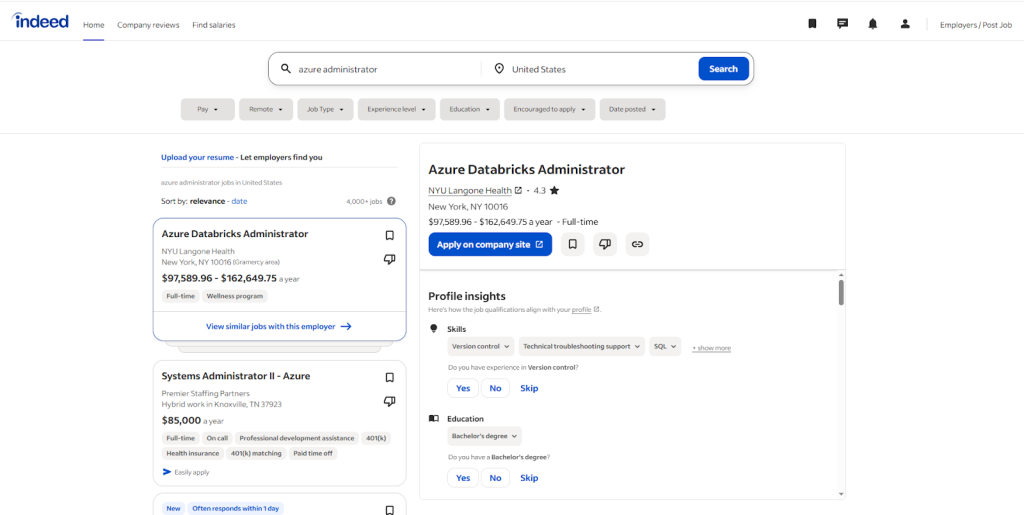
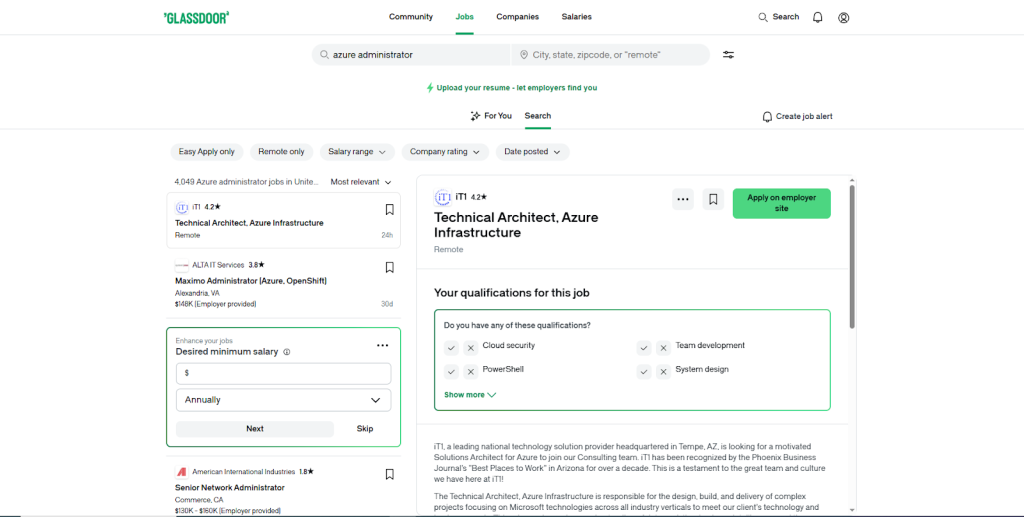
Our analysis shows a significant number of opportunities, with portals like Indeed and Glassdoor listing over 4,000 roles for “Azure Administrator” in the United States. These roles often include titles like “Systems Administrator II – Azure,” “Senior Network Administrator,” and “Technical Architect, Azure Infrastructure,” where Azure expertise is a core requirement for modernizing IT operations.
The Solutions Architect (AZ-305) Job Landscape
The AZ-305 certification propels you from implementation to a senior role focused on design and strategy. The job market for architects is even larger, reflecting the critical need for experienced leaders who can plan and design enterprise-grade cloud solutions.
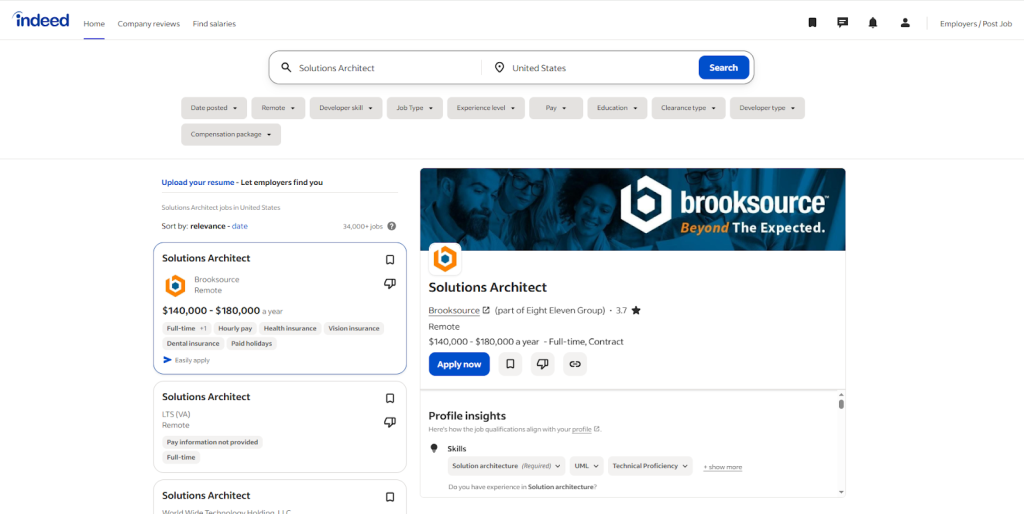
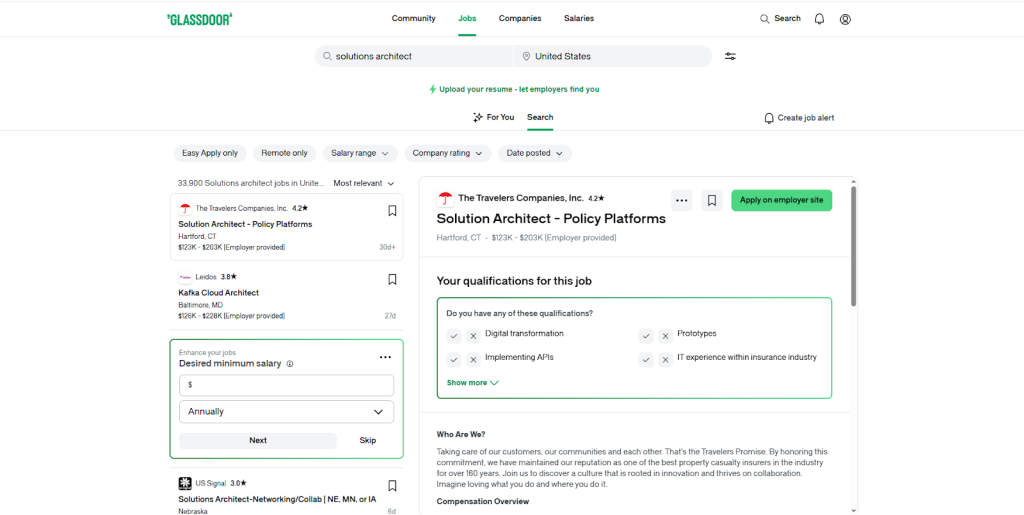
The demand for architects is immense. Our analysis of Indeed and Glassdoor reveals a staggering 34,000+ available jobs for “Solutions Architect” in the United States. The job titles are clearly senior and strategic, such as “Solutions Architect,” “Kafka Cloud Architect,” and “Solution Architect – Policy Platforms,” focusing on high-level design and planning.
Job Market Comparison: Administrator vs. Architect
This table summarizes the key data points from our research, highlighting the career progression.
| Metric | AZ-104 (Administrator) | AZ-305 (Architect) |
|---|---|---|
| Job Volume (US) | 4,000+ | 34,000+ |
| Common Job Titles | Systems Administrator, Cloud Engineer, Network Admin | Solutions Architect, Cloud Consultant, Sr. Cloud Engineer |
| Typical Salary Range | $85,000 – $180,000 | $140,000 – $203,000+ |
| Role Focus | Hands-on Implementation, Maintenance, Troubleshooting | Strategic Design, Planning, Governance, Stakeholder Mgt. |
This data confirms that achieving the Solutions Architect Expert certification after building a foundation with AZ-104 is a direct path to the highest compensation brackets and most strategic roles in cloud infrastructure.
Conclusion: Which Path is Right for You?
The choice between AZ-104 and AZ-305 isn’t really a choice of “either/or” but rather a question of “what’s next?” Following the best Azure certification path for your goals is key.
Focus on AZ-104 (Administrator) if:
- You are starting your Azure infrastructure career or have less than two years of experience.
- You enjoy hands-on implementation, troubleshooting, and daily management tasks.
- You want to build the foundational, practical skills required for any advanced Azure role.
Focus on AZ-305 (Architect) after you have your AZ-104 if:
- You are an experienced Azure Administrator or Engineer ready for the next step.
- You enjoy strategic thinking, planning, and designing solutions to meet business needs.
- You want to move into a senior-level role with higher responsibility and salary potential.
For more information on Microsoft certifications, you can browse the Microsoft certifications category and specifically the Azure certifications category.
Frequently Asked Questions (FAQ)
1. Is the AZ-104 a prerequisite for the AZ-305?
Yes. To earn the Azure Solutions Architect Expert certification, you must first pass the AZ-104 exam and then pass the AZ-305 exam. The AZ-104 is a mandatory prerequisite that provides the necessary foundational knowledge.
2. How much harder is the AZ-305 than the AZ-104?
The AZ-305 is significantly more challenging because it tests a different kind of thinking. The AZ-104 tests your knowledge of how to do something. The AZ-305 tests your ability to decide what should be done from multiple valid options, based on a set of business constraints like cost, performance, and security. It is a test of judgment and experience, not just technical knowledge.
3. Should I study for both exams at the same time?
It is not recommended. The best approach is to focus on and pass the AZ-104 first. Then, get at least 6-12 months of solid hands-on experience as an administrator. This practical experience is invaluable for developing the architectural mindset and real-world context needed to successfully pass the AZ-305.
More Certification Comparisons
Compare scope, difficulty, prep time, and career impact—side by side.
PassITExams vs ExamTopics
Which Platform is Best for IT Certification Exam Preparation?
PassITExams vs Skillcertpro
The Ultimate Guide to Choosing Your IT Certification Success Partner
PassITExams vs Pass4sure
A Critical Examination of Certification Preparation Platforms
CTFA vs CFP
Choosing the Right Financial Designation for a Career in Fiduciary and Wealth Management
Splunk vs Elastic
The Ultimate Comparison for Logging, SIEM, and Observability
IBM QRadar vs Splunk
The Ultimate SIEM Comparison for Modern Security Operations
SageMaker vs Bedrock
Choosing the Right Engine for Your AI Strategy in 2026
az-104 vs az-400
our Definitive Azure Career Path for 2026 (Admin vs. DevOps)
AZ-104 vs AI-900
Azure Admin Associate Or AI Fundamentals?
AZ-104 vs PL-300
Azure Admin or Data Analyst? (Salary & Jobs)
AZ-104 vs AZ-500
Which Azure Certification Is Right for Your Career?
AZ-900 vs CLF-C02
Which Foundational Cloud Cert Unlocks the Best Jobs and Salaries?
AZ-900 vs SAA-C03
Which Cloud Certification is Right for You?
RHIT vs RHIA
Which Health Information Credential Is Right for You?
AZ-900 vs DP-900
Which Azure Certification Should You Take First?
AZ-900 vs SC-900
Choose Your Microsoft Certification Path
AZ-900 vs AI-900
Which Azure Fundamentals Certification Is Your Launchpad?
AZ-204 vs AZ-305
The Builder vs. The Architect
AZ-900 vs AZ-204
Which Microsoft Azure Certification is Right for You?
az-204 vs pl-300
Building the Engine or Charting the Course?
AZ-900 vs AZ-400
Foundational vs. Expert: Complete Guide for Your Azure Career
601 vs 601
CompTIA Security+ 601 vs 701: The Ultimate Comparison Guide
Data Engineer vs Data Scientist
The Ultimate Comparison Guide
AWS vs Azure
The Ultimate Comparison for Certification & Career
CISSP vs SecurityX
Which Certification Will Define Your Cybersecurity Career?
AWS vs Azure
Who is Leading the Cloud Race?
AWS vs Azure
Which Cloud Certification is Paying High?
AZ-104 vs AZ-305
Administrator vs. Architect – Your Ultimate Azure Guide
AZ-104 vs AZ-204
The Ultimate Guide for Your Azure Career
ISSA vs NASM
Which Personal Trainer Certification Is Best for You?
Salesforce Admin vs Salesforce Developer
Unlocking Your Earning Potential in the Salesforce Ecosystem
CISSP vs CCSP
Your Ultimate Guide to a Career in Cloud Security
CRISC vs CISSP
Mastering Risk Management and Information Security
CISSP vs CEH
Your Guide to Mastering Offensive and Defensive Security
CISSP vs PMP
Unlocking Dual Expertise in Security and Project Management
CISSP vs Security+
Choosing the Right Certification to Boost Your Earning Potential
CISSP vs OSCP
Choosing the Right Certification for a Six-Figure Cybersecurity Career
CISSP vs CISM
Which Certification Will Truly Elevate Your Cybersecurity Career?
Azure vs AWS
How to Choose the Right Cloud Platform for Your Business
AZ-900 vs AZ-700
MIcrosoft Career Blueprint: From Azure Fundamentals to Networking
AZ-900 vs AZ-104
Azure Career Blueprint: Your Path from Azure Fundamentals to Azure Administrator
AZ-104 vs SAA-C03
Azure Administrator vs. AWS Architect: Which Career Path Wins?
AZ-900 vs MS-900
Your ultimate Microsoft fundamentals showdown.
