

As businesses worldwide continue their rapid migration to the cloud, Microsoft Azure has solidified its position as a leading platform, driving a massive demand for skilled professionals. For anyone looking to start a career in cloud computing or validate their foundational knowledge, the first and most crucial step in the Azure ecosystem is the AZ-900: Microsoft Azure Fundamentals certification. Explore more about Azure certifications.
But what exactly is the AZ-900 exam? Who is it designed for, what topics does it cover, what is its real world value in the job market, and how do you navigate the process from study to registration?
This comprehensive guide will serve as your definitive resource for the AZ-900 exam. We will break down every aspect of the certification, providing you with a clear roadmap to begin your Azure journey with confidence.
What is the AZ-900 Microsoft Azure Fundamentals Exam?
The AZ-900: Microsoft Azure Fundamentals exam is a foundational level certification that validates a candidate’s broad, conceptual understanding of cloud services and the Microsoft Azure platform. Think of it as the “language course” for the world of Azure; it teaches you the essential vocabulary, core concepts, and the business value of the cloud.

Offered by Microsoft, this exam is not intended to be deeply technical. Instead, its purpose is to ensure that anyone from aspiring IT professionals to sales and marketing teams can speak credibly about Azure services, architecture, security, and pricing. It is the official and highly recommended starting point for any other role based Azure certification path. You can find the official exam page on the Microsoft Learn website.
The AZ-900 Job Trend: Your Entry into a High-Demand Market
The public cloud market is experiencing explosive growth, projected to be worth over a trillion dollars by the end of the decade. Within this market, Microsoft Azure holds a significant share, making Azure skills some of the most sought after in the entire IT industry. While the AZ-900 is a foundational certification, its value in the job market is strategic and multi faceted.
It’s a Powerful “HR Filter”
A search for “Azure” on job portals like Indeed and Glassdoor reveals tens of thousands of open positions. Many of these roles, even if not explicitly for beginners, list a “basic understanding of cloud services” as a prerequisite. The AZ-900 certification is a verifiable keyword on your resume that proves you meet this baseline. It ensures your application gets past the initial automated Applicant Tracking Systems (ATS) and into the hands of a human recruiter, a critical first step in any job search.
What Your Future in Azure Fundamentals Looks Like: Salaries & Job Market Insights
To give you a real-world snapshot of the Azure job market, our research team performed an extensive analysis of major job portals like Indeed, LinkedIn, and Glassdoor. We’ve curated the latest data to show you not just the demand for Azure skills, but the lucrative opportunities that await.
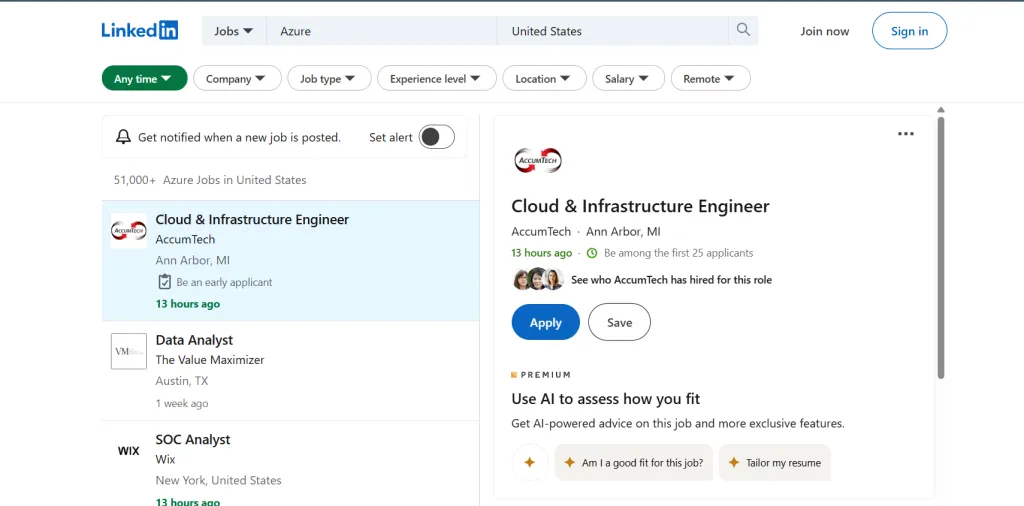
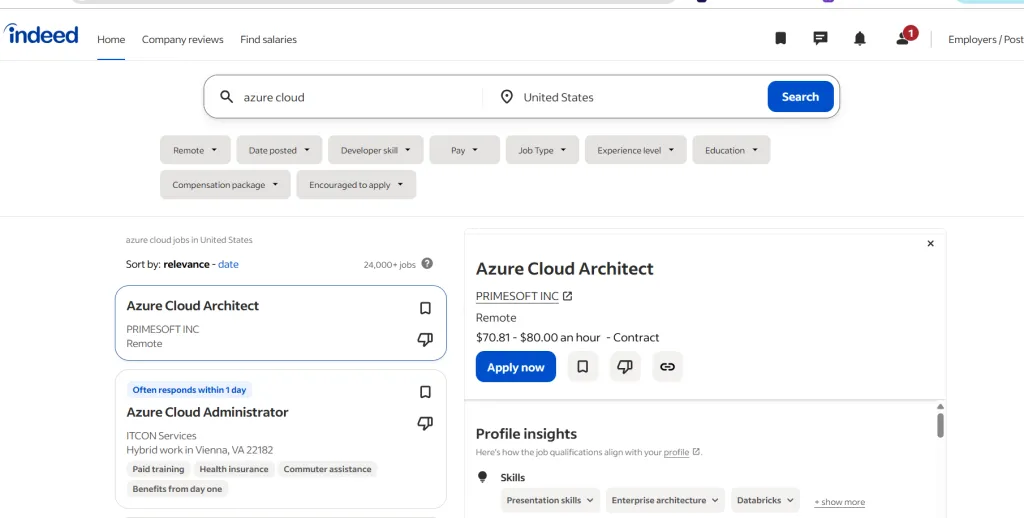
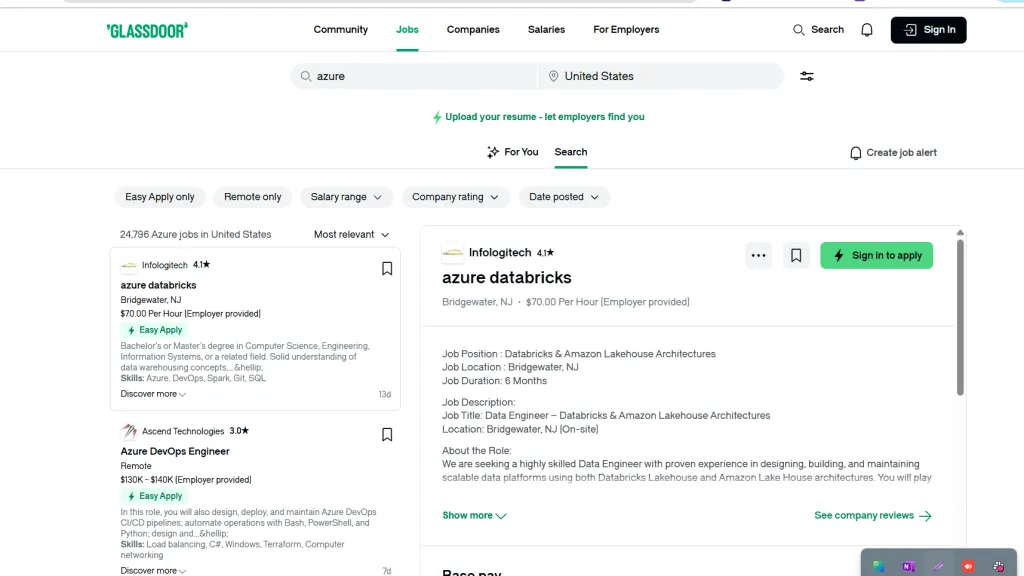
As you can see from the snapshots below, a simple search for “Azure” reveals a massive number of open positions in the United States alone:
LinkedIn shows over 51,000+ Azure-related jobs.
Indeed and Glassdoor each list over 24,000+ open roles.
Diving Deeper: The Roles and Salaries
This isn’t just about quantity; it’s about quality and diversity. The career paths in Azure are vast, ranging from engineering to architecture. Our findings highlight several high-paying roles:
- An Azure DevOps Engineer can command a salary between $130,000 – $140,000 per year.
- Contract roles like Azure Cloud Architect are listed with hourly rates of $70 – $80, which translates to an impressive annual income of over $145,000.
- Specialized roles like Azure Databricks Data Engineer also show highly competitive hourly rates.
Your Starting Point: The Power of the AZ-900 Certification
Now, you might be thinking, “Are these jobs for someone with just an AZ-900 certification?” That’s a great question.
While roles like “Cloud Architect” require advanced experience, every single one of those journeys starts with a solid foundation. That foundation is the AZ-900: Azure Fundamentals certification.
Think of it this way: The AZ-900 is your passport into the world of Azure.
- It Validates Your Commitment: It proves to employers that you are serious about a career in cloud computing and have a verified understanding of core Azure services, security, and pricing models.
- It Opens the Door: For entry-level cloud roles, having the AZ-900 on your resume immediately sets you apart from candidates who don’t. It’s the credential that gets you past the initial screening.
- It’s the First Step on the Ladder: The lucrative, high-paying jobs you see are the destination. The AZ-900 is the essential first step on that path, leading you toward more specialized certifications and hands-on experience.
The data is clear: the Azure ecosystem is booming with high-paying opportunities. By earning your AZ-900 certification, you are not just learning about the cloud—you are taking the first, most critical step into a thriving and rewarding career.
A Value Proposition for Different Career Paths
The AZ-900’s strategic importance varies depending on your role:
- For the IT Professional: For a system administrator or developer with an on premises background, the AZ-900 acts as a “career pivot” tool. It formally validates that your skills are being updated for the modern cloud-first world, making you a much more attractive candidate for hybrid roles and internal promotions.
- For the Non-Technical Professional: In sales, marketing, or project management, credibility is key. The AZ-900 is a “credibility booster,” empowering you to speak the language of your technical clients and teams. This leads to more effective communication, better project scoping, and stronger client relationships.
- For the Career Starter: For a student or recent graduate, the AZ-900 is the “foot in the door.” On a resume with limited professional experience, this official Microsoft credential is a concrete achievement that demonstrates initiative, commitment, and a foundational understanding of a high-growth technology, making you a stronger candidate for internships and entry-level support roles.
The First Step on a Lucrative Ladder
While the certification itself doesn’t come with a specific salary, it is the non-negotiable first step on a very lucrative career path. Generalist roles like “Azure Systems Engineer” can command salaries up to $167,000, and specialized roles in areas like data and infrastructure can reach well over $200,000. The small upfront investment in the AZ-900 is your entry ticket to this high paying ecosystem.
Deep Dive into the AZ-900 Exam Domains
The AZ-900 exam is structured into three core knowledge areas, or “domains.” Mastering these is the key to passing the exam.
1. Describe Cloud Concepts (25–30%)
This domain is the foundation of the entire exam. It ensures you understand the “why” behind cloud computing. You are not expected to know deep technical details here, but you must be fluent in the fundamental principles, including the different cloud models (Public, Private, Hybrid) and service types (IaaS, PaaS, SaaS).
2. Describe Azure Architecture and Services (35–40%)
This is the largest and most detailed domain, testing your ability to recognize and describe the core products within the Azure ecosystem. The key here is to know what a service does, not necessarily how to configure it.
- Core Architectural Components: This sub-domain covers the physical and logical structure of Azure. You’ll need to understand the hierarchy of Regions and Availability Zones for building resilient applications, and the logical containers for your resources, including Resource Groups, Subscriptions, and Management Groups.
- Azure Compute Services: This is about the services that run your applications. You must be able to differentiate between:
- Azure Virtual Machines (VMs): The foundational IaaS offering, giving you full control over a virtualized server (e.g., Windows or Linux) in the cloud.
- Azure App Service: A PaaS offering for building and hosting web apps and APIs without managing the underlying operating system or web server software.
- Azure Container Instances (ACI) & Azure Kubernetes Service (AKS): Services for running containerized applications. ACI is for simple, single containers, while AKS is a full-fledged orchestration service for managing complex, multi-container applications.
- Azure Functions: A serverless compute service that lets you run small pieces of code in response to events (like a new file being uploaded) without managing any servers at all.
- Azure Networking Services: This covers how resources communicate. You’ll need to describe the purpose of:
- Azure Virtual Networks (VNets): Your private, isolated section of the Azure cloud where you can launch resources and control traffic.
- VPN Gateway & ExpressRoute: Services for creating secure, hybrid connections between your on-premises network and your Azure VNet.
- Azure DNS: For hosting your DNS domains in Azure and managing your DNS records.
- Azure Storage Services: This covers data storage. You must know the use cases for:
- Azure Blob Storage: For storing massive amounts of unstructured object data, like images, videos, and log files.
- Azure Disk Storage: High-performance SSD and HDD disks that are attached to your Virtual Machines.
- Azure File Storage: A fully managed file share in the cloud, accessible via the standard SMB protocol, just like a network drive on-premises.
- Azure Database Services: This covers managed database solutions. You should be able to identify:
- Azure SQL Database & Azure SQL Managed Instance: PaaS offerings for relational Microsoft SQL Server databases that automate patching, backups, and high availability.
- Azure Cosmos DB: A globally distributed, multi-model NoSQL database for high-performance applications that require low latency and high availability around the world.
3. Describe Azure Management and Governance (30–35%)
This domain focuses on the tools and features you use to manage, secure, and govern an Azure environment.
- Key objectives include: Recognizing management tools like the Azure Portal and Azure CLI; understanding governance features like Azure Policy and Resource Locks; explaining cost management tools like the Azure Pricing Calculator; and identifying the purpose of monitoring services like Azure Monitor.
Deconstructing the AZ-900 Exam Difficulty
The AZ-900 is considered an entry-level exam and is not “difficult” in the same way as an advanced, role-based exam. However, its challenge should not be underestimated, as it comes from a few specific areas. Read more on is AZ-900 certification hard.
Challenge 1: The Breadth of Knowledge (“A Mile Wide”)
The primary challenge of the AZ-900 is not complexity, but volume. The exam covers a vast number of Azure services and concepts. The difficulty lies in memorizing the names and primary functions of dozens of them—from Virtual Machines and App Service to Blob Storage, Cosmos DB, and Azure AD. You don’t need to know them in depth, but you need to know what they are and what they do.
Challenge 2: The Conceptual Nature
The exam tests your conceptual understanding, not your hands-on skill. The questions are often about choosing the “best” service for a given scenario. This requires you to understand the subtle differences between services. For example, you won’t be asked to configure a virtual network, but you might be asked to choose the best service for connecting an on-premises data center to Azure securely.
What Makes it “Easier” Than Other Exams
To provide a balanced view, it’s important to understand what the AZ-900 does not include:
- No Hands-on Labs: Unlike associate-level exams (like AZ-104 or AZ-700), the AZ-900 has no performance-based labs where you have to configure things in a live Azure environment. The questions are all knowledge-based.
- No Deep Prerequisites: You are not expected to have years of IT experience or prior coding knowledge. This accessibility is a core feature of a foundational exam.
Understanding the Full Investment: A Breakdown of Study Costs
The cost of the AZ-900 is relatively low, making it one of the most accessible certifications in the industry. However, it’s wise to budget for both the exam and your preparation materials. For more details, see the complete breakdown of the AZ-900 certification cost, salary, and jobs.
| Item | Description | Estimated Cost (USD) |
|---|---|---|
| AZ-900 Exam Fee | The mandatory, one-time fee to take the certification exam. | $99 |
| Official Study Guide | (Optional) The official book from Microsoft Press provides in-depth coverage. | $30 – $50 |
| Online Video Courses | (Optional) Structured courses from platforms that provide video lessons and demos. | $15 – $200 |
| Practice Exams | (Highly Recommended) Simulates the real exam to test your readiness and find weak areas. | $20 – $80 |
| Total (Budget Self-Study) | Exam Fee + Practice Exams | ~$120 – $180 |
| Total (Guided Online Learning) | Exam Fee + Online Course + Practice Exams | ~$135 – $380 |
How to Prepare for the AZ-900 Exam
Success on the AZ-900 comes from a combination of structured learning and hands-on familiarity.
- Start with the Official Microsoft Learn Path: Microsoft provides a completely free, comprehensive learning path on its website. This should be your primary study resource.
- Get Hands-On with an Azure Free Account: There is no substitute for practical experience. Sign up for an Azure free trial and practice the basics.
- Use High-Quality Practice Exams: After you have reviewed the material, practice exams are the best way to test your knowledge. Using a trusted resource like PassITExams helps you identify weak areas and get comfortable with the question formats and timing, ensuring you’re fully prepared on exam day.
- Consider a Structured Training Course: For those who prefer a more guided experience, a structured video course can be highly beneficial.
How to Register for the AZ-900 Exam: A Detailed Walkthrough
Registering for the AZ-900 is a straightforward process managed through the Microsoft website. Here’s exactly how to do it:
- Step 1: Navigate to the Official Exam Page
Go to the official AZ-900: Microsoft Azure Fundamentals exam page. This is the central hub for all official information.
- Step 2: Sign In with Your Microsoft Account
On the exam page, click the “Schedule exam” button and sign in using your personal Microsoft account (e.g., an Outlook.com or Hotmail account). If you don’t have one, you’ll need to create one.
- Step 3: Complete Your Certification Profile
You will be redirected to your Microsoft Learn profile. Ensure all your personal information is correct.
Pro Tip: Your name in your certification profile must exactly match the name on the government issued ID you will present at the test center or for the online proctor.
- Step 4: Schedule the Exam with Pearson VUE
After confirming your profile, you will be redirected to the Pearson VUE website, Microsoft’s official exam delivery partner.
- Step 5: Choose Your Exam Location
You will be given two options:
- At a local test center: A traditional, proctored environment.
- At my home or office: An online proctored exam. Be sure to run the pre-check tool to ensure your system is compatible.
- Step 6: Select a Date and Time
Browse the calendar and select an available date and time slot that works for you.
- Step 7: Proceed to Checkout
Confirm your exam details and proceed to the payment page. Enter your credit card information to pay the $99 exam fee and complete your registration. You will receive a confirmation email with all your appointment details.
General Information and Tips for Taking Microsoft Exams
While this guide focuses specifically on the AZ-900, it’s helpful to understand the general rules, formats, and structures that apply across the entire Microsoft certification ecosystem. Knowing these details will help you plan your entire certification journey, not just your first step. See the full list of all Microsoft certifications.
Understanding the Certification Levels
Microsoft structures its certifications in a clear pathway, allowing you to progress from broad knowledge to deep, specialized expertise. The AZ-900 is just the beginning.
- Fundamentals: These certifications (like AZ-900) are the starting point. They validate your foundational understanding of Microsoft technology and are designed for a broad audience. They do not expire.
- Associate: These are role-based certifications (like AZ-104 Azure Administrator or AZ-700 Azure Network Engineer) that validate the hands-on skills needed to perform in a specific job. These certifications require annual renewal.
- Expert: This is the highest tier (like AZ-305 Azure Solutions Architect Expert), validating deep and comprehensive expertise. Earning an Expert certification typically requires passing one or more Associate level exams first. These also require annual renewal.
- Specialty: These certifications (like Azure for SAP Workloads Specialty) validate deep technical skills in highly specific and complex solution areas.
Common Question Types You’ll Encounter
Microsoft exams go beyond simple multiple-choice to test your knowledge in various ways. While the AZ-900 primarily uses simpler formats, as you advance, you will encounter more complex types:
| Question Type | Description | Common In |
|---|---|---|
| Multiple Choice | Standard single-answer or multiple-answer (select all that apply) questions. | All Exams |
| Drag and Drop | You will be asked to match items from one list to another (e.g., matching a service to its description). | All Exams |
| Build List / Sequencing | Requires you to place a series of steps in the correct chronological or logical order. | Associate / Expert |
| Case Studies | You are presented with a detailed business scenario, followed by several questions related to that scenario. | Associate / Expert |
| Performance-Based Labs | You are given access to a live environment and must complete a series of real-world tasks. | Not on AZ-900, but common on Associate and Expert exams. |
The Exam Experience: Online vs. Test Center
When you schedule your exam with Pearson VUE, you must choose between taking it online from home/office or in person at a designated testing center. Each has its pros and cons.
| Feature | Online Proctored (At Home) | At a Test Center |
|---|---|---|
| Environment | You are responsible for a quiet, secure, and empty room. A proctor monitors you via webcam and microphone. | A highly controlled environment provided by Pearson VUE with their equipment. |
| Convenience | Highly flexible; you can take it from anywhere at almost any time. | Less flexible; you must travel to a specific location at a scheduled time. |
| Technical Setup | You must use your own computer and run a system pre-check. A stable internet connection is crucial. | All technical equipment is provided and managed for you, eliminating technical risk. |
| Personal Items | Your desk must be completely clear. No food, drink, or personal items are allowed in view. | You will be given a secure locker to store all your personal belongings. |
Understanding Your Score Report
You will receive your pass or fail result immediately after completing the exam. A few moments later, you will receive a detailed score report. This report includes:
- Your final score (out of 1000).
- Your pass/fail status.
- A bar chart showing your performance in each of the exam’s skill areas.
This bar chart is incredibly valuable, especially if you do not pass. It shows you exactly which domains you were strong in and which ones you need to focus on for your retake, allowing you to create a much more efficient study plan.
Conclusion: Your First Step into a Larger World
The AZ-900 Microsoft Azure Fundamentals exam is more than just a test; it’s the foundational building block for a successful career in the cloud. It is an accessible, affordable, and highly valuable credential that provides a comprehensive overview of the Azure platform. While it October not be the most technically demanding certification, its breadth is its strength, providing the essential context needed for any future specialization. For those looking ahead, you October also be interested in the best IT certifications in 2025.
By earning the AZ-900, you demonstrate a serious commitment to learning cloud technologies and equip yourself with the language and knowledge to confidently take the next step.
Frequently Asked Questions (FAQ)
What is the passing score for the AZ-900?
The passing score for the AZ-900 exam is 700 on a scale of 1000. Microsoft does not reveal how this score is calculated, but you should aim to be very comfortable with all the exam domains to ensure you meet this threshold.
Does the AZ-900 certification expire?
No. As a Fundamentals-level certification, the AZ-900 does not expire. Once you earn it, it is a permanent validation of your foundational knowledge. Associate, Expert, and Specialty certifications, however, do require renewal.
Can I get a job with just the AZ-900?
Typically, no. The AZ-900 is a foundational certification and is usually not sufficient on its own to secure a technical cloud role. It is best viewed as an essential first step that should be paired with hands-on skills and more advanced, role-based certifications like the AZ-104 (Azure Administrator).
How is the AZ-900 exam different from the AZ-104?
They are fundamentally different. The AZ-900 is a conceptual exam that tests the “what” and “why” of Azure services. The AZ-104 (Azure Administrator Associate) is a practical, role-based exam that tests the “how” your hands-on ability to implement, manage, and monitor an Azure environment.
Are there hands-on labs on the AZ-900 exam?
No. The AZ-900 exam consists of various multiple-choice style questions. It does not include performance-based labs where you would need to work in a live Azure environment. The more advanced, role-based exams (like AZ-104 and AZ-700) do contain labs.
