

Choosing your first (or next) cloud certification can feel like a major crossroads. You’re standing at the intersection of two industry giants, Microsoft Azure and Amazon Web Services (AWS). Two of the most common signs you’ll see are AZ-900: Microsoft Azure Fundamentals and SAA-C03: AWS Certified Solutions Architect – Associate.
You might be wondering, “Should I start with the fundamental one, or jump straight into the more technical associate-level exam?” It’s a common question, and the answer depends entirely on your background, career goals, and which tech ecosystem you want to align with.
Both certifications are highly respected and open doors, but they are designed for vastly different purposes. AZ-900 builds a broad, conceptual foundation, while SAA-C03 builds the practical, architectural skills to design solutions.
In this comprehensive guide, we’ll break down everything you need to know about AZ-900 vs SAA-C03. We’ll compare exam difficulty, topic domains, career opportunities, salary potential, and help you decide which one makes the most sense to take first.
AZ-900 vs SAA-C03: At-a-Glance Comparison
Before we dive deep, let’s look at a high-level comparison. This table summarizes the key differences between the two exams.
| Aspect | AZ-900: Microsoft Azure Fundamentals | SAA-C03: AWS Certified Solutions Architect – Associate |
|---|---|---|
| Certification Level | Fundamental (Beginner) | Associate (Intermediate) |
| Cloud Provider | Microsoft Azure | Amazon Web Services (AWS) |
| Target Audience | Beginners, sales, marketing, project managers, and technical staff needing a basic overview. | IT professionals, developers, sysadmins, and aspiring cloud architects. |
| Key Focus | Understanding core cloud concepts, Azure services, security, compliance, pricing, and support. | Designing resilient, secure, cost-optimized, and high-performing solutions on AWS. |
| Prerequisites | None. | None officially, but 1+ year of hands-on AWS experience is highly recommended. |
| Exam Duration | 45-60 minutes | 130 minutes |
| Number of Questions | 40-60 questions | 65 questions |
| Question Format | Multiple-choice, drag-and-drop, true/false. | Multiple-choice and multiple-response (scenario-based). |
| Exam Cost | $99 USD | $150 USD |
| Passing Score | 700 / 1000 | 720 / 1000 |
| Technical Difficulty | Low. Focuses on “what is it?” | Medium to High. Focuses on “how and why should you build it?” |
| Validity Period | Does not expire. | 3 years |
| Preparation Time | 1-4 weeks | 2-4 months |
| Key Career Path | Foundation for all other Azure roles (Admin, Developer, Security, Architect). | Cloud Architect, Solutions Architect, Cloud Engineer, DevOps Engineer. |
What is AZ-900: Microsoft Azure Fundamentals?
The AZ-900 exam is the entry point into the entire Microsoft Azure certification ecosystem. Think of it as “Cloud 101” taught through the lens of Microsoft. Its primary goal is to validate that you have a foundational understanding of cloud services and how those services are provided with Azure.
What Does the AZ-900 Exam Cover?
The exam is “a mile wide and an inch deep.” It doesn’t expect you to know how to configure a virtual network, but it absolutely expects you to know what a virtual network is and why you would use one. You can see how this compares to other fundamental exams, like AZ-900 vs. DP-900 or AZ-900 vs. AI-900.
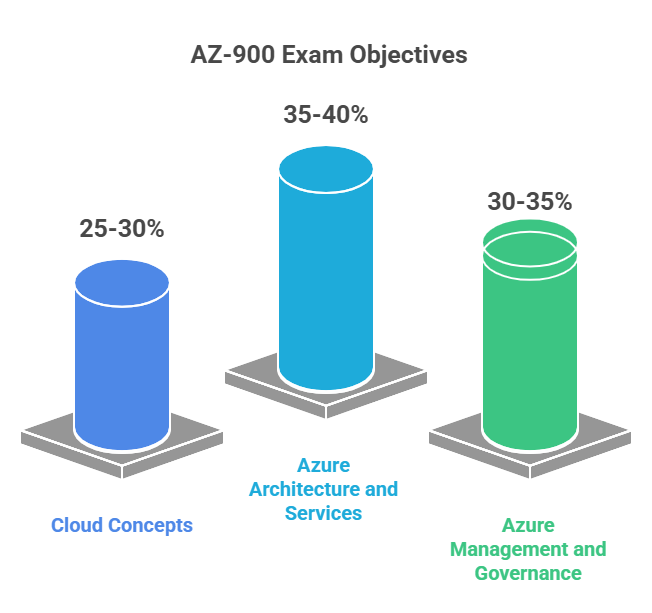
The official domains are:
- Describe cloud concepts (25-30%): This covers the basics—High Availability (HA), Scalability, Elasticity, Disaster Recovery (DR), CapEx vs. OpEx, and the different cloud models (Public, Private, Hybrid) and service types (IaaS, PaaS, SaaS).
- Describe Azure architecture and services (35-40%): This is the core of the exam. You’ll learn the building blocks of Azure, including compute (Virtual Machines, App Services), storage (Blob, File), networking (VNet, VPN Gateway), and databases (Cosmos DB, SQL Database).
- Describe Azure management and governance (30-35%): This section covers how to manage and secure an Azure environment. Topics include Azure Blueprints, Azure Policy, Role-Based Access Control (RBAC), and tools for managing cost (Azure Cost Management) and service health.
Who Should Take the AZ-900?
This certification is perfect for a wide range of professionals:
- Absolute Beginners: If you have zero IT or cloud experience, this is the perfect starting point.
- Non-Technical Roles: Sales, marketing, project managers, and business leaders who work with cloud-based products will benefit immensely from understanding the terminology and value proposition.
- IT Professionals New to Cloud: If you’re a system administrator, developer, or database admin who has worked on-premises, the AZ-900 is a fast and effective way to learn the “Azure way” of doing things.
- Students: It’s an excellent, low-cost way to add a valuable industry certification to your resume before you even graduate.
What is SAA-C03: AWS Certified Solutions Architect – Associate?
The SAA-C03 is one of the most recognized and in-demand certifications in the entire IT industry. It is not a fundamentals exam. This certification validates your ability to design and deploy well-architected solutions on AWS that meet specific business requirements.
The entire exam is built around the AWS Well-Architected Framework, which consists of six pillars:
- Operational Excellence
- Security
- Reliability
- Performance Efficiency
- Cost Optimization
- Sustainability
You will be tested on your ability to make design decisions that balance these pillars.
What Does the SAA-C03 Exam Cover?
The SAA-C03 expects you to think like an architect. The questions are almost entirely scenario-based, presenting you with a business problem (e.g., “A company needs a highly available website that can handle unpredictable traffic”) and asking you to select the best architectural solution.
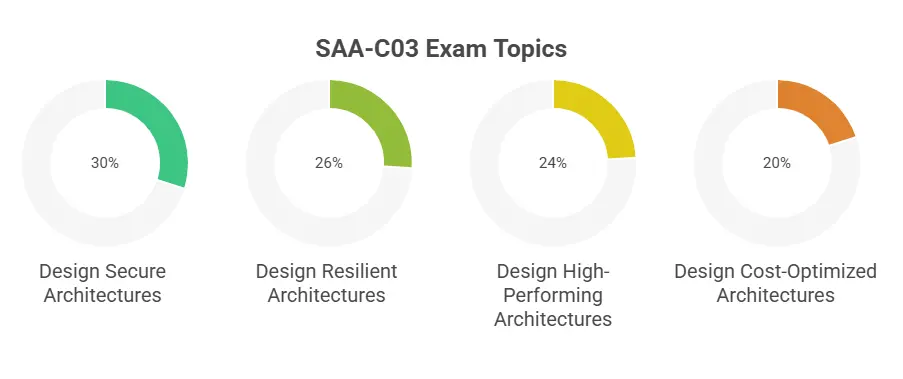
The official domains are:
- Design Secure Architectures (30%): This covers designing secure access to AWS resources (IAM, VPCs, security groups) and implementing encryption at rest and in transit.
- Design Resilient Architectures (26%): This is about building systems that don’t fail, or at least recover gracefully. You’ll need to know AWS services for decoupling (SQS), multi-region/multi-AZ deployments (Route 53, ELB), and data backup (S3, RDS).
- Design High-Performing Architectures (24%): This domain focuses on selecting the right compute (EC2), storage (EBS, S3, EFS), and database (RDS, DynamoDB) services to meet performance needs, as well as caching strategies (ElastiCache).
- Design Cost-Optimized Architectures (20%): You’ll be tested on your ability to choose the most cost-effective services (e.g., Spot Instances vs. On-Demand) and right-size infrastructure to avoid over-spending.
Who Should Take the SAA-C03?
This exam is for technical professionals who want to build and manage solutions:
- IT Professionals with Experience: System administrators, network engineers, and developers with at least one year of IT experience will find this a natural (though challenging) next step.
- Aspiring Cloud Architects: This is the de facto starting point for anyone with the title “Solutions Architect” in their career plan.
- Developers: Understanding the infrastructure you’re deploying code to is a superpower. This cert helps developers build more robust, scalable, and efficient applications.
Exam Difficulty: A Deeper Dive
The difference in difficulty between AZ-900 and SAA-C03 cannot be overstated. They test completely different cognitive skills.
- AZ-900 tests recognition and definition. It asks, “What is Azure Blob Storage?” A typical question is straightforward and knowledge-based. With 1-4 weeks of focused study (e.g., Microsoft’s free official AZ-900 learning path), most people can pass.
- SAA-C03 tests analysis and application. It never asks “What is S3?” It asks, “Given this specific scenario with requirements for durability, cost, and access patterns, which S3 storage class is the best choice and why?” You’ll often find 2-3 answers that are technically correct, but only one that is the most optimal. This requires months of study and, ideally, real-world hands-on practice using the AWS Free Tier.
Career Paths and Salary Expectations
This is where the “AZ-900 vs SAA-C03” debate gets interesting. Your return on investment (ROI) is different for each.
AZ-900: Career and Salary Impact
AZ-900 is a foundational cert, not a job-ready cert. On its own, it will not typically land you a high-paying technical job. Instead, it’s the key that unlocks the door.
- What it does: It makes your resume visible to recruiters screening for “Azure” keywords. It shows you are serious about cloud and have a verified baseline of knowledge.
- Job Opportunities:
- IT Support / Help Desk: Helps you troubleshoot issues related to cloud services.
- Junior Cloud Analyst: A starting role focused on monitoring and reporting.
- Technical Sales & Marketing: Allows you to speak confidently about Azure products.
- Salary Impact: Minimal on its own. Its value is in being the prerequisite for the next certs, like the AZ-104 (Azure Administrator Associate), which have a massive salary impact.
- Next Steps: AZ-104 (Administrator), AZ-204 (Developer), or DP-900 (Data Fundamentals).
SAA-C03: Career and Salary Impact
SAA-C03 is a job-ready cert. Passing this exam signals to employers that you have the practical skills to be billable. The demand for professionals with the AWS Solutions Architect – Associate certification is enormous.
- What it does: It qualifies you for intermediate-level technical roles. Many companies have this as a hard requirement for their cloud engineering positions.
- Job Opportunities:
- Cloud Solutions Architect: The most direct role, responsible for designing and presenting solutions to clients.
- Cloud Engineer: A hands-on role focused on building, deploying, and managing the infrastructure.
- DevOps Engineer: Combines development and operations, using AWS tools for CI/CD, automation, and infrastructure as code.
- Salary Impact: Significant. Professionals holding the SAA-C03 often see salaries ranging from $100,000 to $150,000+ USD per year, depending on location and prior experience.
- Next Steps: AWS Certified Developer (DVA-C02), AWS Certified SysOps Administrator (SOA-C02), or advancing to the AWS Certified Solutions Architect – Professional (SAP-C02).
The Real Comparison: AZ-900 vs. AWS Cloud Practitioner (CLF-C02)
Here’s a crucial point that’s often missed: AZ-900 and SAA-C03 are not direct competitors.
- AZ-900 is a Fundamental level exam.
- SAA-C03 is an Associate level exam.
The true 1:1 competitor to the AZ-900 is the AWS Certified Cloud Practitioner (CLF-C02). Both are fundamentals-level exams that cover the “what” and “why” of their respective platforms (cloud concepts, services, pricing, security).
The true 1:1 competitor to the SAA-C03 is the AZ-305 (Designing Microsoft Azure Infrastructure Solutions), which is an expert-level (formerly associate) exam for Azure architects.
The reason people compare AZ-900 vs SAA-C03 is that they are both popular entry points. But one is an introduction, and the other is a technical deep dive.
Community Perspectives: AZ-900 vs. Cloud Practitioner (CLF-C02)
Looking at community discussions, the debate between the two fundamental certs is common. The general consensus is that both are excellent, low-stress entry points. However, many users note a slight difference in focus.
- AWS Cloud Practitioner (CLF-C02) is often described as a “vocabulary test.” It focuses heavily on knowing the names of a very broad range of AWS services and understanding the core concepts of billing, pricing, and support plans.
- Microsoft Azure Fundamentals (AZ-900) is seen as slightly more technical in its concepts. While still fundamental, it drills a bit deeper into governance and management tools like Azure Policy and Role-Based Access Control (RBAC). Its question formats are also more varied, often including drag-and-drop and other interactive types beyond simple multiple-choice.
Both are considered “foundational” and not “job-ready.” Many experienced IT professionals advise that if your goal is a technical hands-on role, you can often skip these and go directly to the associate-level exams (like SAA-C03 or AZ-104) if you’re willing to put in the extra study time.
Final Verdict: Which Certification Should You Take First?
Let’s answer the core question.
You should take the AZ-900 (Microsoft Azure Fundamentals) first if:
- You are a complete beginner to IT and cloud computing.
- You are in a non-technical role (sales, marketing, project management) and need to “speak cloud.”
- Your company is an Azure shop, and you need to get up to speed quickly.
- You want a quick, low-cost win to build your confidence before tackling harder exams (like the jump from AZ-900 vs. AZ-104).
You should take the SAA-C03 (AWS Solutions Architect) first if:
- You have at least 1-2 years of experience in an IT role (sysadmin, developer, networking).
- You are already comfortable with cloud concepts and want to bypass the “fundamentals” stage.
- Your career goal is to become a Cloud Architect or DevOps Engineer as fast as possible.
- You are targeting a job at an AWS-heavy company and want the certification with the highest immediate ROI.
Ultimately, you can’t go wrong with either, and many senior professionals hold certifications from both AWS and Azure. The best Azure certification path often starts with a fundamental cert like AZ-900 vs. SC-900 to find your specialty. The best path is the one that aligns with your current experience and your future goals.
Frequently Asked Questions (FAQs)
Can I skip AZ-900 and go straight to SAA-C03?
Yes. They are in completely different ecosystems. There are no prerequisites for the SAA-C03. If you have a solid IT background, you can absolutely bypass fundamental certs and go straight for this associate-level exam.
Which is harder, AZ-900 or SAA-C03?
SAA-C03 is significantly harder. AZ-900 tests basic knowledge, while SAA-C03 tests your ability to apply that knowledge in complex, real-world scenarios.
Which cloud provider is more in-demand, AWS or Azure?
Both are in extremely high demand. AWS has a larger market share overall. However, Azure is growing rapidly and has a strong hold in the enterprise space, especially with companies already using Microsoft products (like Windows Server, SQL Server, and Microsoft 365). The best choice is often to learn the platform used by the companies you want to work for, keeping salary differences in mind.
How long does the AZ-900 certification last?
As of October 2026, Microsoft’s fundamental certifications (like AZ-900) do not expire.
How long does the SAA-C03 certification last?
The SAA-C03 is valid for three years. You will need to recertify by either passing the latest version of the exam or by passing the AWS Certified Solutions Architect – Professional exam.
Does AZ-900 help prepare for SAA-C03?
Only in a very general sense. AZ-900 teaches you universal cloud concepts (IaaS, PaaS, SaaS, HA, etc.) that are also relevant to AWS. However, all the specific service names, features, and architectural principles will be completely different. It won’t help you with the actual SAA-C03 exam content.
Where can I find study materials?
For both exams, the best place to start is the official provider’s learning site (Microsoft Learn and AWS Skill Builder). For in-depth preparation and practice for your certification journey, resources from providers like PassITExams can also be valuable.
