
If you’re weighing AZ-104 vs AZ-305, here’s the short version: this isn’t really an either/or decision. It’s a sequence, and for the vast majority of IT professionals, AZ-104 (Azure Administrator Associate) comes first, AZ-305 (Azure Solutions Architect Expert) comes second. Microsoft has actually built this into the certification itself: you can register for AZ-305 without AZ-104, but you cannot earn the Azure Solutions Architect Expert title until you hold an active AZ-104 certification too.
That single fact resolves most of the confusion. But it doesn’t answer the practical questions people actually have. How much Azure experience do you need before either exam? Is AZ-305 really that much harder? Can you skip AZ-104 if you already administer Azure at work? This guide walks through the official domains, the real prerequisite rules, realistic timelines, and a decision framework so you know exactly where to start.
Quick Answer
- Take AZ-104 first unless you already have 1+ years of hands-on Azure administration experience.
- AZ-305 requires an active AZ-104 certification to earn the Azure Solutions Architect Expert title, Microsoft will let you sit the exam without it, but you won’t get the credential.
- AZ-104 tests whether you can implement and manage Azure (identity, storage, compute, networking, monitoring).
- AZ-305 tests whether you can design Azure solutions (architecture, trade-offs, business requirements), it assumes you already know how to build the things you’re designing.
- Realistic path: AZ-104 → 6–12 months of hands-on Azure work → AZ-305.
- Both exams cost $165 USD and use a 700/1000 passing score.
AZ-104 vs AZ-305: Side-by-Side Comparison
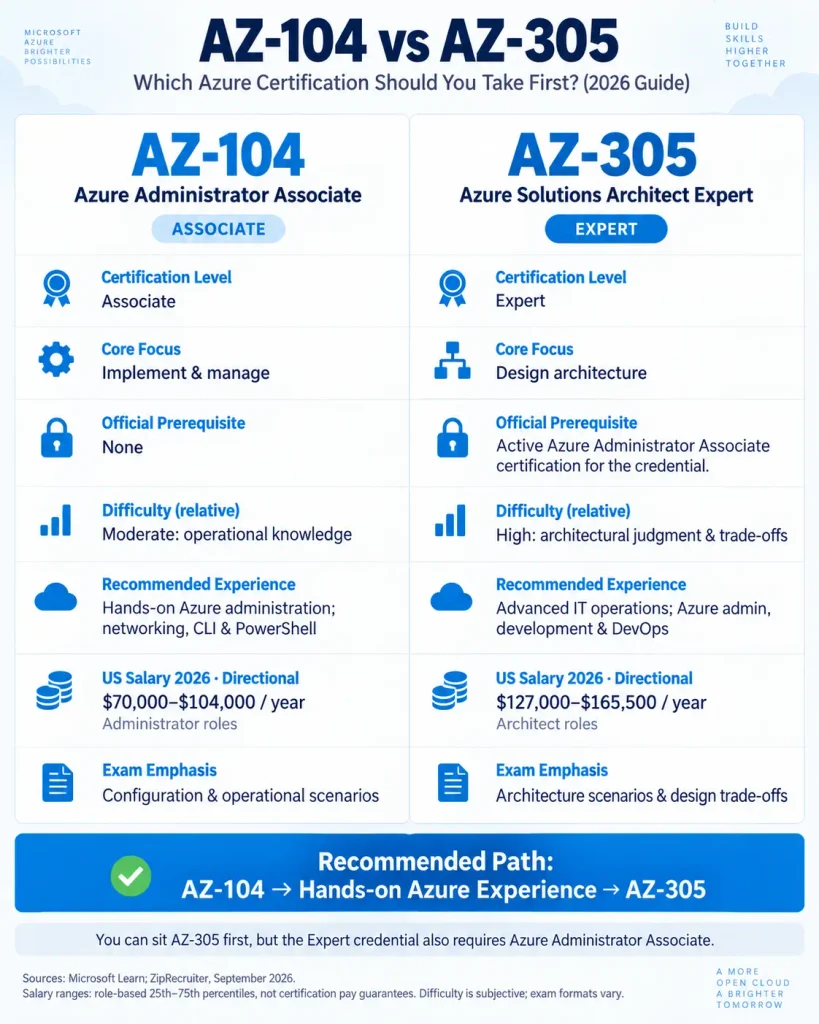
| Attribute | AZ-104 (Azure Administrator) | AZ-305 (Solutions Architect Expert) |
|---|---|---|
| Certification level | Associate | Expert |
| Core focus | Implementing, managing, and monitoring Azure resources | Designing Azure solutions and architecture |
| Official prerequisite | None required | Must hold active AZ-104 to earn the credential (can attempt exam without it) |
| Exam cost | $165 USD | $165 USD |
| Exam duration | ~100 minutes (some listings show up to 120 min including setup) | ~100–120 minutes |
| Question count | 40–60 questions | 40–60 questions |
| Question types | Multiple choice, drag-and-drop, case studies, scenario-based | Multiple choice, case studies (heavier weighting), scenario-based design questions |
| Passing score | 700 / 1000 | 700 / 1000 |
| Difficulty | Moderate, tests operational knowledge and portal/CLI/PowerShell fluency | High, tests architectural judgment and trade-off reasoning |
| Recommended experience | 6+ months hands-on Azure administration | AZ-104 plus 1+ years of Azure admin/design experience |
| Typical US Salary Range (2026) | Roughly $85,000–$135,000 | Roughly $130,000–$190,000+ |
What Does AZ-104 Actually Test?
AZ-104 (Microsoft Azure Administrator) validates that you can operate an Azure environment day to day, not just describe it conceptually. According to Microsoft’s official skills-measured outline, the exam covers five functional domains:
- Manage Azure identities and governance (20–25%): Microsoft Entra ID (formerly Azure Active Directory), role-based access control (RBAC), subscriptions, and governance policies.
- Implement and manage storage (15–20%): storage accounts, blob storage, Azure Files, storage security, and data lifecycle management.
- Deploy and manage Azure compute resources (20–25%): virtual machines, containers, Azure App Service, and increasingly, infrastructure-as-code with ARM templates and Bicep.
- Implement and manage virtual networking (15–20%): virtual networks, load balancing, DNS, network security groups, and connectivity (including Azure Bastion).
- Monitor and maintain Azure resources (10–15%): Azure Monitor, backup, and resource optimization.
Key takeaway: AZ-104 is a hands-on, portal-and-CLI exam. You’re expected to know how to configure things, not just why you’d choose them. If you haven’t spent real time inside an Azure subscription, creating resource groups, configuring NSGs, setting up storage accounts, you’re not ready for this exam yet, regardless of how much you’ve read.
What Does AZ-305 Actually Test?
AZ-305 (Designing Microsoft Azure Infrastructure Solutions) is the required exam for the Microsoft Certified: Azure Solutions Architect Expert credential. Per Microsoft’s official AZ-305 study guide, it covers four domains:
- Design identity, governance, and monitoring solutions (25–30%), authentication/authorization strategy, governance structure across management groups and subscriptions, and logging/monitoring architecture.
- Design data storage solutions (20–25%), relational and non-relational data solutions, data integration strategy.
- Design business continuity solutions (15–20%), backup, disaster recovery, and high availability design.
- Design infrastructure solutions (30–35%), compute architecture, application architecture, migration strategy, and network design. This is the largest and heaviest-weighted domain.
Key takeaway: Every objective on this exam starts with the word “design” or “recommend.” AZ-305 doesn’t test whether you can click through the Azure portal to configure a resource, it tests whether you can weigh cost, security, performance, and reliability against each other and choose the right architecture for a business requirement. Microsoft explicitly expects candidates to already have advanced Azure administration, development, and DevOps experience walking in.
Prerequisite Reality Check: What Microsoft Actually Requires
The official Microsoft position: There is no hard technical block preventing you from scheduling and sitting the AZ-305 exam without holding AZ-104. Microsoft’s exam registration system does not require you to prove you hold AZ-104 before you can pay $165 and take the test.
However, the Azure Solutions Architect Expert certification itself has a formal requirement: you must hold an active Azure Administrator Associate certification (AZ-104).
If you pass AZ-305 without holding AZ-104, Microsoft will not issue you the Solutions Architect Expert credential. Your AZ-305 pass simply sits on your transcript, unused, until you also earn and maintain AZ-104.
What happens if you take AZ-305 first anyway:
- You can pass the exam and still not hold the Expert certification.
- You’ll need to pass AZ-104 (and keep it active through annual free renewal) to unlock the credential.
- Most candidates who attempt AZ-305 without solid administrator-level experience fail on their first try, the exam assumes operational fluency you likely haven’t built yet if you’ve skipped AZ-104-level work.
- There’s no reordering penalty for taking AZ-104 second in terms of scoring, but there’s a real knowledge gap risk.
Bottom line: technically optional, practically mandatory. Treat AZ-104 as a hard prerequisite, because Microsoft has made it one in every way that matters.
AZ-104 vs AZ-305 Difficulty: Operational Knowledge vs. Architectural Judgment
When people compare AZ-104 vs AZ-305 difficulty, they’re really comparing two different skills. AZ-104 and AZ-305 are difficult in genuinely different ways, and understanding that difference tells you a lot about which one you’re ready for.
AZ-104 difficulty comes from breadth and precision. You need working knowledge across identity, storage, compute, networking, and monitoring, and the exam will test specific configuration details, which CLI flag, which portal setting, which RBAC role. It rewards people who’ve actually built things in Azure, even in a lab or sandbox environment.
AZ-305 difficulty comes from ambiguity and trade-offs. There’s rarely one “correct” service, there’s a best-fit service given specific constraints (cost, latency, compliance, existing infrastructure). Case studies present a business scenario and ask you to design around competing priorities. This is a fundamentally different skill: you’re not being tested on what a service does, but on when and why you’d choose it over three plausible alternatives.
In practical terms: most experienced Azure professionals report that AZ-305 feels harder, not because the content is more advanced technically, but because it requires you to think like an architect advising a client, a skill that only develops through real design experience, not memorization.
Who Should Take Which First? Decision Matrix
Your starting point matters more than any generic advice. Here’s how to think about it based on your actual situation:
- Complete beginners to Azure (little to no cloud experience): Start with AZ-104, and consider AZ-900 (Azure Fundamentals) first if you’re new to cloud concepts entirely. Don’t attempt AZ-305 until you’ve administered real Azure resources for at least several months.
- Experienced IT pros (sysadmins, network engineers) new to Azure specifically: Start with AZ-104. Your general IT background will accelerate your learning curve, but Azure-specific tooling (Entra ID, ARM/Bicep, Azure Monitor) still needs dedicated hands-on time.
- Current Azure admins with 1–2 years of hands-on experience: You’re the ideal AZ-104 candidate right now if you don’t already hold it, and a strong AZ-305 candidate within 6–12 months after passing AZ-104, especially if your role already involves some design or migration work.
- Developers or DevOps engineers moving into Azure infrastructure: Still start with AZ-104. Coding skills don’t substitute for infrastructure administration knowledge, and AZ-305 assumes that operational foundation regardless of your development background.
- Senior engineers who already function as an unofficial architect at work: You may be ready to study for both exams in sequence relatively quickly, but you still need AZ-104 to unlock the Expert title, so don’t skip it even if AZ-305 content feels familiar.
- People who already hold AZ-104 and want to specialize: You have two solid choices going forward, AZ-305 (architecture track) or AZ-400 (DevOps track). If long-term design, consulting, or principal-engineer roles interest you, AZ-305 is the natural next step.
Key Takeaway: Regardless of your starting profile, AZ-104 is almost always the right first move, the only real question is how much runway you need before AZ-305.
Recommended Study Path & Realistic Timeline
Standard path (most candidates):
- Weeks 1–8: Study for and pass AZ-104. Use Microsoft Learn’s free learning path, plus hands-on labs in a real or sandbox Azure subscription. Budget 6–10 weeks for people with some IT background, longer if you’re starting cold.
- Months 3–9: Work hands-on with Azure in a real role or substantial lab environment. This is the step people skip, and it’s the one that actually determines whether AZ-305 will make sense to you. Focus on exposure to networking design, identity governance, and cost/performance trade-offs, not just day-to-day ticket resolution.
- Weeks 1–10 (of AZ-305 prep): Study AZ-305 using the official Microsoft Learn path, the Azure Architecture Center reference architectures, and case-study-heavy practice exams. Budget 8–12 weeks.
Fast-track option (experienced professionals): If you already have 1+ years of substantial Azure administration or architecture-adjacent experience, you can compress this into AZ-104 in 3–4 weeks and AZ-305 in 6–8 weeks, provided you’re disciplined about case-study practice for AZ-305 specifically, that format alone can cost unprepared candidates 10+ percentage points.
Realistic total timeline for most people: 9–18 months from zero Azure experience to holding both certifications, factoring in the real-world experience gap in the middle. That gap isn’t wasted time, it’s the difference between passing AZ-305 and actually being able to do the job it certifies.
Salary & Career Impact in 2026
Certifications alone don’t set your salary, experience, region, and role scope matter more, but they correlate strongly with pay bands and are frequently used as hiring filters.
- AZ-104 holders (Azure Administrator, Cloud Engineer roles) typically see US salaries in the $85,000–$135,000 range, with entry-level roles starting lower and senior administrators pushing toward the top of that band.
- AZ-305 holders (Solutions Architect, Cloud Architect, Principal Engineer roles) typically see US salaries in the $130,000–$190,000+ range, with senior architects at large enterprises or consultancies exceeding that.
- The jump from AZ-104 to AZ-305 roles often represents one of the larger single-certification salary increases in the Azure ecosystem, because it usually accompanies a title change from “administrator” to “architect”, a shift in responsibility, not just knowledge.
- AZ-305 is frequently listed as a required or strongly preferred qualification in enterprise architecture and cloud consulting job postings, making it a common gatekeeper credential for senior roles.
These figures vary meaningfully by country, industry, and company size, use them as a directional benchmark, not a guarantee.
Common Mistakes to Avoid
- Jumping straight to AZ-305 to “save time.” You can pass the exam without AZ-104, but you won’t earn the Expert credential, and you’re far more likely to fail without administrator-level foundations anyway.
- Treating AZ-305 like AZ-104. Memorizing what each service does isn’t enough, the exam tests when and why to choose one option over another. Candidates who study this way often plateau around 600/1000.
- Skipping hands-on labs. Both exams penalize theory-only preparation. AZ-104 in particular will test specific configuration steps you can only internalize by doing them.
- Ignoring the Azure Architecture Center. For AZ-305, Microsoft’s own reference architectures are essentially exam blueprints, skipping them is skipping free preparation.
- Underestimating case-study format. AZ-305 leans heavily on multi-part case studies. Practicing only standalone questions leaves a real gap in exam-day readiness.
- Letting certifications lapse. Both AZ-104 and AZ-305 require free annual renewal via a Microsoft Learn assessment, and since AZ-305’s credential depends on an active AZ-104, letting your AZ-104 lapse can jeopardize your Expert status.
Frequently Asked Questions FAQ’s
Can I take AZ-305 without AZ-104?
You can register for and sit the AZ-305 exam without holding AZ-104. However, you cannot earn the Microsoft Certified: Azure Solutions Architect Expert certification until you also hold an active AZ-104 credential. Practically, most candidates who attempt AZ-305 without AZ-104-level experience struggle to pass.
Is AZ-305 harder than AZ-104?
Most candidates and instructors consider AZ-305 more difficult, though for a different reason than raw content volume. AZ-104 tests broad operational knowledge across five domains; AZ-305 tests architectural judgment and trade-off reasoning across four domains, delivered through heavier case-study formats. The skill AZ-305 requires, designing under competing constraints, typically takes longer to develop than the configuration knowledge AZ-104 tests.
How long should I wait between AZ-104 and AZ-305?
There’s no official waiting period, but most successful candidates recommend 6–12 months of real hands-on Azure work between the two. That time is what turns “I passed AZ-104” into “I understand Azure well enough to design with it,” which is exactly what AZ-305 tests.
Is AZ-305 worth it after AZ-104?
For most Azure professionals aiming at senior engineering, architecture, or consulting roles, yes. AZ-305 is frequently required or preferred in job postings for those roles, and it typically corresponds with a meaningful salary increase over administrator-level positions. If your career goals are staying in hands-on operations, AZ-104 (paired with a specialty like AZ-500) may be sufficient without AZ-305.
Conclusion: The Clear Recommendation
When people ask “AZ-104 vs AZ-305, which first,” the honest answer is that the comparison itself is slightly misleading. These aren’t competing options, they’re sequential steps on the same career path. AZ-104 should come first for the vast majority of candidates, both because Microsoft requires an active AZ-104 to unlock the Azure Solutions Architect Expert title, and because the operational knowledge it builds is what makes AZ-305’s design questions make sense in the first place.
If you’re new to Azure or have limited hands-on experience, start with AZ-104, spend real time working in Azure afterward, then move to AZ-305 when you’re ready to think like an architect rather than an operator. If you already have substantial Azure administration experience under your belt, you can move through both exams faster.
Either way, don’t skip AZ-104, Microsoft’s own certification rules won’t let you skip it, and neither should your career plan.
