
Introduction: Why Cisco Certifications Are Your Best Career Investment in 2026
The networking industry in 2026 is not what it was five years ago. Artificial intelligence is reshaping network automation, zero-trust security architecture has moved from buzzword to boardroom mandate, and cloud-native infrastructure is rewriting the rules of enterprise IT. In this environment, one thing hasn’t changed: Cisco certifications remain the gold standard of credibility for networking professionals across the United States and globally.

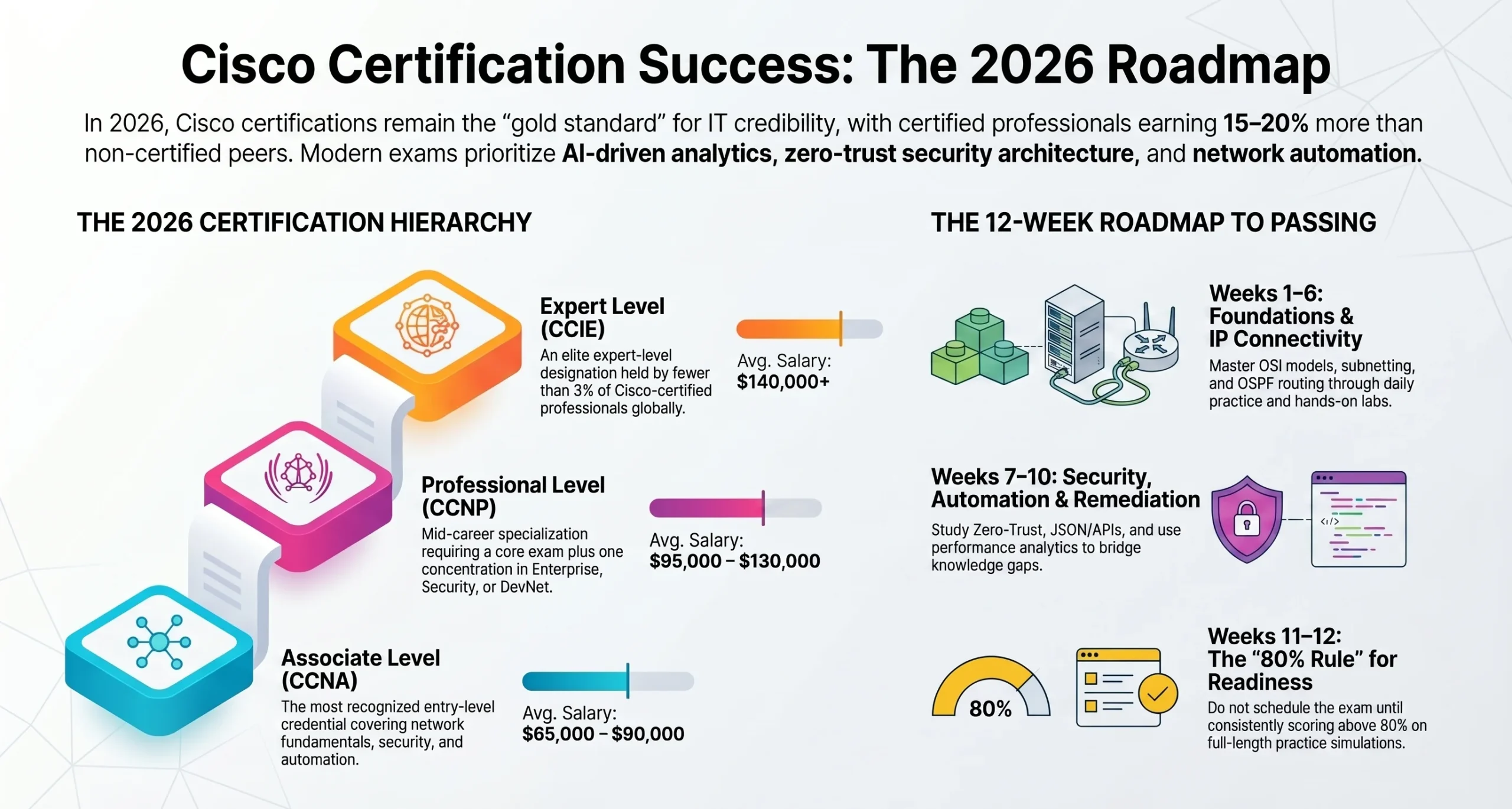
According to the 2025 IT Skills and Salary Report by Global Knowledge, certified networking professionals earn an average of 15–20% more than their non-certified peers. CCNA holders in the USA report average salaries between $65,000 and $90,000, while CCNP-certified professionals command $95,000 to $130,000. CCIE: Cisco’s elite expert-level designation consistently ranks among the top five highest-paying IT certifications worldwide, with average compensation exceeding $140,000 annually.
But earning these credentials is not a casual undertaking. The CCNA 200-301 exam tests candidates across six major domains in a single 120-minute sitting. CCNP-level exams go deeper, requiring both a core exam and a concentration exam. And the CCIE demands laboratory performance that few candidates pass on the first attempt. These are rigorous, professionally designed assessments, and that rigor is exactly what makes them so valuable.
The 2026 exam blueprints reflect Cisco’s commitment to keeping certifications relevant. Network automation using Python and Ansible, SD-WAN, SASE frameworks, AI-driven network analytics, and IPv6 security are now core examination topics, not optional electives. Candidates who prepared for these exams even two years ago will find the landscape meaningfully different.
This guide was written specifically for IT professionals and beginners in the USA who are serious about passing their Cisco exams in 2026. Whether you’re working toward your first CCNA or your CCNP concentration, you’ll find a complete roadmap here: an honest comparison of the best practice test providers, certification-specific study strategies, a proven 8–12-week study plan, and answers to the questions that real candidates ask every day.
The emphasis throughout is on genuine understanding, not rote memorization. Employers don’t just want employees who passed a test. They want engineers who can configure a router, troubleshoot a failing link, and implement a security policy. The preparation strategies in this guide are designed to produce both outcomes: a passing score and real-world competence.
Let’s get started↓
The Cisco Certification Landscape in 2026
The Certification Hierarchy: From Associate to Expert
Cisco’s certification framework is organized into four tiers, each building on the skills of the previous level.

- Entry Level: Cisco Certified Technician (CCT). Designed for field technicians and help desk professionals, the CCT validates the ability to diagnose, restore, and repair Cisco equipment. It’s a strong starting point for those new to networking hardware.
- Associate Level: CCNA (Cisco Certified Network Associate) The CCNA 200-301 remains the most recognized entry-level networking certification in the industry. It covers network fundamentals, IP connectivity, security fundamentals, automation, and programmability. A single exam earns the credential, and it’s valid for three years.
- Professional Level: CCNP CCNP certifications target mid-career professionals who specialize in specific technology tracks. The major CCNP tracks in 2026 include:
- CCNP Enterprise: Focuses on enterprise routing, switching, SD-WAN, and network design. Requires the ENCOR (350-401) core exam plus one concentration.
- CCNP Security: Covers firewalls, VPNs, intrusion prevention, identity management, and zero-trust architecture. Requires SCOR (350-701) plus a concentration.
- CCNP Data Center: Addresses data center design, ACI, storage networking, and automation. Requires DCCOR (350-601) plus a concentration.
- CCNP Collaboration: Covers unified communications, call control, and collaboration applications.
- CCNP Service Provider: Focuses on ISP and large-scale infrastructure environments.
- CCNP DevNet: Cisco’s developer-focused track, emphasizing APIs, automation, and software development for network infrastructure.
- Expert Level: CCIE and CCDE. The CCIE is Cisco’s most prestigious credential. Each track requires a qualifying exam followed by an 8-hour lab exam conducted at Cisco-authorized facilities. The CCDE (Design Expert) targets network architects. These credentials are held by fewer than 3% of Cisco-certified professionals.
- Specialist Certifications Cisco also offers standalone specialist certifications that don’t require prerequisites. These are valuable for professionals who need to validate knowledge in a specific area, such as Cisco SD-WAN, Meraki, or CyberOps, without committing to a full certification track.
What Changed in the 2026 Blueprint Updates
Cisco regularly revises its exam blueprints to reflect the changing technology landscape. Key updates that affect 2026 candidates include:
- AI and ML for networking: Questions on AI-driven network analytics, AIOps for infrastructure monitoring, and intent-based networking now appear across CCNP tracks.
- Zero-trust security: CCNP Security and CCNA Security content now explicitly covers zero-trust architecture principles, SASE, and Cisco’s Secure Access Service Edge implementation.
- Network automation: Python scripting, Ansible playbooks, REST APIs, and JSON/YAML data handling are tested at both CCNA and CCNP levels. This is a significant expansion from previous versions.
- IPv6 transition: IPv6 routing, addressing, and transition mechanisms (including dual-stack and tunneling) carry increased weight across multiple tracks.
- Cloud integration: Enterprise-class SD-WAN and cloud-first connectivity are now core CCNP Enterprise topics, not supplementary.
Candidates preparing with outdated materials risk studying content that no longer matches the current exam. Always verify that any practice test provider you choose has updated their question banks to reflect the current blueprint versions.
Why Staying Current Matters More Than Ever
Cisco exams are not static. The company updates its blueprints on a rolling basis, and exam question pools are refreshed periodically. A candidate who walks in with materials from 2022 or early 2023 may be well-prepared for the foundational content but blindsided by the automation, AI, and security architecture questions that now account for a meaningful percentage of the total score.
The good news: the underlying networking principles don’t change. OSI model, TCP/IP, routing protocols, and switching fundamentals remain constant. The challenge is integrating those fundamentals with the new automation and security layers required by Cisco’s updated blueprints.
Why High-Quality Practice Tests Are Essential for Cisco Exam Success
The Science Behind Practice Testing
Educational research consistently identifies practice testing, also called the “testing effect” or “retrieval practice,”: as one of the most effective learning strategies available. A landmark 2011 study published in Science by Roediger and Karpicke demonstrated that students who used retrieval practice retained material significantly better than those who re-read notes or created concept maps. For Cisco candidates, this translates directly: working through practice questions is not just a way to assess your readiness: it’s a primary learning tool in its own right.
When you encounter a practice question about OSPF cost calculation, fail to answer it correctly, and then read a detailed explanation, you are engaging in what cognitive scientists call “desirable difficulty.” The error-and-correction process encodes the correct information more deeply than passive review would.
Shallow Memorization vs. Deep Understanding
Here is the critical distinction between candidates who pass once and those who build lasting careers: memorizing an answer is not the same as understanding a concept.
An exam question might ask you to identify the administrative distance of EIGRP. Memorization gets you the number (90). Understanding gets you the answer to the follow-up scenario: “A router running both OSPF and EIGRP is learning the same network via both protocols. Which route will be installed in the routing table, and why?” That question requires you to know that EIGRP’s internal administrative distance (90) is lower than OSPF’s (110), understand that lower AD is preferred, and apply that rule to the specific scenario.
High-quality practice tests are designed to test at this deeper level. Questions are scenario-based, not just definition-recall. They present you with network diagrams, configuration outputs, and troubleshooting scenarios that mirror real exam conditions and real job situations.
What Separates High-Quality Practice Materials from Low-Quality Ones
Not all practice resources are created equal. Here is what distinguishes genuinely useful study materials:
- Detailed explanations for every answer option: A good practice question doesn’t just tell you the right answer: it explains why each wrong answer is wrong. This is arguably more valuable than knowing the correct answer, because it closes the knowledge gaps that incorrect answer choices represent.
- Scenario-based question design: Questions should present realistic network situations that require you to analyze, troubleshoot, or configure: not simply recall a definition.
- Regular blueprint alignment: The question bank should be actively maintained to reflect current exam objectives. Providers who let their content go stale are actively misleading candidates.
- Performance tracking and analytics: You need to know not just your overall score, but which topic areas are your weakest. A good platform will break down your performance by exam domain, allowing you to focus your remaining study time on the highest-leverage areas.
- Supplementary resources: Practice tests work best when integrated with study guides, hands-on lab exercises, and reference materials. Providers who offer only question banks without context are providing an incomplete preparation experience.
- Ethical and legal content: Legitimate practice materials are written by certified subject matter experts who create original questions based on the exam blueprint. They do not reproduce actual exam questions, which is both unethical and a violation of Cisco’s candidate agreements. Preparing with stolen exam content puts your certification at risk and undermines the integrity of the credential.
The Role of Performance Tracking
Effective study is not just about putting in hours: it’s about putting in the right hours. If you’re spending 60% of your study time on subnetting when that topic represents only 10% of the exam and you’re already scoring 90% on it, you’re not making efficient use of your preparation time.
The best practice test platforms track your performance across every topic domain and generate a personal gap analysis. Use this data to guide your study schedule. Allocate your time proportionally to both the weight of the topic on the exam and your current performance level in that area.
Top Cisco Practice Test Providers Compared – 2026 Edition
The market for Cisco study materials is crowded. Some providers offer genuine value; others offer outdated content repackaged with updated dates. The comparison below evaluates the most widely used platforms based on content quality, update frequency, depth of explanation, supplementary resources, support, and value.
| Provider | Update Frequency | Explanation Quality | Price Range (USD) | User Support | Pass Rate Claims |
|---|---|---|---|---|---|
| PassITExams | Regularly | Detailed per-option explanations | $25-$30 | Email + community forum | Verified user testimonials |
| Cisco Press | Regularly | Well Explained | $39-$109 | Chat Only | Verified |
| Measureup | Regularly | Basic Explanation | $16.59 – $44.88 | AI Assistant | Unverified |
| Dumpsgate | Regularly | Basic answer keys | $28-$56 | Email only | Verified |
| Edurely | Reguraly | Minimal explanations | $28-$70 | Email only | Verified |
| Certspilot | Quarterly | Basic Explanation | $25-$100 | Email Only | Verified |
| CisocU | Regularly | Well Explained | Depends on the bundles an individual chooses | Email Only | Verified |
| Udemy | Quarterly | Basic Explanation | $11-$30 per month for practice tests. The course fee differs. | Email Only | Unverified |
| O’Reilly Learning | Quarterly | Basic Explanation | $149 for courses and $299 for bundles | Chat Only | Unverified |
| Boson | Quarterly | Basic Explanation | $99 for practice tests | Chat Only | Unverified |
PassITExams: Top Reliable and Best Practice Tests Provider in 2026
Among the platforms evaluated for this guide, PassITExams stands out for the comprehensiveness of its preparation ecosystem. Rather than offering only question banks, it provides an integrated suite of resources that mirrors the full study journey a serious candidate should undertake.
- Practice Tests: The core question banks are authored by certified networking professionals and aligned to current Cisco exam blueprints. Questions are scenario-based, with full explanations for all answer choices: not just the correct one. This “why wrong” methodology is a significant differentiator.
- Quizzes/ Demos: PassITExams also provides free demos and interactive quizzes to help candidates assess their exam readiness. Each quiz features multiple-choice questions (MCQs) designed to evaluate your understanding of key concepts. By completing these quizzes, you can identify knowledge gaps, strengthen weaker areas, and gain insight into the topics covered in the practice tests and exam questions. This hands-on approach helps you prepare more effectively and build confidence before taking the actual exam.
- Study Guides: For candidates who need foundational content alongside practice questions, PassITExams offers topic-by-topic study guides that can be used alongside the question banks. This allows you to study a domain, immediately test your understanding, review the explanations, and then return to the guide to address any gaps.
- Career and Salary Guides: PassITExams publishes regularly updated career guides that provide context on job market demand, role descriptions, and compensation data by certification level and geography. For candidates making career decisions: whether to pursue CCNA vs. CCNP, or Enterprise vs. Security: this information is genuinely useful.
- Articles and Blog Content: The site maintains a content library covering exam strategies, technology updates, and career advice. This is a resource many candidates overlook but find valuable for staying current on blueprint changes and industry trends.
For candidates preparing for the CCNA 200-301, you can explore CCNA Practice Tests on PassITExams. For CCNP Enterprise preparation, dedicated ENCOR resources are also available on the platform.
Best Practice Materials by Cisco Certification
CCNA 200-301: The Foundation of Your Cisco Career
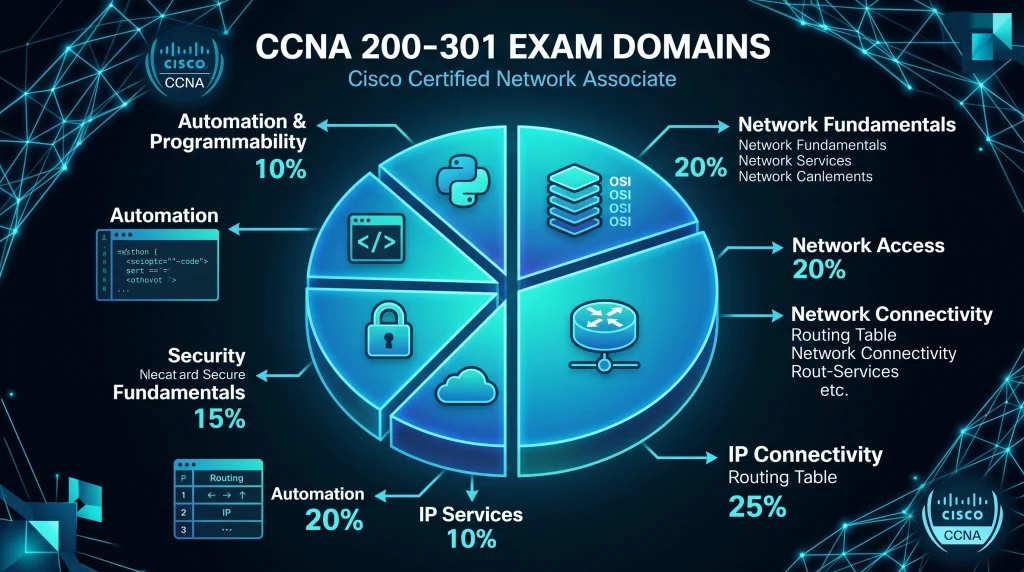
The CCNA 200-301 is a single exam covering a broad range of networking topics. As of 2026, the exam blueprint is organized into six major domains:
| Domain | Weight |
|---|---|
| Network Fundamentals | 20% |
| Network Access | 20% |
| IP Connectivity | 25% |
| IP Services | 10% |
| Security Fundamentals | 15% |
| Automation and Programmability | 10% |
Topic breakdown and what to focus on:
- Network Fundamentals covers the OSI and TCP/IP models, Ethernet switching, IPv4 and IPv6 addressing, and basic wireless concepts. This is foundational material that underpins everything else on the exam. Master subnetting here: it will appear throughout the IP Connectivity domain as well.
- Network Access tests your understanding of VLANs, trunking (802.1Q), spanning tree protocol (STP/RSTP/PVST+), EtherChannel, and basic wireless LAN architecture. This domain rewards hands-on practice; configuring VLANs on Cisco Packet Tracer until the process is second nature is time well spent.
- IP Connectivity is the heaviest domain and covers static routing, OSPFv2, and a basic understanding of eBGP. OSPF deserves significant study time: neighbor formation, LSA types, area design, and troubleshooting are all fair game.
- IP Services covers DHCP, DNS, NAT/PAT, NTP, SNMP, Syslog, and quality of service concepts. This domain is often underestimated; don’t let it be a surprise on exam day.
- Security Fundamentals has grown in scope and now includes access control lists (ACLs), Layer 2 security features, AAA concepts, VPN types, and wireless security protocols (WPA2/WPA3). The inclusion of zero-trust concepts in the 2025–2026 blueprint means candidates should understand the principles of SASE, even at the CCNA level.
- Automation and programmability are where many traditional networking professionals struggle most. Topics include the benefits of automation, controller-based architectures, REST APIs, JSON/YAML, configuration management tools (Ansible, Puppet, Chef), and Cisco DNA Center. Allocate real study time here: this domain is growing in exam weight.
Recommended study approach for CCNA 200-301:
- Read the official Cisco Press CCNA 200-301 Official Cert Guide (Volumes 1 and 2) cover to cover. Take notes on each chapter.
- Complement with video content (Cisco’s own NetAcad or a quality third-party course) to visualize concepts that are hard to absorb in text.
- Build hands-on skills using Cisco Packet Tracer (free) or GNS3. Don’t skip the labs.
- Use PassITExams’ CCNA 200-301 Practice Tests to assess your domain-by-domain readiness. Review every explanation, including for questions you answered correctly.
- Revisit weak domains with a targeted study before scheduling your exam.
Typical time to prepare: 8–16 weeks for candidates with some networking background; 16–24 weeks for those starting from scratch.
CCNP Enterprise: Advanced Routing, Switching, and SD-WAN
The CCNP Enterprise requires two exams: the ENCOR (350-401) core exam and one of several concentration exams. The most popular concentrations are ENARSI (Advanced Routing and Services, 300-410) and ENWLSI (Wireless Implementation, 300-430).
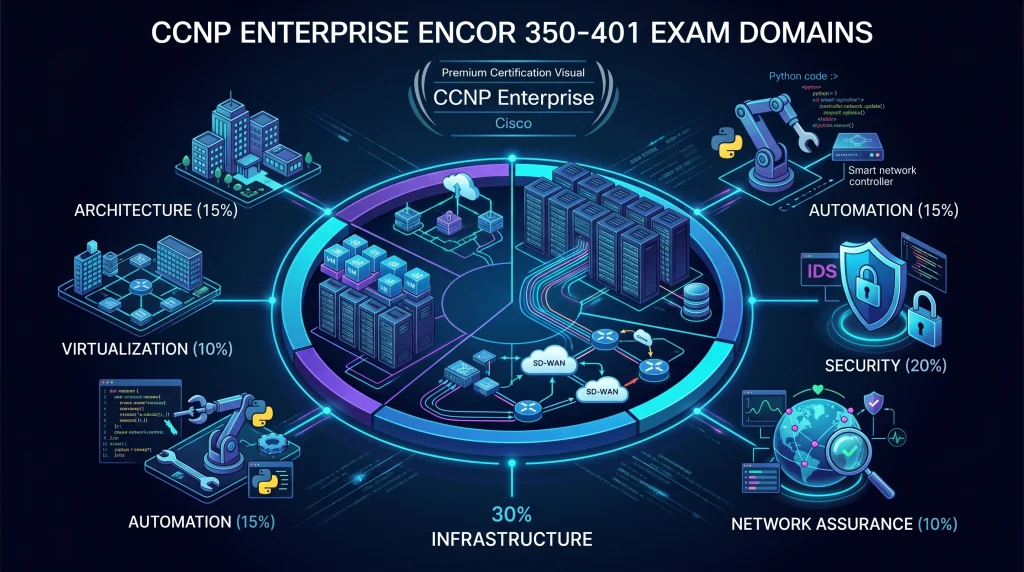
ENCOR (350-401) domain breakdown:
| Domain | Weight |
|---|---|
| Architecture | 15% |
| Virtualization | 10% |
| Infrastructure | 30% |
| Network Assurance | 10% |
| Security | 20% |
| Automation | 15% |
The Infrastructure domain is the weightiest, covering routing protocols (OSPF, EIGRP, BGP, Route Maps), advanced switching (STP, RSTP, PVST+, VTP, private VLANs), and wireless LAN controller architecture. BGP receives significant coverage at the CCNP level, including eBGP and iBGP neighbor relationships, path attributes, and route manipulation.
The Security domain at the CCNP Enterprise level covers AAA with RADIUS and TACACS+, 802.1X, device hardening, and Cisco ISE integration. Zero-trust concepts and SD-Access architecture also appear here.
Automation at the CCNP level goes well beyond CCNA. Expect questions on network programmability, Python scripting for network automation, Ansible for configuring network devices, Cisco DNA Center APIs, and NETCONF/YANG data models.
SD-WAN is a major topic. Cisco’s Viptela-based SD-WAN architecture, including the vManage, vSmart, vBond, and vEdge components, is a heavily tested area that many candidates from traditional networking backgrounds find unfamiliar. Invest specific study time here.
Recommended study approach for CCNP Enterprise:
- The Cisco Press CCNP Enterprise Core ENCOR 350-401 Official Cert Guide is the authoritative text resource.
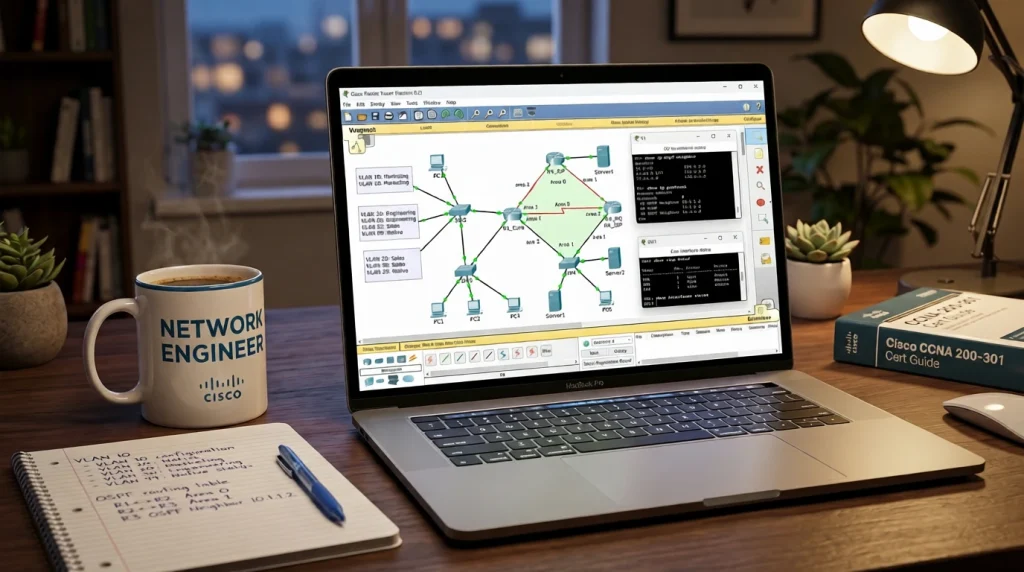
- For labs, EVE-NG (Community Edition) or CML (Cisco Modeling Labs) provides the virtualization environment needed to practice SD-WAN, BGP, and MPLS scenarios that Packet Tracer cannot support.
- Use PassITExams’ CCNP Enterprise ENCOR Practice Tests to benchmark your readiness across each domain.
- Allow 16–24 weeks of preparation time for the ENCOR, plus an additional 8–12 weeks for your chosen concentration exam.
CCNP Security: Zero-Trust, Firewalls, and the Modern Threat Landscape
The CCNP Security track has arguably seen the most significant evolution in its blueprint in the 2025–2026 cycle, reflecting how dramatically the enterprise threat landscape has changed.
The core exam is SCOR (350-701), covering:
| Domain | Weight |
|---|---|
| Security Concepts | 25% |
| Network Security | 20% |
| Securing the Cloud | 15% |
| Content Security | 15% |
| Endpoint Protection and Detection | 10% |
| Secure Network Access, Visibility, and Enforcement | 15% |
What’s new and heavily weighted in 2026:
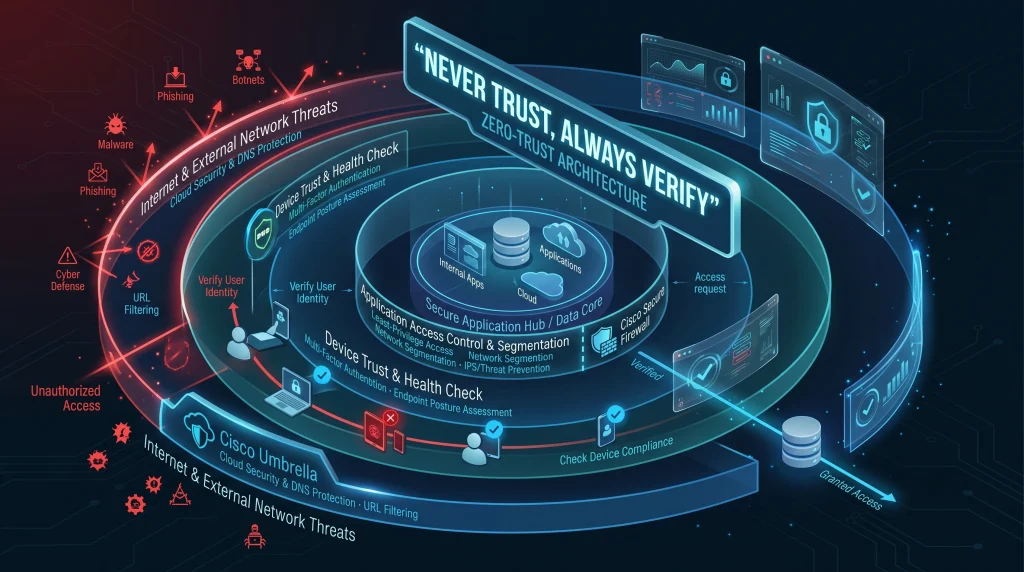
- Zero-trust architecture principles now represent a meaningful portion of the Security Concepts domain. Candidates need to understand the core tenets of zero trust (verify explicitly, use least-privilege access, assume breach), how they apply to network design, and how Cisco’s portfolio, particularly Duo, Umbrella, and Secure Access, implements these principles.
- SASE (Secure Access Service Edge) integration is a concentration-level topic that appears in overview form on the core exam. Understand what SASE combines (SD-WAN + security services) and why cloud-delivered security is driving its adoption.
- Cisco Secure Firewall (formerly ASA/Firepower) remains central to the exam. Firewall policies, NAT, application visibility, intrusion detection, and NGFW concepts are tested extensively.
- Securing the Cloud domain covers cloud security posture management, workload protection, and how Cisco’s Umbrella and Secure Workload products address cloud-native threats.
- Concentration exams include SVPN (Implementing Secure Solutions with VPN Technology), SISE (Implementing and Operating Cisco Security Technologies), SESA (Implementing Cisco Email Security), and SAECS (Implementing Cisco Application Centric Infrastructure Security). The SISE concentration, focused on Cisco ISE and zero-trust network access, is among the most in-demand for enterprise security roles.
Explore CCNP Security Practice Tests for comprehensive coverage of both the SCOR core and SISE/SVPN concentration exams.
CCNP DevNet: For the Network Automation Professional
CCNP DevNet is Cisco’s answer to the growing convergence of software development and network engineering. The core exam is DEVCOR (350-901), and concentration options include ENAUTO (Network Automation), DCAUTO (Data Center Automation), and ENAUI (Enterprise Network Design with Cisco, AI, and Automation).
If your career trajectory involves network automation, SRE roles, or DevOps for infrastructure, the DevNet track offers a competitive edge in a market where pure CLI networking skills are increasingly commoditized by automation tools.
Key skills tested: Python programming (OOP, error handling, libraries like Netmiko and NAPALM), REST API design and consumption, Git version control, CI/CD pipelines for network configuration, model-driven programmability (NETCONF, RESTCONF, gRPC, YANG), and container technologies (Docker basics).
Other Popular Tracks Worth Considering
- CCNP Data Center (DCCOR 350-601): Highly valuable for professionals working in hyperscale or enterprise data center environments. Covers Cisco ACI, NX-OS, storage networking, and data center automation. Strong salary premium for certified professionals in this space.
- CyberOps Associate and Professional: Cisco’s security operations track is well-aligned with SOC analyst roles. If you’re targeting a career in threat detection and incident response rather than network engineering, this track deserves serious consideration.
- Cisco Certified Specialist: SD-WAN Operations: A standalone specialist certification for professionals working with Cisco’s SD-WAN platform who may not be on the full CCNP Enterprise path.
The Ultimate 2026 Cisco Exam Study Strategy (Step-by-Step, 8–12 Weeks)
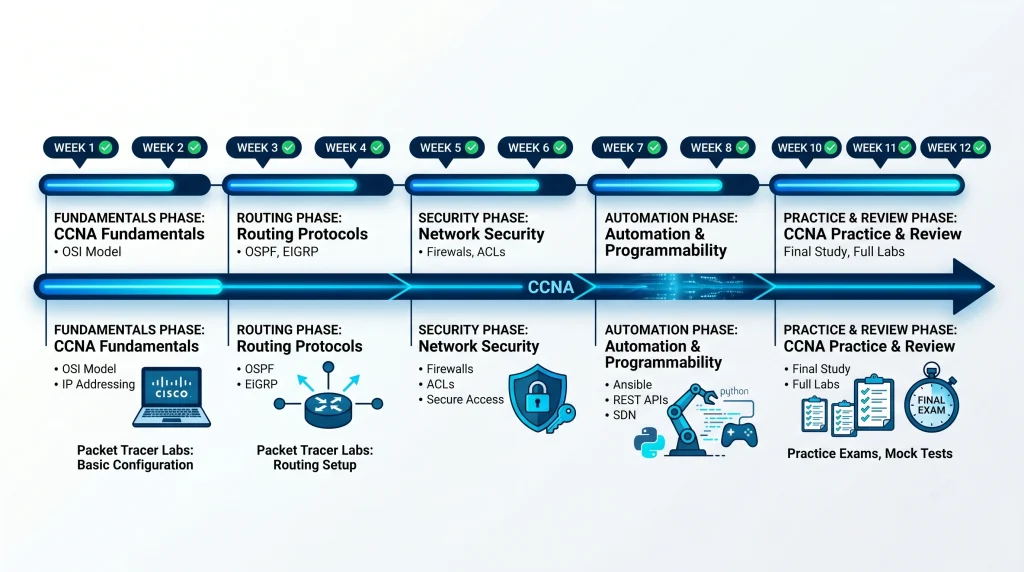
This study plan is designed for candidates preparing for the CCNA 200-301 exam. It can be scaled up proportionally for CCNP-level preparation. The plan assumes 10–15 hours of study per week.
Pre-Study Baseline Assessment (Before Week 1)
Before you open a single textbook, take a full-length practice test. Don’t study for it: just take it cold. Your goal is not to score well; it’s to understand your starting point. Record your domain-by-domain scores and save them. This baseline will guide your prioritization for the entire study period.
Use PassITExams’ CCNA Practice Test for this baseline assessment.
Weeks 1–2: Network Fundamentals and Network Access
Goal: Build a rock-solid foundation in the OSI model, TCP/IP, Ethernet, subnetting, VLANs, and spanning tree.
- Read Chapters 1–8 of the CCNA Official Cert Guide Vol. 1.
- Complete all Packet Tracer labs for VLAN configuration and trunking.
- Practice subnetting daily until you can subnet a /24 or /16 without hesitation. Use the host-based subnetting method consistently so your approach is repeatable under exam pressure.
- End the week with a 40-question practice test focused on Domains 1 and 2. Review all explanations.
Key tools: Cisco Packet Tracer (free download at Cisco Networking Academy), PassITExams topic-specific practice sets.
Weeks 3–4: IP Connectivity (Routing Fundamentals and OSPF)
Goal: Master static routing, administrative distance, and OSPFv2.
- Study OSPF neighbor relationships in depth: the DR/BDR election process, LSA types, and area design are perennial exam topics.
- Build an OSPF topology in Packet Tracer with at least three routers across two areas. Verify neighbor relationships with show ip ospf neighbor. Troubleshoot intentionally: break something and fix it.
- Study the routing table output (show ip route) until you can read it fluently.
- Take a 50-question IP Connectivity practice test. Pay special attention to scenario questions involving route selection, AD comparison, and OSPF troubleshooting.
Weeks 5–6: Security Fundamentals and IP Services
Goal: Cover ACLs, NAT/PAT, DHCP, NTP, and security protocols comprehensively.
- Configure standard and extended ACLs in Packet Tracer. Understand the implicit deny, wildcard masks, and the order of ACL entries.
- Lab NAT/PAT from scratch: configure a router with a private internal network translating to a single public IP using PAT (overload).
- Study WPA2 vs. WPA3 differences, and understand the 802.1X authentication flow.
- Take a combined 40-question practice test covering Domains 4 and 5.
Weeks 7–8: Automation, Programmability, and Review
Goal: Conquer the automation domain and begin full-exam simulation.

- Study JSON and YAML data structures until you can read and write them without reference material. The exam may present a JSON object and ask you to identify specific values.
- Understand REST API concepts: HTTP methods (GET, POST, PUT, DELETE), status codes, and authentication methods.
- Study the role of Cisco DNA Center as a controller-based network management platform. Understand the difference between northbound APIs (connecting DNA Center to external applications) and southbound APIs (connecting DNA Center to network devices).
- Review Ansible basics: what a playbook is, what an inventory file contains, and why Ansible is “agentless.”
- Take your first full-length 120-question practice exam under timed conditions (120 minutes). Simulate real exam conditions: no notes, no phone, no interruptions.
- After reviewing results, build a targeted list of your five weakest topic areas.
Weeks 9–10: Targeted Remediation and Second Full Exam
Goal: Close knowledge gaps identified in Week 8.
- Return to the five weakest areas identified in your first full practice exam. Re-read the relevant textbook chapters. Watch supplementary video explanations if a concept isn’t clicking in text form.
- Complete a second full-length 120-question practice exam. Compare your domain-by-domain scores with Week 8. You should see meaningful improvement in your targeted areas.
- If any domain score is still below 70%, allocate a focused 4–6 hour study block to that domain before moving to Week 11.
Weeks 11–12: Consolidation, Final Practice, and Exam-Day Preparation
Goal: Peak confidence and readiness.
- Complete one or two additional full-length practice exams, targeting a consistent score of 80%+ before scheduling your actual exam.
- Review your most commonly missed question types, not just the topics.
- Review Cisco’s exam policies, the testing center experience (or Pearson VUE online proctoring requirements), and the check-in procedures.
- In the final 48 hours, do light review only: no new topics, no cramming. Trust your preparation.
Exam-day tips:
- Arrive (or log in) 30 minutes early.
- Use the first 5 minutes to note any formulas you want visible (OSPF cost = 10^8 / bandwidth, subnet masks, etc.) on your scratch paper or erasable notepad.
- Flag difficult questions and return to them rather than spending 5 minutes stuck on a single item.
- For simulation questions (in which you must configure a device), work methodically: read the requirements twice before touching any configuration.
- Trust your preparation. Second-guessing your first instinct is a well-documented cause of incorrect answer changes on IT certification exams.
Common Mistakes to Avoid + Pro Tips from Certified Professionals
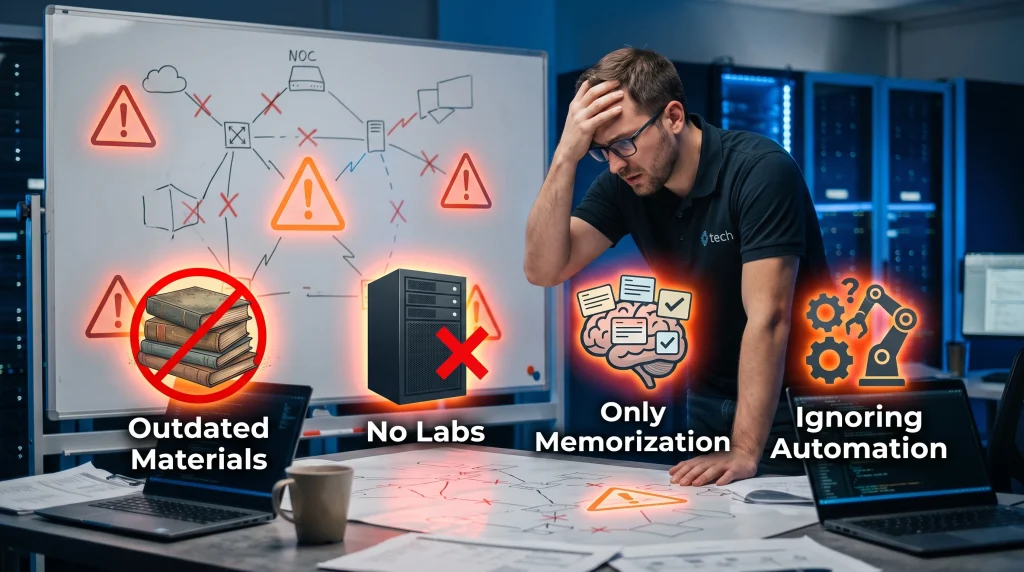
Mistake 1: Relying Solely on Practice Questions Without Building Real Skills
Practice tests are a measurement tool and a learning accelerator. They are not a substitute for understanding. Candidates who use only practice questions without reading, studying, and labbing often hit a ceiling around 60–65% on practice exams and can’t figure out why. The answer is always the same: they’re pattern-matching to question formats they’ve seen, not understanding the underlying concepts.
Pro tip: For every domain you study, spend at least 30% of your time doing hands-on labs. Even a Packet Tracer lab that takes 45 minutes to troubleshoot will teach you more about that protocol than 20 practice questions.
Mistake 2: Ignoring the Automation Domain
Many experienced network engineers have spent their entire careers configuring devices manually via CLI. The automation and programmability domain can feel foreign and irrelevant to them. But this domain represents 10% of the CCNA and 15% of the CCNP Enterprise exam: and it’s growing.
Pro tip: You don’t need to become a Python developer to pass the CCNA. You need to understand what Python scripts do to networks, how REST APIs work conceptually, and what tools like Ansible accomplish. Focus on comprehension, not coding proficiency.
Mistake 3: Scheduling the Exam Too Early
Exam fees range from $325 (CCNA) to over $400 (CCNP) per attempt. Scheduling before you’re ready is an expensive lesson. Yet many candidates: under pressure from employers, self-imposed deadlines, or impatience: book their exam when they’re scoring 65% on practice tests.
Pro tip: Do not schedule your actual exam until you are consistently scoring 80% or above on full-length practice exams. This buffer accounts for exam-day nerves and the natural variance between practice question sets and actual exam content.
Mistake 4: Using Outdated Study Materials
A practice test that was last updated in 2022 may not reflect the 2026 exam blueprint. Network automation, SD-WAN, and zero-trust content have grown significantly in weight since 2022. Candidates preparing with stale materials can find themselves underprepared for 30–40% of the current exam.
Pro tip: Before purchasing any practice resource, confirm the last update date. Reputable providers like PassITExams publish their content refresh dates and flag when questions have been updated to align with blueprint changes.
Mistake 5: Not Using Performance Analytics
Many candidates take a practice test, see their score, feel good (or bad), and move on without analyzing which specific topics they missed. This is a waste of data.
Pro tip: After every practice test, export or note your per-domain scores. Build a simple spreadsheet that tracks your score by domain across every practice session. This will show you your trajectory: which areas are improving and which have plateaued, far more clearly than your overall score does.
Mistake 6: Underestimating IPv6
Candidates with only IPv4 experience often underestimate the IPv6 content on Cisco exams. IPv6 addressing, EUI-64, NDP (Neighbor Discovery Protocol), stateless address autoconfiguration (SLAAC), and IPv6 routing are tested across both CCNA and CCNP levels.
Pro tip: Spend dedicated time on IPv6 addressing notation, prefix length vs. subnet mask differences, and the six types of IPv6 addresses (unicast, multicast, anycast, etc.). Configure an IPv6 topology in Packet Tracer from scratch.
Pro Tips from Certified Professionals
- From a CCNP Enterprise certified network engineer: “The routing protocol questions on CCNP are all about troubleshooting, not just knowing how protocols work. I spent hours just reading debug and show command outputs in EVE-NG until I could diagnose OSPF and BGP issues by the output alone. That’s what the exam actually tests.”
- From a CCNA first-attempt passer: “I made the mistake of treating practice exams like a final grade rather than a diagnostic tool. Once I started treating every wrong answer as a learning opportunity instead of a failure, my score went from 62% to 85% in three weeks.”
- From a CCNP Security certified professional: “The Security exam has shifted significantly toward architecture and design questions. Don’t just memorize what an NGFW does: understand why you’d deploy it at specific points in the network, how it integrates with ISE and Umbrella, and what zero-trust principles it supports.”
Frequently Asked Questions (FAQ’s)
How much do Cisco practice test resources typically cost?
Quality practice test platforms vary widely. Expect to pay $29–$79 per exam or $49–$99/month for subscription-based platforms. Free resources (including Cisco’s own NetAcad sample questions) exist but are typically limited in scope. For a certification that costs $325–$400 to sit, spending $50–$80 on quality practice materials is a sensible investment.
How often are PassITExams’ question banks updated?
PassITExams updates its content monthly and issues additional updates whenever Cisco announces blueprint changes. Updated timestamps are displayed on the product pages so candidates can confirm currency before purchasing.
How long should I study for the CCNA 200-301?
Candidates with a networking background (even basic experience with Cisco equipment) typically need 8–12 weeks at 10–15 hours per week. Those starting from zero networking knowledge should expect 16–24 weeks. The automation and programmability domain often requires additional time for candidates without a development background.
What is the passing score for the CCNA?
Cisco uses a scaled scoring system. The passing score for most exams falls in the range of 825–850 on a scale of 300–1000, though Cisco does not publish the exact passing threshold publicly. Focus on performing consistently above 80% on practice exams to provide a comfortable buffer.
Can I use Packet Tracer instead of real hardware for my CCNA studies?
Yes. Cisco Packet Tracer covers the vast majority of CCNA lab requirements and is free through Cisco Networking Academy (NetAcad). For CCNP-level preparation, EVE-NG or CML is recommended, as Packet Tracer does not support some CCNP-level protocols (MPLS, advanced BGP, SD-WAN).
What is the average salary for CCNA-certified professionals in the USA in 2026?
CCNA-certified network administrators and engineers in the USA typically earn between $65,000 and $90,000 annually, depending on location, experience, and industry. Major metropolitan areas (San Francisco, New York, Seattle, Washington D.C.) generally command 20–35% premiums over national averages. PassITExams’ provides regularly updated compensation data by role and geography.
How difficult is the CCNP Enterprise compared to the CCNA?
The CCNP is substantially more difficult. The content is deeper (advanced BGP, MPLS, SD-WAN, 802.1X with ISE), the questions are more scenario-heavy, and the exam is longer. Most candidates with solid CCNA knowledge need 16–24 weeks to prepare adequately for ENCOR. The concentration exams typically require an additional 8–12 weeks.
Is the CCIE certification worth pursuing in 2026?
For the right professional, absolutely. CCIE holders consistently rank among the highest-paid IT professionals in the United States, with average compensation exceeding $140,000. The credential is also relatively rare: fewer than 70,000 CCIEs are currently active worldwide, which gives it strong market differentiation. The lab exam, however, is one of the most demanding assessments in the IT industry and requires sustained preparation over 12–24 months.
Do Cisco certifications expire?
Yes. Most Cisco certifications are valid for three years. They can be renewed by passing any qualifying Cisco exam, completing continuing education credits through Cisco’s Continuing Education Program, or passing a higher-level exam in the same track. The Continuing Education Program is a newer option that allows professionals to maintain certifications without retesting.
What is the difference between CCNP Security and CyberOps Professional?
CCNP Security focuses on implementing and administering network security technologies: firewalls, VPNs, access control, and identity management. CyberOps Professional (and its associate-level predecessor) focuses on security operations: monitoring, threat detection, incident response, and SOC analysis. Both are valuable; your target role should guide which path you pursue.
Can I self-study for CCNP, or do I need a training course?
Self-study is entirely viable for CCNP, provided you have discipline and access to good materials. Thousands of candidates pass CCNP exams annually without formal training. The keys are the official Cisco Press certification guides, a virtual lab environment for hands-on practice, and a quality practice test platform like PassITExams. Structured training (instructor-led or self-paced video courses) is beneficial for candidates who prefer guided learning or who are new to specific technology areas.
What are the career prospects for CCNP-certified professionals in 2026?
Strong and growing. Enterprise networks are becoming more complex: SD-WAN adoption, zero-trust implementation, network automation, and cloud connectivity all require skilled professionals to design, implement, and manage. Job titles that commonly require or prefer CCNP include Senior Network Engineer, Network Architect, Security Engineer, Network Automation Engineer, and Cloud Network Engineer. LinkedIn job postings in Q1 2026 show a 22% year-over-year increase in roles explicitly requesting CCNP certification.
Should I get CCNA before pursuing CCNP?
While CCNP no longer formally requires CCNA as a prerequisite, Cisco strongly recommends equivalent knowledge. The CCNP assumes a solid foundation in routing, switching, and networking fundamentals. Candidates who skip CCNA and go directly to CCNP typically struggle with gaps in foundational knowledge, making CCNP material harder to absorb.
How realistic are “pass on first attempt” claims from practice test providers?
Treat all first-attempt pass rate claims with appropriate skepticism unless they are backed by verifiable data. What matters more than marketing claims is whether the practice materials are genuinely aligned with current exam blueprints, whether explanations are thorough, and whether the platform has a track record of user satisfaction. Look for verified reviews and real candidate experiences.
What networking trends should I know about for the 2026 Cisco exams?
Three major trends are most relevant to current exam content:
- AI-driven networking: Cisco’s intent-based networking platforms and AIOps for infrastructure monitoring now appear in CCNP-level blueprints
- Zero-trust security: the architectural shift from perimeter-based security to identity-centric, never-trust-always-verify models is embedded throughout the security tracks
- Network automation at scale: NETCONF/YANG, gRPC, and model-driven telemetry are moving from emerging topics to standard exam content across multiple tracks.
Conclusion: Your Path to Cisco Certification Starts with the Right Preparation
Cisco certifications in 2026 represent one of the highest-return investments available to networking professionals in the United States. The combination of strong employer demand, competitive salaries, and a rigorous credential that genuinely validates skill makes the preparation effort worthwhile, but only if that preparation is done right.

The key principles this guide has emphasized throughout:
- Real understanding outperforms memorization at every level. Cisco exams are designed to test whether you can apply knowledge to scenarios, not just recall definitions. Practice materials that train you to think through problems are worth far more than materials that give you answers to memorize.
- Hands-on lab experience is non-negotiable. Whether you’re using Cisco Packet Tracer for CCNA or EVE-NG for CCNP, the tactile experience of configuring, breaking, and fixing network topologies builds the pattern recognition that exam questions test.
- Blueprint alignment is a prerequisite for useful practice materials. The 2026 exam blueprints have meaningfully evolved, particularly in automation, security architecture, and AI-driven networking. Any practice resource you use must be actively maintained to current Cisco specifications.
PassITExams provides one of the most comprehensive Cisco preparation ecosystems currently available. Its combination of regularly updated practice tests, domain-specific study guides, career and salary resources, and in-depth explanatory content makes it a strong foundation for candidates at every level: from CCNA first-timers to CCNP professionals preparing for expert-track advancement.
Whether you’re taking the CCNA 200-301 for the first time or pursuing your CCNP concentration exam, the resources and strategies in this guide give you a clear, actionable path forward.
Start with your baseline assessment. Build your study plan. Lab every concept you study. Use practice tests as diagnostic tools, not finish lines. And when you’ve consistently hit 80%+ on full-length practice exams, schedule your certification with confidence.
Your 2026 Cisco certification journey starts now. Explore PassITExams’ Cisco Practice Test Library to take your first diagnostic test and see exactly where your preparation stands today.
