

Choosing the right Fortinet certification can accelerate your cybersecurity career. But with five certification levels and multiple specialization tracks, which one delivers the best return on your time and investment?
This guide helps you identify the best Fortinet certification for your specific situation, whether you’re starting fresh in cybersecurity, advancing to senior roles, or specializing in cloud security or security operations.
Recommended Read: If you are planning your certification roadmap for the year, check out our guide on The Best IT Certifications.
What Makes a Fortinet Certification “Best” for You?
The best Fortinet certification isn’t the highest level or the hardest to earn. It’s the one that aligns with your current experience, career goals, and the job opportunities you’re targeting.
Three factors determine the best certification choice:
- Your current experience level matters most. Entry-level professionals benefit most from FCF and FCA. Mid-level engineers need FCP. Senior specialists should pursue FCSS. Experts targeting principal roles require FCX.
- Your target job role shapes specialization choices. Network administrators need different certifications than SOC analysts or cloud security engineers.
- Your timeline and budget influence decisions. Some certifications are completely free. Others require exam fees and extensive preparation time.
There’s no single “best” Fortinet certification for everyone. The right choice depends on where you are and where you want to go.
Quick Answer: Best Fortinet Certification by Career Stage
- Complete beginner to cybersecurity: FCF (Fortinet Certified Fundamentals) – It’s free, requires no prerequisites, and builds foundational security knowledge.
- IT professional transitioning to security (0-1 year security experience): FCA (Fortinet Certified Associate) – Teaches hands-on FortiGate operations and opens entry-level security positions.
- Network or security administrator (1-3 years experience): FCP in Network Security – The most valuable mid-level certification that qualifies you for professional security engineer roles.
- Senior engineer or specialist (3-5+ years): FCSS in your specialization area – Validates advanced expertise and opens senior specialist positions.
- Principal architect or consultant (5+ years with Fortinet): FCX (Fortinet Certified Expert) – The pinnacle certification that proves expert-level mastery and commands premium compensation.
FCF and FCA: Best Free Certifications for Beginners
If you’re new to cybersecurity or have limited budget, FCF and FCA offer exceptional value because all training and exams are completely free.
FCF (Fortinet Certified Fundamentals): Best for Absolute Beginners
FCF is recommended for entry-level cybersecurity professionals and everybody that would like to pursue a career in cybersecurity, as well as professionals that need to have a high-level understanding of the most common cybersecurity concepts.
What makes FCF valuable:
- It’s 100% free with no hidden costs. All courses and exams are available online through the Fortinet Training Institute.
- It requires zero technical prerequisites. Anyone can start learning immediately.
- It provides legitimate credentials recognized by employers. FCF demonstrates security awareness that many organizations require.
- Getting Started in Cybersecurity is recommended to professionals in sales and non-technical roles, while Technical Introduction to Cybersecurity is recommended to professionals in technical roles and to anybody that wants to pursue other Fortinet certifications.
Best for: Career changers, students, non-technical professionals needing security awareness, anyone exploring cybersecurity before committing financially.
FCA (Fortinet Certified Associate): Best Free Hands-On Certification
FCA validates your ability to execute high-level operation of FortiGate devices and is recommended for cybersecurity professionals that need to execute high-level configuration and monitoring tasks on FortiGate devices, as well as network security administrators of small and medium size companies.
What makes FCA valuable:
- All training is free, making it the most accessible hands-on security certification available.
- It teaches practical FortiGate firewall skills that immediately apply to real jobs.
- It opens entry-level security positions that specifically require FortiGate knowledge.
- Completion validates you’re serious about security careers, not just exploring.
Best for: IT support staff wanting to move into security, help desk technicians supporting security infrastructure, anyone serious about a security career but unable to invest in paid certifications yet.
FCP: The Most Valuable Mid-Level Certification
The FCP level marks a clear departure from foundational understanding and a movement toward applied mastery, as it is not a one-size-fits-all certification but a suite of tracks carefully tailored to the real-world demands of cyber architecture, operations, and risk mitigation.
For most cybersecurity professionals, FCP represents the sweet spot of certification value. It’s the credential that typically delivers the strongest career and salary impact relative to investment.
Related Resource: For a broader look at how Fortinet compares to other vendors, read our Ultimate Fortinet Certifications Guide.
Why FCP stands out as the best mid-level choice:
- FCP qualifies you for professional-level security positions that command significantly higher salaries than associate roles. Most security engineer and administrator positions list FCP or equivalent as preferred qualifications.
- With exam costs at approximately $200 each and a requirement of two exams per specialization, the total investment of around $400 is modest when compared to the career dividends it unlocks.
- The certification validates practical skills, not just theoretical knowledge. FCP holders can deploy, configure, and manage enterprise security solutions immediately.
- For beginners, Fortinet FortiGate Administrator (FCP) training is the best starting point as this course provides a beginner-friendly experience with firewall basics, interface setup, NAT policies, and security profiles.
Best for: Network administrators moving into security, security analysts wanting vendor-specific expertise, engineers managing FortiGate deployments, professionals with 1-3 years of security experience.
FCP Specializations Compared: Network Security vs Cloud vs Security Operations
FCP offers three specialization tracks. Choosing the right one amplifies your certification’s career value.
FCP Network Security: Best for Traditional Infrastructure Roles
This certification targets professionals responsible for deploying, managing, and monitoring network security products, such as FortiGate firewalls, to protect against evolving threats and is ideal for network engineers, administrators, and security professionals who focus on securing network infrastructures, whether in an on-premise or hybrid cloud environment.
- Core focus: FortiGate firewall administration, VPN implementation, security profiles, high availability, network security design.
- Job roles aligned: Network Security Engineer, Firewall Administrator, Infrastructure Security Specialist, Network Administrator (security focus), Security Operations Engineer.
- Industry demand: Highest demand among FCP specializations. Most organizations run on-premise or hybrid infrastructure requiring FortiGate expertise.
- Salary range: Network security engineers with FCP certification typically earn between $90,000-$140,000 annually depending on experience and location.
Best for: Engineers managing physical and virtual security appliances, professionals working in traditional enterprise IT environments, those wanting the broadest job market access.
FCP Public Cloud Security: Best for Cloud-Native Careers
The FCP in Public Cloud Security certification validates your ability to secure cloud applications by deploying, managing, and monitoring Fortinet public cloud products and covers the day-to-day tasks related to Fortinet public cloud devices and VMs.
- Core focus: Securing AWS, Azure, and GCP environments with Fortinet solutions, cloud firewall deployment, cloud-native security architectures.
- Job roles aligned: Cloud Security Engineer, Cloud Security Architect, DevSecOps Engineer, Multi-Cloud Security Specialist.
- Industry demand: Rapidly growing as organizations migrate to cloud. Specialized knowledge commands premium compensation.
- Salary range: Cloud security engineers with FCP Public Cloud certification often earn $100,000-$160,000+ annually, with cloud-focused roles typically paying 10-20% more than traditional infrastructure positions.
- A cloud solutions architect focused on secure multi-cloud deployments would find alignment with the Public Cloud Security track.
Best for: Professionals working primarily in AWS/Azure/GCP, DevOps engineers adding security skills, organizations undergoing cloud migration, forward-looking career planners targeting high-growth areas.
FCP Security Operations: Best for SOC and Threat Detection Roles
The FCP in Security Operations certification validates your skills in securing networks and applications using Fortinet’s security operations products and covers tasks like log analysis, threat detection and response, and utilizing threat intelligence.
- Core focus: FortiAnalyzer, FortiSIEM, security monitoring, threat detection, incident response, log analysis.
- Job roles aligned: SOC Analyst, Security Analyst, Threat Detection Engineer, Incident Responder, Security Operations Center Team Lead.
- Industry demand: Strong and growing as organizations build and expand SOC capabilities. Every enterprise needs security monitoring.
- Salary range: SOC analysts and security operations professionals with FCP certification typically earn $80,000-$130,000 annually, with senior SOC roles reaching $150,000+.
- A SOC analyst or cybersecurity incident responder should naturally gravitate toward the Security Operations track.
Best for: Analysts in security operations centers, professionals focused on threat detection and response, those wanting to specialize in security monitoring and analysis rather than infrastructure configuration.
FCSS: Best Advanced Certification for Specialists
FCSS certifications target senior professionals who design and deploy advanced Fortinet solutions in specialized domains.
When FCSS becomes the best choice:
- You have 3-5+ years of hands-on experience with Fortinet products in production environments.
- You’re targeting senior engineer, architect, or specialist positions that require advanced expertise.
- You work in a specialized area like OT security, SASE, or advanced cloud security architecture.
- Your organization deploys complex, multi-site Fortinet environments that require advanced design skills.
Available FCSS specializations and who they’re best for:
- FCSS Secure Networking: Best for senior network security architects designing complex enterprise firewall architectures, SD-WAN deployments, and OT security solutions.
- FCSS SASE: Best for professionals implementing Secure Access Service Edge solutions with FortiClient EMS, FortiEDR, and cloud-delivered security services.
- FCSS Public Cloud Security: Best for cloud security architects designing and operating multi-cloud security at scale.
- FCSS Security Operations: Best for senior SOC engineers, threat detection specialists, and those implementing FortiSOAR automation and advanced threat hunting.
- FCSS OT Security: Best for professionals securing operational technology and industrial control systems in manufacturing, energy, or critical infrastructure.
- Salary impact: FCSS certified professionals typically command $120,000-$180,000+ annually, with specialized roles in OT security and cloud architecture often exceeding $200,000.
Best for: Senior engineers with deep Fortinet experience, specialists in cloud or OT environments, professionals targeting architect-level positions, consultants designing complex security solutions.
FCX: The Ultimate Expert Certification (Is It Worth It?)
- FCX demonstrates complete knowledge of how to design, configure, and troubleshoot complex network security systems using Fortinet solutions.
- FCX represents the pinnacle of Fortinet certification. It’s rigorous, expensive in time investment, and requires substantial production experience. But is it the best choice for you?
When FCX is worth pursuing:
- You have 5+ years of extensive production-level experience with Fortinet products across multiple domains.
- You’re targeting principal architect, consulting, or senior leadership positions where FCX is explicitly valued or required.
- Your organization needs to demonstrate the highest level of Fortinet expertise to customers or partners.
- You want to maximize long-term earning potential in Fortinet-focused roles.
What makes FCX unique:
- It requires both a written exam and a hands-on practical exam in a real lab environment, similar to Cisco’s CCIE. You must demonstrate expertise under time pressure with actual devices.
- FCX Level 8 certification shows customers that organizations have the strongest bench and that professionals are all-in, as showing deep technology credentials is important to customers when talking about such important technology as cybersecurity.
- One FCX holder noted, “When an individual is successful at achieving Level 8, it really shows that they know what they’re doing and that they have expert knowledge in network security design, configuration, and troubleshooting for complex networks”.
- Career impact: FCX holders command the highest salaries in Fortinet-focused roles, often $150,000-$250,000+ depending on role and location. The certification differentiates you in consulting and architect positions.
- Time investment: Most candidates spend several months in intensive preparation. The practical exam requires extensive hands-on practice with complex scenarios.
Best for: Principal architects, senior consultants, technical leaders managing Fortinet practices, professionals committed to Fortinet specialization long-term.
Not the best choice if: You’re early or mid-career, work with multiple vendor platforms, or don’t have significant Fortinet production experience yet. In these cases, FCP or FCSS delivers better ROI.
Need Study Material? If you are preparing for these exams, browse our latest Fortinet Exam Dumps and Study Guides.
Best Fortinet Certification by Job Role
| Current/Target Role | Best Certification | Why This Choice |
|---|---|---|
| Career Changer to Security | FCF → FCA | Free, builds foundation, proves commitment |
| Help Desk Technician | FCA | Adds security skills to support role |
| Junior Security Analyst | FCP Security Operations | Validates SOC and monitoring skills |
| Network Administrator | FCP Network Security | Adds security expertise to networking skills |
| Cloud Engineer | FCP Public Cloud Security | Aligns cloud skills with security |
| Firewall Administrator | FCP Secure Networking | Deepens FortiGate expertise |
| SOC Analyst (2-3 years) | FCP Security Operations | Professional-level monitoring and analysis |
| Senior Network Security Engineer | FCSS Secure Networking | Advanced architecture and design |
| Cloud Security Architect | FCSS Public Cloud Security | Multi-cloud security at scale |
| Security Consultant | FCSS or FCX | Demonstrates deep expertise to clients |
| Principal Architect | FCX | Highest level of technical credibility |
Salary Impact: Which Certification Pays Best?
Fortinet certifications deliver measurable salary impact, with higher-level certifications generally commanding higher compensation.
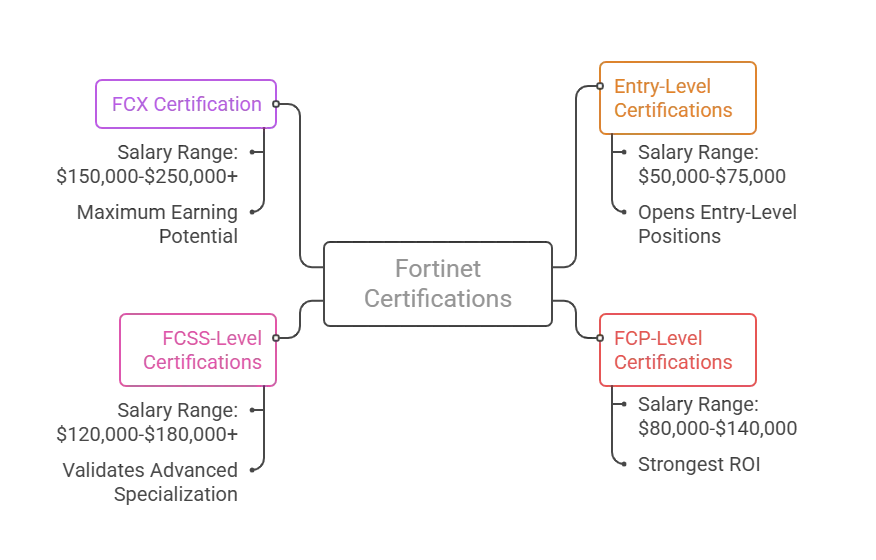
- Entry-level certifications (FCF/FCA): Typical roles: IT Support, Junior Analyst, Network Technician Salary range: $50,000-$75,000 annually Value: Opens doors to entry-level security positions
- FCP-level certifications: Typical roles: Security Engineer, Network Security Administrator, SOC Analyst, Cloud Security Engineer Salary range: $80,000-$140,000 annually Value: Strongest ROI for mid-career professionals. The $400 investment in FCP exams typically pays for itself within months through salary increases or new job opportunities.
- According to market data, Fortinet firewall professionals in the United States earn an average of $53.99 per hour, with wages ranging between $45.91 (25th percentile) to $61.54 (75th percentile), translating to approximately $112,000 annually.
- FCSS-level certifications: Typical roles: Senior Security Engineer, Security Architect, SOC Team Lead, Senior Consultant Salary range: $120,000-$180,000+ annually Value: Validates advanced specialization worth premium compensation
- FCX certification: Typical roles: Principal Architect, Director of Security Engineering, Senior Consultant, Security Engineering Manager Salary range: $150,000-$250,000+ annually Value: Maximum long-term earning potential in Fortinet-specialized roles
- Professionals have seen a significant boost in their salaries by gaining NSE certification, as Fortinet credentials are highly recognized by employers and the salary of an NSE certified person is defined by the level of certification, with higher levels commanding more salary.
- Certification with highest ROI: FCP Network Security typically delivers the best return on investment because it requires moderate preparation time ($400 exam cost, 80-120 hours study time) but qualifies you for positions paying $30,000-$50,000 more than associate-level roles.
Difficulty Levels: Easiest to Hardest Fortinet Certifications
Understanding certification difficulty helps you choose a realistic target based on your experience and available preparation time.
| Certification | Difficulty Level | Study Time Needed | Pass Rate (Estimated) | Key Challenge |
|---|---|---|---|---|
| FCF | Very Easy | 10-20 hours | High (80%+) | None – foundational concepts |
| FCA | Easy | 30-50 hours | High (75%+) | Basic hands-on practice needed |
| FCP | Moderate | 80-120 hours | Moderate (60-70%) | Requires deep hands-on experience |
| FCSS | Hard | 120-180 hours | Lower (50-60%) | Advanced scenarios and design |
| FCX | Very Hard | 300+ hours | Low (30-40%) | Practical exam under time pressure |
Easiest Fortinet certification: FCF requires minimal technical knowledge and covers only fundamental concepts. It’s designed for complete beginners.
Best difficulty-to-value ratio: FCP represents moderate difficulty but delivers strong career value. Most professionals with 1-2 years of hands-on experience can pass FCP with dedicated preparation.
Hardest Fortinet certification: FCX demands expert-level knowledge across all Fortinet products and technologies. The practical exam tests your ability to design, configure, and troubleshoot complex environments under strict time limits.
Free vs Paid: Budget-Friendly Certification Options
Budget constraints influence certification choices. Understanding which Fortinet certifications are free helps you plan.
Completely free certifications (training and exams):
- FCF (Fortinet Certified Fundamentals)
- FCA (Fortinet Certified Associate)
Both include all course materials and online exams at no cost. This makes them the best budget-friendly options.
Paid certifications (exam fees required):
- FCP: Approximately $400 total (two exams at ~$200 each)
- FCSS: Varies by track, typically $200-$400
- FCX: Highest cost (written exam + practical exam fees, plus extensive lab access for practice)
Free training with paid exams: All self-paced training courses are free through the Fortinet Training Institute, even for FCP, FCSS, and FCX. You only pay for exam vouchers.
Best budget strategy:
- Start with FCF and FCA (completely free) to build foundation
- Gain hands-on experience through your job or home lab
- Pursue FCP when ready, budgeting for $400 in exam fees
- Request employer reimbursement for professional development
Many organizations reimburse certification costs. Check your company’s professional development policy before paying out of pocket.
Making Your Decision: A Simple Framework
Follow this four-step framework to identify your best certification choice.
Step 1: Assess your current experience
- No security experience → FCF
- 0-1 years IT experience → FCA
- 1-3 years security experience → FCP
- 3-5+ years experience → FCSS
- 5+ years Fortinet specialization → FCX
Step 2: Identify your career goal
- Exploring cybersecurity careers → FCF
- Getting first security job → FCA
- Advancing to engineer role → FCP
- Specializing at senior level → FCSS
- Reaching principal/expert level → FCX
Step 3: Choose your specialization (if pursuing FCP or above)
- Traditional infrastructure focus → Network Security
- Cloud-native environments → Public Cloud Security
- SOC and threat detection → Security Operations
- Advanced SD-WAN/OT → FCSS Secure Networking
- Zero Trust/SASE → FCSS SASE
Step 4: Verify alignment with job market Search job postings for your target role. Which certifications appear in requirements or preferred qualifications? Choose certifications that match market demand in your area.
Why Employer Preference Matters
Organizations prefer to hire candidates with certifications, with the Fortinet NSE Certification program carefully crafted to address the rapidly evolving threat landscape as well as job-market needs.
The best certification is one that employers actively seek. Before committing time and money, research job postings in your target area and role. See which certifications appear most frequently.
FCP Network Security appears in more job postings than other FCP specializations, making it often the best general choice. However, if you’re specifically targeting cloud roles or SOC positions, the specialized FCP tracks become better investments.
Your Career Path: Which Certification Comes Next?
Most professionals progress through multiple certifications as their careers advance.
Typical progression paths:
- Network Security Path: FCF → FCA → FCP Network Security → FCSS Secure Networking → FCX
- Cloud Security Path: FCF → FCA → FCP Public Cloud Security → FCSS Public Cloud Security
- Security Operations Path: FCF → FCA → FCP Security Operations → FCSS Security Operations
- Generalist to Specialist Path: FCA → FCP Network Security → FCSS (choose specialization) → FCX
You don’t need to follow these paths linearly. If you have the experience and knowledge, you can skip levels. However, the progressive structure exists because each level builds on the previous one.
Frequently Asked Questions
What is the most valuable Fortinet certification?
For most professionals, FCP represents the highest value certification. It qualifies you for professional-level security positions, requires moderate investment, and delivers strong ROI. Specifically, FCP Network Security opens the most job opportunities because it’s the most widely requested in job postings. However, “most valuable” depends on your experience level—FCF is most valuable for complete beginners, while FCX is most valuable for experts.
Which Fortinet certification should I start with?
Start with FCF if you’re completely new to cybersecurity or want to explore the field before committing. Start with FCA if you have basic IT knowledge and are serious about a security career. Start with FCP if you already have 1-2 years of security or networking experience and hands-on exposure to firewalls or network security devices.
Is Fortinet certification worth it in 2026?
Yes, Fortinet certification remains highly valuable. The Fortinet Training Institute has issued over 1.8 million certifications to date, demonstrating widespread adoption. Organizations using Fortinet products (which includes a large percentage of enterprises) specifically seek certified professionals. The certifications validate practical skills and typically lead to salary increases that exceed the investment cost.
What’s the easiest Fortinet certification to get?
FCF (Fortinet Certified Fundamentals) is the easiest. It requires no prerequisites, covers only fundamental concepts, and provides free training and exams. You can complete it in 10-20 hours of study. FCA is the second easiest, requiring about 30-50 hours but still completely free with basic hands-on requirements.
Should I get FCP in Network Security or Public Cloud Security?
Choose FCP Network Security if you work primarily with on-premise or hybrid infrastructure, manage physical or virtual firewalls, or want access to the broadest job market. Choose FCP Public Cloud Security if you work primarily in AWS/Azure/GCP environments, support DevOps teams, or your organization is cloud-native. Network Security has higher overall demand, but Cloud Security often commands premium compensation for specialized roles.
How long does it take to get Fortinet FCP certified?
Plan for 6-8 weeks of consistent study if you have relevant experience, investing 2-3 hours daily. Complete beginners should allow 10-12 weeks. The timeline includes completing training courses, hands-on lab practice, and passing both the core and elective exams. If you already work with FortiGate daily, you might reduce this to 4-6 weeks.
Can I skip FCA and go straight to FCP?
Yes. Fortinet doesn’t enforce prerequisites—if you have the knowledge and experience, you can attempt any certification directly. However, FCA is free and provides good foundational practice. Most professionals with no Fortinet experience benefit from completing FCA before FCP, even if not strictly required.
Which Fortinet certification pays the most?
FCX (Fortinet Certified Expert) commands the highest salaries, with certified professionals often earning $150,000-$250,000+ in principal architect and senior consulting roles. However, FCSS certifications in specialized areas like OT Security or Public Cloud Security can also command premium compensation ($120,000-$200,000+) without the extreme difficulty of FCX. For ROI, FCP often delivers the best salary increase relative to time investment.
Is FCSS harder than FCP?
Yes, significantly. FCSS certifications target advanced scenarios, complex architectures, and specialized expertise. They require 3-5+ years of hands-on experience to pass comfortably. FCP is considered moderate difficulty, while FCSS is hard. However, if you have the experience and work in a specialized area daily, FCSS becomes more achievable.
Do I need hands-on experience to pass Fortinet certification?
For FCF, no—it’s purely conceptual. For FCA, basic hands-on practice helps but isn’t strictly required. For FCP and above, hands-on experience is essential. You cannot pass these certifications through memorization alone. They test your ability to configure, troubleshoot, and manage Fortinet products in realistic scenarios. Plan to spend significant time in lab environments practicing actual configurations.
Your Next Step: Choose Your Certification
The best Fortinet certification for you aligns with your current experience, target role, and career timeline.
Take action today:
- If you’re new to cybersecurity, register for FCF at training.fortinet.com. It’s free and you can start immediately.
- If you have IT experience, skip directly to FCA to learn hands-on FortiGate skills.
- If you’re ready for professional-level certification, choose your FCP specialization based on your work environment—Network Security for traditional infrastructure, Public Cloud Security for cloud-native roles, or Security Operations for SOC positions.
- If you’re a senior professional, evaluate whether FCSS in your specialization or FCX matches your career goals and the positions you’re targeting.
- Each certification focuses on different areas of security, networking, or solution engineering, so exploring each Fortinet certification is wise before choosing a path, as choosing the right certification helps you reach your goals.
The cybersecurity field continues to face a massive skills shortage. Organizations need professionals who can implement and manage security solutions effectively. Your Fortinet certification proves you have those skills.
Choose the certification that matches where you are now and where you want to be. Then commit to the preparation and take the exam. Your certified future self will thank you.
