
Breaking into IT or advancing your tech career requires more than just interest in technology. You need credentials that employers recognize and value. IT certifications provide exactly that, validating your skills and opening doors to roles in high-demand fields like cloud computing, cybersecurity, and network administration.
Whether you’re starting from scratch or looking to specialize, the right certification can accelerate your career, boost your salary, and give you a competitive edge. This guide covers the best IT certifications for 2026, organized by career level and specialization, so you can make an informed decision about your next credential.
What Are IT Certifications and Why Do They Matter?
IT certifications are industry-recognized credentials that validate your knowledge and skills in specific technology areas. Organizations like CompTIA, Microsoft, AWS, Cisco, and ISC² offer these certifications, which typically require passing one or more exams.
Unlike college degrees that provide broad theoretical education, certifications focus on practical, job-ready skills. They prove to employers that you understand specific tools, platforms, or security practices well enough to apply them in real-world scenarios.

Benefits of Earning IT Certifications
Research shows that IT certifications deliver measurable career benefits. According to recent industry data, professionals who earned new certifications saw an average salary increase of around $13,000. But the value extends beyond compensation.
Certifications help you:
- Build credible expertise. They demonstrate verified knowledge in areas like cloud security, network administration, or system troubleshooting.
- Improve job performance. The structured learning process strengthens your technical foundation and exposes you to best practices.
- Increase competitiveness. In competitive job markets, certifications help your resume pass initial screening and show hiring managers you’re serious about the field.
- Accelerate career progression. Many IT professionals report receiving promotions or new job opportunities within months of earning certifications.
- Bridge the experience gap. For career changers or recent graduates, certifications can compensate for limited work history.
Best Entry-Level IT Certifications for Beginners
If you’re new to IT, these foundational certifications provide the skills and credentials you need to land your first tech role. They require no prior experience and cover the basics that every IT professional should know.
CompTIA A+
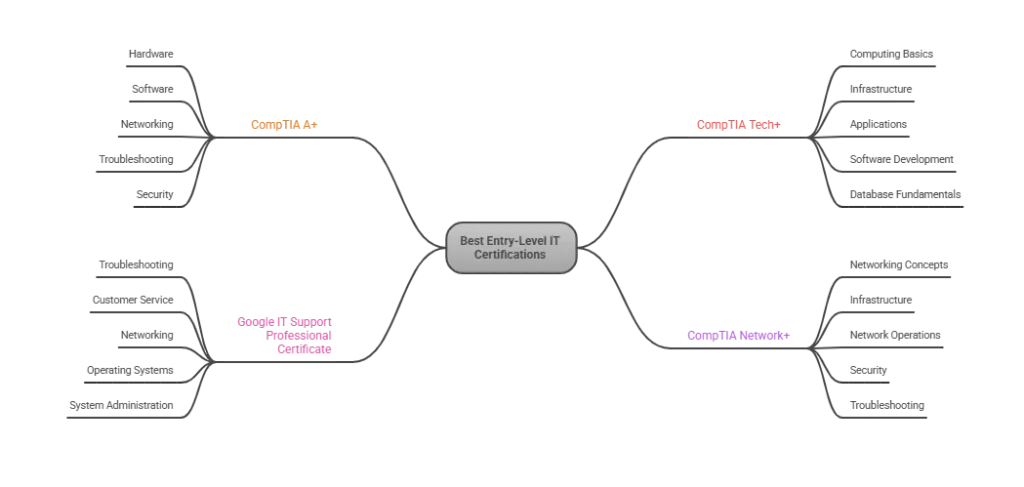
CompTIA A+ remains the most recognized entry point into IT careers. This vendor-neutral certification validates foundational skills in hardware, software, networking, troubleshooting, and basic security.
The certification requires passing two exams covering operating systems, mobile devices, virtualization, cloud computing, and security fundamentals. CompTIA recommends nine to 12 months of hands-on experience, though many candidates prepare through self-study or training programs.
- Best for: Help desk technicians, desktop support specialists, field service technicians, IT support specialists
- Typical exam cost: Around $250 per exam (two exams required)
- Entry-level salary range: Positions start around $48,000 to $62,000 annually
CompTIA Tech+ (formerly IT Fundamentals)
For absolute beginners who want to explore IT before committing to a career path, CompTIA Tech+ introduces essential concepts like computing basics, infrastructure, applications, software development, database fundamentals, and security.
This certification helps you determine if IT is the right field for you and provides foundational knowledge before pursuing more specialized credentials like A+ or Security+.
- Best for: Career explorers, non-technical professionals transitioning to IT, students deciding on tech specializations
- Typical exam cost: Around $130
- Career impact: Primarily educational; typically a stepping stone to A+ or other entry certifications
Google IT Support Professional Certificate
This professional certificate from Google prepares complete beginners for IT support roles through hands-on projects covering troubleshooting, customer service, networking, operating systems, system administration, and security.
The program aligns with CompTIA A+ certification objectives and takes most learners three to six months to complete. It requires no prior experience and can be completed entirely online.
- Best for: Complete beginners with no IT background, career changers, anyone seeking remote-friendly credentials
- Typical program cost: Subscription-based, typically under $50 per month
- Career paths: IT support specialist, help desk technician, desktop support technician
CompTIA Network+
After establishing IT fundamentals with A+, many professionals pursue Network+ to specialize in networking. This vendor-neutral certification covers networking concepts, infrastructure, network operations, security, and troubleshooting.
Network+ validates your ability to design, configure, manage, and troubleshoot wired and wireless networks, making it valuable for roles focused on network infrastructure.
- Best for: Junior network administrators, network support specialists, systems engineers
- Typical exam cost: Around $358
- Salary range: Network support specialists earn between $55,000 and $75,000 depending on experience and location
Top Cloud Computing Certifications
Cloud computing continues to dominate IT hiring priorities. These certifications prove you can work with the platforms that run modern business infrastructure.

AWS Certified Cloud Practitioner
Amazon Web Services offers this foundational certification for anyone beginning a cloud career. It covers AWS cloud concepts, security, core services, billing, and pricing models.
AWS recommends six months of exposure to AWS cloud, though many candidates prepare in less time using free training resources and practice exams provided by AWS.
- Best for: Beginners entering cloud computing, non-technical professionals working with AWS, anyone planning advanced AWS certifications
- Typical exam cost: $100
- Career paths: Cloud support technician, junior cloud engineer, technical account manager
AWS Certified Solutions Architect – Associate
This associate-level certification is the most popular AWS credential. It validates your ability to design and deploy scalable, highly available systems on AWS, covering compute, storage, database, and networking services.
AWS recommends one year of hands-on experience designing available, cost-efficient, fault-tolerant systems on AWS before attempting this exam.
- Best for: Solutions architects, cloud engineers, developers working with AWS infrastructure
- Typical exam cost: $150
- Average salary: Professionals with this certification report salaries around $120,000 to $140,000
Microsoft Azure Fundamentals (AZ-900)
For professionals working in Microsoft-centric environments, Azure Fundamentals introduces cloud concepts, core Azure services, security, privacy, compliance, and pricing models.
This foundational certification requires no prerequisites and serves as a gateway to more advanced Azure certifications in administration, security, or architecture.
This certification proves you can deploy applications, monitor operations, and manage enterprise solutions on Google Cloud Platform. It covers cloud architecture, implementation, and service management.
Google recommends six months of hands-on GCP experience, though many candidates prepare through Google’s training resources.
- Best for: Cloud engineers, DevOps professionals, system administrators working with GCP
- Typical exam cost: $125
- Career opportunities: Prepares you for roles in cloud support, Azure administration, and cloud engineering
Best Cybersecurity Certifications
Cybersecurity remains one of the fastest-growing areas in IT. These certifications validate your ability to protect systems, data, and networks from evolving threats.
CompTIA Security+
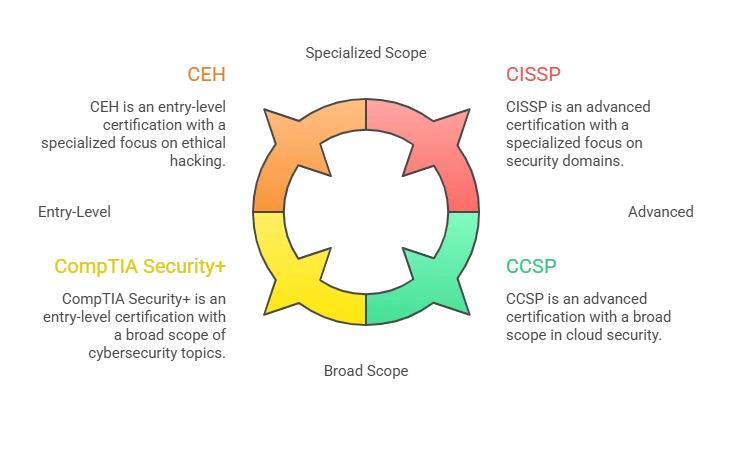
Security+ is the most widely recognized entry-level cybersecurity certification. It covers network security, compliance, operational security, threats and vulnerabilities, application security, access control, and cryptography.
This certification validates baseline cybersecurity skills and prepares you for roles protecting organizational networks and responding to security incidents.
- Best for: Security specialists, junior security analysts, systems administrators with security responsibilities
- Typical exam cost: Around $381
- Starting salary: Entry-level cybersecurity specialists typically earn $75,000 to $112,000
Certified Information Systems Security Professional (CISSP)
CISSP is the gold standard for experienced cybersecurity professionals. Offered by ISC², it covers eight security domains including security and risk management, asset security, security architecture, communication and network security, and security operations.
This advanced certification requires five years of cumulative paid work experience in two or more CISSP domains, though a four-year degree can substitute one year of experience.
- Best for: Security managers, security consultants, security architects, chief information security officers
- Typical exam cost: $749
- Average salary: CISSP holders report average salaries around $143,000, with total compensation reaching $175,000
Certified Cloud Security Professional (CCSP)
As organizations migrate to cloud platforms, CCSP validates advanced technical skills in designing, managing, and securing data and infrastructure in the cloud. This ISC² certification covers cloud concepts, architecture, platform security, application security, and operations.
CCSP requires five years of cumulative paid work experience in IT, with three years in information security and one year in one or more CCSP domains.
- Best for: Cloud security architects and engineers, security consultants specializing in cloud
- Typical exam cost: $599
- Average salary: Around $171,500
Certified Ethical Hacker (CEH)
The CEH certification teaches security professionals to think like attackers to identify and fix vulnerabilities. It covers scanning networks, system hacking, malware threats, web application attacks, and penetration testing.
EC-Council recommends two years of information security experience, though candidates can waive this by taking official training.
- Best for: Penetration testers, vulnerability analysts, security consultants
- Typical exam cost: Varies by training option; exam-only vouchers start around $1,199
- Career value: Ethical hackers with CEH credentials typically earn $90,000 to $130,000
Essential Networking Certifications
Networking forms the backbone of modern IT infrastructure. These certifications prove you can design, implement, and troubleshoot the networks that keep organizations connected.
Cisco Certified Network Associate (CCNA)
CCNA is the industry standard for networking professionals working with Cisco technologies. It covers network fundamentals, network access, IP connectivity, IP services, security fundamentals, and automation.
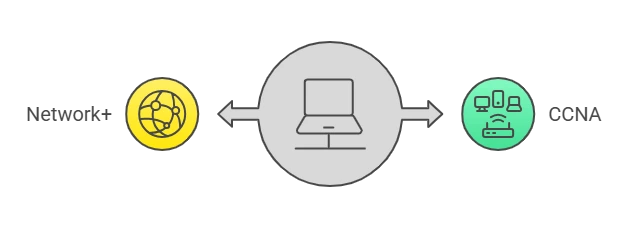
Unlike CompTIA Network+, CCNA focuses specifically on Cisco equipment and requires hands-on configuration skills with routers and switches.
- Best for: Network administrators, network engineers, systems administrators managing network infrastructure
- Typical exam cost: $300
- Salary range: CCNA-certified professionals typically earn $70,000 to $95,000
CompTIA Network+
Covered earlier as an entry-level option, Network+ deserves mention here as a networking specialization. Its vendor-neutral approach makes it valuable for professionals working across multiple platforms and vendors.
Highest-Paying IT Certifications
Salary isn’t everything, but it matters. Here are the certifications commanding the highest compensation in 2026, according to recent salary surveys. (If you want a broader benchmark list, see15 top-paying cybersecurity certifications.)
| Certification | Average Salary | Best For |
|---|---|---|
| AWS Certified Security – Specialty | $203,597 | Advanced AWS security professionals |
| Google Cloud – Professional Cloud Architect | $190,204 | Cloud architects designing GCP solutions |
| Nutanix Certified Professional (NCP-MCI) | $175,409 | Multicloud infrastructure specialists |
| CCSP – Certified Cloud Security Professional | $171,524 | Cloud security architects and engineers |
| CISM – Certified Information Security Manager | $167,396 | Security managers and leaders |
| AWS Certified Solutions Architect – Professional | $165,000+ | Senior AWS solutions architects |
| CISA – Certified Information Systems Auditor | $155,000+ | IT auditors and compliance professionals |
The highest-paying certifications typically require significant experience. AWS Certified Security – Specialty, which tops the salary list, has seen steady increases from an average of $149,741 two years ago to over $203,000 today.
Several factors drive these premium salaries. Cloud computing and cybersecurity represent the top areas where employers struggle to find qualified talent. Certifications that combine deep technical skills with strategic knowledge command the highest premiums.
How to Choose the Right IT Certification for Your Career
With hundreds of certifications available, selecting the right one requires strategic thinking about your goals, current experience, and market opportunities.
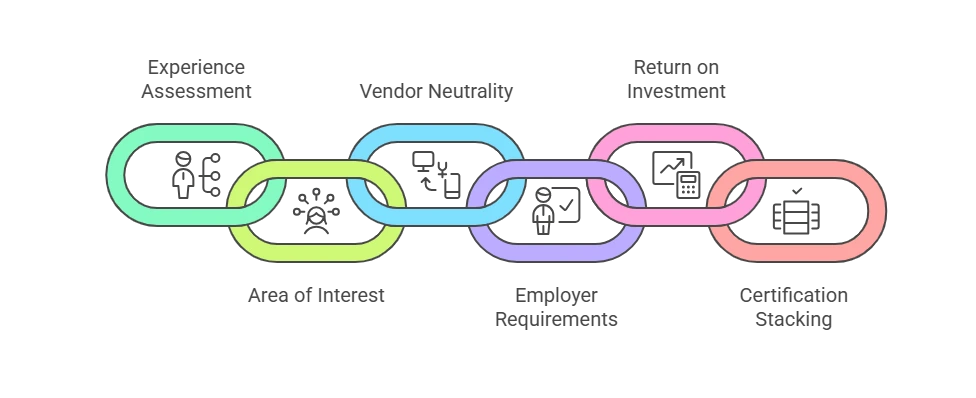
- Assess your current experience level. Complete beginners should start with foundational certifications like CompTIA A+ or Google IT Support. Those with one to three years of experience can pursue associate-level certifications in their chosen specialization. Professionals with five or more years should consider advanced credentials like CISSP or cloud architect certifications.
- Identify your area of interest. IT encompasses many specializations. Do you enjoy helping users solve technical problems? Focus on support certifications like A+. Fascinated by networks? Pursue Network+ or CCNA. Passionate about security? Start with Security+ and progress toward CISSP.
- Consider vendor-neutral versus vendor-specific paths. Vendor-neutral certifications like CompTIA’s portfolio apply across any technology platform. Vendor-specific certifications from AWS, Microsoft, or Cisco provide deep expertise in widely-used platforms. You can read more about AWS vs Azure certification paths to help decide.
- Research employer requirements. Look at job postings for roles you want. Which certifications appear most frequently? Some organizations specifically require CompTIA Security+ for cybersecurity roles.
- Calculate return on investment. Factor in exam costs, training materials, study time, and potential salary increases. Entry-level certifications typically cost less and boost earnings by 10 to 15 percent for junior roles. Advanced certifications cost more but can deliver salary increases of $20,000 or more.
- Think about certification stacking. Many IT professionals build credential portfolios that demonstrate breadth and depth. A common path: Start with A+, add Network+ or Security+ based on interest, then pursue advanced certifications in your specialization.
IT Certification Career Paths: From Beginner to Expert
IT careers rarely follow linear paths, but certifications provide clear milestones for progression. Here’s how certifications typically stack for common career tracks.

IT Support to Systems Administration Path
- Entry point: CompTIA A+ or Google IT Support
- Intermediate: CompTIA Network+, Microsoft Endpoint Administrator (MD-102)
- Advanced: CompTIA Server+, CompTIA Linux+, advanced Microsoft certifications
This path builds from frontline support toward infrastructure management and system administration.
Cybersecurity Specialist to Security Leader Path
- Entry point: CompTIA Security+
- Intermediate: CEH (Certified Ethical Hacker), CompTIA CySA+ (Cybersecurity Analyst)
- Advanced: CISSP, CISM (Certified Information Security Manager), CCSP
This progression moves from technical security work toward security architecture and management.
Cloud Engineering Path
- Entry point: AWS Cloud Practitioner, Azure Fundamentals, or Google Cloud Digital Leader
- Intermediate: AWS Solutions Architect Associate, Azure Administrator, Google Associate Cloud Engineer
- Advanced: AWS Solutions Architect Professional, Azure Solutions Architect Expert, Google Professional Cloud Architect
Cloud paths emphasize both breadth across services and depth in architecture and security.
Network Administration to Network Architecture Path
- Entry point: CompTIA Network+
- Intermediate: CCNA (Cisco Certified Network Associate)
- Advanced: CCNP (Cisco Certified Network Professional), specialized networking certifications
Networking careers often focus on Cisco technologies, though vendor-neutral skills remain valuable.
Budget Considerations: What IT Certifications Actually Cost
Understanding the full cost helps you plan your certification journey. Expenses include more than just exam fees.
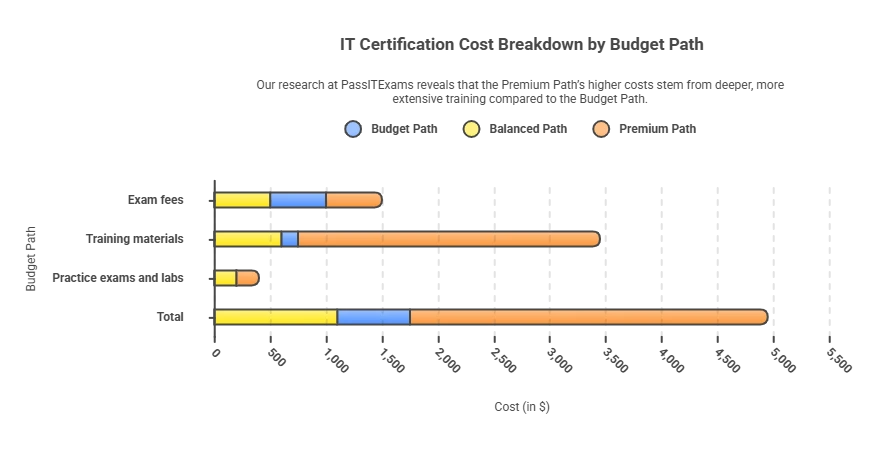
- Exam fees range from around $100 for foundational certifications to over $700 for advanced credentials like CISSP. Most entry-level certifications cost between $130 and $400 per exam.
- Training materials vary widely based on your learning style. Self-study using free resources and low-cost practice exams might cost $50 to $200. Comprehensive training courses from vendors or third-party providers range from $500 to $3,000.
- Practice exams and labs help you prepare, especially for hands-on certifications. Budget $50 to $200 for quality practice materials.
- Renewal costs matter for certifications requiring ongoing maintenance. CompTIA certifications require continuing education credits every three years. ISC² certifications need annual maintenance fees plus continuing professional education.
Here’s a realistic budget comparison for three common certification paths:
Budget Path (Self-Study)
- CompTIA A+ exams: $500
- Study materials and practice tests: $150
- Total: $650
Balanced Path (Some Training)
- CompTIA A+ exams: $500
- Online training course: $400
- Study guides and practice tests: $200
- Total: $1,100
Premium Path (Full Training)
- CompTIA A+ exams: $500
- Instructor-led bootcamp: $2,500
- Additional materials: $200
- Total: $3,200
Most certification candidates fall somewhere between the budget and balanced approaches. The key is matching your investment to your learning style and career urgency.
Maximize Your Certification ROI
Getting the certification is just the first step. Here’s how to ensure it delivers career value.

- Apply your skills immediately: Look for opportunities to use your new knowledge at work, even before completing the certification. Volunteer for relevant projects or help with tasks related to your certification area.
- Update your resume and LinkedIn profile: Add certifications prominently. Include them in your summary, create a dedicated certifications section, and mention relevant skills throughout your profile.
- Seek promotions or new opportunities: Don’t wait for recognition. Schedule a conversation with your manager about new responsibilities or advancement. Consider applying for roles that require your certification.
- Stay current with renewals: Letting certifications expire wastes your initial investment and can hurt your credibility. Track renewal dates and plan for continuing education requirements.
- Stack strategically: Build a certification portfolio that tells a coherent story about your expertise. Employers value depth in a specialization supported by foundational breadth.
Getting Started: Your Next Steps
Ready to pursue an IT certification? Here’s your action plan:
- First, choose your certification based on your experience level and career goals. Use the guidance in this article to narrow your options to one or two strong candidates.
- Second, create a realistic study timeline. Most entry-level certifications require 100 to 200 hours of preparation. Schedule consistent study time rather than cramming.
- Third, gather your study materials. Start with official exam objectives from the certification provider. Supplement with study guides, video courses, and practice exams matching your learning style.
- Fourth, consider structured preparation resources. PassITExams provides comprehensive study materials and practice questions designed to help you prepare efficiently for popular IT certifications. Their resources align with official exam objectives and include realistic practice scenarios.
- Finally, register for your exam once you’re consistently scoring well on practice tests. Many testing centers offer flexible scheduling, allowing you to choose a date that fits your preparation timeline.
Frequently Asked Questions FAQ’s
What is the best IT certification for complete beginners?
CompTIA A+ is widely regarded as the best starting point for IT beginners. It covers fundamental skills in hardware, software, networking, and security that apply across nearly every IT role. The Google IT Support Professional Certificate is another excellent option that prepares you for the same entry-level positions while providing hands-on projects and no-prerequisite access.
Do IT certifications actually lead to higher salaries?
Yes, research consistently shows that IT certifications correlate with higher earnings. Recent data indicates that professionals who earned new certifications saw average salary increases around $13,000. Entry-level certifications typically boost pay by 10 to 15 percent, while advanced certifications can deliver increases of $20,000 or more. However, the impact depends on combining certifications with relevant experience and applying your skills effectively.
How long does it take to get an IT certification?
The timeline varies significantly based on the certification and your study approach. Entry-level certifications like CompTIA A+ typically require 100 to 200 hours of study, which most people complete in three to six months studying part-time. More advanced certifications like CISSP can require 200 to 300 hours of preparation. Your prior experience, study intensity, and learning style all influence the timeline. Read more about how long to study for CISSP here.
Can I get an IT job with just certifications and no degree?
Absolutely. Many IT roles prioritize skills and certifications over formal degrees, especially for entry-level positions. Help desk roles, desktop support positions, and junior network administrator jobs often hire candidates with strong certifications even without a bachelor’s degree. CompTIA A+, Network+, and cloud certifications from AWS or Azure can qualify you for real IT positions. Once you gain experience, your work history becomes more important than educational credentials.
Which IT certification pays the most?
According to 2026 salary data, the AWS Certified Security – Specialty certification commands the highest average salary at over $203,000 annually. Google Cloud Professional Cloud Architect follows at around $190,000. However, these advanced certifications require significant experience. For entry-level professionals, focusing on high-growth areas like cloud computing and cybersecurity provides the best long-term earning potential.
Should I get CompTIA A+ or go straight to Security+?
This depends on your background. If you’re completely new to IT with no hands-on experience, start with A+ to build foundational knowledge of hardware, operating systems, and basic networking. If you already work in IT and understand these fundamentals, you can skip directly to Security+ to specialize in cybersecurity. Security+ assumes basic IT knowledge that A+ provides.
Are cloud certifications worth it?
Yes, cloud certifications deliver strong value in today’s job market. Organizations across industries continue migrating infrastructure and applications to cloud platforms, creating sustained demand for cloud skills. AWS, Azure, and Google Cloud certifications prove you can work with platforms that run modern business operations. Cloud certifications also tend to command higher salaries than traditional IT credentials at similar experience levels.
How often do I need to renew IT certifications?
Renewal requirements vary by certification provider. CompTIA certifications require renewal every three years through continuing education units. ISC² certifications like CISSP require annual membership fees plus continuing professional education credits. Some vendor certifications from AWS, Microsoft, and Google remain valid for two to three years before requiring recertification. Always check specific renewal requirements when choosing a certification, as letting credentials expire wastes your initial investment.
What’s the difference between vendor-neutral and vendor-specific certifications?
Vendor-neutral certifications like those from CompTIA cover concepts and skills that apply across any technology platform. They’re not tied to specific products from companies like Cisco, Microsoft, or AWS. Vendor-specific certifications focus on particular platforms or products. CCNA covers Cisco networking equipment, while AWS certifications focus on Amazon’s cloud services. Vendor-neutral certifications provide broader applicability, while vendor-specific credentials demonstrate deep expertise in widely-used platforms.
Can I study for IT certifications on my own without taking courses?
Yes, self-study is a common and cost-effective approach to certification preparation. Most certification providers publish detailed exam objectives outlining exactly what you need to know. You can use official study guides, video courses, practice exams, and hands-on labs to prepare independently. Self-study works best if you’re disciplined, have strong research skills, and learn well from written materials. Formal courses provide more structure but aren’t mandatory for success.
Take Your Next Step in IT
IT certifications provide clear pathways into technology careers and advancement opportunities for experienced professionals. Whether you’re starting with CompTIA A+ or pursuing advanced credentials in cloud security, certifications validate your skills and demonstrate your commitment to the field.
Success with certifications requires more than just passing exams. Choose credentials aligned with your career goals, invest adequate time in preparation, and actively apply your new knowledge in real-world situations.
Ready to start your certification journey? PassITExams offers targeted study materials and practice resources to help you prepare efficiently for popular IT certifications. Explore their exam preparation resources to build the knowledge and confidence you need to succeed.
