
Every year, tens of thousands of professionals decide to get Six Sigma certified; and most of them start by asking the wrong question. They ask “Green Belt or Black Belt?” before they’ve asked “certified by whom?”
That second question matters more. A Green Belt from a rigorous, accredited body that requires a real improvement project will open doors that a $49 weekend certificate never will, even though both technically say “Green Belt” on the PDF. Hiring managers in operations, healthcare, manufacturing, and supply chain have seen enough resumes to know the difference between a credential that required work and one that required a credit card.
This guide compares the providers that actually matter in 2026; what they require, what they cost, and who each one is genuinely best for; so you can make a decision you won’t need to defend in an interview. If you’re still weighing whether to pursue a certification at all, our Is Six Sigma Worth It? guide covers the ROI question in depth. If cost is your main concern, see our full Six Sigma Certification Cost breakdown.
What Makes a Six Sigma Certification “Recognized” in 2026
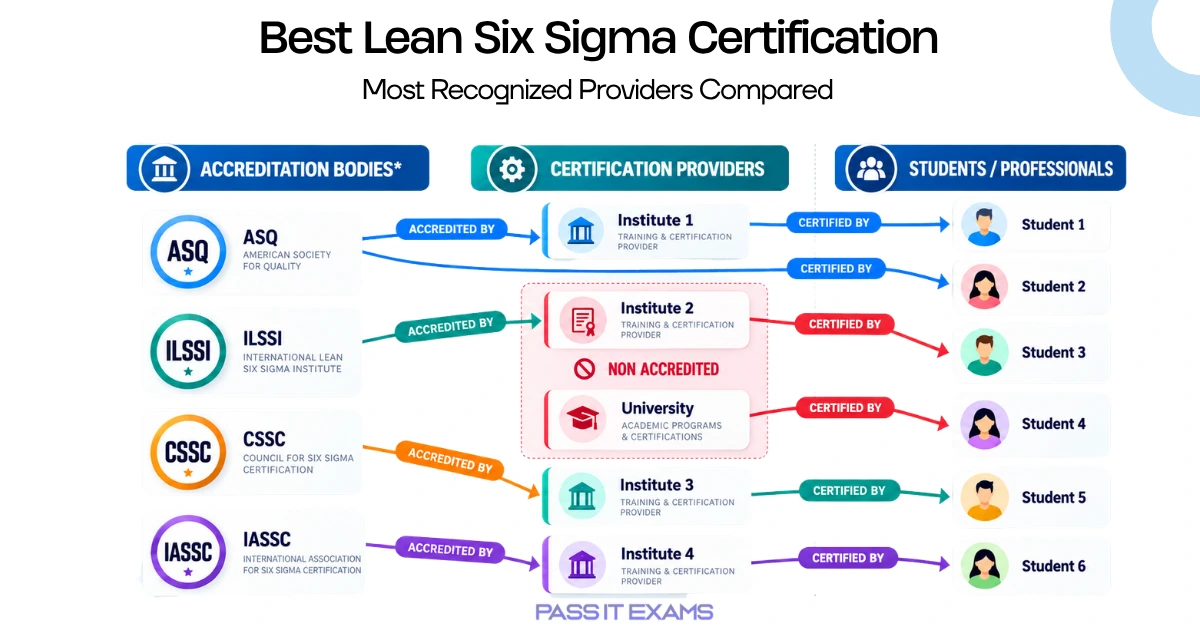
Six Sigma has no single global governing body; unlike, say, the PMP for project management. That’s the root of most of the confusion buyers run into. “Recognized” in this space comes down to four factors:
- Accreditation and standardization: Bodies like IASSC and CSSC are third-party certifying organizations with published, standardized Bodies of Knowledge. ASQ is a long-established professional association (over 75 years old) with its own certification arm. Because there’s no single accreditor sitting above all of them, recognition is really about industry track record, not a stamp from a government agency.
- Whether a project is required: ASQ requires work experience at the Green and Black Belt levels, plus a completed project for Black Belt certification, while IASSC has no prerequisites and certifies purely on exam performance. Employers in regulated or engineering-heavy industries increasingly ask candidates to describe their certification project in interviews; a credential with no project behind it can be harder to defend.
- Exam format and rigor: ASQ’s exams are open-book and considered rigorous, while IASSC’s are closed-book, proctored exams focused on knowledge validation. Neither is objectively “harder”; they’re testing different things: applied judgment versus recall under pressure.
- Industry and geographic footprint: ASQ carries particular weight in manufacturing, healthcare, and regulated industries in North America. IASSC is widely recognized internationally and among training providers and consultancies. University-affiliated programs (Villanova, Purdue, UC San Diego, Emory, and others) carry the additional weight of an academic brand, which some employers; and some resumes; benefit from.
The practical takeaway: there is no universally “best” certifying body. There is a best body for your industry, your goals, and how much rigor you want to prove you went through.
Comparison Table of Top Providers
| Provider | Accreditation / Standing | Project Required? | Cost Range | Format | Employer Recognition |
|---|---|---|---|---|---|
| ASQ | Long-established professional association | Yes, for Black Belt (Green Belt requires experience) | Yellow Belt: $322 member / $422 non-member. Green Belt (CSSGB): $369 member / $469 non-member. Black Belt (CSSBB): $468 member / $568 non-member | In-person and online exams | Strongest in manufacturing, healthcare, regulated industries |
| IASSC | Standardized, internationally recognized exam body | No | Yellow Belt: $195. Green Belt: $295. Black Belt: $395 (on-demand/partner vouchers may run higher; roughly 350–402 for Green Belt and 450–516 for Black Belt) | Fully online, on-demand | Strong globally, especially with training partners |
| CSSC | Independent certifying council | Yes, for Black Belt (project review fee) | White Belt: Free. Yellow Belt: $99. Green Belt: $195. Black Belt (standard): $295 | Fully online, open-book | Growing recognition; budget-friendly, no renewal cycle |
| University programs (Villanova, Purdue, UC San Diego, Emory, etc.) | Academic institution + often IASSC/ASQ-aligned curriculum | Usually yes | 500–6,500+ depending on belt and school | Online, in-person, or hybrid | Strong brand value; useful for career changers |
| Corporate/consultancy providers (e.g., Lean Sigma Corp, SSDSI, training partners) | Often IASSC-accredited training partner | Varies | 300–2,000+ | Online cohorts, in-person workshops | Good for team-wide standardization |
Best Overall Certification: ASQ
For sheer weight on a resume, ASQ remains the benchmark, particularly if you work in manufacturing, healthcare, aerospace, or any regulated field where quality management has deep institutional roots. ASQ certifies what you’ve done and know; requiring documented work experience and, for Black Belt, a completed improvement project; rather than knowledge alone.
That rigor is exactly what makes it valuable: a hiring manager who sees “ASQ Certified Six Sigma Black Belt” knows the candidate had to prove real project leadership, not just pass a test. The tradeoff is cost and time; ASQ’s Black Belt (CSSBB) exam runs $468 for members and $568 for non-members as of 2026, and you’ll need qualifying experience before you’re even eligible to sit for it.
Choose ASQ if: you’re in a traditional quality, manufacturing, or regulated industry, you already have relevant work experience, and you want the credential that’s hardest to question.
Best for Green Belt Specifically: IASSC
Green Belt is the certification most professionals actually need; it signals you can lead a process-improvement project without requiring you to have run a department-wide initiative first. For this level, IASSC is the strongest all-around pick, with a base exam price of $295 as of 2026 (on-demand and partner-bundled vouchers can run higher, typically 350–402).
IASSC has zero prerequisites, meaning anyone can sit for the exam regardless of experience, and its certification is recognized perpetually without additional renewal proof, though ongoing “Current” status specifically runs on a 3-year cycle (more on that in the FAQ below). That matters for Green Belt candidates specifically: many are pursuing the credential before they have a project to point to, as a way to qualify for process-improvement roles in the first place. IASSC’s Lean Six Sigma branding, closed-book proctored exams, and fast scheduling make it a practical, respected middle ground; rigorous enough to matter, accessible enough to actually finish.
CSSC is a reasonable budget alternative at the Green Belt level; its Green Belt exam is $195; but it currently carries less brand recognition than ASQ or IASSC among private-sector employers.
Choose IASSC if: you want a Green Belt that’s affordable, doesn’t require prior work experience, and is recognized by training providers and employers internationally.
Best Fully Online Options: IASSC and CSSC
If your priority is completing certification entirely on your own schedule with no in-person component, IASSC and CSSC are the two strongest choices. CSSC’s exams are open-book and delivered fully online, and its certifications do not expire, which appeals to learners who don’t want to manage a renewal cycle. IASSC’s exams are similarly delivered on-demand and web-based, with vouchers purchasable directly or bundled through accredited training partners.
ASQ also offers online, proctored exams, so “online” alone shouldn’t be your only filter; the real distinction is whether the training behind the exam is self-paced video, live virtual cohorts, or nothing at all (exam-only, bring-your-own-prep). Be specific about which of these you’re buying before you check out, because “online course” gets used loosely across this market; some packages include a full instructor-led curriculum, others are little more than a PDF and a practice test.
Choose this route if: you want maximum flexibility, don’t need an in-person cohort or instructor, and are comfortable self-directing your exam prep.
Best for Corporate / Team Training: Accredited Training Partners
If you’re certifying a team rather than yourself, the calculus changes. Individual exam vouchers from ASQ, IASSC, or CSSC are designed for one person at a time; what most organizations actually need is standardized in-house training delivered to a cohort, mapped to their own processes, with certification bundled at the end.
This is where accredited training partners and consultancies; firms authorized to deliver IASSC- or ASQ-aligned curricula; tend to outperform going direct to the certifying body. They typically offer:
- Volume pricing across multiple seats
- Live, instructor-led workshops using the company’s own process data as case material
- Project mentorship, so Black Belt candidates get through the required project faster
- A single point of contact for scheduling, rather than each employee coordinating separately
The tradeoff is that quality varies enormously between training partners, so vet the instructor’s credentials and ask for references from past corporate clients before signing a group contract.
Choose this route if: you’re certifying five or more people at once, want training tailored to your company’s actual processes, and have budget for instructor-led delivery rather than self-paced modules.
Red Flags to Avoid
The Six Sigma certification market has a real problem with low-quality providers riding on the credibility of the methodology itself. Watch for:
- “Certified in 4 hours” offers. A genuine Green Belt or Black Belt requires meaningful study time and, for Black Belt in particular, project work. If a provider promises full certification in an afternoon with no assessment of prior knowledge, the credential won’t carry weight with employers who know the space.
- No project component at Black Belt level. Nearly every credible body; ASQ, CSSC, and most university programs; requires some form of project documentation for Black Belt. If a provider skips this entirely and still calls it a Black Belt, be skeptical of how it will be received.
- Unverifiable or unknown certifying bodies. If you can’t find the organization mentioned anywhere outside its own marketing; no mentions in job postings, no presence in industry forums, no track record; treat it as a red flag.
- “Free” Green Belt or higher offers. No major accredited certifying body currently offers a genuinely free Green Belt or higher credential; free offerings are typically White Belt overviews used as lead generation, not real certifications.
- Lifetime “unlimited belts for one flat fee” deals with no exam. If there’s no assessment at all; just a course completion certificate; it’s training, not certification. That’s not necessarily bad, but don’t confuse the two when it comes to what you list on a resume.
- Pressure tactics and countdown timers. Legitimate certifying bodies don’t need to manufacture urgency. Aggressive “enroll in the next 10 minutes” sales pages are a marketing red flag independent of the actual training quality.
None of this means budget-friendly options are automatically bad; CSSC, for instance, is inexpensive and still requires an exam and, at Black Belt, a project review. The distinction is between affordable and rigorous versus cheap and hollow.
How to Decide Based on Your Goals
If your goal is career advancement in a regulated or traditional industry (manufacturing, healthcare, aerospace, pharma): Prioritize ASQ. Its recognition in these fields is the deepest, and its experience requirements mean the credential does real signaling work on a resume.
If your goal is to break into process improvement without prior experience: Start with IASSC Yellow or Green Belt. No prerequisites means you can build the credential before you have the job, not after.
If budget is your primary constraint: CSSC offers legitimate, exam-based certification at the lowest price point among accredited bodies, with no renewal fees to manage down the line. Just confirm the specific job postings you’re targeting recognize it before betting your whole strategy on it.
If you’re pursuing this alongside a degree or career change and want maximum resume weight: A university-affiliated program adds an academic brand on top of the certification itself, which can matter more than the certifying body for career switchers without a quality-management background.
If you’re certifying a whole team: Go with an accredited corporate training partner rather than individual vouchers; the cost-per-person usually comes down, and the training can be tailored to your actual workflows.
In every case, match the provider to how the certification will actually be used; read job postings in your target field and note which certifying bodies, if any, they name explicitly. That’s a stronger signal than any ranking list, including this one.
Frequently Asked Questions FAQ’s
Is ASQ or IASSC more recognized?
Neither is universally “more” recognized; ASQ operates as a broader professional association with higher costs and more formal requirements, while IASSC focuses on standardized exams delivered through third-party training providers. ASQ tends to carry more weight in regulated and traditional manufacturing/healthcare industries; IASSC is widely recognized internationally and among training providers generally.
Do I need a project to get Green Belt certified?
It depends on the body. ASQ requires relevant work experience for Green Belt (though not a formal project affidavit as it does for Black Belt). IASSC and CSSC do not require a project at Green Belt.
Can I get Six Sigma certified fully online?
Yes. IASSC and CSSC exams are entirely online and on-demand. ASQ also offers remote-proctored exams, though its experience requirements still apply regardless of exam location.
How long does certification take?
Green Belt typically takes 4–8 weeks of study depending on your pace and prior exposure to the material. Black Belt, especially with a required project, commonly takes 3–6 months.
Does Six Sigma certification expire?
It depends on the body, and the wording is more nuanced than a flat “yes” or “no”:
- IASSC certifications are recognized perpetually, but “Current” status specifically lasts 3 years, after which it becomes “Elapsed” unless you recertify.
- ASQ Green Belt and Yellow Belt are lifetime certifications with no renewal requirement; Black Belt requires recertification every 3 years.
- CSSC standard certifications do not expire.
Is a cheaper certification ever the right choice?
Yes; if it’s from an accredited body with a real exam and your target employers don’t specifically require ASQ. Budget doesn’t automatically mean low quality, but it should never mean skipping the exam and project requirements entirely.
Conclusion: A Simple Framework for Choosing
Strip away the marketing, and the decision comes down to three questions, in this order:
- What does my target industry or employer actually recognize? Check job postings before choosing a provider.
- Do I need to prove experience, or do I need to build a credential from zero? ASQ suits the former; IASSC suits the latter.
- What’s my real budget once training, exam, and any renewal fees are included; not just the advertised sticker price?
Answer those three, and the “best” provider stops being an abstract debate and becomes an obvious choice for your specific situation. For a full financial breakdown across all major providers and belt levels, visit our Six Sigma Certification Cost guide, and if you’re still deciding whether to pursue certification at all, start with Is Six Sigma Worth It?
