
Here’s a realistic scenario, built from the salary ranges we’re about to walk through: a mid-level admin earning around $95K adds the Agentforce Specialist certification, spends the next several months applying it on a real Agentforce rollout at work, and moves into a senior admin or solution-engineer role paying $140K–$150K. That’s not a fantasy number, it’s roughly where the data from Salesforce Ben, Mason Frank, and Clientell’s 2026 compensation research says a certified, experienced professional in an AI-adjacent role lands. The certification alone doesn’t do it. The certification plus applied experience does.
That distinction matters more in 2026 than it ever has, because Salesforce is mid-pivot. Agentforce, the company’s AI agent platform, is now baked into nearly every cloud, Data Cloud has been rebranded to Data 360, and Salesforce renamed more than 35 certifications in 2025–2026 to reflect this shift. If you’re choosing a certification path this year, you’re not just picking a credential, you’re picking a lane in the AI-driven CRM economy that Salesforce is betting its entire platform on.
So which certification actually moves your salary the most? Below is a data-backed breakdown, not a sales pitch, including where the “highest-paying certification” claims hold up, and where they don’t.
Key Takeaway: 2026 is the best window in years to certify in Agentforce or Data 360 skills specifically, because the talent pool is still thin and the premiums for those skills are real, but a single certification is a starting point, not a salary guarantee.
2026 Salary Reality Check
Before ranking certifications, it’s worth being honest about how certification pay bumps actually work, because most articles oversell this.
Salary growth by certification is non-linear. According to certification-and-salary research published by TechCerted, the data shows a clear pattern: professionals with 7–10 Salesforce certifications average around $155,000, which is close to the peak of the certification curve. Counterintuitively, professionals holding 16 or more certifications tend to see salaries drop relative to that 7–10 sweet spot, likely because piling on certs past a certain point signals exam-collecting rather than deepening real expertise, and because time spent chasing credential #17 is time not spent on billable, resume-building project work.
Mason Frank’s Salesforce salary research has consistently found that certified professionals report a meaningful pay premium over non-certified peers, with certified admins earning up to roughly 25% more than their non-certified counterparts, and developers with certifications typically earning $10,000–$20,000 more annually. Salesforce Ben’s 2026 salary data (pulling from Mason Frank, Stott & May, and its own 2,300+ respondent survey) shows median pay roughly doubling to tripling from admin (~$110,000) to technical architect (~$200,000), and that climb is not a straight line. It’s steep at the architect transition and relatively flat in the middle.
Here’s the part that matters most for your decision: certifications correlate with salary, they don’t single-handedly cause it. Recruiters we’d expect to see quoted on this (and that KORE1’s 2026 developer salary guide backs up directly) routinely note that two candidates with the same certifications can be $30K–$35K apart in salary because one has real production experience and the other doesn’t. Certifications open the interview door and validate baseline knowledge. Experience, and increasingly, hands-on Agentforce or Data Cloud implementation work, is what closes the gap to the top of the range.
Key Takeaway: Don’t chase certifications past the point of diminishing returns. Aim for a focused stack of 7–10 relevant, role-aligned certifications, backed by real project work, not a wall of badges.
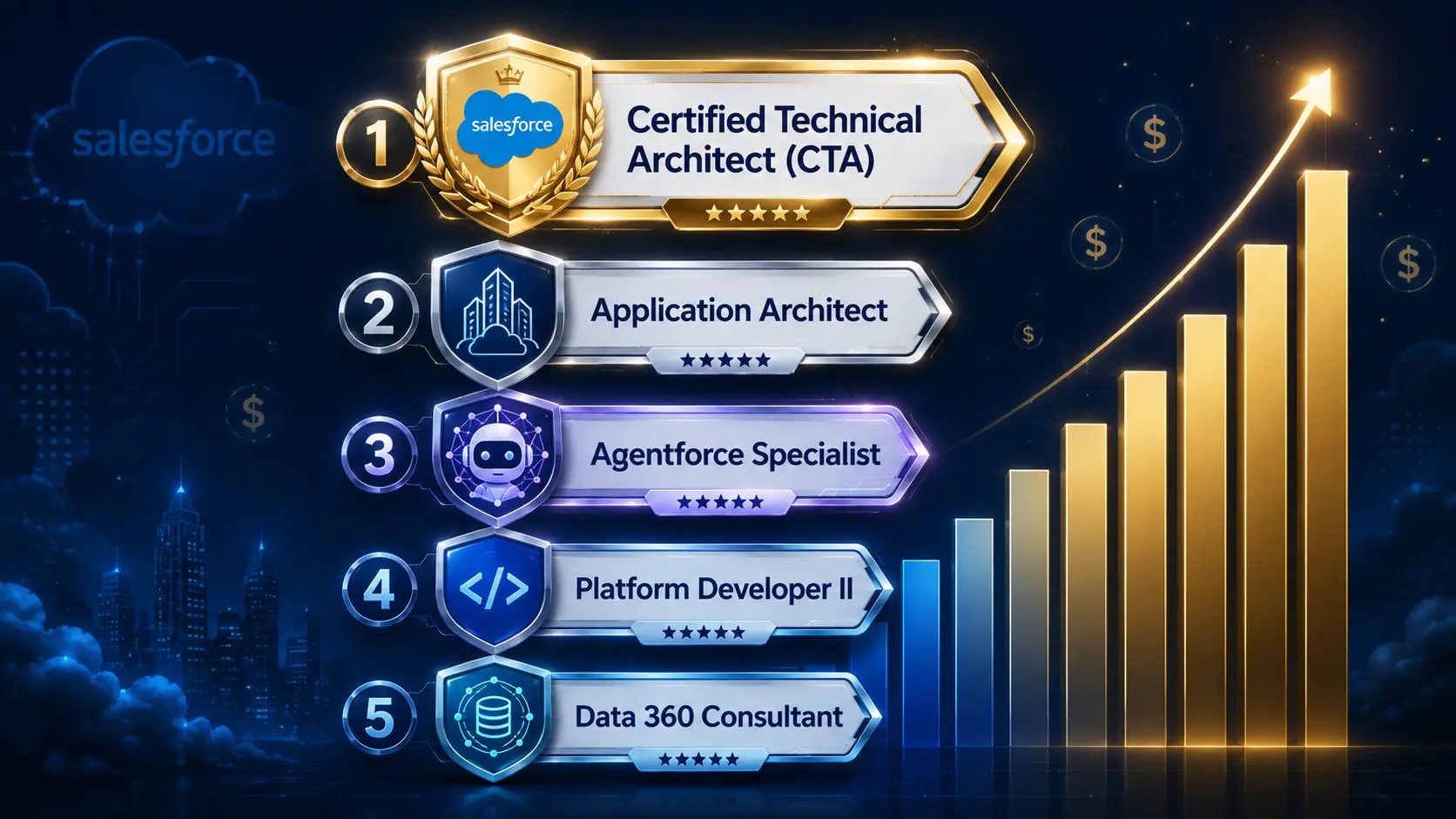
Top 5 Highest-Paying Salesforce Certifications Ranked
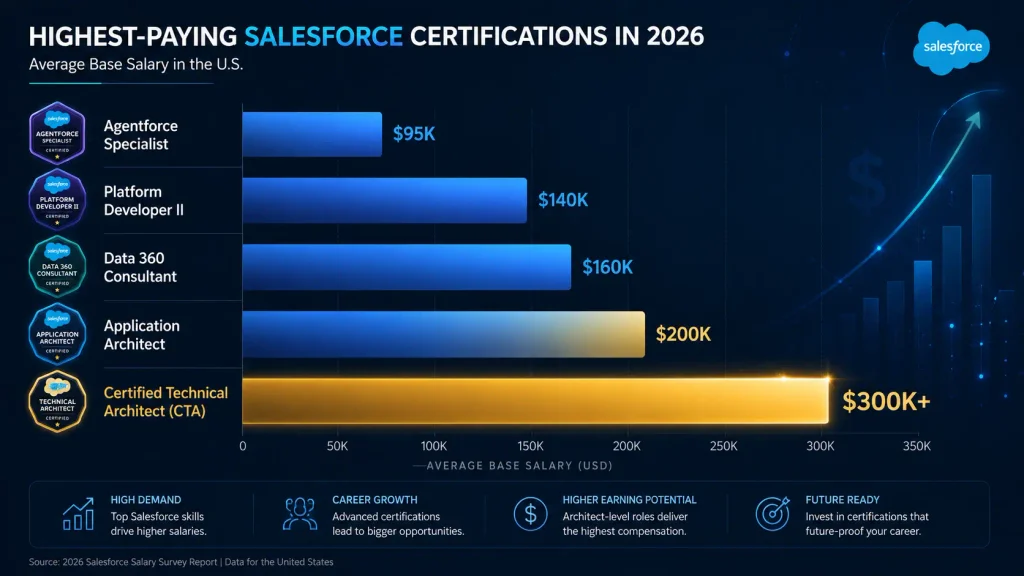
| Certification | 2026 Salary Range (US) | Average Salary Increase | Difficulty | Cost | Best For |
|---|---|---|---|---|---|
| Certified Technical Architect (CTA) | $260,000–$340,000+ (total comp); $160K–$250K+ base | $40,000–$100,000+ over non-CTA architects | Extremely High (review board) | $6,000 | Senior architects, 8+ yrs experience |
| Application Architect | $155,000–$215,000+ | Unlocks CTA path; architect-tier pay | High (4 prerequisite exams) | ~$1,200 total | Experienced developers moving into architecture |
| Agentforce Specialist | $95,000–$150,000+ (role-dependent) | $8,000–$35,000 premium (sources vary) | Moderate | $200 ($100 retake) | Admins, consultants, developers going AI-first |
| Platform Developer II (PD2) | $130,000–$160,000 | Signals real technical depth | High | ~$400 | Experienced developers proving advanced Apex skills |
| Data 360 (Data Cloud) Consultant | $115,000–$175,000+ | $8,000–$25,000 premium | Moderate–High | $200 ($100 retake) | Consultants and architects specializing in data/AI readiness |
1. Certified Technical Architect (CTA), The Ceiling of the Ecosystem
The CTA isn’t a multiple-choice exam, it’s a review board defense where candidates present a solution architecture live to a panel of judges and defend every design decision under cross-examination. That format alone filters out anyone without deep, real-world architecture experience.
- Pros: By far the highest-paid credential in the ecosystem. Salary research from KORE1’s 2026 architect guide puts CTA total compensation at $260,000–$340,000+, with base pay research from other sources landing CTAs at $160,000–$250,000+. Salesforce Ben’s survey data cited in CTA prep research shows an average 40–50% salary increase after earning it, compared to holding domain architect certifications alone.
- Cons: Total exam cost is $6,000 ($1,500 for the Architect Review Board Evaluation, $4,500 for the Technical Architect Review Board Exam), prerequisites take years to assemble, and pass rates are historically low. Salesforce recommends 5+ years of implementation experience and 3+ years as a practicing architect before attempting it.
- Why it’s #1 for salary: Nothing else in the Salesforce ecosystem creates a bigger single-credential pay jump. It’s rare enough, and hard enough to earn, that it functions as a genuine scarcity premium rather than a resume line.
2. Application Architect, The On-Ramp to Architect-Tier Pay
Unlike the CTA, the Application Architect credential isn’t a standalone exam, it’s automatically awarded once you pass four prerequisite certifications: Platform App Builder, Platform Developer I, and the Data Architecture and Sharing & Visibility architect-level exams.
- Pros: Total exam cost across the four prerequisites is roughly $1,200, dramatically cheaper than the CTA, and it’s one of the two required credentials (alongside System Architect) before you can even attempt the CTA. Architect-tier base pay in 2026 runs $155,000–$215,000, per KORE1’s architect salary data.
- Cons: It requires real depth across data modeling, security, and sharing, this isn’t a weekend cert. Expect an 8–18 month realistic prep timeline if you’re building the prerequisite knowledge from scratch.
- Why it ranks high: It’s the most direct, lowest-cost path into six-figure architect territory, and it’s a prerequisite for the highest-paying credential on this list.
3. Agentforce Specialist, 2026’s Fastest-Moving Premium
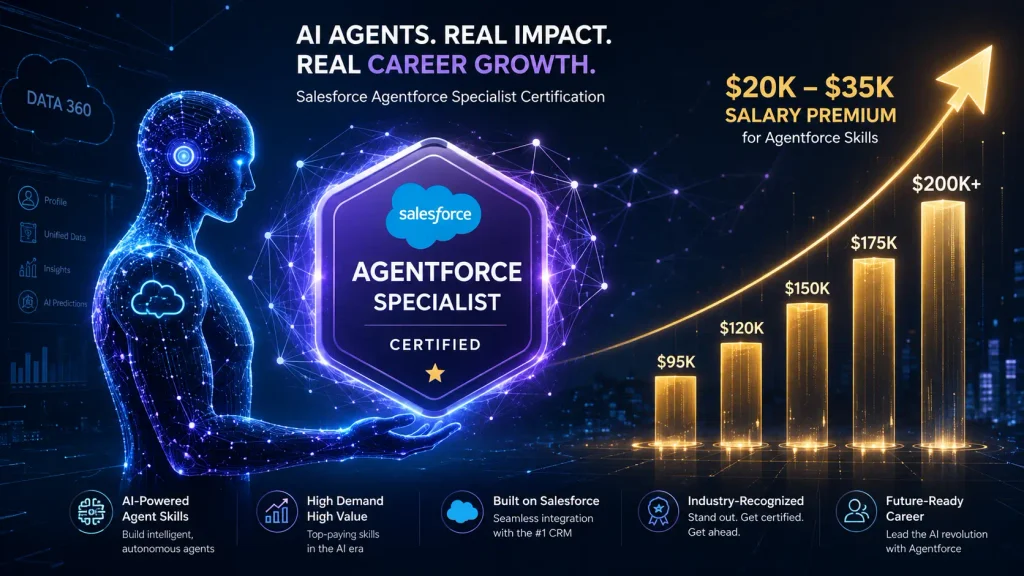
This is the certification formerly known as AI Specialist, automatically renamed by Salesforce on March 3, 2025, as the exam shifted from roughly 23% Agentforce content to about 70%. It’s a 60-question, 105-minute exam with no formal prerequisites.
- Pros: Cheapest cert on this list at $200 ($100 retake), and demand is currently outpacing supply. KORE1’s 2026 developer salary research found $8,000–$12,000 premiums for candidates holding Data Cloud Consultant or AI/Agentforce-adjacent certs, while Clientell’s 2026 developer guide put Agentforce Specialist premiums as high as $20,000–$35,000 in some roles, the wide range reflects how new and role-dependent this premium still is.
- Cons: Because it’s newer and doesn’t require years of prerequisite experience, it carries less weight on its own than an architect credential. Its value comes largely from being paired with real Agentforce implementation work, not the badge alone.
- Why it’s rising fast: Recruiters interviewed in 2026 salary guides describe the qualified Agentforce talent pool as “thin” and note the premium likely won’t compress meaningfully before late 2027. If you want the best current ROI-per-dollar-spent certification, this is it, as long as you back it with hands-on project work.
4. Platform Developer II (PD2), The Technical Credibility Signal
PD2 is the advanced companion to PD1, testing asynchronous Apex, complex triggers, and testing frameworks that are genuinely difficult to fake without real coding experience.
- Pros: KORE1’s 2026 data shows PD2 holders typically earn $130,000–$160,000, and recruiters report taking PD2-holding resumes more seriously at the technical screen stage because the exam is hard to pass without production coding experience.
- Cons: It’s a technical-depth cert, not a leadership or architecture one, the ceiling is lower than Application Architect or CTA unless you pair it with an architecture track.
- Why it’s on this list: Among developer-track credentials, PD2 is the one that reliably separates “can configure Salesforce” developers from “can build complex custom logic” developers, and pay reflects that gap.
5. Data 360 (Data Cloud) Consultant, The AI-Readiness Multiplier
Rebranded from Data Cloud Consultant to Data 360 Consultant on March 27, 2026 (same exam, new name, a good example of the platform-wide renaming trend), this credential validates your ability to unify customer data, prepare it for AI use, and activate it across Salesforce clouds.
- Pros: Clientell’s 2026 developer salary data cites $15,000–$25,000 premiums for Data Cloud Consultant holders specifically, and the credential pairs unusually well with Agentforce Specialist, since Agentforce agents are grounded in Data Cloud/Data 360 data. KORE1 separately measured $8,000–$12,000 premiums when looking at Data Cloud and AI Specialist certs together, a reminder that premium size varies by source and role.
- Cons: It’s a newer, narrower specialization, less universally required than Admin or PD1, so its value is concentrated in data- and AI-heavy roles rather than being a broad career floor-raiser.
- Why it makes the list: It’s the certification most directly tied to the thing every Salesforce customer is now asking for, AI-ready data, and that alignment with 2026’s biggest platform investment is exactly why it commands a premium.
Key Takeaway: The CTA pays the most in absolute dollars, but the Agentforce Specialist and Data 360 Consultant certifications currently offer the best return per dollar and hour invested, because demand for those specific skills is outrunning the supply of certified, experienced people.
Which Cert is Best for You?
Your best certification depends entirely on where you are in your career, chasing the CTA as your first credential would be like trying to run a marathon before you’ve jogged a mile.
| Career Stage | Recommended Path | 2026 Salary Target | Why |
|---|---|---|---|
| Beginner | Administrator → Agentforce Specialist | $95,000–$140,000 | Admin is the recognized baseline; Agentforce Specialist adds the fastest-growing 2026 premium with no prerequisites required |
| Developer | Platform Developer I → Platform Developer II → Agentforce Specialist / Data 360 Consultant | $130,000–$175,000+ | PD1+PD2 prove coding depth; layering AI/data certs captures the 2026-specific premium on top |
| Architect | Application Architect + System Architect → Certified Technical Architect | $200,000–$340,000+ | This is the only path to CTA-tier pay, and each prerequisite step raises your ceiling along the way |
The simple decision flow:
- If you want the fastest, cheapest salary bump right now → Agentforce Specialist.
- If you want the highest absolute ceiling and have 5+ years of experience → Application Architect, then System Architect, then CTA.
- If you’re a developer wanting to future-proof without going full architect → PD1 + PD2 + Agentforce Specialist or Data 360 Consultant.
- If you want maximum salary, full stop → CTA. There is no credential in the Salesforce ecosystem that pays more.
Key Takeaway: Match the certification to your current experience level, not your target salary. Skipping steps toward the CTA without the underlying architecture experience is the single most common way people waste exam fees in this ecosystem.
How Many Certifications = Maximum Salary?

This is one of the most-asked and most-misunderstood questions in the Salesforce community, and the data gives a specific, useful answer.
TechCerted’s certification-and-salary research found that the sweet spot sits at 7–10 certifications, where professionals average around $155,000. That’s a meaningful jump over single-cert professionals, but the same research found that piling on certifications beyond that range, 16 or more, actually correlates with lower salaries, not higher ones.
Why does this happen? A few likely reasons, consistent with what recruiters describe across 2026 salary guides:
- Diminishing signal value. Once you have a coherent stack (say, Admin + Advanced Admin + Agentforce Specialist + Data 360 Consultant), each additional unrelated badge tells an employer less about your actual capability.
- Opportunity cost. Hours spent studying for certification #14 are hours not spent on billable project work, which is what actually drives senior-level pay.
- Perception risk. Some hiring managers explicitly read a wall of 15–20 certifications as “exam collector” rather than “practitioner,” especially if the certifications span unrelated clouds with no obvious career narrative connecting them.
The practical implication: build a focused, role-aligned stack of 7–10 certifications that tell a coherent story, Admin track, Developer track, or Architect track, rather than maximizing badge count.
Key Takeaway: More certifications is not automatically more money. The data points to a specific, focused sweet spot around 7–10 relevant credentials, after that, invest your time in project experience instead.
Exam Cost vs Salary ROI Calculator
Here’s how the math actually plays out. All figures below use the salary ranges cited earlier in this article.
| Certification Path | Total Exam Cost | Typical Salary Increase | Break-Even Time |
|---|---|---|---|
| Agentforce Specialist (standalone) | $200 | $8,000–$35,000 (role-dependent) | Under 1 month |
| PD1 + PD2 | ~$600 (incl. one retake buffer) | $19,500+ (PD1 alone: $130K → $149.5K per TechCerted data) | 1–2 months |
| Application Architect (4 prereqs) | ~$1,200 | Architect-tier jump to $155K–$215K base | 2–4 months |
| Full CTA path (App Architect + System Architect + CTA review boards) | ~$8,500–$9,500 total | $40,000–$100,000+ over non-CTA architects | 3–6 months |
Three real-world examples:
- The Admin-to-AI Pivot: A $95,000 admin spends $200 on the Agentforce Specialist exam, then spends four months applying it on a live Agentforce deployment at work. They move to a $135,000 role. Cost: $200. Gain: $40,000/year. Break-even: instant, first paycheck.
- The Developer Stack: A $113,000 mid-level developer invests roughly $600 in PD1 and PD2 exam fees (including one retake), moving into a $150,000 senior developer role over 12–18 months. Cost: $600. Gain: $37,000/year. Break-even: under one week of the new salary.
- The Architect Leap: A $180,000 Solution Architect spends roughly $9,000 total across the Application Architect, System Architect, and CTA review boards over 18–24 months. They move into a $280,000 total-comp CTA role. Cost: $9,000. Gain: $100,000/year. Break-even: about a month at the new salary.
Key Takeaway: Every path on this list pays for its own exam fees within the first few weeks of the new salary. The real cost isn’t the exam, it’s the study hours and, for architects, the years of experience the credential requires you to already have.
Step-by-Step Career Roadmap

- Start with Salesforce Administrator. This is the recognized baseline credential across the entire ecosystem, almost no serious Salesforce role hires without it or equivalent hands-on experience.
- See also: 2026 Salesforce security updates for admins.
- Build a Developer Edition org and get hands-on. Certifications without applied practice score poorly with hiring managers; use free Trailhead modules and a sandbox to build real configurations before your next exam.
- Add Agentforce Specialist early. With no prerequisites and a $200 exam fee, this is the lowest-risk way to capture 2026’s biggest platform-alignment premium.
- Decide: Developer track or Consultant/Architect track. Platform Developer I is the fork in the road, take it if you want to code; skip it and pursue Advanced Administrator or a Consultant credential if you want to stay functional/configuration-focused.
- If developer-track: earn Platform Developer II. This is the credential recruiters treat as genuine proof of advanced technical skill, not just exam-passing ability.
- Layer in Data 360 (Data Cloud) Consultant. Pairs directly with Agentforce Specialist since agents are grounded in Data 360 data, this combination is currently one of the most in-demand skill pairings in the ecosystem.
- Get 2–3 years of real implementation experience before attempting architecture certs. Salesforce’s own guidance, and every architect salary guide we reviewed, is consistent on this: architecture credentials without implementation experience behind them don’t hold up in interviews or on the job.
- Earn Platform App Builder, then the two Architect-level Designer exams, to unlock Application Architect. This automatically-awarded credential is your bridge into six-figure architect-tier pay.
- Pursue System Architect in parallel or shortly after. Both Application Architect and System Architect are required before you’re eligible for the CTA.
- Prepare for the Architect Review Board Evaluation, then the Technical Architect Review Board Exam. Budget 3–6+ months of dedicated prep, real mock-board practice, and the full $6,000 exam investment.
- Maintain everything. Every certification requires ongoing (usually free) Trailhead maintenance modules three times a year, skipping these causes credentials to lapse, which recruiters and hiring managers do check.
Key Takeaway: The roadmap to maximum salary isn’t a sprint through exams, it’s a sequence where each certification both raises your pay and unlocks eligibility for the next, higher-paying one.
Final Verdict & Next Steps
If you want the single highest-paying credential in the Salesforce ecosystem, the answer is unambiguous: the Certified Technical Architect, at $260,000–$340,000+ in total compensation. But if you’re not already an experienced architect, that’s not your next move, it’s your destination.
For most people reading this in 2026, the smartest next certification is the Agentforce Specialist, it’s cheap, has no prerequisites, and sits directly on top of the fastest-growing premium in the ecosystem right now. Pair it with Data 360 Consultant if you work anywhere near data or AI-readiness projects, and you’re capturing two of the strongest 2026-specific premiums for a combined exam cost of $400.
Next actions:
- Map your current certifications against the 7–10 sweet spot and identify the gap.
- If you’re Admin- or Consultant-track, schedule the Agentforce Specialist exam this quarter, it’s the lowest-cost, fastest-moving premium available right now.
- If you’re Developer-track, prioritize PD2 over adding more foundational certs.
- If you’re already an experienced Solution or Technical Architect, start the Application Architect → System Architect → CTA sequence, nothing else on this list gets you closer to six-figure premiums.
Frequently Asked Questions FAQ’s
Is the Agentforce Specialist worth it in 2026?
Yes, for most Salesforce professionals. It costs $200, has no prerequisites, and current salary research shows premiums ranging from roughly $8,000 to $35,000 depending on role and how directly you apply it. The wide range reflects how new the demand curve still is, pairing it with real Agentforce project experience is what pushes you toward the top of that range.
What is the highest paying Salesforce certification?
The Certified Technical Architect (CTA) is the highest-paying credential in the ecosystem, with 2026 total compensation research showing $260,000–$340,000+ for holders, and base salaries commonly in the $160,000–$250,000+ range.
How much does a CTA cost?
The full CTA path costs $6,000 in review board fees alone, $1,500 for the Architect Review Board Evaluation and $4,500 for the Technical Architect Review Board Exam, on top of the roughly $1,200–$2,000 needed to earn the required Application Architect and System Architect prerequisites.
Can I get multiple certifications at once?
Salesforce doesn’t strictly enforce prerequisites at scheduling for most exams, so technically yes. But data on the 7–10 certification “sweet spot” suggests pacing yourself around real experience matters more than speed, rushing multiple exams without applying the knowledge tends to produce weaker interview performance and doesn’t move salary further than a smaller, well-applied stack.
What about Data Cloud Consultant salary?
Now officially renamed Data 360 Consultant as of March 27, 2026 (same exam, new name), this credential shows salary premiums in the $8,000–$25,000 range depending on the data source and role, making it one of the strongest ROI-per-dollar certifications available given its $200 exam cost.
Is it better to focus on one cert or many?
Focus on a coherent stack of 7–10 role-aligned certifications rather than maximizing badge count. Research shows salaries plateau, and can even dip, for professionals with 16 or more certifications, likely because it signals exam-collecting over deep, applied expertise.
Do I need the Salesforce Administrator certification before anything else?
It’s not technically mandatory for every path, but nearly every salary guide and career roadmap treats it as the practical floor for a Salesforce career, most employers expect it as a baseline even for developer- or consultant-track hires.
How long does it take to become a Certified Technical Architect?
Most successful candidates have 5+ years of implementation experience and 3+ years as a practicing architect before attempting the CTA, plus 3–6 months of dedicated review-board prep. It’s realistically a multi-year career milestone, not a study-and-pass exam.
Does certification alone guarantee a salary increase?
No, Recruiters and 2026 salary research are consistent on this point: certifications correlate with higher pay, but real, applied project experience is what actually closes the gap between two candidates holding the same credentials.
What’s the cheapest certification with the best salary ROI in 2026?
The Agentforce Specialist, at $200 with no prerequisites, currently offers the fastest break-even and one of the highest percentage returns of any Salesforce credential, because demand for Agentforce skills is outpacing the certified talent pool.
Is Platform Developer II worth it if I already have PD1?
Yes, for developers planning to stay technical. PD2 holders typically earn $130,000–$160,000, and because the exam tests real asynchronous Apex and testing-framework skills, it carries more weight with technical interviewers than most other developer-track credentials.
Why did so many Salesforce certification names change recently?
Salesforce renamed more than 35 certifications starting July 21, 2025, to standardize naming across roles and products, alongside moving certification management to Trailhead Academy and exam delivery to Pearson VUE. Data Cloud Consultant becoming Data 360 Consultant (March 27, 2026) and AI Specialist becoming Agentforce Specialist (March 3, 2025) are two of the most salary-relevant examples, same exams, new names reflecting Salesforce’s AI-first platform direction.
Salesforce is also restructuring the catalog through 2027 certification retirements, with 24 separate credentials scheduled to retire rather than simply be renamed.
Resources
- Salesforce Certification Site: Official list of all current certifications, exam guides, and maintenance requirements
- Agentforce Specialist Certification: Official exam guide and Trailhead learning path for Agentforce Specialist
- Salesforce Architect Program: Official Architect track (Application Architect, System Architect, and CTA)
- Trailhead: Free official learning platform for all certification preparation and release exams
