
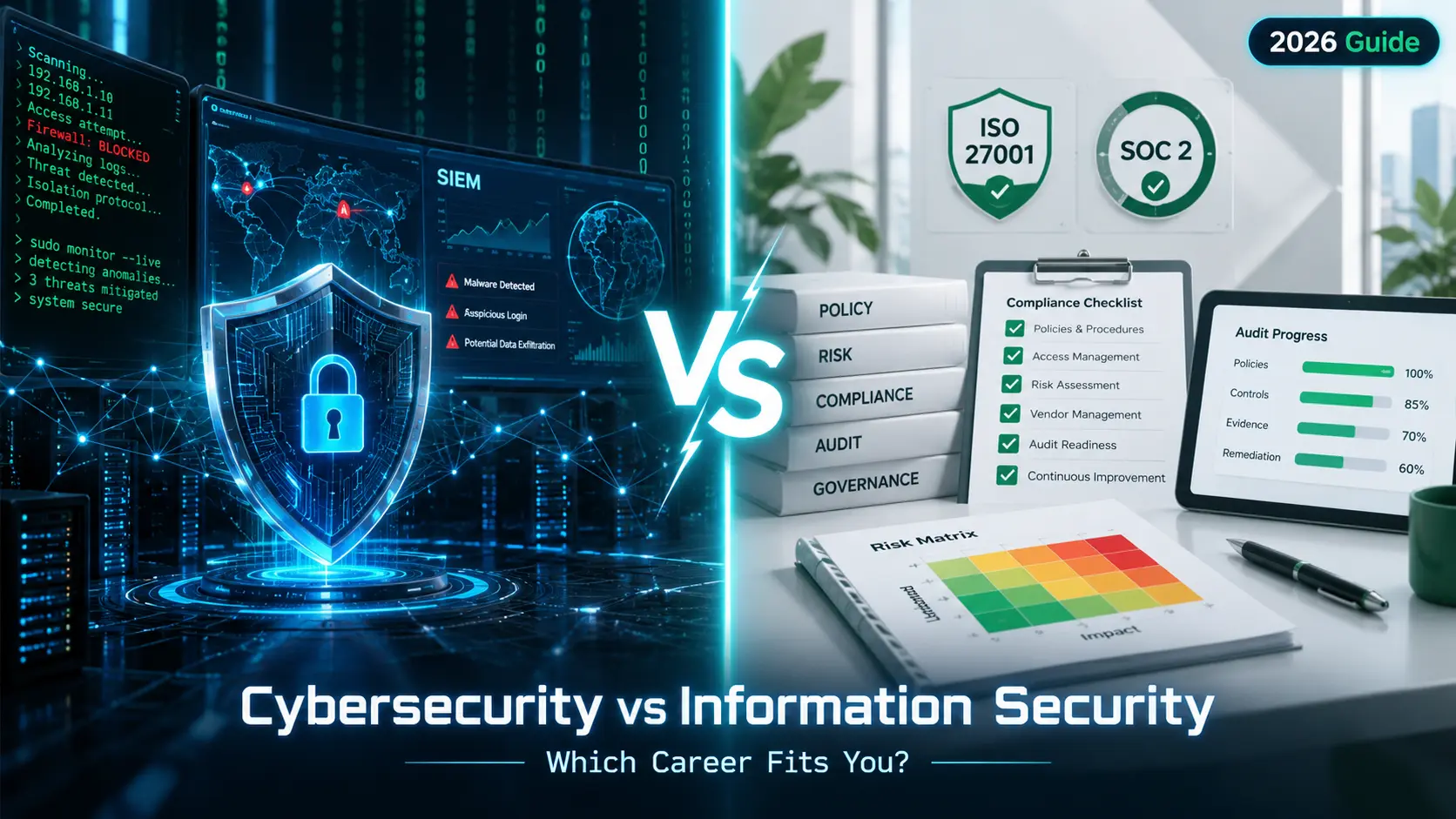
“Cybersecurity” and “information security” get used interchangeably in job postings, LinkedIn headlines, and college brochures; but the actual day-to-day work behind those titles can look completely different. Understanding the difference between cybersecurity and information security is the first step before choosing a career path.
One person spends their morning chasing a live intrusion alert in a SOC dashboard. Another spends it walking an auditor through evidence for a SOC 2 renewal. Both call themselves “security professionals.” Neither one is doing the other’s job.
This guide uses 2026 salary data from Glassdoor, Indeed, ZipRecruiter, and LinkedIn Salary as of September 2026, cross-checked against U.S. Bureau of Labor Statistics figures, so the numbers below reflect the current market; not outdated averages recycled from a few years ago.
If you’re trying to break into the field or pivot within it, understanding the difference between cybersecurity and information security is one of the highest-leverage career decisions you’ll make. It shapes:
- Which certifications are actually worth your money
- Whether your daily work is hands-on-keyboard or hands-on-policy
- How fast you can get promoted, and to what
- Your long-term earning ceiling
- Whether your best days involve solving technical puzzles or untangling organizational risk
This guide breaks down both paths, compares them side by side with current salary data, and walks you through a simple self-assessment so you can decide with confidence; not guesswork.
Want this on hand while you study? Download the full PDF with the self-assessment and salary tables at the end of this guide.
The Cybersecurity Career Path
Cybersecurity is the operational and technical side of protecting systems. This is the path for people who want to build, break, defend, or hunt; hands-on, tool-heavy, and often reactive to real-time threats.
What the work actually looks like
- SOC Analyst (Tier 1–3): Monitoring alerts, triaging incidents, investigating suspicious activity, escalating to threat hunters
- Penetration Tester / Ethical Hacker: Simulating attacks against networks, applications, and cloud environments to find exploitable weaknesses before criminals do
- Security Engineer: Building and hardening infrastructure; firewalls, SIEM tuning, endpoint detection, cloud security controls
- Incident Responder / Threat Hunter: Leading the response when something actually breaks; containment, forensics, root-cause analysis
- CISO (Chief Information Security Officer): The executive ceiling of the technical track; owning the entire security program, budget, and board-level risk conversations
Core skills employers expect
- Networking fundamentals (TCP/IP, firewalls, VPNs)
- Scripting/automation (Python, Bash, PowerShell)
- SIEM and EDR tools (Splunk, CrowdStrike, Microsoft Sentinel)
- Cloud security (AWS, Azure, GCP)
- Offensive tooling (Burp Suite, Metasploit, Nmap) for pentest-track roles
2026 salary snapshot
- SOC Analyst (Tier 1): $70,000–$96,000 (U.S. national average, 2026)
- Cybersecurity Analyst (general/mid-level): $99,000–$129,000 (U.S. national average, 2026), depending on source; Glassdoor and Indeed both trend toward the higher end of this band
- Senior Cybersecurity Analyst: $132,600 (U.S. national average, 2026)
- Penetration Tester: $120,000–$155,000, median base near $130,000 (U.S. national average, 2026); senior red-team operators clear $200,000+ in total comp
- CISO: $220,000–$420,000+ base (U.S. national average, 2026); total compensation at large enterprises often exceeds $500,000 with bonus and equity
Growth trajectory
The technical track rewards depth. A typical progression looks like:
- Help desk / IT support → SOC Tier 1
- SOC Tier 2 → Security Engineer or Threat Hunter
- Senior Engineer / Lead Pentester → Security Architect or Manager
- Director of Security → CISO
Certifications like Security+, CySA+, OSCP, and CISSP each add measurable pay premiums along the way; CISSP holders in particular report earning well above non-certified peers.
The Information Security Career Path
Information security (often shortened to “InfoSec” or bucketed under GRC; Governance, Risk, and Compliance) is the strategic and organizational side of protecting data. This path is less about stopping an active attacker and more about making sure the organization never gets breached, fined, or sued in the first place, because its policies, controls, and processes are sound.
What the work actually looks like
- GRC Analyst: Maintaining the control library, running risk assessments, tracking remediation, answering client security questionnaires
- Compliance Analyst: Mapping business processes to frameworks like SOC 2, ISO 27001, HIPAA, PCI DSS, or NIST 800-53
- Privacy Analyst / DPO track: Handling GDPR, CCPA, and the growing list of global data-protection laws
- IT/Security Auditor: Testing whether controls actually work, documenting findings, working with external auditors
- GRC Manager / Head of Compliance / CISO (governance track): Owning the entire risk and compliance program at the executive level
Core skills employers expect
- Framework fluency: ISO 27001, SOC 2, NIST CSF, PCI DSS, HIPAA
- Risk assessment and risk-register management
- Policy writing and stakeholder communication
- Audit coordination and evidence collection
- GRC platforms (ServiceNow GRC, Vanta, Drata, OneTrust)
- Working knowledge of regulations (GDPR, DORA, NIS2, SOX)
2026 salary snapshot
- GRC Analyst (entry/associate): $60,000–$80,000 (U.S. national average, 2026)
- GRC Analyst (mid-level): $80,000–$115,000 (U.S. national average, 2026), with national averages clustering around $97,000–$112,000
- Information Security GRC Analyst: $96,652 (U.S. national average, 2026)
- Senior GRC Analyst / Lead: $105,000–$135,000+ (U.S. national average, 2026)
- GRC Manager / Head of Compliance: $130,000–$180,000+ (U.S. national average, 2026)
Growth trajectory
The GRC path rewards breadth and judgment over raw technical depth. A typical progression looks like:
- IT/audit support or junior compliance role → GRC/Compliance Analyst
- Mid-level analyst owning a full framework cycle (SOC 2, ISO 27001)
- Senior analyst leading multi-framework programs and pre-sales security reviews
- GRC Manager → Director of Risk & Compliance → CISO (governance-focused) or Chief Risk Officer
This path is also one of the most remote-friendly specializations in security; the work is documentation, meetings, and evidence review, which travels well across time zones.
Side-by-Side Comparison
| Cybersecurity | Information Security (GRC/Compliance) | |
|---|---|---|
| Entry-level salary | $55,000–$91,000 (2026 avg.) | $60,000–$80,000 (2026 avg.) |
| Mid-career salary | $99,000–$150,000 (2026 avg.) | $85,000–$115,000 (2026 avg.) |
| Senior/executive salary | CISO: $220,000–$420,000+ (2026 avg.) | GRC Director: $130,000–$180,000+ (2026 avg.) |
| Core skills | Networking, scripting, SIEM, offensive tools, cloud security | Risk frameworks, audit, policy writing, GRC platforms |
| Daily work | Alerts, investigations, testing systems, building defenses | Evidence collection, risk registers, audits, policy reviews |
| Pace | Reactive, urgent, incident-driven | Cyclical, deadline-driven (audit windows, renewals) |
| Remote-friendliness | Moderate; SOC shifts often need coverage | High; roughly 4 in 10 GRC roles are fully remote |
| Best for | People who like tools, troubleshooting, technical depth | People who like structure, communication, cross-team influence |
| Top certifications | Security+, CySA+, OSCP, CISSP | CISA, CRISC, CGRC, ISO 27001 Lead Auditor |
Want a deeper look at the standards that underpin each path? See our breakdown of NIST CSF vs ISO 27001.
My Recommendation: Which One Should You Choose?
Before you pick a path, answer these five questions honestly; then check your score.
1. When something breaks, do you want to fix it; or prevent it from ever being possible?
- Fix it in real time → Cybersecurity
- Prevent it systemically → Information Security
Quick Score: “Fix it” = +1 Cybersecurity. “Prevent it” = +1 InfoSec.
2. Do you enjoy writing scripts and using technical tools daily, or writing policies and talking to stakeholders daily?
- Tools and scripts → Cybersecurity
- Policies and people → Information Security
Quick Score: Mostly tools = +1 Cybersecurity. Mostly people/policy = +1 InfoSec.
3. Would you rather work a rotating shift monitoring live threats, or work standard hours around audit deadlines?
- Shift-based monitoring → Cybersecurity (especially SOC roles)
- Predictable audit cycles → Information Security
Quick Score: Shift work = +1 Cybersecurity. Standard hours = +1 InfoSec.
4. Are you more energized by chasing an attacker’s footprint, or by mapping a business process to a compliance framework?
- Chasing footprints → Cybersecurity
- Mapping processes → Information Security
Quick Score: Footprints = +1 Cybersecurity. Frameworks = +1 InfoSec.
5. Long-term, do you want to be the person the board calls during a breach, or the person the board calls before one happens?
- During → Cybersecurity (Incident Response/CISO track)
- Before → Information Security (GRC/Risk track)
Quick Score: During = +1 Cybersecurity. Before = +1 InfoSec.
Final tally: Mostly Cybersecurity points → start with Security+ and SOC Analyst roles. Mostly InfoSec points → start with a GRC Analyst role and CISA prep. Split down the middle? You’re a strong candidate for a hybrid role like cloud security or security architecture, where both skill sets matter.
This isn’t a permanent fork. Plenty of SOC analysts move into GRC once they want more predictable hours, and plenty of GRC analysts move toward technical security once they want to get closer to the systems they’re governing. The two tracks also converge at the top; many CISOs have walked either road to get there.
2026 Job Market Trends
- Demand still outpaces supply. Global estimates put unfilled cybersecurity positions in the millions, with roughly 3.4 million+ open roles worldwide and over half a million open postings in the U.S. alone; a gap that has not meaningfully closed in years.
- New laws are creating compliance jobs that didn’t exist five years ago. The EU’s NIS2 and DORA regulations, India’s DPDP Act, Brazil’s LGPD, Nigeria’s NDPA, and Kenya’s Data Protection Act are each forcing companies to staff up GRC and privacy functions to stay compliant across borders.
- Cloud security is the strongest crossover premium in the market. Roles blending cloud infrastructure knowledge with either track; cloud security engineer or cloud compliance analyst; command some of the highest premiums in security, with cloud credentials adding measurable pay on top of base certifications.
- Remote work splits sharply by track. Roughly 4 in 10 live GRC roles are fully remote, since the work is documentation, meetings, and evidence review. SOC and incident-response roles remain more likely to require on-site presence or shift-based coverage, given the need for continuous monitoring.
- Entry-level pay is rising. More than half of surveyed employers report increasing starting offers in 2026 to compete for scarce talent; good news whichever path you choose.
Fresh certifications worth watching in 2026:
- CGRC (Certified in Governance, Risk and Compliance); ISC2’s governance-focused credential is gaining traction as GRC hiring accelerates
- Cloud-specific security certs (AWS Security Specialty, Microsoft SC-100); increasingly requested alongside traditional credentials
- AI/ML security literacy: not yet a standalone certification category, but a skill line item appearing more often in both SOC and GRC job postings as organizations govern AI system risk. For a detailed look at how AI is changing both disciplines, see AI threats in cybersecurity vs InfoSec.
How to Decide: Take the Assessment + Next Steps
If you’re still torn, don’t overthink it; take action instead:
- Take the self-assessment above and tally your score honestly.
- Shadow or informational-interview someone in each role on LinkedIn; a 20-minute conversation will tell you more than any quiz.
- Try a free intro course in each direction (a SOC/SIEM fundamentals course vs. an ISO 27001 or GRC fundamentals course) and notice which one you want to keep studying after hour one.
- Pick an entry certification and commit to 90 days. Security+ for the technical track, or a GRC/CISA foundations course for the governance track.
Conclusion
Cybersecurity and information security aren’t competing career paths; they’re two different instruments in the same orchestra. One defends systems in real time; the other makes sure the organization is structurally sound enough not to need constant defending. Both are in high demand in 2026. Both pay well above the median U.S. salary. Both offer a clear route to six figures and beyond.
The right choice isn’t about which field is “better”; it’s about which kind of work will still energize you five years from now. Technical puzzle-solving under pressure, or structured risk management and cross-team influence? You now have the data, the comparison, and the self-assessment. The only step left is to start moving; pick a certification, take the free intro course, and let your first 90 days tell you the rest.
Want to keep this guide on hand? Download the full PDF version; including the self-assessment, salary tables, and certification roadmap.
Sources & References
- U.S. Bureau of Labor Statistics; Information Security Analysts Occupational Outlook: bls.gov/ooh/computer-and-information-technology/information-security-analysts
- Cybersecurity and Infrastructure Security Agency (CISA); Cybersecurity careers and workforce resources: cisa.gov/careers
- National Institute of Standards and Technology (NIST); Cybersecurity Framework and NICE Workforce Framework: nist.gov/cyberframework
- ISC2; Cybersecurity Workforce Study and GRC/CGRC certification data: isc2.org
- Gartner; Security and risk management research and workforce trend reports: gartner.com/en/information-technology/insights/cybersecurity
- Glassdoor, Indeed, and ZipRecruiter salary databases; U.S. national salary averages referenced throughout this guide, current as of September 2026
This article was written by the PassitExams editorial team, a group of certified cybersecurity and GRC professionals dedicated to helping career-changers and IT professionals break into security roles through clear, practical, exam-focused guidance. Our content is reviewed against current industry salary data and job-market trends to stay accurate for 2026 and beyond.
