

In the world of senior cybersecurity credentials, two certifications stand as pillars of excellence: the Certified Information Systems Security Professional (CISSP) and the Certified Information Security Manager (CISM). Both are highly respected and unlock access to top-tier leadership roles. But for professionals planning their next career move, a crucial question always emerges: which one is truly harder?
The answer isn’t simple. The difficulty of CISSP and CISM is not a matter of one being objectively easier than the other; instead, their challenge lies in fundamentally different areas. One tests the breadth of your knowledge across the entire security landscape, while the other tests the depth of your expertise in management and governance.
We recently looked at the differences between two major contenders in the cybersecurity space, CISSP vs Security+. This time, we’re diving into CISSP or CISM. We will provide you with a deep, multi faceted analysis of what makes each certification difficult, helping you understand which challenge is the right fit for your experience, mindset, and career aspirations.
What is CISSP?
The Certified Information Systems Security Professional (CISSP), offered by (ISC)², is the globally recognized gold standard for cybersecurity professionals. It is designed to validate the deep technical knowledge and managerial skills required to design, engineer, and manage an organization’s overall security posture. The CISSP covers a vast landscape, spanning eight domains from risk management to software development security, making it ideal for the hands-on practitioner who is evolving into a senior technical leader or security architect. To get a better sense of its foundational concepts, it helps to understand the 5 core principles of CISSP.

What is CISM?
The Certified Information Security Manager (CISM), offered by ISACA, is the premier certification for individuals who manage, design, and oversee an enterprise’s information security program. Unlike the broad scope of the CISSP, the CISM has a laser focus on four key areas: security governance, risk management, program development, and incident management. It is designed for the strategist and manager whose primary role is to align security initiatives with business goals.

CISSP vs. CISM: A Head to Head Comparison
To help you see the differences at a glance, our team at PassITExams has compiled this summary table before we dive into the details.
| Feature | CISSP (from (ISC)²) | CISM (from ISACA) |
|---|---|---|
| Primary Focus | Technical execution & strategic management (“The Advisor”) | Business strategy & security governance (“The Manager”) |
| Scope | Broad: “A mile wide, an inch deep” | Focused: “An inch wide, a mile deep” |
| Number of Domains | 8 Domains | 4 Domains |
| Experience Req. | 5 years in 2+ domains (flexible) | 5 years, with 3 in management (strict) |
| Exam Format | Computer Adaptive Test (CAT) | Linear, Multiple-Choice |
| Avg. Salary (US) | ~$135,500 | ~$133,400 |
| Exam Cost (USD) | $749 | $575 (Member) / $760 (Non-Member) |
| Best For | Senior technical experts, architects, and versatile leaders. | Aspiring and current security managers, directors, and CISOs. |
A Deeper Dive into the Difficulty
The difficulty isn’t just in the content but in the unique combination of knowledge, mindset, and experience each exam demands.
1. The Battle of Breadth vs. Depth
CISSP: “A Mile Wide, an Inch Deep”
The CISSP exam’s difficulty stems from its sheer breadth. It requires you to demonstrate competency across eight distinct domains, from cryptography to physical security. The challenge is retaining a massive amount of information and being able to switch contexts between technical and managerial topics.
CISM: “An Inch Wide, a Mile Deep”
The CISM exam’s difficulty comes from its depth. It focuses intensely on only four domains, but it requires a profound understanding of each. The questions are highly situational, demanding you apply management frameworks and strategic thinking to complex business scenarios.
2. Mindset: The Security Advisor vs. The Business Manager
CISSP Mindset
You must think like a senior security advisor or architect, selecting the best security control while understanding its technical implications. It’s a blend of technical knowledge and managerial oversight.
CISM Mindset
You must think exclusively like a business focused manager. Every decision is viewed through the lens of business objectives and risk. For a deeply technical professional, this can be incredibly difficult.
3. The Exam Experience Itself
CISSP Exam
The Computerized Adaptive Test (CAT) format is notoriously challenging. The questions adapt to your skill level, and you cannot go back to review answers, creating immense psychological pressure. To succeed, you’ll need more than just knowledge; you need a strategy, which you can find in our comprehensive CISSP exam guide.
CISM Exam
The linear exam is more predictable. You get 150 questions in 4 hours and can flag items for review, a format many candidates find less stressful.
4. The Hurdle of Prerequisites
CISSP
Requires five years of experience in two of eight domains. This is a broad requirement, and the “Associate of (ISC)²” path makes the exam itself accessible before the experience is fully met. For a full breakdown of these requirements and associated fees, see our guide on CISSP certification costs and requirements.
CISM
Requires five years of experience, with three of those years strictly in information security management. This is a much narrower requirement, effectively gating the certification to those already in management.
Job Opportunities and Salary: How Difficulty Translates to Value
The rigorous nature of both certifications translates directly into elite job opportunities and substantial salaries.
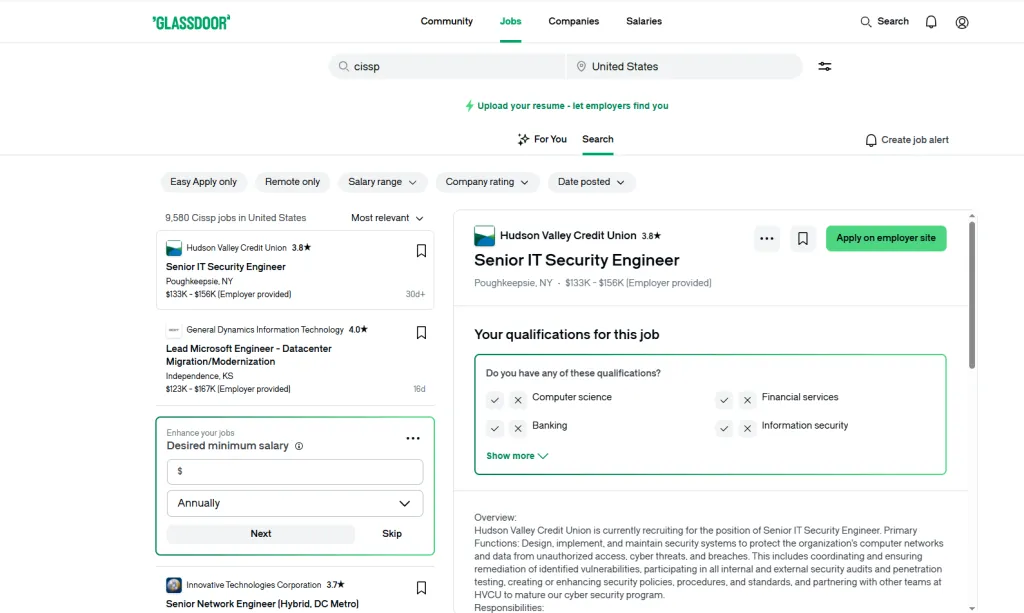
CISSP Job Opportunities
The CISSP’s broad scope makes holders versatile and valuable for roles like CISO, Security Architect, IT Director, Security Consultant, and Senior Security Engineer. The average salary is approximately $135,500. This significant earning potential is a key reason we explore the question, is the CISSP certification worth it?
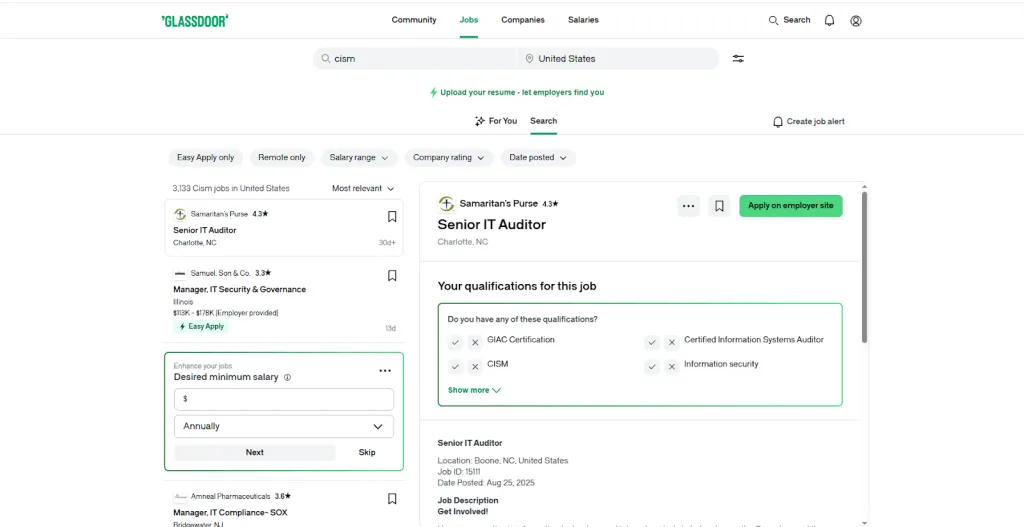
CISM Job Opportunities
The CISM is designed to propel you into management and strategic leadership roles like Information Security Manager, Director of Information Risk, and GRC Lead. The average salary is highly competitive at approximately $133,400.
Cost and Recertification: The Long Term Investment
Earning these credentials requires both an upfront and an ongoing commitment.
CISSP Cost
The exam fee is $749 USD, with a $135 Annual Maintenance Fee. Recertification requires 120 Continuing Professional Education (CPE) credits every three years.
CISM Cost
The exam fee is $575 for ISACA members and $760 for non members, with an annual maintenance fee ($45 for members, $85 for non members). Recertification also requires 120 CPEs over three years.
Insights from the Cybersecurity Community: CISSP vs. CISM Difficulty
To move beyond official descriptions, our research team delved into discussions on professional forums like Reddit, where certified individuals share their firsthand experiences. We analyzed numerous threads comparing the difficulty of the CISSP and CISM to distill the most valuable, real world insights for our readers.
The consensus is clear: neither exam is “easier,” but their difficulty comes from completely different sources.
The “Mindset” is the Real Challenge
A recurring theme in community discussions is that the true difficulty of each exam lies in the specific mindset you must adopt.
CISSP Mindset
Professionals consistently describe the CISSP as forcing you to “think like a manager, but with the knowledge of an engineer.” The challenge is its vast breadth. As one certified professional put it, “You have to know a little about a lot and be able to connect technical controls to business risk on the fly.” The difficulty is in switching contexts across eight different domains.
CISM Mindset
The CISM, according to those who have passed it, requires you to think exclusively like a business executive. The challenge is often “unlearning” the technical impulse to fix a problem and instead choosing the answer that best aligns with governance and business objectives. A common sentiment is, “The technically correct answer is often wrong on the CISM. You have to ask, ‘what is best for the business?‘
Experience Dictates the Difficulty
Our analysis of community feedback shows a clear pattern: your professional background is the single biggest predictor of which exam you will find harder.
- Deeply technical professionals, such as network engineers or security analysts, often report that they find the CISM’s business centric approach more difficult. The concepts of governance and program management can feel abstract and foreign.
- Conversely, professionals from a GRC, auditing, or management background tend to struggle more with the sheer volume of technical topics on the CISSP, such as cryptography and network architecture.
The Exam Format Factor
The structure of the exam itself is frequently cited as a major factor in difficulty.
- The CISSP’s Computer Adaptive Testing (CAT) format is a significant source of stress. Professionals share that the inability to review answers and the variable test length makes it a uniquely intense experience that tests confidence as much as knowledge.
- The CISM’s traditional linear format is often described as more manageable. The ability to flag difficult questions and return to them later allows candidates to apply a more predictable and less stressful test-taking strategy.
Our research into these community discussions concludes that neither exam is objectively easier. The difficulty is entirely subjective. The CISSP is a test of broad security knowledge under pressure, while the CISM is a test of deep managerial judgment. The harder exam will always be the one that least aligns with your existing experience and natural way of thinking.
Conclusion: Which is Harder For You?
Neither certification is objectively “easier.” The difficulty is subjective and depends on your professional background.
CISSP is likely harder if
You struggle with memorizing a vast amount of information or dislike the pressure of an adaptive exam.
CISM is likely harder if
You have a purely technical background and struggle to think from a business risk perspective.
Ultimately, the choice comes down to aligning the certification’s challenge with your career goals. Both are difficult and highly rewarding, but they test different aspects of what it means to be a security leader.
Frequently Asked Questions (FAQ)
Is CISM or CISSP better for a CISO role?
Both are highly valuable. However, the CISM is more directly aligned with the core governance and risk management responsibilities of a CISO. Many CISOs hold both to demonstrate broad security knowledge (CISSP) and management expertise (CISM).
Can I use the same study materials for both exams?
No. While there is a small overlap in risk management, they require completely separate and dedicated study materials tailored to their unique domains and question styles. they require completely separate and dedicated study materials. For CISSP, we recommend starting with high-quality practice questions to gauge your readiness.
What are the official pass rates for CISSP and CISM?
Neither (ISC)² nor ISACA publish official pass rates. However, both are understood to be challenging exams that require significant and dedicated preparation to pass.
Should I get both CISSP and CISM?
For senior cybersecurity leaders, holding both is a powerful combination. Earning the CISSP first can build a comprehensive foundation, after which the CISM can be added to formally validate your management expertise.
More Certification Comparisons
Compare scope, difficulty, prep time, and career impact—side by side.
PassITExams vs ExamTopics
Which Platform is Best for IT Certification Exam Preparation?
PassITExams vs Skillcertpro
The Ultimate Guide to Choosing Your IT Certification Success Partner
PassITExams vs Pass4sure
A Critical Examination of Certification Preparation Platforms
CTFA vs CFP
Choosing the Right Financial Designation for a Career in Fiduciary and Wealth Management
Splunk vs Elastic
The Ultimate Comparison for Logging, SIEM, and Observability
IBM QRadar vs Splunk
The Ultimate SIEM Comparison for Modern Security Operations
SageMaker vs Bedrock
Choosing the Right Engine for Your AI Strategy in 2026
az-104 vs az-400
our Definitive Azure Career Path for 2026 (Admin vs. DevOps)
AZ-104 vs AI-900
Azure Admin Associate Or AI Fundamentals?
AZ-104 vs PL-300
Azure Admin or Data Analyst? (Salary & Jobs)
AZ-104 vs AZ-500
Which Azure Certification Is Right for Your Career?
AZ-900 vs CLF-C02
Which Foundational Cloud Cert Unlocks the Best Jobs and Salaries?
AZ-900 vs SAA-C03
Which Cloud Certification is Right for You?
RHIT vs RHIA
Which Health Information Credential Is Right for You?
AZ-900 vs DP-900
Which Azure Certification Should You Take First?
AZ-900 vs SC-900
Choose Your Microsoft Certification Path
AZ-900 vs AI-900
Which Azure Fundamentals Certification Is Your Launchpad?
AZ-204 vs AZ-305
The Builder vs. The Architect
AZ-900 vs AZ-204
Which Microsoft Azure Certification is Right for You?
az-204 vs pl-300
Building the Engine or Charting the Course?
AZ-900 vs AZ-400
Foundational vs. Expert: Complete Guide for Your Azure Career
601 vs 601
CompTIA Security+ 601 vs 701: The Ultimate Comparison Guide
Data Engineer vs Data Scientist
The Ultimate Comparison Guide
AWS vs Azure
The Ultimate Comparison for Certification & Career
CISSP vs SecurityX
Which Certification Will Define Your Cybersecurity Career?
AWS vs Azure
Who is Leading the Cloud Race?
AWS vs Azure
Which Cloud Certification is Paying High?
AZ-104 vs AZ-305
Administrator vs. Architect – Your Ultimate Azure Guide
AZ-104 vs AZ-204
The Ultimate Guide for Your Azure Career
ISSA vs NASM
Which Personal Trainer Certification Is Best for You?
Salesforce Admin vs Salesforce Developer
Unlocking Your Earning Potential in the Salesforce Ecosystem
CISSP vs CCSP
Your Ultimate Guide to a Career in Cloud Security
CRISC vs CISSP
Mastering Risk Management and Information Security
CISSP vs CEH
Your Guide to Mastering Offensive and Defensive Security
CISSP vs PMP
Unlocking Dual Expertise in Security and Project Management
CISSP vs Security+
Choosing the Right Certification to Boost Your Earning Potential
CISSP vs OSCP
Choosing the Right Certification for a Six-Figure Cybersecurity Career
CISSP vs CISM
Which Certification Will Truly Elevate Your Cybersecurity Career?
Azure vs AWS
How to Choose the Right Cloud Platform for Your Business
AZ-900 vs AZ-700
MIcrosoft Career Blueprint: From Azure Fundamentals to Networking
AZ-900 vs AZ-104
Azure Career Blueprint: Your Path from Azure Fundamentals to Azure Administrator
AZ-104 vs SAA-C03
Azure Administrator vs. AWS Architect: Which Career Path Wins?
AZ-900 vs MS-900
Your ultimate Microsoft fundamentals showdown.
