

In the world of professional development, certifications are powerful tools for career growth. For experienced professionals in the technology and business sectors, two credentials stand out as global benchmarks of excellence: the Certified Information Systems Security Professional (CISSP) and the Project Management Professional (PMP). While both are highly respected, they lead down distinctly different career paths. While this guide focuses on the contrast with PMP, understanding the broader context of CISSP vs. Security+ can also help clarify its position in the cybersecurity hierarchy.
Many professionals, especially those in IT, find themselves at a crossroads, wondering which of these powerhouse certifications will provide the best return on investment. Should you specialize in protecting an organization’s most critical assets, or in managing the projects that bring its goals to life?
This guide will provide a deep, comprehensive comparison of CISSP and PMP, clarifying the confusion and helping you make the strategic decision that best aligns with your skills and career aspirations.
What is CISSP? A Deeper Look
The Certified Information Systems Security Professional (CISSP) is the globally recognized gold standard in cybersecurity. Offered by the non-profit organization (ISC)², the CISSP is designed for experienced security practitioners who aim to prove their deep technical and managerial competence.
The certification validates an individual’s ability to effectively design, implement, and manage a best-in-class cybersecurity program. It covers a vast body of knowledge across eight domains, ensuring that certified professionals can handle every aspect of information security, from risk management and security architecture to operational security. To truly grasp its scope, it’s essential to understand the foundational ideas that guide the certification. Learn more about the 5 core principles of CISSP. The CISSP is for the protector of information assets. It signifies that you are a senior-level expert capable of overseeing an entire security landscape.
What is PMP? A Deeper Look
The Project Management Professional (PMP) is the world’s leading project management certification. Offered by the Project Management Institute (PMI), the PMP validates the expertise of professionals who lead and direct projects and teams.
This certification proves you have the skills to manage the entire project lifecycle—initiating, planning, executing, monitoring, controlling, and closing a project. The PMP is not specific to any single industry or methodology, making it a highly versatile credential for anyone who wants to demonstrate their ability to deliver projects on time and within budget. The PMP is for the organizer of resources and timelines, ensuring that strategic goals are turned into tangible results.
CISSP vs. PMP: A Head-to-Head Comparison
While both certifications are for experienced professionals, they operate in different worlds. To help you see the differences at a glance, this summary table breaks down the key distinctions.
| Feature | CISSP (Certified Information Systems Security Professional) | PMP (Project Management Professional) |
|---|---|---|
| Primary Domain | Cybersecurity & Information Security | Project Management (Across All Industries) |
| Governing Body | (ISC)² | Project Management Institute (PMI) |
| Core Focus | The “What”: Protecting information assets and managing security programs. | The “How”: Managing scope, schedule, budget, and teams to execute projects. |
| Experience Req. | 5 years in 2 of 8 security domains. | 36-60 months leading projects. |
| Job Trends | Extremely high demand for security leaders, architects, and CISOs. | Consistently high demand across all sectors for skilled project leaders. |
| Avg. Salary (US) | ~$140,000 | ~$135,000 |
Focus and Scope
CISSP
Has a vertical, specialized focus on information security. Its entire scope is dedicated to the principles and practices of protecting the confidentiality, integrity, and availability of data and systems. It is deep expertise in a single, critical business function.
PMP
Has a horizontal, universal focus on the process of project management. These principles can be applied to any industry, whether it’s IT, construction, healthcare, or finance. It is a portable skill set that transcends specific technical knowledge.
Experience and Eligibility Requirements
Both certifications require significant real world experience, but the nature of that experience is fundamentally different.
CISSP
Requires a minimum of five years of cumulative, paid work experience in two or more of the eight CISSP domains. This must be direct security work. A one year waiver can be granted for a four year degree or an equivalent credential. Aspiring professionals can take the exam before meeting the requirement to become an “Associate of (ISC)².” For a detailed breakdown of these prerequisites and the financial investment involved, see our complete guide on CISSP certification cost and requirements.
PMP
Requires either 36 months of experience leading projects (if you have a four year degree) or 60 months of experience leading projects (if you have a high school diploma). Additionally, all candidates must complete 35 hours of formal project management education.
Knowledge Areas (The Domains)
The content of each certification clearly shows their different priorities.
CISSP
CISSP covers its eight domains in depth: Security and Risk Management, Asset Security, Security Architecture and Engineering, Communication and Network Security, Identity and Access Management (IAM), Security Assessment and Testing, Security Operations, and Software Development Security.
PMP
PMP covers three key domains:
- People: Focusing on the soft skills needed to effectively lead and motivate a project team.
- Process: Reinforcing the technical aspects of managing a project (e.g., managing scope, schedule, budget, and risk).
- Business Environment: Highlighting the crucial connection between projects and overall organizational strategy.
Exam Format and Difficulty
CISSP
The exam is a 4 hour, Computerized Adaptive Test (CAT) with 125-175 questions. It is notoriously difficult due to its vast scope and the need to think like a senior security advisor, often choosing the “most correct” answer from several viable options. Preparing for this notoriously difficult test requires a solid strategy. Our detailed CISSP exam guide can help you build your study plan.
PMP
The exam is 230 minutes long with 180 multiple-choice and multi-select questions. It is also very challenging, focusing heavily on situational judgment and your ability to apply the correct project management process to complex, real-world scenarios. To master the situational judgment questions and the “PMI way,” many candidates find value in focused study aids. Explore our PMP exam dumps and preparation materials.
Job Trends and Salary Opportunities
To illustrate the distinct career paths and market value of the CISSP and PMP certifications, our research team has curated the latest job market data from the major portal, Glassdoor. Our findings reveal how each certification is valued for different types of leadership and commands significant, top-tier salaries.
The CISSP Market: A Focus on Security Leadership
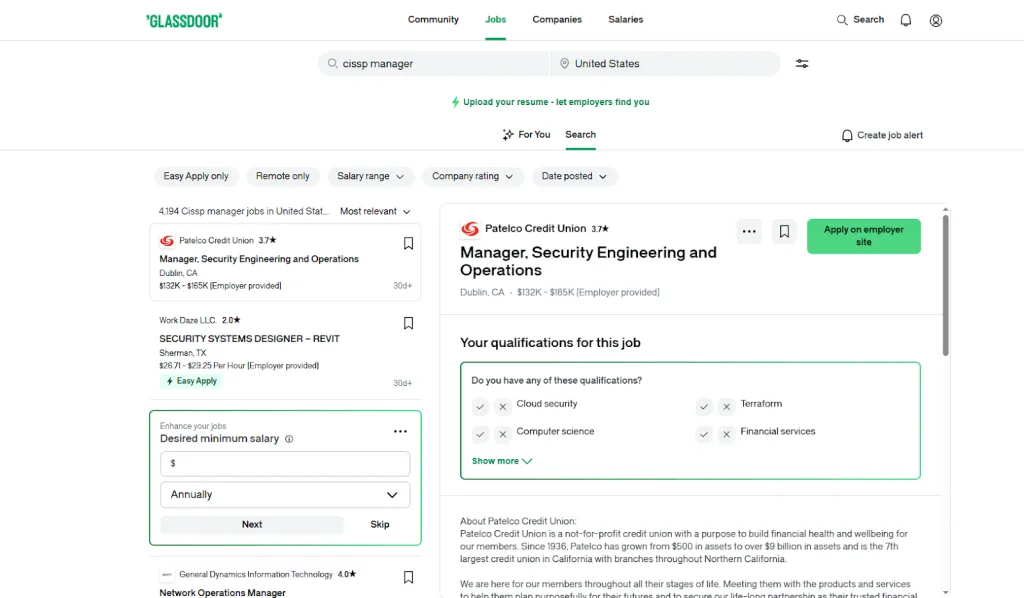
Our research into management-level roles requiring the CISSP shows a strong, specialized demand. As seen in the screenshot, a targeted search for “cissp manager” yields over 4,100 open positions in the United States.
These are high responsibility roles such as “Manager, Security Engineering and Operations,” with employers like Patelco Credit Union offering substantial salaries in the $132,000 – $185,000 range. This data confirms that the CISSP is a key credential for professionals aiming for leadership positions specifically within the cybersecurity domain.
The PMP Market: Versatility and Broad Industry Demand
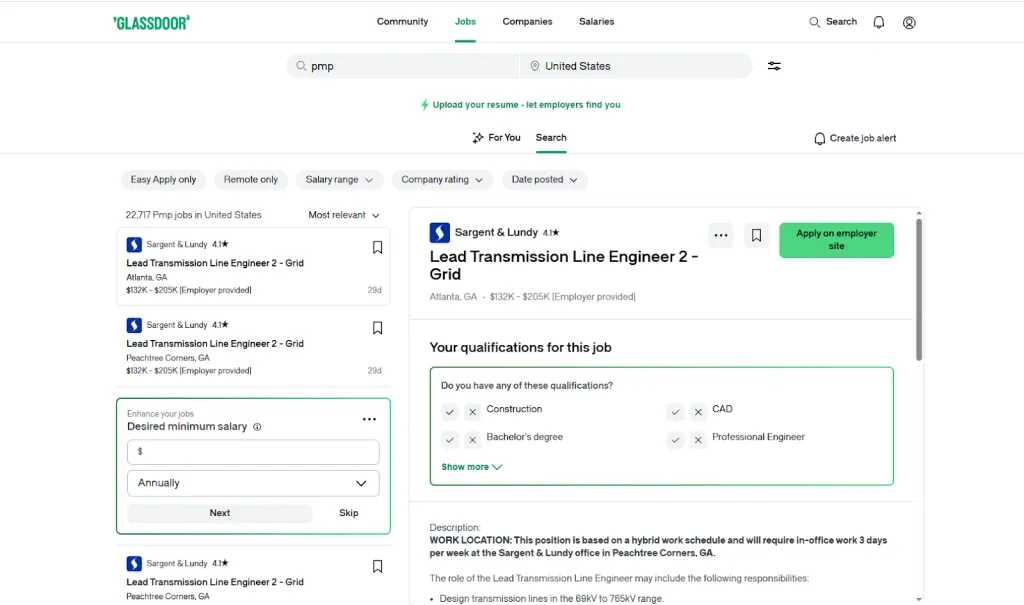
In contrast, our data on the PMP certification highlights its immense versatility and broad appeal across all industries. The screenshot shows a staggering 22,700+ open roles in the U.S. listing PMP as a desirable credential.
The roles extend far beyond traditional IT, as evidenced by the “Lead Transmission Line Engineer” position in the energy sector. This type of high-stakes project leadership role also commands an elite salary, with a range of $132,000 – $205,000. This demonstrates the PMP’s value for leading complex projects in any field.
Cost and Recertification
- CISSP: The exam fee is $749 USD. Maintaining the certification requires a $135 Annual Maintenance Fee and earning 120 Continuing Professional Education (CPE) credits every three years.
- PMP: The exam fee is $405 for PMI members and $575 for non-members. Maintaining the certification requires a renewal fee and earning 60 Professional Development Units (PDUs) every three years.
Which Certification is Good for You?
The choice between CISSP and PMP should be based on your core passion and career goals. Ask yourself this fundamental question: Do I want to manage the protection of assets or the execution of projects?
Choose CISSP if…
- Your career is fundamentally rooted in technology and you are passionate about cybersecurity.
- You want to design secure systems, manage risk, and lead an organization’s security strategy.
- Your goal is to become a CISO, Security Architect, or a senior security leader.
If this path aligns with your goals, you may be wondering about the long-term value. Find out if the CISSP certification is worth it for your career. Ready to explore this specialization further? Browse our full category of cybersecurity certifications.
Choose PMP if…
- Your passion is in leadership, organization, and delivering results on time and on budget.
- You want a highly versatile credential that applies to any industry, not just IT.
- Your goal is to become a Project Manager, Program Manager, or Director of a PMO.
If leading projects is your passion, the PMP is just one of many excellent credentials available. Explore our other top-tier management certifications.
For some professionals, particularly those in the role of Cybersecurity Project Manager, holding both certifications can make you an exceptionally valuable and highly sought-after candidate.
A Real World Look at CISSP vs. PMP Difficulty
To add a layer of real world context, our research team analyzed numerous discussions on professional forums like Reddit, where certified individuals share their firsthand experiences. We curated the most common sentiments to provide a qualitative look at each certification’s unique challenge.
Different Kinds of “Hard”: Technical Breadth vs. Process Rigor
The community consensus is that both exams are difficult, but for entirely different reasons.
- CISSP’s Challenge is its Immense Scope: Professionals consistently describe the CISSP’s difficulty as a test of endurance and vast knowledge. The challenge lies in its “mile wide” scope, covering eight deep domains from cryptography to physical security. As many have shared, you must be a high level generalist, able to connect disparate security concepts to business risk. To succeed, many professionals rely on high-quality study materials to cover the vast syllabus. Discover the best CISSP dumps to aid your preparation.
- PMP’s Challenge is its Methodical Mindset: The PMP’s difficulty is consistently attributed to mastering a specific methodology and mindset. The exam is famous for its situational questions that require you to identify the “PMI way” of handling a problem. For professionals used to more flexible or agile environments, adopting this structured, process driven thinking is often the biggest hurdle.
Your Background Defines the Challenge
Our analysis of community feedback reveals a clear pattern: your professional background is the single biggest predictor of which exam you will find harder.
- Deeply technical security practitioners often report that the PMP’s process driven, people focused nature is a greater challenge.
- Conversely, experienced project managers may find themselves overwhelmed by the sheer technical breadth and security-specific knowledge required for the CISSP.
Conclusion
Ultimately, CISSP and PMP are both elite certifications that validate different but equally critical skill sets. The CISSP is about the “what” the security program itself. The PMP is about the “how“, the process of executing projects to build and improve that program. Both require a significant investment and are highly rewarding. By carefully considering your personal interests, you can choose the certification that will set you on a career path you are passionate about for years to come.
Frequently Asked Questions (FAQ)
Which pays more, CISSP or PMP?
On average, their salaries are very comparable, with both leading to high six-figure incomes. The CISSP often has a slight edge in salary surveys due to the high demand for senior security experts, but both are considered top-tier in terms of earning potential.
Is CISSP or PMP harder?
The difficulty is subjective. The CISSP is considered harder in terms of the sheer breadth of technical and managerial knowledge required across its eight domains. The PMP is considered hard due to its focus on complex situational judgment and applying the correct project management processes to nuanced scenarios.
Can a Security Professional benefit from PMP?
Yes, absolutely. A PMP provides security professionals with a structured framework to manage complex initiatives like deploying a new security infrastructure or leading a compliance audit. It adds formal project management skills to their technical security expertise, making them more effective leaders.
Can a Project Manager benefit from CISSP?
Yes, especially for those managing IT, software, or technology projects. A CISSP provides a deep understanding of security risks, which is crucial for building secure products and infrastructure. It gives a PM the credibility and knowledge to speak the language of their security teams and stakeholders.
More Certification Comparisons
Compare scope, difficulty, prep time, and career impact—side by side.
PassITExams vs ExamTopics
Which Platform is Best for IT Certification Exam Preparation?
PassITExams vs Skillcertpro
The Ultimate Guide to Choosing Your IT Certification Success Partner
PassITExams vs Pass4sure
A Critical Examination of Certification Preparation Platforms
CTFA vs CFP
Choosing the Right Financial Designation for a Career in Fiduciary and Wealth Management
Splunk vs Elastic
The Ultimate Comparison for Logging, SIEM, and Observability
IBM QRadar vs Splunk
The Ultimate SIEM Comparison for Modern Security Operations
SageMaker vs Bedrock
Choosing the Right Engine for Your AI Strategy in 2026
az-104 vs az-400
our Definitive Azure Career Path for 2026 (Admin vs. DevOps)
AZ-104 vs AI-900
Azure Admin Associate Or AI Fundamentals?
AZ-104 vs PL-300
Azure Admin or Data Analyst? (Salary & Jobs)
AZ-104 vs AZ-500
Which Azure Certification Is Right for Your Career?
AZ-900 vs CLF-C02
Which Foundational Cloud Cert Unlocks the Best Jobs and Salaries?
AZ-900 vs SAA-C03
Which Cloud Certification is Right for You?
RHIT vs RHIA
Which Health Information Credential Is Right for You?
AZ-900 vs DP-900
Which Azure Certification Should You Take First?
AZ-900 vs SC-900
Choose Your Microsoft Certification Path
AZ-900 vs AI-900
Which Azure Fundamentals Certification Is Your Launchpad?
AZ-204 vs AZ-305
The Builder vs. The Architect
AZ-900 vs AZ-204
Which Microsoft Azure Certification is Right for You?
az-204 vs pl-300
Building the Engine or Charting the Course?
AZ-900 vs AZ-400
Foundational vs. Expert: Complete Guide for Your Azure Career
601 vs 601
CompTIA Security+ 601 vs 701: The Ultimate Comparison Guide
Data Engineer vs Data Scientist
The Ultimate Comparison Guide
AWS vs Azure
The Ultimate Comparison for Certification & Career
CISSP vs SecurityX
Which Certification Will Define Your Cybersecurity Career?
AWS vs Azure
Who is Leading the Cloud Race?
AWS vs Azure
Which Cloud Certification is Paying High?
AZ-104 vs AZ-305
Administrator vs. Architect – Your Ultimate Azure Guide
AZ-104 vs AZ-204
The Ultimate Guide for Your Azure Career
ISSA vs NASM
Which Personal Trainer Certification Is Best for You?
Salesforce Admin vs Salesforce Developer
Unlocking Your Earning Potential in the Salesforce Ecosystem
CISSP vs CCSP
Your Ultimate Guide to a Career in Cloud Security
CRISC vs CISSP
Mastering Risk Management and Information Security
CISSP vs CEH
Your Guide to Mastering Offensive and Defensive Security
CISSP vs PMP
Unlocking Dual Expertise in Security and Project Management
CISSP vs Security+
Choosing the Right Certification to Boost Your Earning Potential
CISSP vs OSCP
Choosing the Right Certification for a Six-Figure Cybersecurity Career
CISSP vs CISM
Which Certification Will Truly Elevate Your Cybersecurity Career?
Azure vs AWS
How to Choose the Right Cloud Platform for Your Business
AZ-900 vs AZ-700
MIcrosoft Career Blueprint: From Azure Fundamentals to Networking
AZ-900 vs AZ-104
Azure Career Blueprint: Your Path from Azure Fundamentals to Azure Administrator
AZ-104 vs SAA-C03
Azure Administrator vs. AWS Architect: Which Career Path Wins?
AZ-900 vs MS-900
Your ultimate Microsoft fundamentals showdown.
