

In an age of increasing cyber threats, cybersecurity skills are in high demand. For IT professionals looking to get ahead, earning an advanced certification can give your resume a significant boost. Two of the most prestigious credentials in the field are the Certified Information Systems Security Professional (CISSP) and the SecurityX.
While both are highly respected, they are designed for distinctly different career paths and professional mindsets. Many senior practitioners find themselves at a crossroads, wondering which of these powerhouse certifications will provide the best return on investment. Should you focus on becoming a security manager, responsible for strategy and governance, or a master practitioner, the hands-on technical expert who implements and defends the enterprise?
This guide will provide a deep, comprehensive comparison of CISSP and SecurityX. We will dissect their focus, exam details, job roles, and provide a detailed salary analysis to help you make the strategic decision that best aligns with your skills and career aspirations.
What is CISSP? A Deeper Look
The Certified Information Systems Security Professional (CISSP) is the globally recognized gold standard in cybersecurity leadership and management. Offered by the non-profit organization (ISC)², the CISSP is designed for experienced security practitioners who aim to prove their deep technical knowledge and managerial competence.

The certification validates an individual’s ability to effectively design, implement, and manage a best-in-class cybersecurity program. It covers a vast body of knowledge across eight domains, ensuring professionals can handle everything from risk management to security operations. CISSP is for the senior-level expert overseeing an entire security landscape. Considering the investment, many wonder if the certification is worth it.
What is SecurityX? A Deeper Look
The CompTIA Advanced Security Practitioner (SecurityX) is the pinnacle of hands-on, technical cybersecurity certifications. Offered by CompTIA, the SecurityX is designed for advanced practitioners not managers, who are responsible for the hands-on implementation and engineering of secure solutions.

This certification validates an expert’s ability to architect, engineer, integrate, and implement secure solutions across complex environments. Unlike many other certifications, SecurityX is heavily focused on performance-based questions, requiring candidates to perform real tasks in a simulated environment. It is the only hands-on, performance-based certification for advanced security practitioners. The SecurityX is for the master technician and problem-solver, proving you are a hands-on expert who can defend an enterprise at the highest technical level.
CISSP vs SecurityX: A Head-to-Head Comparison
To help you see the differences at a glance, this table breaks down the key distinctions between these two elite credentials.
| Feature | SecurityX | CISSP (Certified Information Systems Security Professional) |
|---|---|---|
| Administered By | CompTIA | (ISC)² |
| Core Focus | Technical hands-on security skills | Managerial, conceptual infosec knowledge |
| Experience Req. | Recommended: 10 years in IT admin or security role | Minimum of 5 years in 2 of the 8 CISSP domains |
| Exam Format | 90 multiple-choice & performance-based questions | 100-150 multiple-choice questions |
| Exam Length | 165 Minutes | 3 hours |
| Renewal | 3 years with 75 CEU credits | 3 years with 120 CPE credits |
| Domains Covered | Risk management, enterprise security operations, and architecture | 8 domains including security and risk management, asset security, etc. |
Job Market Trends, Career Paths, and Salary Expectations
To provide you with the most accurate and up-to-date picture of the cybersecurity job market, our research team has performed an extensive analysis of major job portals. We’ve curated the latest data to illustrate how the SecurityX and CISSP certifications translate into real world job prospects and earning potential. Our findings reveal distinct demands and impressive salaries for both, depending on the specialization.
The SecurityX Market: A Demand for Advanced Technical Expertise
Our research into job roles requiring the SecurityX certification highlights a strong, specialized demand for hands-on technical experts.
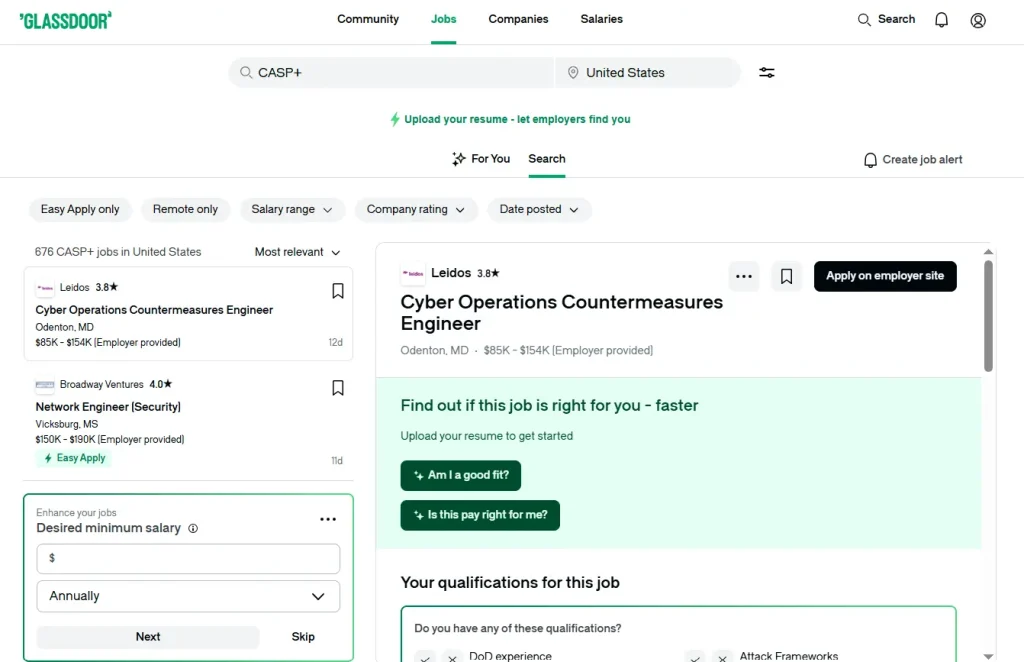
As seen in the screenshot above, a targeted search for “SecurityX” on Glassdoor in the United States yields a significant number of open positions, currently over 600. These are often high-responsibility, technical roles such as “Cyber Operations Countermeasures Engineer” with employers like Leidos, offering substantial salaries in the $105,000 – $189,000 range. The job qualifications explicitly highlight requirements like “DoD experience” and “IAT” along with “CASP Analyst,” underscoring the certification’s value in advanced technical and government/military cybersecurity roles. This data confirms that the SecurityX is a key credential for professionals aiming for senior-level, hands-on engineering, and operational cybersecurity positions.
Common job titles for SecurityX holders include:
- Security Architect
- Senior Security Engineer
- Technical Lead Analyst
- Application Security Engineer
The CISSP Market: Unmatched Demand for Security Leadership
In contrast, our data on the CISSP certification unequivocally highlights its immense and widespread demand, particularly for leadership and managerial roles across all industries.

The screenshot above, showcasing a search for “CISSP” on Glassdoor, reveals a staggering demand with 9,470 open positions in the U.S. This is significantly higher than SecurityX, reflecting its broader application in strategic security roles. Examples include “Information Security Manager” with a salary range up to $120,000. The job qualifications shown here, such as “IT management” and “CISM,” further reinforce that the CISSP is a critical credential for professionals aspiring to leadership positions where they design, manage, and govern an organization’s security posture.
Common job titles for CISSP holders include:
- Chief Information Security Officer (CISO)
- Information Security Manager
- Security Architect
- Cybersecurity Engineer
Detailed Salary Analysis
Average CISSP Salary
The CISSP is one of the highest-paying certifications in IT. According to ZipRecruiter, the average salary for a CISSP holder in the USA is approximately $125,470, but this varies significantly.
- By Experience Level: An entry-level professional (0-5 years) might earn around $83,000, while a seasoned expert with 20+ years of experience can command over $168,000.
- By Industry: Industries like Banking/Finance ($131k) and Healthcare ($129k) tend to pay more than Retail ($98k).
- By Location: Top metro areas like San Francisco ($150k) and New York ($147k) command the highest salaries.
The following table shows average salaries for common CISSP job titles.
| Job Title | Average Salary (USA) |
|---|---|
| Information Security Analyst | $73,135 |
| Security Engineer | $94,774 |
| Information Security Manager | $118,405 |
| Security Architect | $125,841 |
| Chief Information Security Officer (CISO) | $165,291 |
Average SecurityX Salary
SecurityX also opens up lucrative career opportunities. According to Payscale, the average salary for SecurityX certified professionals ranges from $91,000 to $115,000, with significant potential for growth.
- By Job Role: Entry-level analysts may start around $65,000, while senior security architects can earn well over $150,000.
- By Location: Tech hubs pay a premium. The table below shows the wide salary ranges in different U.S. cities.
| Location | Salary Range (USA) |
|---|---|
| San Antonio, TX | $45,130 – $86,476 |
| Norfolk, VA | $74,369 – $94,819 |
| San Diego, CA | $62,819 – $123,126 |
| Washington, D.C. | $73,700 – $122,829 |
The following table from Payscale shows the average salaries for various roles held by SecurityX certified professionals.
| Job Title | Average Salary (USA) |
|---|---|
| Cyber Security Analyst | $89,986 |
| Information Security Engineer | $98,730 |
| Security Architect, IT | $102,829 |
| Senior Security Consultant | $126,862 |
| Security Manager, IT | $130,000 |
Which Certification is Right for You?
The choice between CISSP and SecurityX should be based on your core passion and career goals. Ask yourself this fundamental question: Do I want to manage the security program, or be the most skilled practitioner within it?
Choose CISSP if…
- Your career goal is to move into management and leadership.
- You are passionate about strategy, policy, risk management, and aligning security with business objectives.
- You want to become a CISO, Security Director, or a senior security consultant.
Choose SecurityX if…
- Your passion is in the deep, technical, hands-on aspects of cybersecurity.
- You want to remain a top-tier technical expert, solving the most complex security engineering challenges.
- Your goal is to become a Principal Security Engineer, a Security Architect, or a top-level penetration tester.
Conclusion
Ultimately, CISSP and SecurityX are both elite certifications that validate different but equally critical skill sets. The CISSP is about the “what” and “why” of the security program itself and the risks it addresses. The SecurityX is about the “how”, the technical implementation of the controls that make that program effective. Both require a significant investment and are highly rewarding. For those studying, understanding how long it takes to prepare for the CISSP is a key first step.
Frequently Asked Questions (FAQ)
Which pays more, CISSP or SecurityX?
On average, their salaries are very comparable, with both leading to high six-figure incomes. The CISSP is often associated with higher-level management roles like CISO, which can have a higher salary ceiling. However, a top-tier Principal Security Engineer with a SecurityX can also command an elite salary.
Is CISSP or SecurityX harder?
The difficulty is subjective. The CISSP is considered harder in terms of the sheer breadth of managerial and technical knowledge required across its eight domains. The SecurityX is considered harder due to its focus on hands-on, performance-based questions that require you to solve real technical problems in a simulated environment.
Can I get a CISSP after a SecurityX?
Yes, absolutely. This is an excellent career path. Earning the SecurityX first validates your deep technical skills and provides you with the hands-on experience that is highly valuable for understanding the concepts in the CISSP.
Which certification is better for government and DoD jobs?
Both are highly respected and meet the requirements for many DoD 8570/8140 directives. The CISSP is often required for management-level positions, while the SecurityX is also approved for many advanced technical and management levels, making both of them excellent choices for government and military cybersecurity careers.
Is it beneficial to hold both SecurityX and CISSP certifications?
Yes, for certain senior roles, holding both can be a powerful combination. It signals that you not only have the deep technical expertise to implement solutions (SecurityX) but also the broad managerial understanding to lead strategy and manage risk (CISSP), making you a uniquely qualified candidate.
More Certification Comparisons
Compare scope, difficulty, prep time, and career impact—side by side.
PassITExams vs ExamTopics
Which Platform is Best for IT Certification Exam Preparation?
PassITExams vs Skillcertpro
The Ultimate Guide to Choosing Your IT Certification Success Partner
PassITExams vs Pass4sure
A Critical Examination of Certification Preparation Platforms
CTFA vs CFP
Choosing the Right Financial Designation for a Career in Fiduciary and Wealth Management
Splunk vs Elastic
The Ultimate Comparison for Logging, SIEM, and Observability
IBM QRadar vs Splunk
The Ultimate SIEM Comparison for Modern Security Operations
SageMaker vs Bedrock
Choosing the Right Engine for Your AI Strategy in 2026
az-104 vs az-400
our Definitive Azure Career Path for 2026 (Admin vs. DevOps)
AZ-104 vs AI-900
Azure Admin Associate Or AI Fundamentals?
AZ-104 vs PL-300
Azure Admin or Data Analyst? (Salary & Jobs)
AZ-104 vs AZ-500
Which Azure Certification Is Right for Your Career?
AZ-900 vs CLF-C02
Which Foundational Cloud Cert Unlocks the Best Jobs and Salaries?
AZ-900 vs SAA-C03
Which Cloud Certification is Right for You?
RHIT vs RHIA
Which Health Information Credential Is Right for You?
AZ-900 vs DP-900
Which Azure Certification Should You Take First?
AZ-900 vs SC-900
Choose Your Microsoft Certification Path
AZ-900 vs AI-900
Which Azure Fundamentals Certification Is Your Launchpad?
AZ-204 vs AZ-305
The Builder vs. The Architect
AZ-900 vs AZ-204
Which Microsoft Azure Certification is Right for You?
az-204 vs pl-300
Building the Engine or Charting the Course?
AZ-900 vs AZ-400
Foundational vs. Expert: Complete Guide for Your Azure Career
601 vs 601
CompTIA Security+ 601 vs 701: The Ultimate Comparison Guide
Data Engineer vs Data Scientist
The Ultimate Comparison Guide
AWS vs Azure
The Ultimate Comparison for Certification & Career
CISSP vs SecurityX
Which Certification Will Define Your Cybersecurity Career?
AWS vs Azure
Who is Leading the Cloud Race?
AWS vs Azure
Which Cloud Certification is Paying High?
AZ-104 vs AZ-305
Administrator vs. Architect – Your Ultimate Azure Guide
AZ-104 vs AZ-204
The Ultimate Guide for Your Azure Career
ISSA vs NASM
Which Personal Trainer Certification Is Best for You?
Salesforce Admin vs Salesforce Developer
Unlocking Your Earning Potential in the Salesforce Ecosystem
CISSP vs CCSP
Your Ultimate Guide to a Career in Cloud Security
CRISC vs CISSP
Mastering Risk Management and Information Security
CISSP vs CEH
Your Guide to Mastering Offensive and Defensive Security
CISSP vs PMP
Unlocking Dual Expertise in Security and Project Management
CISSP vs Security+
Choosing the Right Certification to Boost Your Earning Potential
CISSP vs OSCP
Choosing the Right Certification for a Six-Figure Cybersecurity Career
CISSP vs CISM
Which Certification Will Truly Elevate Your Cybersecurity Career?
Azure vs AWS
How to Choose the Right Cloud Platform for Your Business
AZ-900 vs AZ-700
MIcrosoft Career Blueprint: From Azure Fundamentals to Networking
AZ-900 vs AZ-104
Azure Career Blueprint: Your Path from Azure Fundamentals to Azure Administrator
AZ-104 vs SAA-C03
Azure Administrator vs. AWS Architect: Which Career Path Wins?
AZ-900 vs MS-900
Your ultimate Microsoft fundamentals showdown.
