
The world of Information Technology is a universe of endless opportunity, but for newcomers, it can feel vast and intimidating. With countless specializations, technologies, and career paths, the most common question is often the most difficult: Where do I even start? A successful journey requires a map, a clear, structured guide that shows you the way from your first step to your ultimate destination. In the IT industry, that map is the CompTIA Certification Roadmap.
For over three decades, CompTIA (the Computing Technology Industry Association) has been the gold standard for establishing the foundational, vendor-neutral skills that every successful IT professional needs. Their certifications are respected by employers globally because they represent a universal language of technology.
This comprehensive guide is designed to be your definitive resource for navigating the CompTIA roadmap in this year. We will deconstruct each pathway, explore every core certification, and provide a strategic blueprint to help you build your IT career with confidence, one credential at a time.
Why a Certification Roadmap is Your Most Powerful Career Tool
Before we dive into the specific certifications, it’s crucial to understand why a roadmap is so essential. In IT, certifications are more than just lines on a resume; they are verifiable milestones of your skills and knowledge. A structured roadmap transforms your approach from randomly collecting badges to strategically building a cohesive, in-demand skill set.
The core strength of the CompTIA roadmap lies in its vendor-neutral philosophy. This means the skills you learn are not tied to a specific brand like Microsoft, Cisco, or Apple. Instead, you master the fundamental principles that underpin all technology. This makes you a more versatile, adaptable, and valuable professional who can thrive in any IT environment.
A roadmap allows you to:
- Build a Logical Skill Progression: Each certification builds upon the last, creating a solid foundation before moving to more advanced topics.
- Align Certifications with Job Roles: The roadmap is designed around real-world IT jobs, helping you understand potential CompTIA certification salary ranges and target the specific credentials needed for various roles
- Stay Motivated and Focused: A clear path with defined steps provides tangible goals, keeping you motivated and on track as you advance in your career.
Deconstructing the CompTIA Roadmap: The Four Main Pillars
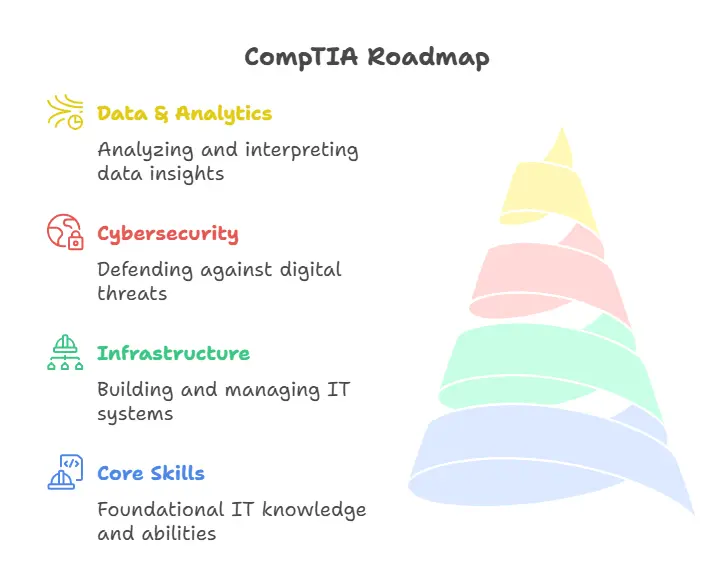
The CompTIA roadmap is elegantly organized into four distinct pillars, or pathways. While there is some overlap, each path represents a major specialization within the IT industry.
- Core Skills Pathway: This is the foundation for everyone. It covers the essential hardware, software, networking, and security knowledge that is a prerequisite for virtually every IT role.
- Infrastructure Pathway: This path is for professionals who want to build and manage the backbone of IT operations, from physical servers to the cloud.
- Cybersecurity Pathway: A highly specialized and in-demand track for those dedicated to protecting data and defending against digital threats.
- Data & Analytics Pathway: A newer path focused on the critical skills of interpreting and leveraging data to drive business decisions.
Now, let’s explore each of these pathways in detail.
Pillar 1: The Core Skills Pathway – Your Foundational Journey
This is where nearly every successful IT career begins. The Core Skills pathway is comprised of what is famously known as “The CompTIA Trifecta,” along with an optional on-ramp for absolute beginners.
Optional Starting Point: CompTIA IT Fundamentals (ITF+)

- Who It’s For: The ITF+ is designed for individuals with zero prior IT knowledge. It’s perfect for students, career changers, or professionals in non-technical roles (like sales or marketing) who need to understand the basics of IT.
- What It Validates: A foundational understanding of IT terminology, concepts, infrastructure, software development, and security. It proves you have basic IT literacy.
- The Takeaway: While a valuable starting point for some, most individuals aspiring to a hands-on technical career can begin directly with the A+.
The True Beginning: CompTIA A+
The A+ is the undisputed industry standard for establishing a career in IT. It is the most commonly required certification for entry-level IT jobs.

- What It Validates: Earning the A+ requires passing two separate exams:
- Core 1: Focuses on hardware, mobile devices, networking technology, and troubleshooting.
- Core 2: Focuses on installing and configuring operating systems (Windows, macOS, Linux, Android, iOS), software troubleshooting, and operational procedures.
- Target Job Roles: With an A+, you can explore various CompTIA A+ salary and jobs, including roles like Help Desk Technician, Technical Support Specialist, Field Service Technician, and Tier 1 Support.
- The Roadmap Step: This is your first major milestone. It proves to employers that you have the essential skills to handle the day-to-day challenges of an IT support role.
The Next Logical Step: CompTIA Network+
Once you understand how individual devices work (A+), the next step is to understand how they connect and communicate. The Network+ is the cornerstone of modern IT.

- What It Validates: Your ability to design, configure, manage, and troubleshoot both wired and wireless networks. It covers networking concepts (OSI model, TCP/IP), infrastructure (routers, switches, firewalls), network operations, and network security.
- Target Job Roles: Network Administrator, Junior Network Engineer, IT Consultant, Network Field Technician.
- The Roadmap Step: Network+ provides the foundational knowledge required for virtually every other specialization, from cloud computing to cybersecurity.
The Bridge to Specialization: CompTIA Security+
Security+ is arguably the most critical certification in the core pathway. It is a global benchmark for baseline cybersecurity skills. Many professionals wonder if the CompTIA Security+ SY0-701 is worth it, and understanding the differences between exam versions, like the Security+ 601 vs 701, is key.

- What It Validates: Your knowledge of core cybersecurity principles, including threats, attacks, and vulnerabilities; identity and access management; risk management; cryptography; and secure network architecture.
- Why It’s Crucial: Security+ meets the U.S. Department of Defense (DoD) 8570/8140 directive, making it an essential credential for anyone working in or with the government, a massive employer in the tech sector.
- Target Job Roles: Security Administrator, Systems Administrator, Junior Security Analyst, Network Administrator.
- The Roadmap Step: Completing Security+ marks the end of the foundational “Trifecta” and acts as the primary gateway to the specialized Cybersecurity Pathway.
Pillar 2: The Infrastructure Pathway – Building and Managing IT Systems
This pathway is for professionals who move beyond frontline support to build, manage, and optimize the underlying infrastructure that powers modern business.
CompTIA Cloud+
As businesses increasingly move to the cloud, the skills to manage these environments are in high demand. Cloud+ validates these skills from a vendor-neutral perspective.

- What It Validates: Your ability to deploy, manage, and secure cloud environments. It covers concepts that are applicable across all major platforms, including AWS, Microsoft Azure, and Google Cloud.
- Target Job Roles: Cloud Engineer, Systems Administrator, Cloud Specialist, Network Administrator.
- The Roadmap Step: This is an excellent choice after the Core Trifecta for those who want to specialize in the cloud but don’t want to be tied to a single vendor’s ecosystem just yet.
CompTIA Server+
This certification focuses on the skills required to manage and maintain the physical and virtual servers that are the heart of any data center. Server+ validates expertise in server administration, security, and troubleshooting.

- What It Validates: Expertise in server administration, including server hardware and software, storage, security, and troubleshooting across various server environments.
- Target Job Roles: Server Administrator, Data Center Technician, IT Manager.
CompTIA Linux+
Linux is the dominant operating system for servers, cloud computing, and cybersecurity tools. Linux+ is a powerful credential that proves your mastery of this critical open-source platform.

- What It Validates: Your skills as a Linux administrator, covering system management, security, scripting, and automation from the command line.
- Target Job Roles: Linux Administrator, Junior DevOps Engineer, Systems Administrator.
Pillar 3: The Cybersecurity Pathway – Defending the Digital Frontier
This is a highly specialized and lucrative path for professionals who have already completed the Core Trifecta, especially Security+.
The Blue Team Path: CompTIA CySA+ (Cybersecurity Analyst)
The CySA+ focuses on the defensive side of cybersecurity. It’s for the professionals who monitor the network, detect threats, and respond to incidents.

- What It Validates: Your ability to use threat intelligence and detection tools, perform data analysis, and respond to cybersecurity incidents.
- Target Job Roles: Cybersecurity Analyst, Security Operations Center (SOC) Analyst, Threat Intelligence Analyst.
The Red Team Path: CompTIA PenTest+ (Penetration Tester)
PenTest+ focuses on the offensive side of security. It’s for the ethical hackers who are hired to find and exploit vulnerabilities before malicious actors do.

- What It Validates: Your skills in planning, scoping, and executing penetration tests. It covers information gathering, vulnerability scanning, attacks and exploits, and reporting.
- Target Job Roles: Penetration Tester, Security Consultant, Vulnerability Assessment Analyst.
The Pinnacle: CompTIA SecurityX
CompTIA SecurityX is the master-level certification for elite cybersecurity professionals. Unlike other CompTIA exams, it is highly hands-on and performance-based.

NOTE: The CompTIA Advanced Security Practitioner (CASP+) certification is now known as CompTIA SecurityX. This rebranding took effect with the release of the new exam version, CAS-005, in December 2024, marking the launch of CompTIA’s “Xpert” series. Professionals who currently hold the CASP+ certification will automatically receive the updated SecurityX badge. The certification’s core focus remains unchanged, continuing to validate the advanced skills of senior security engineers and architects.
- What It Validates: Your advanced skills in enterprise security architecture, risk management, and the technical integration of security solutions. This is not for managers, but for hands-on technical leaders.
- Target Job Roles: Security Architect, Senior Security Engineer, Senior Cybersecurity Analyst.
Pillar 4: The Data & Analytics Pathway
This newer pathway addresses the growing need for professionals who can work with data.
CompTIA Data+
- What It Validates: Data+ validates your ability to mine, manipulate, visualize, and report on data to help organizations make data-driven decisions.
- Target Job Roles: Data Analyst, Business Intelligence Analyst, Reporting Analyst.
Your Action Plan: How to Use This Roadmap
Navigating this roadmap is a strategic process. Here’s your action plan:
- Self-Assessment: Honestly evaluate your current knowledge and define your long-term career goals. Where are you now, and where do you want to be in five years?
- Choose Your Starting Point: For 90% of aspiring tech professionals, the journey begins with CompTIA A+.
- Download the Exam Objectives: Before you buy any course or book, go to the official CompTIA website and download the detailed exam objectives for your chosen certification. This is your study bible.
- Adopt a Multi-Faceted Study Approach: Combine different learning methods for the best results. Use video courses for concepts, official study guides for detail, and hands-on labs for practical skills.
- Validate Your Readiness with Practice Exams: This is a critical, non-negotiable step. Use high-quality practice questions (dumps) from a trusted source like PassITExams. This will prepare you for the unique question formats, including the challenging Performance-Based Questions (PBQs), and will help you identify and remediate your weak areas before you sit for the real exam.
- Schedule, Pass, and Advance: Once you pass a certification, celebrate your success and then look to the next logical step on your personalized roadmap. Before you purchase your exam voucher, review the current CompTIA promo codes & official discounts, legitimate savings of 10–55%+ are still available in 2026.
Conclusion: Building Your Future, One Certification at a Time
The CompTIA certification roadmap is more than just a list of exams; it is a proven, industry-respected framework for building a long and successful career in Information Technology. It provides a clear path through a complex industry, allowing you to systematically build your skills from a solid, vendor-neutral foundation to advanced, specialized expertise.
By understanding this map and strategically planning your journey, you are not just preparing for a test—you are building your future. Take the first step today.
Frequently Asked Questions (FAQs)
Which CompTIA certification should I absolutely get first?
For anyone aiming for a hands-on technical role, the CompTIA A+ is the undisputed starting point. It is the industry standard for entry-level IT and covers the essential hardware, software, and troubleshooting skills employers look for. If you are a student or career changer with zero IT background, the optional IT Fundamentals (ITF+) can be a great, less technical introduction to the field before you tackle the A+.
How long are CompTIA certifications valid and how do I renew them?
Most core CompTIA certifications, including A+, Network+, and Security+, are valid for three years from the date you pass the exam. To renew them, you must participate in the Continuing Education (CE) program. You can do this by earning Continuing Education Units (CEUs) through various activities (like attending webinars or gaining work experience) or by passing the latest version of the exam or a higher-level CompTIA certification.
Are CompTIA certifications still relevant in a cloud-first world?
Absolutely. Think of it like building a house 🏠. You need a solid foundation before you can build the walls and roof. CompTIA certifications provide that vendor-neutral foundation in networking, security, and infrastructure that all cloud technologies are built upon. This core knowledge makes you a much stronger candidate for specialized cloud roles.
What are Performance-Based Questions (PBQs) on the exams?
Performance-Based Questions (PBQs) are hands-on, simulated questions that test your practical skills. Instead of just answering a multiple-choice question, you might be asked to perform a task in a simulated environment, like configuring a firewall rule, troubleshooting a network connection in a command-line interface, or matching hardware components on a diagram. They are a key part of what makes CompTIA exams so respected.
