
Facing a “fail” on your CompTIA exam score report is a deeply disheartening experience. You invested significant time, effort, and money into your preparation, and falling short of the passing score can feel like a major setback. It’s natural to feel frustrated or demotivated.
However, it’s crucial to reframe this moment. A failed exam is not the end of your IT journey; it is a data point. It’s a learning opportunity that, if approached correctly, can make you a stronger, more knowledgeable IT professional. The first step in transforming this setback into a comeback is understanding the official CompTIA Exam Retake Policy.
This comprehensive guide will walk you through every aspect of the retake policy, based on the official guidelines from CompTIA. We’ll cover the mandatory waiting period, the financial implications, and, most importantly, provide a strategic blueprint to ensure your next attempt is a successful one.
The Official CompTIA Retake Policy: The Core Rules You Must Know
The CompTIA policy for retaking a failed exam is straightforward, fair, and designed to encourage genuine learning rather than repeated brute-force attempts. It is essential to understand these rules to plan your next steps effectively.
1. The 14-Day Waiting Period
The cornerstone of the entire policy is the mandatory waiting period. According to the official CompTIA Candidate Agreement, if you do not pass an exam on your first attempt, you must wait 14 calendar days before you are eligible to retake the same exam.
- What it means: If you take an exam on Wednesday, October 15th, and fail, the earliest you can sit for the same exam again is Wednesday, October 29th. The Pearson VUE scheduling system, accessed through your CompTIA account, will physically prevent you from registering for that specific exam until the 14-day period has elapsed.
- For Subsequent Attempts: If you fail the exam for a second (or any subsequent) time, the 14-day waiting period still applies.
- Why it exists: This “cool-down” period serves two primary purposes. First, it upholds the integrity of the certification by preventing candidates from immediately re-attempting in the hopes of getting an easier set of questions. Second, and more importantly, it provides you with a dedicated, non-negotiable window to analyze your performance, identify your weak areas, and engage in focused study to fill those knowledge gaps.
2. No Lifetime Limit on Retakes
This is a critically important and reassuring aspect of the policy. CompTIA does not impose a limit on the number of times you can attempt a certification exam. Whether it takes you two, three, or more attempts, your path to certification remains open. This policy reflects a core philosophy that CompTIA values learning and eventual mastery over a one-time performance. This is a key part of the overall CompTIA Certification Roadmap.
| Policy Aspect | Official Rule |
|---|---|
| Waiting Period (First Fail) | 14 calendar days after the failed attempt. |
| Waiting Period (Second+ Fail) | 14 calendar days after each subsequent failed attempt. |
| Lifetime Attempt Limit | None. You can retake an exam as many times as needed. |
| Applicability | The waiting period applies only to the specific exam you failed. |
The Financial Reality: Do I Have to Pay Again?
This is often the first question candidates ask after learning about the waiting period. The answer is unambiguous:
Yes, you must pay the full exam fee for each retake attempt.
There are no discounts offered for a second or subsequent attempt on a failed exam. This policy underscores the importance of being fully prepared. If you used a voucher, it is considered consumed. This investment is worthwhile considering the Benefits of CompTIA Certification.
If you used an exam voucher for your failed attempt, that voucher is now considered consumed and cannot be used again. You will need to purchase a new voucher or pay the full fee with a credit card for your retake.
The 5-Step Strategic Plan for Your Retake Attempt
Simply waiting 14 days and trying again is a recipe for another failure. The waiting period is your opportunity to turn a setback into a setup for success. Here is a proven 5-step plan to follow.
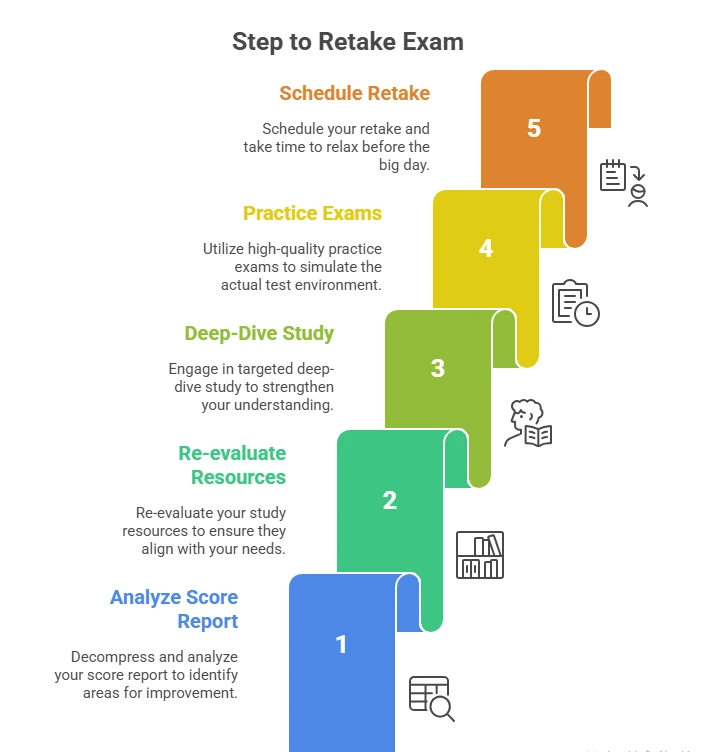
Step 1: Decompress and Analyze Your Score Report (Days 1-2)
The moment you see the “fail” result, your first instinct might be to feel frustrated. Allow yourself a day to decompress, but no more. On day two, it’s time for analysis. Your CompTIA score report is your most valuable tool. After your exam, you can access it from your CompTIA account. It will provide a list of the exam objectives you missed. It won’t show you the exact questions, but it will highlight the specific topics where you struggled. It might look something like this:
- Objective 1.3: Given a scenario, install and configure motherboards, CPUs, and add-on cards. – Incorrect
- Objective 2.5: Given a scenario, use appropriate networking tools. – Incorrect
This isn’t just a score; it’s a personalized study guide. It tells you exactly where you need to focus your energy.
Step 2: Re-evaluate Your Study Resources (Day 3)
Honestly assess the resources you used for your first attempt. Did your video course gloss over your weak areas? Were your practice exams too easy or not representative of the real test, especially the Performance-Based Questions (PBQs)? Now is the time to diversify. Consider adding a new resource that attacks your weak domains from a different angle. This could be:
- Official CompTIA Study Guides: For deep, authoritative knowledge.
- A different video course: Sometimes, a new instructor’s teaching style can make a concept click.
- Hands-on labs: Move from theory to practice. For A+, this means disassembling and reassembling a PC. For Network+, it means configuring a home router’s settings.
Step 3: Targeted Deep-Dive Study (Days 4-10)
Do not re-watch your entire 40-hour video course. Your study time is now a precious resource. Dedicate this week to a laser-focused deep dive into the exam objectives you missed, as identified by your score report. If you struggled with networking tools, spend this time mastering the command-line usage of ping, ipconfig/ifconfig, tracert, and netstat. If you missed questions on mobile device synchronization, dive deep into the specific email protocols (IMAP, POP3, SMTP) and data sync methods.
Step 4: The Power of High-Quality Practice Exams (Days 11-13)
This is arguably the most critical step. Invest in a set of high-quality, timed practice exams. To truly simulate the test and validate your renewed knowledge, using realistic practice questions (dumps) from a trusted source like PassITExams can be invaluable. The goal here is twofold:
- Knowledge Validation: Test your understanding of the topics you’ve just re-studied.
- Exam Simulation: Recreate the pressure of the real exam. Practice time management, learn to dissect complex questions, and specifically practice the interactive PBQs. For every question you get wrong in practice, don’t just look at the right answer—read the detailed explanation until you understand why it is correct and why the other options are incorrect.
Step 5: Schedule Your Retake and Relax (Day 14+)
After two weeks of strategic, focused effort, you can now log back into your CompTIA account and schedule your retake. Trust the process and the work you’ve put in to pass the CompTIA exam. It’s often wise to give yourself another week or so, booking your exam for around the 3-week mark from your initial attempt. Use the day before your new exam date to relax and do a light review of your notes. Do not cram. Trust the process and the work you’ve put in.
The Logistics: How to Register for a Retake
The practical process of registering for a retake is identical to your initial registration, with one key difference: the 14-day lockout.
- Log in to your CompTIA Certification Account.
- Navigate to “Schedule an Exam.”
- During the 14-day waiting period, you will notice that the exam you failed is greyed out or otherwise unavailable for registration.
- On the 15th day (or anytime thereafter), the exam will become available again.
- Click to schedule, select your provider (Pearson VUE), choose your preferred date and time, and complete the full payment for the exam fee.
Frequently Asked Questions (FAQs)
Is the 14-day waiting period business days or calendar days?
It is 14 calendar days, which includes weekends and holidays.
Will my retake exam have the same questions as my first attempt?
No. CompTIA has a very large pool of questions, including many different PBQs, for each certification. Your retake will be a new, unique exam with a different combination of questions drawn from that pool to maintain exam security.
Can I take a different CompTIA exam within the 14-day waiting period?
Yes. The retake policy is specific to the exam you failed. If you fail the CompTIA Network+ exam, you are free to schedule and take the CompTIA Security+ exam the very next day if you wish. Wondering if the CompTIA Security+ SY0-701 is worth it?
What is the retake policy for beta exams?
Beta exams have a different, much stricter policy. According to CompTIA, you can only take a beta exam once. If you fail, you cannot retake the beta version. You must wait until the official, production version of the exam is released to the public before you can attempt it again.
What is the policy for multi-part exams like CompTIA A+?
The policy applies to each exam individually. Your passing score on one part remains valid while you retake the other. A+ certification can lead to excellent CompTIA A+ salary and jobs.
Conclusion: A Second Chance for a Stronger Finish
Failing a CompTIA certification exam is not a reflection of your potential, but rather a snapshot of your preparation at a single point in time. The CompTIA Retake Policy is designed to empower you to change that snapshot. By using the waiting period strategically, you can turn a disappointing result into a resounding success and eventually address CompTIA Certification Renewal down the line. Follow the steps, trust the process, and prepare to earn that certification with confidence.
