
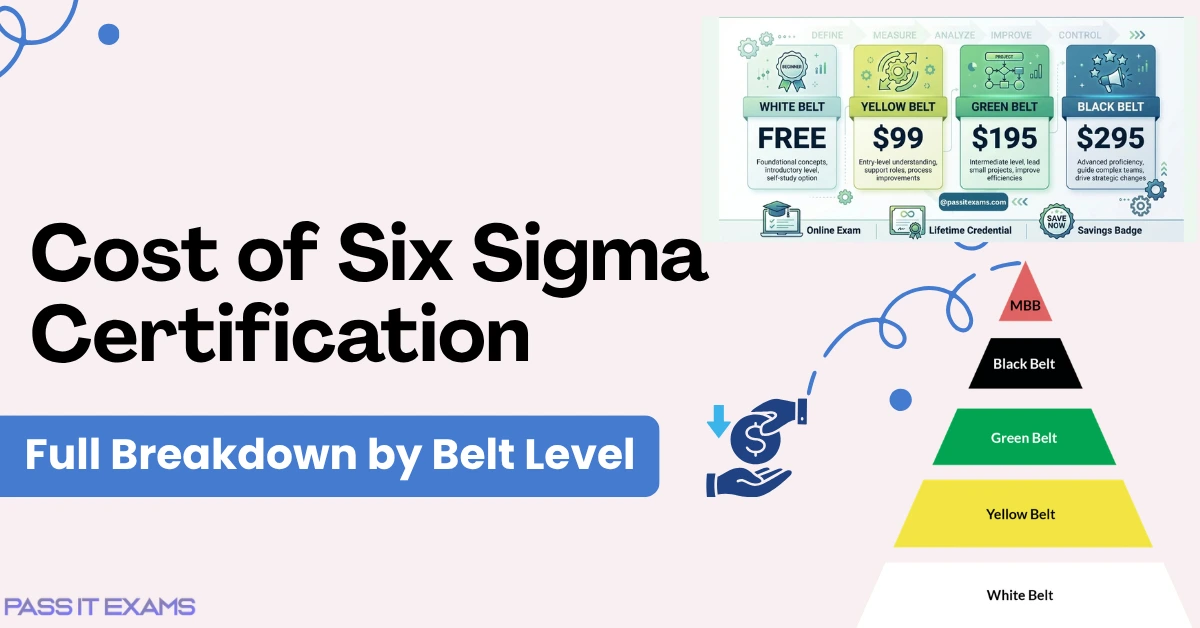
If you’re trying to figure out the real cost of Six Sigma certification, you’ve probably noticed the numbers online don’t agree with each other. Quoted prices range from $0 to $10,000, and it’s not because anyone is lying to you; it’s because “Six Sigma certification” isn’t one product. It’s a bundle of separate line items: training, an exam fee, study materials, sometimes a mentored project, and sometimes recertification years later.
What is the average cost of Six Sigma certification in 2026? Across all belt levels, most candidates pay between $0 (White Belt) and roughly $500 for exam-only certification through a recognized body like ASQ or IASSC, or between $300 and $3,000 for a full training-and-exam package at the Green Belt level. Black Belt and Master Black Belt packages run considerably higher, often $3,000 to $10,000, once mentored project work and advanced training are included.
Most course-comparison pages quote you the training price and stop there. But the training price is rarely the whole bill. A $299 Green Belt course can end up costing $600 or more once you add the exam fee, a retake, and a study guide you didn’t realize wasn’t included. This guide breaks down real 2026 pricing at every belt level; White, Yellow, Green, Black, and Master Black Belt; so you can budget accurately and avoid the hidden costs that catch most first-time candidates off guard.
What Is the Average Cost of Six Sigma Certification in 2026? (By Belt Level)
All pricing below is verified as of October 2026 from official ASQ, IASSC, and CSSC sources. Certification fees change without notice; always confirm current pricing on the certifying body’s website before purchasing.
Here’s what candidates are actually paying in 2026 across the major certifying bodies and popular training providers, plus what a full training-and-exam package typically costs.
| Belt Level | ASQ Member Fee | ASQ Non-Member Fee | IASSC / CSSC Fee | Typical Training + Exam Package |
|---|---|---|---|---|
| White Belt | N/A | N/A | Usually free | $0 – $60 |
| Yellow Belt | $294 | $394 | IASSC $195 / CSSC $99 | $175 – $2,000 |
| Green Belt | $338 – $383 | $438 – $483 | IASSC $295 / CSSC $159 | $300 – $3,000 |
| Black Belt | $438 – $485 | $538 – $585 | IASSC $395 / CSSC $229+ | $500 – $8,000 |
| Master Black Belt | $700 (portfolio) + $1,499 (exam) | $800 (portfolio) + $1,599 (exam) | CSSC $665 | $2,500 – $10,000+ |
A few specifics worth knowing:
- White Belt is almost always free or under $60, since providers use it as an introductory, no-prerequisite credential and a lead-generation tool for paid belts.
- Six Sigma Yellow Belt cost: ASQ charges $394 for non-members and $294 for members, with a $184 retake fee. IASSC charges $195, and CSSC charges $99 for the equivalent credential. Budget training providers can bring full packages in well under $200, while comprehensive instructor-led courses run into the low thousands.
- Six Sigma Green Belt certification cost: ASQ’s current exam fee runs $438 to $483 for non-members and $338 to $383 for members, with a retake fee of roughly $269 to $283; pricing has shifted slightly through 2026, so confirm the exact current figure on ASQ’s site. IASSC’s official Green Belt fee is $295, and CSSC’s is $159. Note that some IASSC on-demand exam vouchers, sold through third-party proctoring platforms, run higher; typically $350 to $402. University-affiliated programs sit at the high end: one university’s online Green Belt program runs $2,625, with an early-bird rate of $2,362.50.
- Six Sigma Black Belt certification cost: ASQ charges $538 to $585 for non-members and $438 to $485 for members. CSSC offers three tiers; a $229 base level plus $300 for each additional level; and IASSC’s official Black Belt fee is $395.
- Master Black Belt: ASQ’s current structure requires a portfolio review costing approximately $700 for members or $800 for non-members, plus an exam fee of roughly $1,499 (members) or $1,599 (non-members), with a retake fee near $1,399. CSSC’s Master Black Belt exam costs $665.
Key takeaway: The certifying-body exam fee is usually the smallest, most predictable number in your budget. The training you pay to prepare for that exam; not the exam itself; is what swings your total cost of Six Sigma certification by thousands of dollars.
True Cost Example: Self-Paced vs. Mentored Green Belt
| Path | Course/Training | Exam Fee | Materials | Estimated Total |
|---|---|---|---|---|
| Self-paced online, exam bundled | $299.95 | Included | Included | ≈ $300 |
| University / mentored program | $2,362.50 (early bird) | Included | Included, plus live Q&A and project coaching | ≈ $2,363 |
Both paths can lead to the same recognized credential. The roughly $2,000 gap buys live instructor access, structured project mentoring, and cohort accountability; not a “better” certification on paper.
What Affects the Price of Six Sigma Certification?
Six factors explain almost all of the price variation you’ll see between providers.
- Accreditation body: ASQ is the most rigorous and widely recognized certifying body in the U.S., and it prices accordingly. IASSC positions itself as a standardized, training-agnostic exam body with moderate fees and no experience prerequisites. CSSC and smaller bodies compete on price, which is why Green Belt exam fees alone range from $159 to $483 depending on which organization issues the credential.
- Online vs. classroom delivery: Self-paced online courses are almost always cheaper, since they don’t carry instructor or facility costs. Live classroom or virtual-instructor-led training; especially through universities or corporate training firms; commands a premium, often three to ten times the price of a self-paced equivalent, because you’re paying for real-time coaching and cohort accountability.
- Project mentoring: Green Belt and above typically require, or strongly recommend, a real-world improvement project. Courses that include one-on-one mentoring through that project cost significantly more than courses that hand you a template with no support.
- Exam fees vs. bundled pricing: Some providers sell training and exam access separately; others bundle them into one price. Always check whether the advertised price includes the certifying exam or just the coursework.
- Study materials: Textbooks, simulation software (like Minitab), practice exams, and case-study packs are sometimes included and sometimes sold as add-ons costing $50 to $300.
- Employer or corporate discounts: If you’re going through a corporate training initiative, per-seat pricing for group cohorts can run 30% to 50% below individual retail pricing.
What Hidden Costs Do People Forget When Budgeting for Six Sigma?
The advertised price is rarely your final price. Budget for these before you commit:
- Exam retakes: Retake fees are not trivial. ASQ’s Green Belt retake costs roughly $269 to $283, Black Belt retake sits near $338 to $485, and Master Black Belt retake is a steep $1,399. Failing once at the higher belt levels can meaningfully change your total spend.
- Project time, not just project cost: Green Belt and Black Belt certifications through rigorous bodies require documented, real-world projects, sometimes with signed affidavits. This isn’t a cash cost, but it’s a real cost: dozens to hundreds of hours of your time, often unpaid, before you’re eligible to certify.
- Recertification fees: Credentials from bodies like ASQ typically need renewal every three years. Renewal usually involves a fee, often in the $75 to $150 range, plus continuing education or professional development units.
- Software licenses: Minitab, JMP, or similar statistical software used in Green Belt and Black Belt coursework often requires a separate license if it isn’t bundled. Student licenses typically run $30 to $100 for a limited term.
- Travel and lost wages for classroom training: If you’re attending an in-person bootcamp, factor in travel, lodging, and time away from billable work.
Key takeaway: Add these hidden costs up, and a candidate’s true cost of Six Sigma certification commonly runs 20% to 40% higher than the number shown at checkout.
Is Six Sigma Certification Worth the Cost? ROI by Belt Level
Here’s where the math tends to work in the candidate’s favor, even at the more expensive end. For a deeper look at whether the investment makes sense for your specific situation, see our full Is Six Sigma Certification Worth It? pillar guide.
| Belt Level | Typical U.S. Salary (2026) | Reported Salary Uplift vs. Non-Certified Peers |
|---|---|---|
| White Belt | ~$57,000 | Minimal; entry signal only |
| Yellow Belt | ~$85,000 | Modest; supports internal mobility |
| Green Belt | $85,000 – $128,000 | $8,000 – $15,000 annually |
| Black Belt | $117,000 – $147,000 | $15,000 – $30,000 annually |
| Master Black Belt | $145,000 – $190,000+ | $25,000 – $50,000 annually |
Salary.com data compiled by GoLeanSixSigma shows White Belts earning around $57,000 and Yellow Belts around $85,000, while Green Belts sit at a national average near $119,800, with Glassdoor placing the average even higher at $128,005. Black Belts commonly earn between $117,200 and $147,200, and Master Black Belts frequently clear $145,000 or more.
It’s not just salary. Average project savings at the Black Belt level often exceed $230,000 per project, which is a large part of why employers are willing to fund training directly. The payback period also tends to be fast: moving from Green Belt to Black Belt is commonly reported to add roughly $17,200 in average annual salary, enough to recover most training costs within the first year for many professionals.
Salary uplift depends heavily on industry, location, whether you actually led a project versus just passed an exam, and your specific employer’s compensation structure. Promotion probability after Green Belt certification typically ranges from 30% to 70% within 12 to 24 months, so treat the ROI figures above as a realistic ceiling, not a guarantee.
Key takeaway: Across every belt level, documented salary uplift and project-savings data suggest the cost of Six Sigma certification pays for itself quickly for candidates who complete a real project, but results vary significantly by employer and industry.
Is a More Expensive Six Sigma Program Always Better?
No; and this is where a lot of candidates overspend. Price correlates with delivery format and support level, not automatically with credibility or exam pass rates. A $2,600 university Green Belt course and a $299 self-paced course can lead to the exact same ASQ or IASSC certification, since both simply prepare you for that body’s exam.
What expensive programs genuinely tend to buy you:
- Live instructor access and real-time Q&A
- Structured, mentored project work, valuable if you don’t already have a project in mind
- Cohort accountability, which helps completion rates
- Brand recognition on a resume, in some industries
What expensive programs don’t automatically buy you:
- A “better” certification; an ASQ Green Belt is an ASQ Green Belt regardless of which course prepared you for it
- Guaranteed job outcomes
- Faster time-to-competency, since self-discipline matters more than price here
Before paying anything, check these four quality filters:
- Is the course explicitly aligned to a recognized body’s Body of Knowledge (ASQ, IASSC, or CSSC), or is it an unaffiliated “certificate of completion” with no external exam?
- Does the price include the actual certifying exam, or only preparation for an exam you’ll still pay for separately?
- Are instructors credentialed (Black Belt or Master Black Belt themselves), and is that verifiable?
- Is there a real project component, or is the “hands-on project” just a case study you read?
Key takeaway: A higher price buys support and structure, not a superior credential; the certifying body, not the course price, determines how the certification is recognized.
How Do You Get the Best Value on Six Sigma Certification?
Start at White or Yellow Belt if you’re new to the field. Don’t pay Green Belt prices to find out whether you enjoy process improvement work; many White Belt courses are free and Yellow Belt options start under $200.
Separate the exam fee from the training fee when comparing providers. A “$399 Green Belt course”that doesn’t include the exam is not cheaper than a”$483 course” that does. For a side-by-side comparison of specific providers, see our Best Lean Six Sigma Certification guide.
Ask your employer to sponsor it; and make the case directly. Many companies running Lean Six Sigma initiatives will cover training costs, especially for Green Belt and above, since the organization benefits directly from completed projects and documented savings. Frame the request around a specific process problem you’d tackle as your certification project; employers are far more likely to fund training tied to a concrete, budgeted outcome than a general “professional development” request.
Check for bundled multi-belt pricing. Some providers discount Yellow+Green or Green+Black bundles significantly compared to buying each belt separately.
Budget for the retake, not just the first attempt. If a program’s retake fee is unusually high, factor that risk into your decision; a slightly more expensive course with stronger exam prep can be cheaper in expectation.
Verify accreditation before comparing price at all. A $99 “certification” from an unaccredited provider isn’t a bargain if employers don’t recognize it; it isn’t truly comparable to a $295 IASSC or $483 ASQ credential.
Decision framework: if your goal is maximum employer recognition, particularly in manufacturing, healthcare, or government-adjacent industries, prioritize ASQ despite the higher fees. If speed and lower cost matter more than brand recognition, IASSC or CSSC are usually the better fit.
Six Sigma Certification Cost FAQ
Is Six Sigma White Belt certification free?
Yes, most providers offer Six Sigma White Belt certification at no cost or for under $60, since it’s designed as a no-prerequisite entry point with minimal content.
What is the Six Sigma Yellow Belt certification fee?
The Six Sigma Yellow Belt certification fee through ASQ is $394 for non-members and $294 for members, with a $184 retake fee. IASSC charges $195, and CSSC charges $99. Full training packages with materials typically range from $175 to $2,000.
How much does Six Sigma Green Belt certification cost through ASQ?
ASQ’s Six Sigma Green Belt certification cost is $438 to $483 for non-members and $338 to $383 for members, with a retake fee of roughly $269 to $283. Pricing has shifted slightly during 2026, so confirm the current figure on ASQ’s site before paying.
Is IASSC or ASQ cheaper for Six Sigma certification?
IASSC is generally cheaper than ASQ and has no work-experience prerequisites. Official IASSC fees are $195 for Yellow Belt, $295 for Green Belt, and $395 for Black Belt, though some on-demand exam vouchers sold through third-party proctors run higher, at $350 to $402. ASQ is often viewed as the more established name for U.S. employers, particularly in manufacturing and quality-management fields.
Does Six Sigma certification expire?
Yes, Six Sigma certifications typically expire every three years through bodies like ASQ, requiring a renewal fee and often continuing education credits to keep the credential active.
Do I need to pay for a project to get Green Belt or Black Belt certified?
There’s no direct cash cost for the project itself, but there is a real time cost. ASQ’s Black Belt path, for example, requires two completed and signed-off projects, or one project plus three years of experience, completed largely on the candidate’s own time.
Conclusion: Choosing the Right Six Sigma Investment for 2026
The true cost of Six Sigma certification is rarely the number on the landing page. Between exam fees, retakes, materials, and recertification, real spending ranges from free (White Belt) to well over $8,000 (Master Black Belt with mentored training). The good news: at every belt level, documented salary uplift and project-savings data suggest the investment pays for itself quickly for candidates who complete a real project, not just an exam.
Before you enroll, confirm which certifying body you’re targeting, whether the exam fee is included in your quoted price, and what happens if you need a retake. If you’re still deciding which program offers the best mix of price and credibility, see our full Best Six Sigma Certification Programs in 2026 guide. And if you’re not yet sure certification is the right move for your career at all, our pillar guide Is Six Sigma Certification Worth It? walks through the decision in more depth.
