

The rise in sophisticated cyber threats and complex data privacy regulations has created an urgent need for professionals with specialized expertise in cybersecurity and risk management. For those looking to validate their skills at a high level, two of the most prominent certifications are CRISC (Certified in Risk and Information Systems Control) and CISSP (Certified Information Systems Security Professional).
While both are globally recognized and highly respected, they are designed for different career paths and philosophies. Choosing the Best Cybersecurity Certification is a critical step in your professional journey, defining whether you become a specialist in business risk or a generalist in security leadership. This article will explore the key differences, backed by live job market data and community insights, to help you make an informed decision.
What is CRISC Certification?

The Certified in Risk and Information Systems Control (CRISC) certification is offered by ISACA, a global leader in IT governance and assurance. This certification is designed specifically for IT and business professionals who identify and manage risk through the development and implementation of information system (IS) controls.
CRISC focuses exclusively on assessing, mitigating, and managing IT risk in alignment with an organization’s broader business objectives. It is the premier certification for individuals who want to specialize in risk management, control assurance, and IT governance roles. The CRISC professional is comfortable in the boardroom, translating complex technical vulnerabilities into quantifiable business risks that executives can understand and act upon.
What is CISSP Certification?

The Certified Information Systems Security Professional (CISSP) certification is offered by the International Information Systems Security Certification Consortium, or (ISC)². The CISSP is widely considered the gold standard in information security certifications for leadership roles.To understand its foundational concepts, you can explore the 5 core principles of CISSP.
It is aimed at professionals who design, implement, and manage a secure business environment. Unlike the specialized focus of CRISC, the CISSP covers a broad range of information security topics across eight domains. A CISSP isn’t expected to be the best penetration tester or the best cryptographer, but they are expected to understand how all those pieces fit together to form a cohesive security program.
CRISC vs CISSP: At-a-Glance Comparison
| Feature | CRISC (Certified in Risk and Information Systems Control) | CISSP (Certified Information Systems Security Professional) |
|---|---|---|
| Certification Provider | ISACA | (ISC)² |
| Primary Focus | IT Risk Management & Business Alignment | Broad Information Security Leadership & Management |
| Exam Time | 4 hours | 4 hours |
| Passing Score | 450 out of 800 | 700 out of 1000 |
| Exam Cost (USD) | $575 (Member) / $760 (Non-member) | $749 – For a detailed breakdown, see the CISSP Certification Cost. |
For those preparing for the exam, this CISSP Exam Guide can be a helpful resource, and you might also be interested in finding the best CISSP dumps.
Data Driven Insights: A Look at the Live Job Market
To provide a clear picture of how employers value these certifications, our research team conducted an extensive analysis of the job portals Indeed and Glassdoor.
The CISSP Job Market: A Gateway to the C-Suite
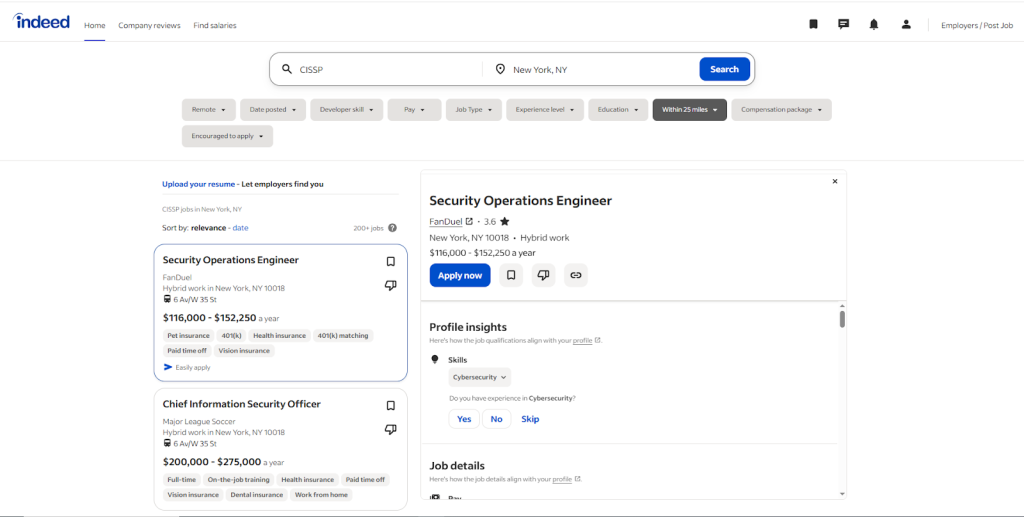

Our research confirms the massive demand for CISSP holders, with over 9,400 jobs listed nationally on Glassdoor and 200+ in a single city like New York on Indeed. More importantly, the data shows the CISSP is a direct pathway to the executive suite. The search uncovered roles for Chief Information Security Officer (CISO) with a staggering salary range of $200,000 – $275,000. This highlights that the CISSP certification is worth it. The presence of this C-suite role is a powerful indicator of the career apex that the CISSP path enables.
The CRISC Job Market: The High-Value Risk Specialist
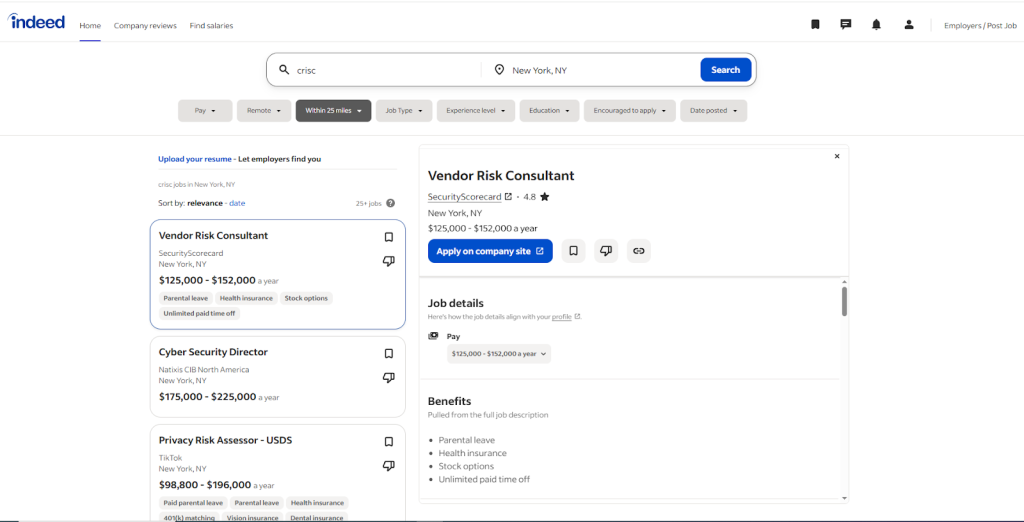
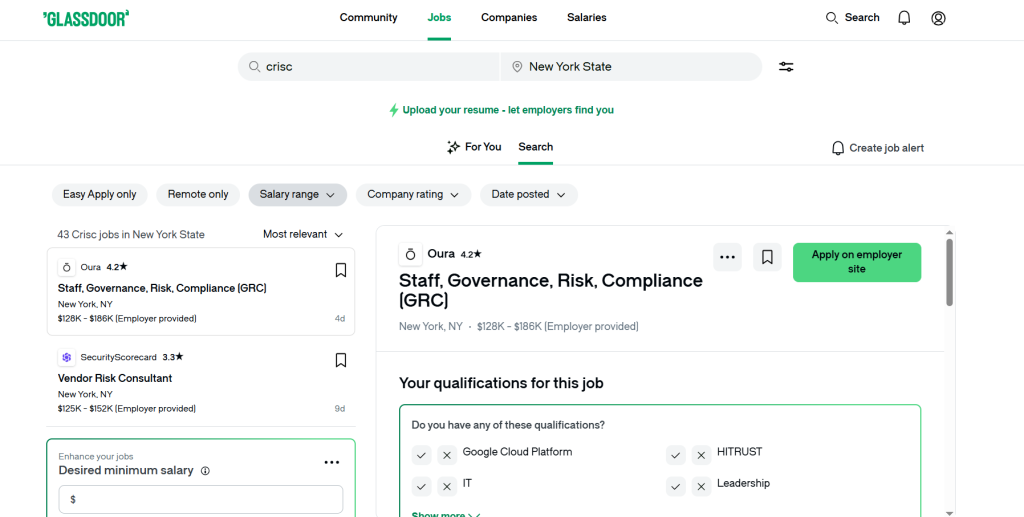
Our analysis for CRISC shows a more specialized but extremely lucrative market. While the number of national jobs is smaller (over 500 on Glassdoor), the roles are highly focused on risk and command elite salaries. We found positions like “Cyber Security Director” with a salary of up to $225,000 and “Lead IT Risk & Control” with a range of $111,000 – $190,000. The high salaries for these specialized roles show that the market places a significant premium on the niche expertise that CRISC validates.
Insights from the Cybersecurity Community: Builder vs. Auditor
To get a feel for how practitioners in the field view these certifications, our research team analyzed a popular discussion on the professional forum Reddit. The most powerful insight was a recurring analogy:
- The CISSP is for the “Builder” or “Architect” who designs and implements the security program. They are concerned with questions like, “What is the best firewall architecture for this application?”
- The ISACA certifications (like CRISC) are for the “Auditor” or “Governor” who assesses that program against business risk and compliance requirements. They are concerned with questions like, “Does our firewall architecture meet our compliance obligations and align with our stated risk appetite?”
Professionals in the forum consistently state that the certifications are not competitors but are complementary. The consensus is that the CISSP provides the broad security knowledge, while the CRISC provides the deep expertise in business risk needed for executive-level decision making.
Key Differences Between CRISC And CISSP
Focus and Domain Variations
CRISC
Has a laser focus on IT risk management. Its four domains are Governance, IT Risk Assessment, Risk Response and Reporting, and Information Technology and Security.
CISSP
Covers a broad spectrum of information security. Its eight domains include Security and Risk Management, Asset Security, Security Architecture and Engineering, Communication and Network Security, Identity and Access Management (IAM), Security Assessment and Testing, Security Operations, and Software Development Security.
Work Experience Requirements
CRISC
Requires three years of cumulative work experience in IT risk management and IS control. This experience must be in at least three of the four CRISC domains and must be earned within the preceding 10 years.
CISSP
Requires five years of cumulative work experience in two or more of the eight CISSP domains. This must be full-time, paid experience. A one-year waiver can be granted for a relevant four-year degree or an approved credential. For more details, check the CISSP Certification Cost and Requirements.
CISSP Comparison with other Key Certifications
While this article focuses on CRISC vs CISSP, many professionals also consider other certifications. Here are some other popular comparisons to help you get a complete picture:
Job Roles and Salary Prospects
CRISC
Leads to specialized roles like IT Risk Advisor, GRC Consultant, and Technology Risk Analyst. The average salary for a CRISC-certified professional in the U.S. is approximately $152,000 per year.
CISSP
Leads to a wider range of roles like Security Manager and Security Architect. The average salary for a CISSP-certified professional in the U.S. is approximately $140,000 per year.
Conclusion: Which Path is Right for You?
Choosing between CRISC and CISSP is not about which certification is “better,” but which one aligns with your specific career aspirations.
- You should choose CRISC if: Your passion and career are focused on risk, governance, and compliance (GRC). You want to be the expert who bridges the gap between technical IT risks and business objectives, advising leadership on risk posture and response.
- You should choose CISSP if: You are aiming for a broad security leadership role. You want a comprehensive, 360-degree understanding of all aspects of information security, from technical controls to policy and management, preparing you to lead an entire security program.
Ultimately, many senior GRC and security executives hold both certifications to demonstrate their broad security knowledge (CISSP) and their deep expertise in risk management (CRISC).
Frequently Asked Questions (FAQs)
Is CRISC or CISSP harder?
The difficulty is subjective. The CISSP is generally considered harder due to its vast “mile-wide” scope across eight domains and its challenging adaptive exam format. The CRISC is narrower in scope but requires very deep, specialized knowledge of risk management frameworks and business processes.
Which certification pays more?
Both are among the highest-paying IT certifications. Recent salary surveys and our live job market data often place the CRISC slightly higher on average. This is likely due to its highly specialized nature and the intense demand for experienced risk management professionals in high-stakes industries like finance.
Do I need CISSP before CRISC?
No, the CISSP is not a prerequisite for the CRISC. They are distinct career paths. However, the knowledge gained from the CISSP provides a strong foundation for a professional who later decides to specialize with the CRISC.
Are these certifications for beginners?
No. Both CRISC and CISSP are designed for experienced professionals. They require a minimum of three to five years of dedicated, real-world work experience in their respective fields before you can become fully certified.
More Certification Comparisons
Compare scope, difficulty, prep time, and career impact—side by side.
PassITExams vs ExamTopics
Which Platform is Best for IT Certification Exam Preparation?
PassITExams vs Skillcertpro
The Ultimate Guide to Choosing Your IT Certification Success Partner
PassITExams vs Pass4sure
A Critical Examination of Certification Preparation Platforms
CTFA vs CFP
Choosing the Right Financial Designation for a Career in Fiduciary and Wealth Management
Splunk vs Elastic
The Ultimate Comparison for Logging, SIEM, and Observability
IBM QRadar vs Splunk
The Ultimate SIEM Comparison for Modern Security Operations
SageMaker vs Bedrock
Choosing the Right Engine for Your AI Strategy in 2026
az-104 vs az-400
our Definitive Azure Career Path for 2026 (Admin vs. DevOps)
AZ-104 vs AI-900
Azure Admin Associate Or AI Fundamentals?
AZ-104 vs PL-300
Azure Admin or Data Analyst? (Salary & Jobs)
AZ-104 vs AZ-500
Which Azure Certification Is Right for Your Career?
AZ-900 vs CLF-C02
Which Foundational Cloud Cert Unlocks the Best Jobs and Salaries?
AZ-900 vs SAA-C03
Which Cloud Certification is Right for You?
RHIT vs RHIA
Which Health Information Credential Is Right for You?
AZ-900 vs DP-900
Which Azure Certification Should You Take First?
AZ-900 vs SC-900
Choose Your Microsoft Certification Path
AZ-900 vs AI-900
Which Azure Fundamentals Certification Is Your Launchpad?
AZ-204 vs AZ-305
The Builder vs. The Architect
AZ-900 vs AZ-204
Which Microsoft Azure Certification is Right for You?
az-204 vs pl-300
Building the Engine or Charting the Course?
AZ-900 vs AZ-400
Foundational vs. Expert: Complete Guide for Your Azure Career
601 vs 601
CompTIA Security+ 601 vs 701: The Ultimate Comparison Guide
Data Engineer vs Data Scientist
The Ultimate Comparison Guide
AWS vs Azure
The Ultimate Comparison for Certification & Career
CISSP vs SecurityX
Which Certification Will Define Your Cybersecurity Career?
AWS vs Azure
Who is Leading the Cloud Race?
AWS vs Azure
Which Cloud Certification is Paying High?
AZ-104 vs AZ-305
Administrator vs. Architect – Your Ultimate Azure Guide
AZ-104 vs AZ-204
The Ultimate Guide for Your Azure Career
ISSA vs NASM
Which Personal Trainer Certification Is Best for You?
Salesforce Admin vs Salesforce Developer
Unlocking Your Earning Potential in the Salesforce Ecosystem
CISSP vs CCSP
Your Ultimate Guide to a Career in Cloud Security
CRISC vs CISSP
Mastering Risk Management and Information Security
CISSP vs CEH
Your Guide to Mastering Offensive and Defensive Security
CISSP vs PMP
Unlocking Dual Expertise in Security and Project Management
CISSP vs Security+
Choosing the Right Certification to Boost Your Earning Potential
CISSP vs OSCP
Choosing the Right Certification for a Six-Figure Cybersecurity Career
CISSP vs CISM
Which Certification Will Truly Elevate Your Cybersecurity Career?
Azure vs AWS
How to Choose the Right Cloud Platform for Your Business
AZ-900 vs AZ-700
MIcrosoft Career Blueprint: From Azure Fundamentals to Networking
AZ-900 vs AZ-104
Azure Career Blueprint: Your Path from Azure Fundamentals to Azure Administrator
AZ-104 vs SAA-C03
Azure Administrator vs. AWS Architect: Which Career Path Wins?
AZ-900 vs MS-900
Your ultimate Microsoft fundamentals showdown.
