
If you’re considering the Certified Trust and Fiduciary Advisor (CTFA) certification, you’re looking at one of the most respected credentials in wealth management and trust services. This isn’t just another certification to add to your resume it’s the gold standard that separates dedicated professionals from the rest of the pack in the fiduciary industry.
Let me walk you through everything you need to know about the CTFA exam, from pass rates and difficulty to preparation strategies and career impact.
Is the CTFA Pass Rate Publicly Disclosed? Understanding Exam Rigor
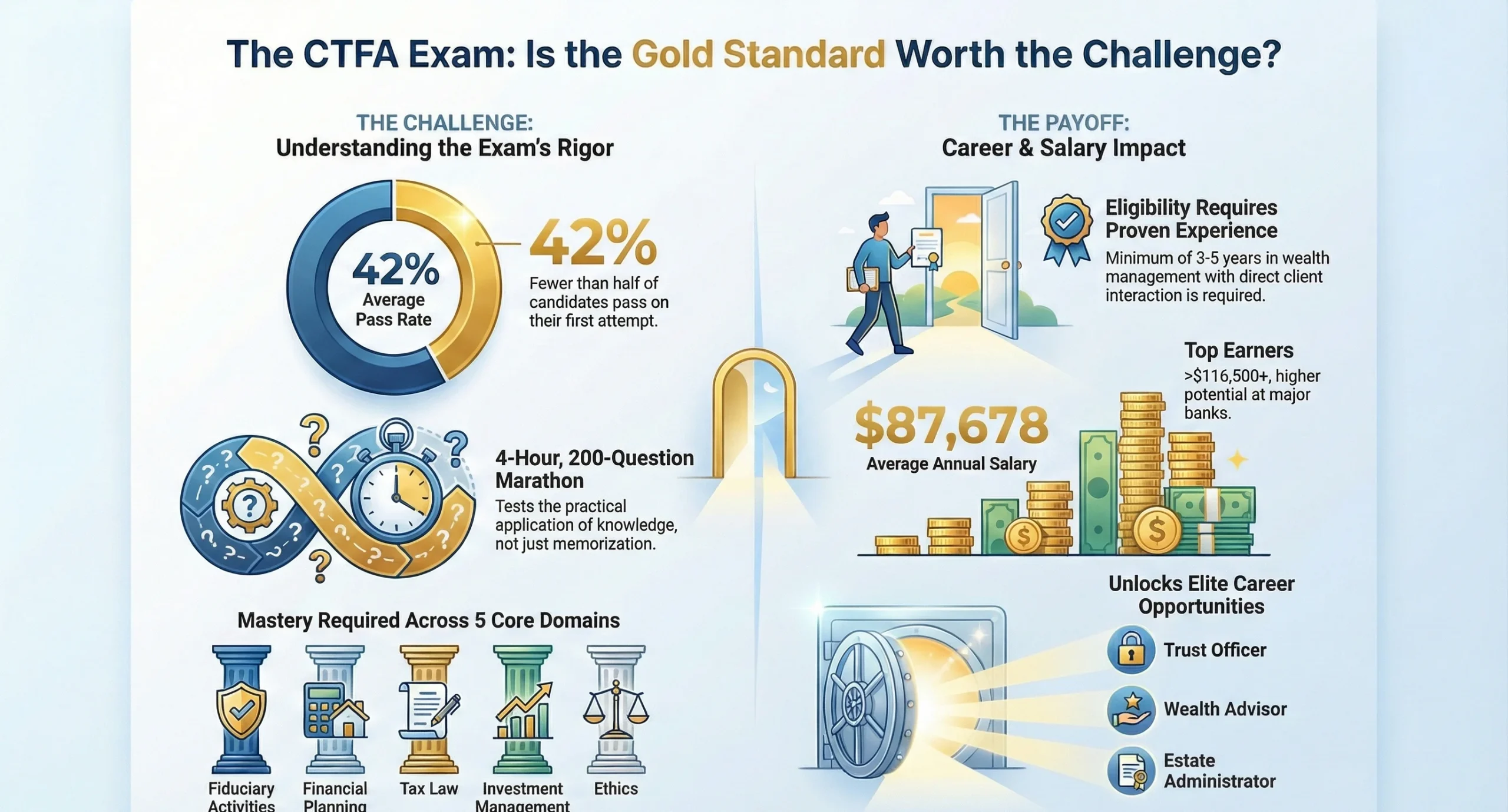
Here’s the thing about the CTFA pass rate: the American Bankers Association doesn’t officially publish exact pass rate statistics. However, based on industry data and third-party analysis, the average pass rate hovers around 42%. This means fewer than half of candidates pass on their first attempt.
Why does this matter? Because this pass rate tells you something important about the exam’s rigor. The CTFA isn’t a certification you can casually study for over a weekend. The exam assesses not only your knowledge of topics but also your application of that knowledge to real-world scenarios. This practical application component is what trips up many otherwise well-prepared candidates.
The American Bankers Association maintains this level of difficulty intentionally. They’re not trying to make things harder for you they’re ensuring that anyone who earns the CTFA designation truly has the expertise needed to serve as a trusted advisor for high-net-worth clients. Your dedication to earning this certification signals to employers and clients that you’re serious about fiduciary responsibilities and professional excellence.
What Makes the CTFA Exam Difficult?
The exam’s complexity stems from several factors. First, the breadth of material is substantial. You need in-depth knowledge across tax law, regulatory compliance, fiduciary principles, investment management, and financial planning. The exam requires extensive understanding of how to recognize signs of elder abuse, navigate complex trust structures, and comply with regulations governing trusts and estates.
Second, the questions aren’t straightforward recall. They present case studies and scenarios that require you to synthesize information from multiple domains. You might see a question that tests your understanding of tax implications while simultaneously requiring knowledge of estate planning strategies and fiduciary duties.
Third, the field itself is constantly evolving. Laws and regulations change regularly, and the October exam covers laws and regulations in effect through October 31 of the prior year, while other exams cover current laws and regulations. This means you can’t rely solely on outdated study materials.
CTFA Examination Details: Format, Scoring, and Logistics
Let’s get into the specifics of what you’ll face on exam day.
Exam Format:
- 200 multiple-choice questions
- 4-hour time limit
- Questions can be marked for review and answers can be changed if time permits
Scoring System: The ABA uses scaled scoring for all professional certification exams. Your score will fall on a scale from 200 to 800, with 500 being the predetermined passing score. This scaled approach ensures fairness across different exam administrations.
Testing Options: You have flexibility in how you take the exam. The ABA offers approved candidates two options:
- Testing at Meazure Learning’s physical test sites across the United States
- Live remote proctoring through the ProctorU platform, allowing you to take the exam at home if you meet the technical requirements
Exam Windows: The ABA offers multiple testing windows throughout the year. For example, the October 1-28, 2026 testing window requires applications by October 5, 2025. These month-long windows give you flexibility to schedule your exam on the day and time that works best for you.
Cost Structure: Let’s talk about the financial investment. While some sources cite different figures, the current exam pricing structure requires careful planning. The initial exam fee represents a significant investment, and if you need to retake the exam, there’s an additional retake fee. If your application is denied, you’ll receive a refund minus a $100 application fee.
Results: Most computer-based exams at test sites provide instant “Pass/Fail” outcomes, though occasionally instant outcomes aren’t provided while statistical analysis is conducted. Official score reports are delivered via email within 6 weeks after the close of the exam window.
CTFA Core Domains and Knowledge Areas
The CTFA exam is built around five core competency areas that reflect what a competent trust advisor professional needs to know:
1. Fiduciary and Trust Activities This domain covers the ethical and legal responsibilities inherent in fiduciary roles. You’ll need to understand trust administration, fiduciary duties, and the regulatory frameworks that govern trust activities.
2. Financial Planning This section tests your ability to develop comprehensive financial strategies for clients. Levels 1 and 2 of the ABA’s training have been redesigned to include all content covered for the CTFA designation, ensuring you’re prepared for integrated financial planning scenarios.
3. Tax Law and Planning Tax planning is one of the most complex areas of the exam. You need current knowledge of federal and state tax laws, estate tax planning, gift tax strategies, and income tax considerations for trusts and estates.
4. Investment Management This domain requires understanding across various asset classes and their management implications. You’ll need to demonstrate knowledge of portfolio management, asset allocation, and investment strategies appropriate for fiduciary accounts.
5. Ethics and Risk Management Professional ethics aren’t just philosophical concepts they’re practical requirements for anyone managing client assets in a fiduciary capacity. This domain covers ethical decision-making, risk assessment, and compliance requirements.
Retake Policy and Certification Timelines
If you don’t pass on your first attempt, here’s what you need to know:
- You must wait a minimum of 90 days between the start date of your most recent exam window and the start date of your retake window
- You have a 3-year window from the date of your first attempt to pass the exam
- If you don’t pass within that 3-year period, you’ll need to submit a new application and pay the full fee again
The silver lining? This retake policy actually protects the value of the certification. It ensures that when you do pass, your CTFA designation represents current, relevant knowledge rather than outdated information from years-old study materials.
Key Prerequisites: Do You Qualify to Take the CTFA Exam?
The ABA has specific eligibility requirements designed to ensure candidates have sufficient practical experience before attempting the certification. You can’t just study your way into this exam you need real-world experience to even qualify.
Experience Requirements (you must meet one of these):
Three years minimum experience in wealth management AND a bachelor’s degree
Five years minimum experience in wealth management within the last seven years AND a bachelor’s degree
Ten or more years of experience in wealth management, with at least five of those years within the last seven years
Qualifying Training Programs: Alternatively, you can qualify through completion of specific accredited programs, including:
- Florida Trust and Wealth Management Schools (Junior and Senior level) earned through Florida Bankers Association and completion of the ABA CTFA Exam Online Prep
- Texas Trust School and Graduate Texas Trust School earned through the Texas Bankers Association
- University of Delaware’s Trust Management Minor (when coupled with a Finance or Financial Planning major)
Additional Requirements: Beyond experience, you must demonstrate a history of ethical conduct and agree to abide by the ABA’s code of ethics. This isn’t just a formality the ABA takes professional ethics seriously, and violations can result in certification revocation.
Understanding Qualifying Wealth Management Experience
Not all financial services experience counts toward CTFA eligibility. Wealth management experience is defined as direct client interaction to deliver fiduciary services planning and advice, asset management, trusts, estates, IRAs, qualified retirement plans, and custody services.
What this means in practical terms: if you’ve been working in corporate trust operations without direct client interaction, or in roles that don’t involve fiduciary services, that experience October not qualify. The ABA is looking for professionals who have hands-on experience advising clients on wealth management matters.
Effective Strategies for CTFA Exam Preparation and Success
Now let’s talk about how to actually prepare for this exam. Based on what works for successful candidates, here’s your roadmap:
Start with Official ABA Resources The ABA offers a 4-series Reference Guide to Wealth Management and Trust that’s updated annually. These guides are comprehensive resources that cover expanded topics to meet diverse client expectations, with two entire volumes focused on integrated planning and advice. If you’re taking the exam during the October window, the Reference Guide released the previous year will suffice.
Take the Online Prep Course The ABA offers an interactive, user-friendly online course that allows you to study at your own pace, with access to resources and practice tests modeled after the actual exam. This isn’t optional in my opinion the practice tests alone are worth the investment because they help you understand question formats and identify weak areas.
Focus on Application, Not Just Memorization Remember, the exam tests your ability to apply knowledge to real-world scenarios. When you study, don’t just memorize definitions. Instead, think through how concepts apply to client situations. Practice explaining complex tax strategies or trust structures as if you were advising an actual client.
Create a Study Schedule With 200 questions covering five major domains, you need a structured approach. Allocate study time based on the weight of each domain and your current knowledge level. If you’re weak in tax law, spend more time there. If investment management is your strength, review it but don’t over-invest time.
Use Practice Exams Strategically Don’t save all your practice exams for the end of your study period. Take one early to establish a baseline, then use practice exams throughout your preparation to track progress and adjust your study plan. Sample questions are available on the ABA website to help you get familiar with the format.
Join Study Groups or Forums Connect with other CTFA candidates. Explaining concepts to others reinforces your own understanding, and you’ll gain insights from people who see things differently than you do.
Stay Current on Regulatory Changes Set up alerts for significant changes in trust law, tax regulations, and fiduciary standards. The exam covers current regulations, so you can’t rely solely on materials from a year ago.
The Value of Passing: CTFA Salary and Career Opportunities
Let’s be honest about why you’re considering this certification: you want to advance your career and increase your earning potential. The CTFA delivers on both fronts.
Salary Ranges: As of recent data, the average annual salary for CTFA-certified professionals in the United States is $87,678. However, this figure tells only part of the story. The majority of CTFA salaries currently range between $72,000 at the 25th percentile to $107,500 at the 75th percentile, with top earners in the 90th percentile making $116,500 annually.
Geographic location significantly impacts earning potential. Salaries vary substantially by location, with cities like Nome, Alaska offering salaries that are 24% above the national average.
By employer, compensation varies as well. At major financial institutions, average salaries for CTFA-certified professionals include approximately $103,500 at some institutions and $140,993 at Bank of America.
Career Advancement Opportunities: The CTFA opens doors to specialized roles that aren’t accessible without it:
- Trust Officer positions at major banks
- Wealth Management Advisor roles for high-net-worth clients
- Estate Administrator positions
- Senior Trust Consultant roles
- Fiduciary Advisor positions in private banking
Beyond specific job titles, the certification signals to employers that you’re committed to the profession and have the knowledge to handle complex fiduciary responsibilities. This often translates to faster promotions and access to more challenging (and higher-paying) client relationships.
Long-Term Value: The CTFA isn’t just a one-time boost to your career. It requires continuing education to maintain, which means you’ll stay current in the field. This ongoing learning, combined with the professional network you’ll build, compounds the certification’s value over time.
The credential also provides credibility with clients. When you’re advising someone on multi-million dollar trusts or complex estate plans, having the CTFA after your name reassures them that you have the expertise to manage their wealth responsibly.
10 Essential FAQs About the CTFA Certification
Q1: What is the Certified Trust and Fiduciary Advisor (CTFA) certification?
The CTFA is a prestigious professional credential offered by the American Bankers Association that validates expertise in trust services, fiduciary management, investments, and tax law. It’s recognized as the gold standard in the wealth management and trust industry.
Q2: Is the CTFA exam considered difficult?
Yes, the CTFA exam is known for its rigor. With an average pass rate around 42%, it requires dedicated study and preparation. The exam tests both knowledge and the ability to apply that knowledge to practical scenarios, which makes it challenging even for experienced professionals.
Q3: What score is required to pass the CTFA exam?
All ABA Professional Certification exams use scaled scoring from 200 to 800, with 500 being the predetermined passing score. This scaled approach ensures consistency across different exam administrations.
Q4: How long is the CTFA certification exam?
The CTFA exam is a 4-hour exam consisting of 200 multiple-choice questions. The exam assesses both knowledge and the ability to apply that knowledge to practical examples.
Q5: What are the core subject areas tested on the CTFA exam?
The CTFA exam covers five core domains: Fiduciary and Trust Activities, Financial Planning, Tax Law and Planning, Investment Management, and Ethics and Risk Management. Each domain requires in-depth understanding and practical application skills.
Q6: How much does it cost to take the CTFA exam?
The exam requires a significant financial investment for the initial sitting, with a separate retake fee if needed. The specific amounts vary, so check the ABA website for current pricing. If your application is denied, you’ll receive a refund minus a $100 application fee.
Q7: What are the primary prerequisites for taking the CTFA exam?
Candidates generally need a minimum of three years of experience in wealth management (or five years with certain conditions, or ten years without a degree), along with direct client interaction experience. You must also demonstrate ethical conduct and typically need a relevant educational background or completion of an accredited trust training program.
Q8: How soon can a candidate retake the CTFA exam if they fail?
If you don’t pass, you must wait a minimum of 90 days three months between the start date of your most recent exam window and the start date of the retake window before you can sit for the exam again.
Q9: How long do candidates have to pass the CTFA exam after their first attempt?
Candidates must successfully pass the exam within a 3-year period from the date of their first attempt. If you don’t pass within this timeframe, you’ll need to submit a new application and pay the full fee again.
Q10: What is the typical salary range for a CTFA-certified advisor?
Salaries for CTFA-certified advisors vary significantly based on experience, location, and employer. The national average is around $87,678 annually, with most professionals earning between $72,000 and $107,500. Top earners can make $116,500 or more, and positions at major financial institutions often command higher compensation.
Final Thoughts: Is the CTFA Worth It?
The CTFA exam is challenging, expensive, and time-consuming. The pass rate suggests you have about a 40% chance of passing on your first try. So why put yourself through it?
Because the CTFA represents more than just a certification it’s a commitment to excellence in a profession where your clients’ financial futures depend on your expertise. The rigorous exam ensures that when you earn those four letters after your name, they mean something real.
For professionals serious about building a career in wealth management and trust services, the CTFA isn’t just worth it it’s essential. The investment you make in preparation will pay dividends throughout your career, from the immediate salary boost to the long-term career opportunities that only open up to certified professionals.
Start your journey by reviewing the official ABA eligibility requirements and exam preparation resources. Give yourself adequate time to prepare most successful candidates spend several months in focused study. And remember, if you don’t pass on your first attempt, you’re in good company. Many successful CTFA holders needed more than one try. What matters is your commitment to mastering the material and serving your clients with the highest level of professional expertise.
The wealth management industry needs more professionals with the deep expertise that the CTFA represents. If you’re ready to join their ranks, start preparing today.
