
If you are mapping out a career in enterprise networking, you have likely encountered a massive alphabet soup of IT acronyms. For professionals looking to specialize in Wi-Fi and radio frequency technologies, one of the most common early queries is “CWNA vs CWNP.” Which one is better? Which one should you take first? Which one pays more?
Let’s clear the air immediately: comparing CWNA to CWNP is like comparing a Big Mac to McDonald’s. You cannot choose between them because one is the product and the other is the company that makes it. However, the confusion is entirely understandable given how the IT industry names its credentials.
In this comprehensive guide, we will break down exactly what the CWNP organization is, why the CWNA certification is considered the absolute gold standard for wireless engineers, how it stacks up against vendor-specific certifications like Cisco, and how climbing the wireless certification ladder can significantly accelerate your career trajectory.
The Core Difference: It is Actually a Trick Question
To establish a clear baseline before we dive into the technical details, here is the exact difference between the two terms:

- CWNP (Certified Wireless Network Professional): This is the globally recognized IT training organization and certification body. They are the governing entity that researches the industry, writes the exam blueprints, sets the testing standards, and issues the credentials.
- CWNA (Certified Wireless Network Administrator): This is the actual certification exam. It is the core, foundational administrator-level test provided by the CWNP organization.
When people ask on professional forums if they should “get their CWNP,” they usually mean they want to enter the CWNP certification track. The very first serious step on that track is passing the CWNA exam.
What Exactly is CWNP? (The Organization)
Founded in 1999—right around the time the 802.11b standard was beginning to make Wi-Fi a viable technology in the enterprise space—the CWNP is the recognized global standard for vendor-neutral enterprise Wi-Fi and Internet of Things (IoT) education.
What does “vendor-neutral” actually mean, and why is it so critical for your career?
If you take a Cisco or an Aruba wireless exam, a massive portion of your study time is dedicated to learning how to navigate their specific proprietary dashboards. You learn their specific features, their licensing models, and their unique Command Line Interface (CLI) prompts.
CWNP takes a fundamentally different approach. The organization does not care whose logo is stamped on the plastic access point hanging from the ceiling. CWNP teaches you the underlying physics of Radio Frequency (RF). You learn how radio waves behave when they hit concrete versus drywall. You learn how the IEEE 802.11 standards dictate frame exchanges in the air, and how cryptographic security handshakes actually function at the packet level.
Because the laws of physics do not change when a company decides to replace its Meraki hardware with Juniper Mist, CWNP knowledge is universally applicable. It makes you a highly valuable, adaptable troubleshooter in any networking environment.
What Exactly is the CWNA? (The Certification)
The CWNA (Certified Wireless Network Administrator) is the flagship certification of the CWNP program. If you want a serious, high-paying career in wireless networking, this is your true starting line.
Currently on exam version CWNA-109, this test is rigorous. Do not let the word “Administrator” fool you into thinking it is an entry-level breeze. Experienced network engineers who have been configuring small-business routers for years routinely fail this exam because they drastically underestimate the complex physics involved in enterprise deployments.
To pass the CWNA, you must score at least a 70% on a 90-minute exam consisting of 60 highly specific, multiple-choice questions.
Here is a breakdown of the exact knowledge domains the CWNA covers:
- Radio Frequency (RF) Technologies: The actual math behind signal strength. You will learn the “Rule of 10s and 3s” to calculate power in decibel-milliwatts (dBm) and milliwatts (mW). You will learn about antenna polarization, gain, attenuation, and Free Space Path Loss (FSPL).
- WLAN Regulations and Standards: Deep dives into how Wi-Fi 5, Wi-Fi 6/6E, and Wi-Fi 7 actually negotiate connections, plus understanding government regulatory bodies and Dynamic Frequency Selection (DFS) channels.
- WLAN Protocols and Devices: Understanding the MAC layer, how client devices decide to roam between access points, and the critical differences between control, management, and data frames.
- WLAN Network Architecture: The differences between standalone, controller-based, and modern cloud-managed architectures.
- WLAN Network Security: Moving far beyond basic home passwords. You will learn the mechanics of WPA3, 802.1X/EAP authentication, and how RADIUS servers integrate with wireless hardware.
- RF Validation: The basics of how to physically plan, deploy, and validate a wireless network using specialized site-surveying software.
The Vendor-Neutral Advantage: Why CWNP Matters
To put the value of the CWNA into perspective, consider how a generalist network administrator handles a problem versus a CWNA-certified engineer.
The Scenario: Users in a densely packed conference room complain the Wi-Fi is “slow and constantly dropping.”
- The Generalist Admin: Logs into the vendor dashboard. The dashboard indicates the Access Point is online. The admin reboots the Access Point. The problem temporarily goes away as clients disconnect, but 10 minutes later, the users complain again. The admin blames the ISP or the users’ laptops.
- The CWNA Engineer: Knows that “slow Wi-Fi” is almost always a layer 1 or layer 2 issue. They pull up a packet analyzer or a spectrum analyzer. They immediately identify massive Co-Channel Interference (CCI) because three different Access Points in the hallway are all transmitting on Channel 1 at full power. The client devices are confused and constantly re-transmitting frames. The CWNA engineer lowers the transmit power, manually adjusts the channel plan, and permanently resolves the root cause of the physics problem.
That ability to perform root-cause troubleshooting is exactly what enterprise employers are paying a premium for.
CWNA vs. Vendor-Specific Certifications (Cisco & Aruba)
Another frequent debate in the IT community is whether to pursue the CWNA or a vendor-specific certification, such as the Cisco CCNP Enterprise Wireless concentrations.
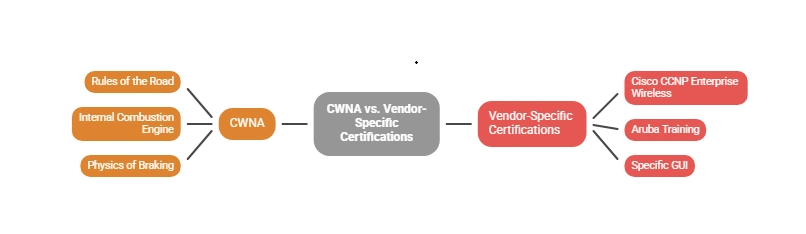
Here is the consensus from industry veterans: Do both, but do the CWNA first.
Think of learning how to drive a car. The CWNA teaches you the rules of the road, how an internal combustion engine works, and the physics of braking and momentum. Cisco or Aruba training teaches you how to operate a specific 2026] Honda Civic.
If you solely learn the Honda Civic (Cisco), and your employer suddenly hands you the keys to a Ford truck (Aruba), you will struggle. However, if you understand the core mechanics of driving (CWNA), you can drive absolutely anything. Top-tier engineers use the CWNA to learn how Wi-Fi works in the air, and then they acquire a vendor-specific certification to learn the specific Graphical User Interface (GUI) of the equipment their employer utilizes.
The Complete CWNP Certification Path: Where Do You Fit?
The CWNP organization offers a highly logical, tiered progression ladder. You do not take the CWNA and simply stop. As your career grows, your certifications scale with you. Here is how the roadmap is structured.
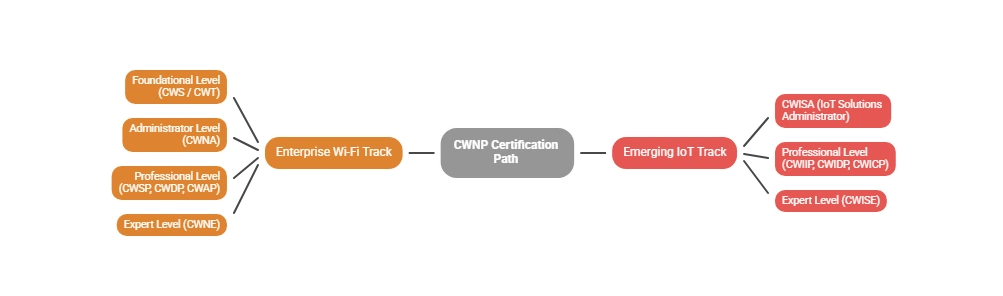
The Enterprise Wi-Fi Track
- Foundational Level (CWS / CWT): These are entry-level certifications (Certified Wireless Specialist and Certified Wireless Technician) focusing on basic terminology and simple hardware installation. They are designed for IT sales representatives or tier-1 helpdesk staff. You do not need these to take the CWNA. Most networking professionals bypass these entirely.
- Administrator Level (CWNA): As discussed, this is your baseline. Crucially, the CWNA is a mandatory prerequisite for all higher-level professional exams. You cannot skip it.
- Professional Level (CWSP, CWDP, CWAP): Once you hold an active CWNA, you unlock the professional tier. You can take these three exams in any order depending on your career focus.
- CWSP (Security Professional): Focuses heavily on network defense, Wireless Intrusion Prevention Systems (WIPS), and complex enterprise encryption.
- CWDP (Design Professional): Designed for architects. You learn to design complex, high-density networks for demanding environments (like hospitals and massive stadiums) using predictive modeling software.
- CWAP (Analysis Professional): Widely considered the most difficult exam. It teaches you how to capture raw packets, read MAC layer frames bit-by-bit, and hunt down non-Wi-Fi interference.
- Expert Level (CWNE): There is no single “expert exam.” To become a Certified Wireless Network Expert, you must pass the CWNA, CWSP, CWDP, and CWAP. Furthermore, you must hold a third-party networking certification, submit essays detailing real-world enterprise wireless projects you have completed, and receive endorsements from peers. It is highly prestigious; there are only a few hundred CWNEs globally.
The Emerging IoT Track
Because enterprise networks are now heavily populated with smart sensors and automation devices, CWNP launched a parallel Internet of Things track:
- CWISA (IoT Solutions Administrator): The baseline IoT certification. It covers Bluetooth Low Energy (BLE), Zigbee, LoRaWAN, and cellular IoT architectures.
- Professional Level: CWIIP (Integration), CWIDP (Design), and CWICP (Connectivity).
- Expert Level: CWISE (IoT Solutions Expert).
Salary Expectations: The ROI of Wireless Expertise
Certifications require significant investments of time and money, making the Return on Investment (ROI) a critical factor. Because wireless networking is notoriously difficult—and because poor Wi-Fi immediately halts corporate productivity—specialists in this field are compensated exceptionally well.

Based on industry salary aggregates across the US market for 2026:
- Administrator Level (CWNA): $75,000 – $115,000 annually. Holding a CWNA serves as a massive resume filter. It proves to hiring managers that you can manage enterprise infrastructure, frequently leading to immediate pay increases for junior engineers transitioning into network administrator roles.
- Professional Level (CWSP, CWDP, CWAP): $120,000 – $165,000+ annually. Engineers capable of architecting a flawless warehouse scanning network (CWDP) or preventing a catastrophic wireless data breach (CWSP) command serious market premiums.
- Expert Level (CWNE): $160,000 – $250,000+ annually. At this elite tier, professionals often operate as principal architects or independent consultants, billing high hourly rates to resolve architectural nightmares that no one else can fix.
(Note: While these figures represent the US market, proportional salary premiums for CWNP credential holders exist in the UK, Australia, the Middle East, and APAC regions).
How to Prepare for the CWNA Exam
The CWNA exam voucher costs $274.99 USD, and CWNP does not offer free retakes. If you fail, you must pay full price to attempt it again. You must approach the exam with respect and a solid study plan.
Here is a reliable blueprint for passing:
- Download the Official Exam Objectives: Visit the CWNP website and download the exam blueprint for the current exam version. If a topic is not on that document, it will not be on the test. Use it as your primary checklist.
- Read the Official Study Guide: The official Sybex CWNA study guide is dense but absolutely mandatory. Take physical notes on the RF math—you will need to perform calculations in your head on exam day without a calculator.
- Build a Home Lab: Do not rely solely on reading. Purchase a used enterprise access point online, download a free packet analyzer like Wireshark, and watch the wireless frames transmit through the air. Seeing the theory applied practically solidifies the knowledge.
- Validate Before You Test: Do not walk into the testing center relying purely on textbook theory. You need to understand how the questions are structured and how to manage your 90-minute time limit. Before purchasing the exam voucher, validate your knowledge. Avoid outdated, unverified “brain dumps” from dubious forums. Instead, utilize high-quality, accurate practice exams and study guides from a reputable provider like PassITExams to identify your exact blind spots. Using robust practice tests ensures you walk into the exam room with total confidence.
Frequently Asked Questions (FAQs)
Does the CWNA certification expire?
Yes. The CWNA, as well as all professional-level CWNP certifications, are valid for exactly three (3) years from the date you pass the exam.
How do I renew my CWNA certification?
You have two options: you can pay to retake the current version of the CWNA exam before your existing one expires, or you can pass one of the professional-level exams (CWSP, CWDP, CWAP). Passing a higher-tier exam automatically renews all your lower-tier certifications for another three years.
Is there a lot of advanced math on the CWNA?
There is math, but it is not calculus. It primarily involves basic addition and subtraction utilizing the “Rule of 10s and 3s” to calculate RF power changes. You are not permitted to use a calculator during the exam, so you must be comfortable performing these calculations on the provided digital scratchpad.
How long does it take to study for the CWNA?
If you possess a basic IT networking background (such as holding a CompTIA Network+ or CCNA), expect to invest roughly 80 to 120 hours of focused study. Most candidates spread this out over 2 to 3 months of consistent evening and weekend studying.
Are there any mandatory prerequisites for taking the CWNA?
No. You do not need to take the CWS or CWT foundational exams first. You can register for the CWNA immediately, provided you feel fully prepared for the material.
Can I use a Mac for my wireless home lab?
Yes. In fact, MacBooks are incredibly popular among wireless engineers because macOS includes excellent native wireless diagnostic tools and can easily be placed into “monitor mode” to capture wireless frames in Wireshark—a process that often requires specialized USB adapters on Windows machines.
Conclusion: Taking the Next Step in Your Career
Stop worrying about the difference between CWNA and CWNP. Commit to learning the foundational physics of wireless networking through the CWNP program, earn your CWNA credential, and watch your IT career expand in ways that vendor-specific training simply cannot facilitate.
The enterprise networking industry desperately needs engineers who know how to troubleshoot the airwaves, not just read the dashboards. Download the official exam blueprint, set up your home lab, and ensure you are fully prepared by utilizing premium practice materials from trusted sources like PassITExams. Put in the necessary hours, master the RF math, and take the definitive step toward becoming a wireless networking expert.
