
Building a long-term career in IT networking used to mean memorizing command-line prompts and graphical user interfaces for specific hardware vendors. But wireless networking is a fundamentally different beast. When you build and manage Wi-Fi, you are dealing with invisible radio frequencies, highly complex IEEE 802.11 standards, and physical environments that can change by the minute as people and objects move around.
If you want to truly master wireless technology, you need to understand how it works in the air, not just how it looks on a dashboard. This is exactly where the CWNP certification path comes in.
The Certified Wireless Network Professional (CWNP) program is the recognized global standard for vendor-neutral enterprise Wi-Fi and Internet of Things (IoT) education. Since 1999, it has provided a rigorous, highly respected educational roadmap for IT professionals. Instead of teaching you which buttons to click to configure a specific brand’s router, CWNP teaches you the underlying physics and core protocols of wireless communication.
Whether you are a helpdesk technician looking to specialize, a sales professional needing to understand what you are selling, or a seasoned network engineer aiming for elite expert status, this guide breaks down the entire CWNP roadmap step-by-step so you can successfully plan your next career move.
Why Choose the Vendor-Neutral CWNP Certification Path?
Before committing months of study time to any certification, you might be wondering if you should pursue a vendor-specific track—like the Cisco CCNP Enterprise with wireless concentrations or the Aruba Certified Professional path—or stick to the CWNP path.
Both have tremendous value, but the beauty of the CWNP path is its universal, hardware-agnostic application.
The networking space is an interesting dichotomy of time-proven RF physics and rapidly evolving feature sets. Vendor certifications teach you how to deploy their specific features using their specific menus. However, a professional who understands how co-channel interference physically works, or how to read a raw MAC layer frame capture in Wireshark, can troubleshoot a failing network regardless of whether the access points hanging on the ceiling are made by Cisco, Aruba, Ruckus, Extreme Networks, or Juniper.
Hiring managers and enterprise IT directors actively seek out CWNP-certified engineers because they possess foundational, root-cause troubleshooting skills. Furthermore, the CWNP tracks are logically structured, allowing you to progress at your own pace from basic terminology all the way to high-level architectural design.
The Enterprise Wi-Fi Certification Track: Step-by-Step
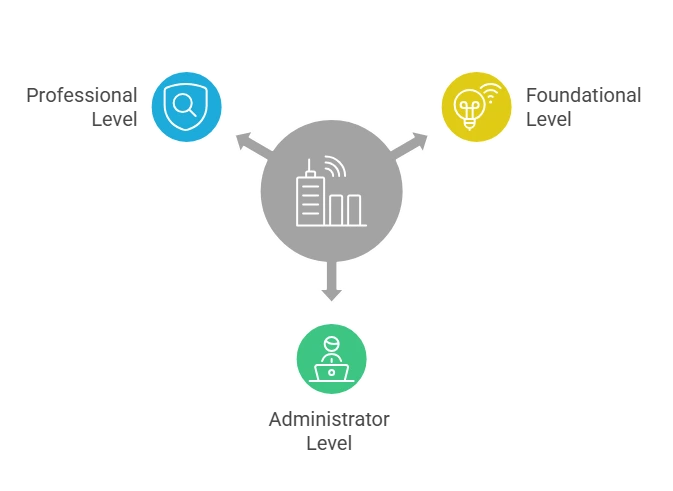
The traditional enterprise Wi-Fi track is the bread and butter of the CWNP organization. It is structured into four distinct, progressive tiers: Foundational, Administrator, Professional, and Expert. Let’s walk through the progression so you know exactly where to start.
1. Foundational Level (Optional but Highly Helpful)
If you are brand new to IT, or if you work in a non-technical role like technology sales, marketing, or IT project management, this is your starting point. These entry-level exams have no prerequisites and act as a gentle introduction to the world of wireless.
- CWS (Certified Wireless Specialist) / CWSS (Sales Specialist): This entry-level certification focuses on the language of Wi-Fi. You will learn basic RF hardware concepts, the differences between 802.11 standards (like Wi-Fi 5, 6, and 7), and how to match an organization’s business goals with the correct wireless solutions. It proves you can “talk the talk.”
- CWT (Certified Wireless Technician) / CWTS (Technology Specialist): A step above the CWS, this certification is specifically designed for the field technician or junior IT support staff. It covers hands-on, practical tasks like physically installing access points based on a design document, configuring basic client security settings, and troubleshooting simple end-user connectivity issues.
2. Administrator Level: The CWNA (Your True Starting Point)
For active network engineers, system administrators, and cybersecurity professionals, the CWNA (Certified Wireless Network Administrator) is the real starting line. It is the cornerstone of the entire CWNP program and a mandatory prerequisite for all higher-level, professional certifications.
- What it covers: The CWNA is incredibly comprehensive. It covers the core physics of Radio Frequency (RF) behavior, antenna polarization and gain concepts, wireless network architectures, basic site surveying principles, in-depth 802.11 standards, and enterprise security fundamentals like WPA3 and 802.1X.
- Why it matters: Passing the CWNA proves you have a solid, working knowledge of how enterprise wireless networks operate at a fundamental level. It is highly respected in the industry and typically leads to immediate career advancement and salary bumps. Most engineers consider this the most important certification in their wireless journey.
3. Professional Level: Choose Your Specialty
Once you hold an active, unexpired CWNA certification, you unlock the Professional tier. You can take these three exams in any order based on your specific career goals or current job requirements.
- CWSP (Certified Wireless Security Professional): This track focuses heavily on network defense and vulnerability mitigation. You will master 802.1X/EAP authentication methods, RADIUS servers, complex encryption protocols, Wireless Intrusion Prevention Systems (WIPS), rogue access point detection, and how to properly secure fast-roaming mobile clients across a large campus.
- CWDP (Certified Wireless Design Professional): This is for the architects. The CWDP exam tests your ability to plan, survey, and design complex Wireless Local Area Networks (WLANs) for specific, high-demand environments (like multi-story hospitals, high-density sporting stadiums, or automated warehouses). You will learn active, passive, and predictive site surveying, advanced capacity planning, and how to effectively use enterprise design software like Ekahau.
- CWAP (Certified Wireless Analysis Professional): Often widely considered the most difficult of the three professional exams, the CWAP certification focuses on deep-dive, granular troubleshooting. You will learn to capture and read raw wireless packets using tools like Wireshark, dissecting frame exchanges bit by bit. You will also learn advanced RF spectrum analysis to hunt down and eliminate non-Wi-Fi interference sources, such as microwave ovens, Bluetooth devices, or radar systems.
The Wireless IoT Certification Track: The New Frontier
Enterprise networks are no longer just supporting employee laptops and smartphones. Today, networks are flooded with smart building sensors, medical telemetry equipment, inventory tracking tags, and industrial automation tools. Recognizing this massive shift in the industry, CWNP introduced an entirely separate certification track dedicated to the Internet of Things (IoT).
1. Administrator Level: CWISA
The CWISA (Certified Wireless IoT Solutions Administrator) is the exact equivalent of the CWNA, but tailored for the IoT world. It serves as the foundational requirement for the rest of the IoT professional track.
- What it covers: It touches on basic RF concepts, but expands far beyond standard Wi-Fi to include low-power, wide-area network (LPWAN) protocols. You will study Bluetooth Low Energy (BLE), Zigbee, LoRaWAN, cellular IoT architectures, and the basic principles of integrating these disparate devices into a single corporate network.
2. Professional Level IoT
After earning your CWISA, you can specialize in exactly how IoT devices are designed, integrated, and maintained within enterprise networks.
- CWICP (IoT Connectivity Professional): Focuses heavily on the physical (PHY) and MAC layers of various IoT protocols. You will learn how to troubleshoot connectivity issues within specific IoT ecosystems and understand how they share the RF environment without causing destructive interference.
- CWIDP (IoT Design Professional): Teaches you how to architect and design complex, multi-protocol IoT networks. You will learn how to select the absolute best wireless standard for a specific business use case (e.g., choosing LoRaWAN for a massive agricultural farm versus BLE for indoor asset tracking).
- CWIIP (IoT Integration Professional): Focuses more on the software and systems engineering side. You will learn about integrating APIs, managing cloud data flows, ensuring interoperability between different IoT vendors, and securing the massive amounts of data generated by IoT endpoints.
The Expert Level: How to Become a CWNE or CWISE
The absolute pinnacle of the CWNP certification path is the Expert level. Earning this designation places you in a highly elite, globally recognized group of wireless consultants, senior architects, and principal engineers.
- CWNE (Certified Wireless Network Expert): The capstone for the Wi-Fi track. There are only a few hundred CWNEs globally.
- CWISE (Certified Wireless IoT Solutions Expert): The capstone for the IoT track.
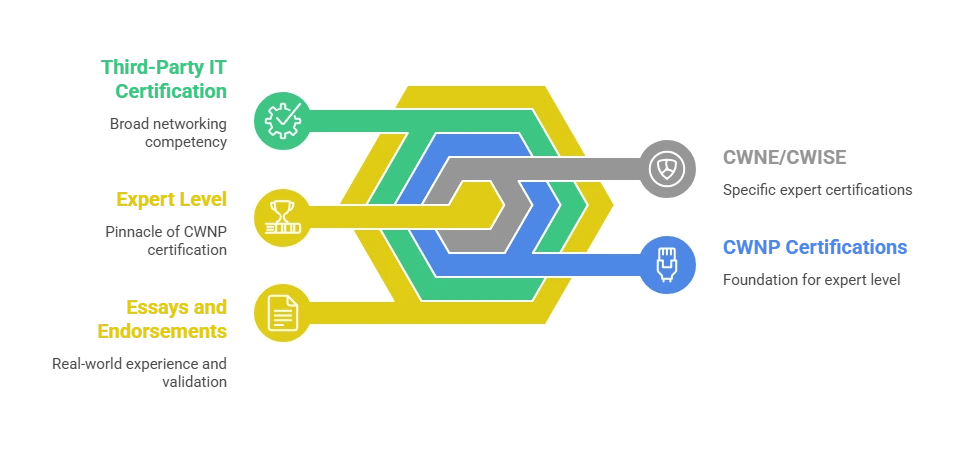
Crucially, there is no single “Expert Exam” you can simply purchase and take. Instead, to achieve these prestigious titles, you must pass a rigorous, peer-reviewed board application process. For the CWNE, as an example, you must meet the following strict criteria:
- Hold active, valid CWNA, CWSP, CWDP, and CWAP certifications.
- Hold a recognized third-party IT certification (like a Cisco CCNA, CompTIA Network+, or similar credentials) to prove broad networking competency.
- Submit three detailed essays outlining real-world, complex enterprise wireless projects you have successfully designed, deployed, or troubleshot.
- Provide professional endorsements from managers, clients, or colleagues attesting to your high-level technical character and expertise.
Practical Advice: How to Prepare for CWNP Exams
CWNP exams are notorious in the IT industry for testing applied, practical knowledge rather than simple rote memorization. You cannot just skim a book the weekend before and expect to pass. Here is a proven, multi-step study strategy to ensure your success:
- Download the Official Blueprint: Always start your journey at the official CWNP website. Download the specific exam objectives for your target test and use it as your master study checklist. The rule of thumb is simple: if a topic is not on the blueprint, it will not be on the test. If it is on the blueprint, you need to understand it deeply.
- Read the Official Study Guides: The official Sybex or CWNP-published study guides are notoriously dense, but they are absolutely essential. Read them cover to cover, taking meticulous notes—specifically focusing on RF math (the rules of 10s and 3s) and MAC frame structures.
- Build a Home Lab: Theoretical knowledge only gets you so far, especially for the analysis and design exams. Buy a couple of used enterprise-grade access points online, a Power over Ethernet (PoE) switch, and a USB Wi-Fi adapter capable of monitor mode. Practice capturing frames and changing configurations to see how the RF environment physically reacts.
- Use High-Quality Practice Tests: Validating your knowledge before test day is critical to avoid expensive voucher retake fees (which often run around $350). Using authentic, up-to-date practice materials from reputable platforms helps you get comfortable with the exam’s phrasing, time limits, and overall difficulty. This is where leaning on trusted study guides and exam simulations, such as those provided by PassITExams, can make the vital difference between a confident pass and a frustrating fail.
Common Mistakes to Avoid on Your Certification Journey
To keep your wireless certification journey smooth and on budget, make sure to avoid these frequent pitfalls:
- Underestimating the CWNA: Many highly experienced network engineers assume they can walk into the CWNA without studying simply because they have configured a few home routers or basic corporate networks. The exam’s heavy focus on RF physics, antenna calculations, and 802.11 amendments usually proves them wrong. Respect the exam and study thoroughly.
- Taking the CWAP First: While the rules allow you to take the professional exams in any order once you have your CWNA, most industry experts strongly recommend saving the CWAP (Analysis) for last. Start with Design (CWDP) or Security (CWSP) to build your momentum and confidence before tackling intense, bit-level packet analysis.
- Relying on Outdated Materials: The wireless industry moves fast. Exams are updated every three years to include new technologies like Wi-Fi 6E (6 GHz) and Wi-Fi 7 (MLO). Using an old study guide from 2018 will leave you completely unprepared for modern exam questions.
- Letting Your Certifications Expire: CWNP certifications are valid for exactly three years. The best, most cost-effective strategy is to take your next professional-level exam before your CWNA expires. Passing any professional exam automatically renews your CWNA (and any other professional certs you hold) for another three years, saving you from having to pay for and retake the CWNA all over again.
Frequently Asked Questions (FAQ’s)
Do I have to take the CWS or CWT before I can take the CWNA?
No. The Foundational level exams (CWS/CWT) are entirely optional. If you already possess basic IT networking knowledge and understand standard IT terminology, you can bypass them and jump straight into studying for the CWNA.
How long does it realistically take to prepare for the CWNA?
For an IT professional with basic networking experience (such as holding a CompTIA Network+ or having a year of helpdesk experience), you should expect to spend roughly 80 to 120 hours of focused study. This is usually spread over 2 to 3 months of consistent preparation.
Are CWNP exams open book?
No. All CWNP exams are closed-book, strictly proctored examinations. As of August 2024, they are administered globally through Prometric testing centers, offering both in-person testing and highly monitored remote online proctoring.
How much do the CWNP exams cost?
While pricing is always subject to change, foundational exams generally cost around $175 USD. The administrator exams (CWNA and CWISA) cost roughly $275 USD, while the professional-level exams cost about $350 USD each. The CWNE application fee is a flat $500.
Can I use my Cisco wireless experience to easily pass the CWNP exams?
Your Cisco experience is incredibly valuable, but it is not enough on its own. Cisco exams focus heavily on navigating Cisco architectures, navigating DNA Center, and managing specific controllers. CWNP focuses heavily on the IEEE 802.11 standards and raw RF physics. You will still need to study the vendor-neutral materials thoroughly.
Does the CWNP track cover the latest standards like Wi-Fi 6, 6E, and Wi-Fi 7?
Yes. CWNP regularly updates its exam objectives and study materials to reflect the latest technologies deployed in the enterprise space. Current exams extensively cover the use of the 6 GHz spectrum, OFDMA, and the Multi-Link Operation (MLO) features introduced in Wi-Fi 7.
Can I hold both a CWNE and a CWISE?
Absolutely. If you complete the prerequisites for both the Wi-Fi track and the IoT track and successfully pass the board reviews for both, you can hold both expert-level designations simultaneously.
What happens if I fail an exam? Do I get a free retake?
No. If you fail a CWNP exam, you must purchase a brand new exam voucher at full price to attempt the test again. This underscores the importance of utilizing comprehensive practice exams before booking your test date.
Conclusion: Start Your Journey to Wireless Expertise
The CWNP certification path is undeniably one of the most rewarding, lucrative, and highly respected educational tracks in the modern IT industry. By starting with the CWNA, you build an unshakeable, vendor-neutral foundation in wireless technology that physically insulates your career from vendor lock-in, corporate restructuring, and market shifts. Whether your ultimate goal is to become a dedicated cybersecurity specialist, a highly-paid wireless architect, or to pursue the prestigious CWNE, the steps are clear and the return on investment is proven.
As you map out your personal study plan and timeline, remember that passing these rigorous, real-world exams requires testing your knowledge thoroughly before exam day arrives. To ensure you are fully prepared and to identify any lingering knowledge gaps early, explore the comprehensive study guides and authentic practice tests available at PassITExams. Equip yourself with the right resources, set up your home lab, and take the very first step toward wireless mastery today.
