

Deciding which IT certification to pursue requires a careful calculation of time, energy, and financial investment. If your career path involves enterprise networking, you have likely encountered the Certified Wireless Network Professional (CWNP) program. You might be weighing it against well-known, vendor-specific paths like the Cisco CCNP or Aruba Certified Professional tracks, leaving you with one critical question: Is the CWNP certification worth it?
The short answer is yes. For anyone serious about mastering wireless networking, earning a credential from the CWNP program is one of the highest-ROI investments you can make in your IT career.
Instead of teaching you which dropdown menus to click on a specific brand’s proprietary dashboard, CWNP training forces you to understand the invisible physics of Radio Frequency (RF) and the mechanics of IEEE 802.11 standards. This guide breaks down exactly why this vendor-neutral approach holds so much weight in the job market, what salary expectations look like across the certification levels, and how to evaluate the true cost of earning your credentials.
What Makes the CWNP Track Different? (Technology vs. Product)
To understand the value of CWNP, you must understand the difference between learning a technology and learning a product.
When you study for a Cisco or Aruba wireless certification, you spend a massive portion of your time learning the quirks of their specific operating systems, licensing structures, and graphical user interfaces. This is highly valuable if your employer exclusively uses that hardware. However, if your company switches vendors, or if you take a new job in a Juniper Mist environment, a large percentage of your product-specific knowledge becomes instantly obsolete.
The CWNP program, established in 1999, is entirely hardware-agnostic. It focuses on the physical layer and the data link layer of wireless communication. You learn how radio waves propagate through drywall versus concrete. You learn how to read raw MAC layer frames using packet analyzers like Wireshark. You learn the exact cryptographic handshakes required for WPA3 security.
Because the laws of physics and the IEEE 802.11 standards apply universally to every access point on the planet, CWNP knowledge never becomes obsolete. A co-channel interference issue caused by poor architectural design behaves the exact same way on a Cisco network as it does on a Ubiquiti network.
Top 5 Reasons CWNP Certifications Deliver High ROI
Earning a CWNP credential—starting with the foundational Certified Wireless Network Administrator (CWNA)—requires serious dedication. Here is why enterprise network engineers worldwide consider the effort completely worth it.
1. True Vendor-Neutral Versatility
In enterprise IT, flexibility equals employability. A CWNP-certified engineer can walk into any hospital, university campus, or corporate high-rise and immediately begin troubleshooting the Wi-Fi, regardless of whose logo is printed on the ceiling-mounted access points. Managed Service Providers (MSPs) and IT consulting firms highly value this versatility because it allows them to deploy one engineer to handle multiple diverse client environments.
2. Deep Technical Mastery of Root-Cause Troubleshooting
Generalist network administrators often rely on vendor dashboards to tell them what is wrong. If the dashboard simply says “Client Disconnected,” a generalist might reboot the router and hope for the best. A CWNP professional understands why the client disconnected. They can trace the issue back to a specific sticky client failing to roam, a mismatch in supported data rates, or a radar event triggering Dynamic Frequency Selection (DFS). This ability to fix the root cause rather than treating the symptom makes you an irreplaceable asset.
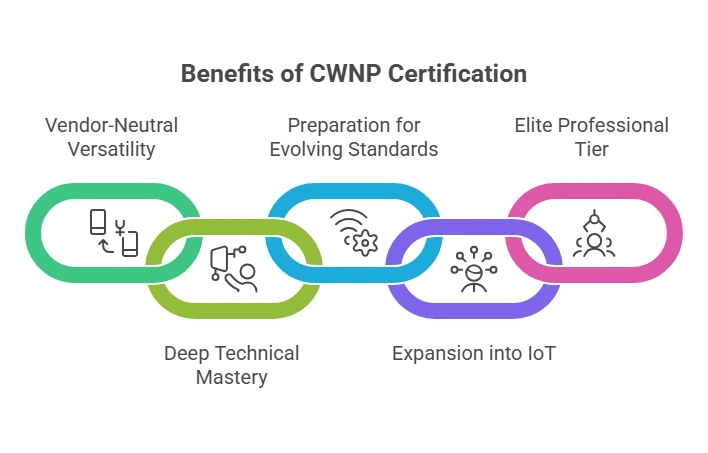
3. Preparation for Rapidly Evolving Standards
The wireless industry moves at breakneck speed. We are currently navigating the mass adoption of the 6 GHz spectrum (Wi-Fi 6E) and the rollout of Wi-Fi 7 (802.11be) with features like Multi-Link Operation (MLO). Hardware vendors often lag behind the standards in their training materials. Because CWNP is strictly tied to the IEEE standards, professionals in this track are actively learning and mastering new protocols long before the hardware vendors release updated GUI training.
4. Expansion into the Internet of Things (IoT)
Enterprise networks are no longer just laptops and smartphones. They are flooded with smart thermostats, medical telemetry sensors, and industrial automation tools. CWNP has recognized this shift by introducing an entire, parallel IoT certification track. Starting with the CWISA (Certified Wireless IoT Solutions Administrator), IT professionals can now validate their expertise in non-Wi-Fi protocols like Bluetooth Low Energy (BLE), Zigbee, LoRaWAN, and cellular IoT, dramatically expanding their career prospects.
5. Inclusion in an Elite Professional Tier
At the top of the CWNP ladder is the CWNE (Certified Wireless Network Expert). There are fewer than 600 CWNEs globally. Achieving advanced CWNP certifications places you in an exclusive community of principal engineers and chief architects. The peer-to-peer networking, mentorship, and direct referral opportunities within this niche are unparalleled in the IT industry.
CWNP vs. Cisco and Aruba: Which Should You Choose?
This is the most common dilemma for network engineers. The reality is that these certifications are not mutually exclusive; they are complementary.
- Vendor-Specific Certifications (Cisco CCNA/CCNP, Aruba ACMA/ACMP): Choose these if your current job strictly requires you to manage a specific brand’s controllers and you need to know exactly how to navigate their command-line interface (CLI) or cloud dashboard (like Cisco DNA Center or Aruba Central).
- CWNP Certifications: Choose this path to build your foundational understanding of how wireless actually works in the air.
The Recommended Strategy: Speak to any senior wireless architect, and they will almost universally recommend achieving your CWNA first. Building a rock-solid, unshakeable foundation in RF math and 802.11 behaviors makes learning any vendor-specific configuration infinitely easier. Once you understand the theory of fast roaming from your CWNA studies, learning which checkbox to tick in a Cisco controller takes less than five minutes.
Salary Expectations: How Much Do CWNP Professionals Make?
When evaluating if a certification is “worth it,” the financial return is the deciding factor for most professionals. Because CWNP certifications are rigorous and specialized, they command premium compensation packages in the global market.
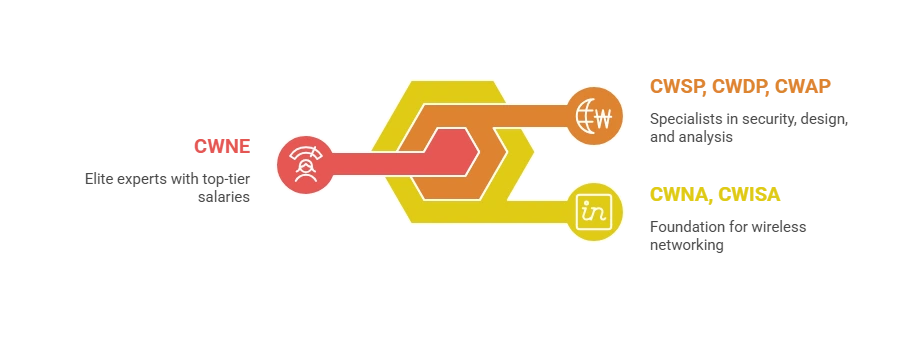
Based on industry salary aggregates and IT employment data for 2026, here is the expected career progression and salary range in the US market (note that proportional premiums apply globally in the UK, Australia, and APAC regions):
The Administrator Level (CWNA / CWISA)
- Target Roles: Network Administrator, Junior Wireless Engineer, IT Support Specialist.
- Average Salary: $75,000 – $115,000 annually.
- The Value: The CWNA acts as a powerful resume filter. It proves to hiring managers that you have moved beyond basic helpdesk knowledge and understand enterprise-grade infrastructure. Earning a CWNA frequently results in immediate promotions or significant leverage during salary negotiations.
The Professional Level (CWSP, CWDP, CWAP)
Once you hold a valid CWNA, you can specialize in Security (CWSP), Design (CWDP), or Analysis/Troubleshooting (CWAP).
- Target Roles: Wireless Security Analyst, WLAN Architect, Senior Network Engineer.
- Average Salary: $110,000 – $155,000+ annually.
- The Value: Professionals at this tier are paid to prevent disasters before they happen (Design/Security) or fix catastrophic downtime (Analysis). Designing a high-density network for a 60,000-seat stadium requires specialized math and surveying skills that very few IT professionals possess, allowing these engineers to demand top-tier salaries.
The Expert Level (CWNE / CWISE)
- Target Roles: Principal Network Architect, Global IT Consultant, Chief Technology Officer.
- Average Salary: $160,000 – $250,000+ annually.
- The Value: As elite, globally recognized experts, CWNEs often operate as independent consultants or top-level architects for Fortune 500 companies. Their earning potential is limited only by how many consulting hours they wish to bill.
The True Cost of CWNP Certification: Time and Money
To accurately gauge ROI, you must understand the initial investment. CWNP exams are proctored globally via Prometric (both in-person and remote).
- Exam Vouchers: The foundational exams (like CWTS) cost around $175. The administrator exams (CWNA, CWISA) cost roughly $275. The professional-level exams (CWSP, CWDP, CWAP) are priced around $350 each.
- Study Materials: Official study guides run between $60 and $90. Comprehensive e-learning bundles directly from CWNP can cost anywhere from $900 to $1,200.
- Lab Equipment: While the CWNA can be passed with heavy reading, the professional exams require hands-on experience. Expect to spend $150 to $300 on used enterprise access points, a PoE switch, and a USB Wi-Fi adapter capable of packet capture.
- Time: The CWNA requires roughly 80 to 120 hours of focused, intense study for an individual with basic networking knowledge.
The ROI Calculation: If you self-study, the total cost to achieve your CWNA is roughly $350 to $450. If that credential helps you secure a promotion that increases your salary by even $5,000 a year, the certification pays for itself entirely within the first month of your new pay rate. The financial ROI is undeniably positive.
How to Prepare Effectively and Avoid Costly Retakes
The biggest threat to your certification budget is failing an exam. CWNP does not offer free retakes; if you score a 69% on a CWNA exam, you must pay another $275 to try again. The exams are explicitly designed to test real-world, situational application, not just vocabulary memorization.
Here is how to ensure your investment pays off on the first attempt:
- Rely on the Official Blueprint: Download the exact exam objectives from the CWNP website. Treat this document as your master syllabus.
- Read the Official Textbooks: The Sybex/CWNP study guides are dense but critical. Pay special attention to the chapters on RF math (the rules of 10s and 3s) and antenna polarization.
- Validate Your Knowledge Before Testing: Do not sit for the exam until you have consistently passed high-quality practice tests. This is where many candidates make a crucial error. Testing your readiness against realistic, up-to-date exam simulations helps you identify weak spots in your RF theory before you spend money on the real voucher. Utilizing reputable study guides and authentic practice materials from platforms like PassITExams can comfortably bridge the gap between textbook theory and the actual pacing of the Prometric exam environment.
- Build a Packet Capture Habit: Download Wireshark (it is free) and practice capturing management frames, control frames, and data frames on your home network. Seeing the theory play out live on your screen solidifies the knowledge permanently.
Frequently Asked Questions (FAQs)
Is the CWNA hard to pass?
Yes, it is considered a challenging exam, especially for those who underestimate it. Many general network engineers assume their experience configuring home routers is sufficient. It is not. The CWNA requires a deep understanding of RF physics, math, and strict 802.11 protocols. Dedicated study is required.
Does a CWNP certification expire?
Yes. The CWNA, CWISA, and all professional-level certifications are valid for three (3) years.
How do I renew my CWNP certification without paying for the same test again?
The CWNP program uses a “trickle-down” renewal system. If you pass a higher-level professional exam (like the CWSP) before your CWNA expires, your CWNA is automatically renewed for another three years. The most cost-effective career strategy is to take one professional exam every 2.5 years.
Do I need to know programming or Python for CWNP?
Currently, no. Unlike modern Cisco tracks that heavily emphasize network automation and Python scripting, CWNP remains focused purely on wireless architectures, physical RF behavior, and security protocols.
Are there any prerequisites for the CWNA?
No official prerequisites exist. You do not need to take the foundational CWS or CWT exams first. However, having a baseline understanding of basic networking (equivalent to the CompTIA Network+ or Cisco CCNA) is highly recommended before starting CWNA material.
Is the CWNP track recognized outside of the United States?
Absolutely. CWNP is the globally recognized standard for vendor-neutral Wi-Fi. The certifications hold significant weight in the UK, Europe, Australia, the Middle East, and Asia.
Conclusion: The Final Verdict on CWNP Value
So, is the CWNP certification worth it? The answer is an unequivocal yes.
By prioritizing a deep, vendor-neutral understanding of how wireless technology functions at the physical and protocol levels, the CWNP program provides a level of career resilience that product-specific training simply cannot match. It equips you with the root-cause troubleshooting skills necessary to command higher salaries, secure elite architectural roles, and adapt instantly to new networking standards like Wi-Fi 7 and IoT expansion.
If you are ready to elevate your career from a generalist network administrator to a highly specialized wireless expert, the CWNA is your starting line. Review the exam blueprints, invest the necessary hours into your study guides, and ensure you validate your readiness with reliable practice tests from trusted providers like PassITExams. The investment in your vendor-neutral education will pay dividends for the rest of your IT career.
