
“Cybersecurity” and “information security” get used interchangeably in boardrooms, job postings, and exam prep guides; but they aren’t the same thing, and the confusion has real consequences. Cybersecurity is the practice of defending networks, systems, and data from digital attack. Information security is the broader discipline of protecting information in any form; digital, physical, or verbal; throughout its entire lifecycle.
That distinction matters more in 2026 than it ever has. AI-accelerated phishing, supply-chain compromises, and ransomware-as-a-service have pushed regulators and boards to demand proof of a structured security program, not just good intentions. Two frameworks dominate that conversation worldwide:
- NIST Cybersecurity Framework (CSF) 2.0: a US-born, outcomes-based framework increasingly used far beyond government contractors
- ISO/IEC 27001:2022: the global, certifiable standard for building and running an Information Security Management System (ISMS)
Neither framework has stood still. NIST Cybersecurity Framework (CSF) 2.0 (released February 2024); now in its third year of use with major AI expansions and enterprise risk management alignment. ISO/IEC 27001:2022 is now the baseline auditors expect when a client asks, “Are you certified?” Understanding how these two frameworks differ; and how they complement each other; is essential knowledge for security professionals, compliance teams, and anyone studying for a certification exam in this space.
For a broader breakdown of how these two disciplines differ in scope, responsibilities, and career paths, see our complete guide to Cybersecurity vs Information Security.
What Is NIST Cybersecurity Framework 2.0?
Definition
The NIST Cybersecurity Framework is a voluntary, risk-based framework developed by the U.S. National Institute of Standards and Technology. Originally written for critical infrastructure operators, CSF 2.0 (released in 2024) was rewritten so any organization; hospitals, universities, startups, manufacturers; can apply it, regardless of size or sector.
Unlike ISO 27001, NIST CSF is not certifiable. There’s no auditor who stamps your organization “NIST CSF compliant.” Instead, it gives you a common vocabulary and a structured way to assess, describe, and improve your cybersecurity posture.
Core Functions
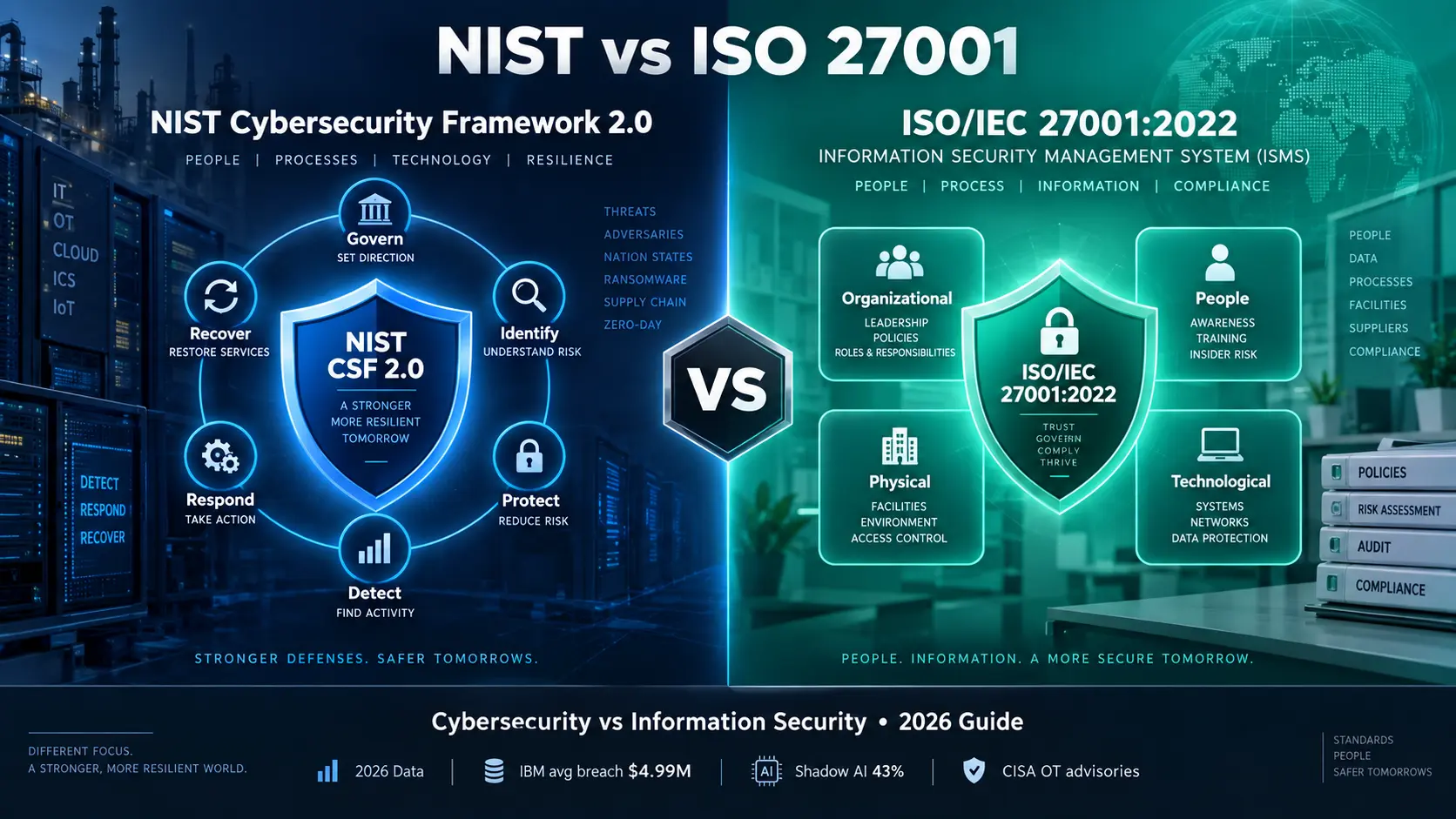
CSF 2.0’s biggest structural change was adding a sixth core function, Govern, to the original five:
- Govern: Establish and monitor the organization’s cybersecurity risk management strategy, roles, policies, and oversight (new in 2.0)
- Identify: Understand assets, risks, and vulnerabilities across the organization
- Protect: Implement safeguards to limit or contain the impact of a potential event
- Detect: Find and analyze anomalies and indicators of compromise
- Respond: Take action once an incident is detected
- Recover: Restore capabilities and services impaired by an incident
These functions aren’t sequential; they operate continuously and in parallel, which is a common exam trap for people who assume NIST CSF works like a linear checklist.
Key Updates Going Into 2026
- Govern as a business function, not an IT afterthought. NIST has been explicit that cybersecurity decisions should be driven at the executive level, reflecting how boards now treat cyber risk as enterprise risk.
- AI-specific guidance is expanding fast. NIST’s National Cybersecurity Center of Excellence has been running workshops throughout early 2026 on a draft “Cyber AI Profile,” and a Quick-Start Guide for using AI tools in CSF analysis and reporting has been open for public comment.
- AI is now the top emerging risk category. Industry threat reports from 2026; including IBM’s X-Force Threat Intelligence Index; point to AI-enabled vulnerability discovery and exploitation as a leading driver of the sharp rise in attacks on public-facing applications. Organizations that pair a structured framework like NIST CSF with a documented ISMS such as ISO 27001 are generally better positioned to detect and contain these incidents faster, though specific “X% faster response” figures vary widely by source and should be verified against the original report before being cited.
- New Informative References. NIST has continued publishing mappings; including one tying the OWASP LLM Top 10 directly to CSF 2.0; making it easier to translate AI-specific risks into the framework’s existing categories.
- Tighter integration with Enterprise Risk Management (ERM). Updated NIST IR 8286 publications now align more closely with CSF 2.0, reinforcing the framework’s shift from a pure IT tool to an enterprise risk-management tool.
AI has also widened the practical gap between the two disciplines. Cybersecurity teams now face autonomous attack chains and AI-generated malware, while information security teams wrestle with shadow AI, model integrity, and data governance failures. A detailed look at the real 2026 AI threats in each discipline is available here: AI threats in cybersecurity vs information security.
What Is ISO/IEC 27001:2022?
Definition
ISO/IEC 27001 is an international standard, jointly published by the International Organization for Standardization (ISO) and the International Electrotechnical Commission (IEC), that specifies requirements for establishing, implementing, maintaining, and continually improving an Information Security Management System (ISMS). The current version, ISO/IEC 27001:2022, replaced the 2013 edition and remains the version organizations are certified against in 2026.
Where NIST CSF is a flexible reference model, ISO 27001 is a formal management-system standard; closer in spirit to ISO 9001 (quality) than to a threat-response playbook. It asks organizations to build a system: policies, risk assessments, documented controls, internal audits, and management review, all operating on a continuous improvement cycle.
Annex A Controls
ISO/IEC 27001:2022 restructured its reference control set (Annex A, drawn from ISO/IEC 27002:2022) into 93 controls across four themes, down from 114 controls in 14 domains under the 2013 version:
- Organizational controls (37 controls): policies, roles, supplier relationships, threat intelligence, cloud security
- People controls (8 controls): screening, training, disciplinary process, remote working
- Physical controls (14 controls): secure areas, equipment maintenance, clear desk/clear screen
- Technological controls (34 controls): access control, cryptography, secure coding, data leakage prevention, logging and monitoring
The 2022 revision also introduced 11 new controls addressing modern risks that didn’t exist; or weren’t prioritized; in 2013, including threat intelligence, cloud service security, data masking, and secure development lifecycle practices.
Certification Process
Getting ISO/IEC 27001 certified is a multi-stage process:
- Gap analysis: Compare current practices against the standard’s requirements
- Risk assessment and Statement of Applicability (SoA) – Identify risks and document which Annex A controls apply and why
- ISMS implementation: Roll out policies, controls, and documented procedures
- Internal audit and management review: Test the ISMS before the real audit
- Stage 1 audit: Auditor reviews documentation and readiness
- Stage 2 audit: Auditor tests whether controls are actually operating effectively
- Certification and surveillance audits: Certificates are valid for three years, with annual surveillance audits in between
This is the piece that makes ISO 27001 attractive to organizations that need to prove compliance to customers, regulators, or partners; something NIST CSF alone cannot offer.
Side-by-Side Comparison Table
| Criteria | NIST CSF 2.0 | ISO/IEC 27001:2022 |
|---|---|---|
| Purpose | Risk-based framework to assess and improve cybersecurity posture | Management-system standard to build and certify an ISMS |
| Origin | U.S. NIST (government-backed, globally adopted) | International (ISO/IEC, globally recognized) |
| Scope | Cybersecurity; digital assets, networks, systems | Information security; digital, physical, and human information assets |
| Certifiable? | No; self-assessment / attestation only | Yes; formal third-party certification |
| Structure | 6 functions, categories, subcategories | Clauses 4–10 (management requirements) + 93 Annex A controls |
| Flexibility | Highly flexible; tiers and profiles adapt to any org | Prescriptive; requires formal documentation and audit evidence |
| Best fit | Organizations wanting a practical risk-management vocabulary | Organizations needing to prove compliance to customers/regulators |
| Effort level | Low to moderate; can start with a current-vs-target profile | High; requires dedicated resourcing, documentation, and audits |
| Cost | Free to adopt (framework is publicly published) | Costs include consulting, internal resourcing, and audit fees |
| Renewal | Continuous, no formal cycle | 3-year certification cycle with annual surveillance audits |
For a complete side-by-side breakdown of how these two disciplines differ in scope, threat models, frameworks, and day-to-day responsibilities, see our full guide to cybersecurity vs information security.
Pros & Cons of Each
NIST CSF 2.0
Pros
- Free, publicly available, and easy to start using immediately
- Flexible enough for a five-person startup or a Fortune 500 enterprise
- Strong alignment with U.S. federal guidance and increasingly referenced internationally
- The new Govern function makes it easier to get executive buy-in
- Fast-moving guidance on AI risk keeps it current
Cons
- No formal certification; harder to “prove” compliance externally
- Requires interpretation; two assessors may score maturity differently
- Less prescriptive on physical and personnel security than ISO 27001
Choose NIST CSF when: you want a practical starting point for building or maturing a security program, need a common risk-management language across departments, or your customers don’t specifically demand a certificate.
ISO/IEC 27001:2022
Pros
- Globally recognized certification that satisfies procurement and regulatory requirements
- Forces documented, auditable rigor across people, process, and technology
- Covers information security broadly, not just digital/cyber risk
- Strong signal of trust for enterprise sales, especially in the EU, UK, and APAC
Cons
- Significant time, cost, and internal resourcing to achieve and maintain
- Can become a “check-the-box” exercise if treated as a one-time project rather than a living system
- Less agile than NIST CSF when responding to fast-moving technical threats
Choose ISO 27001 when: customers or regulators require formal certification, you operate internationally, or you need a documented management system that auditors and insurers will accept as evidence of due diligence.
In 2026, the winning move is almost never choosing one framework over the other. Most organizations use NIST CSF 2.0 internally for day-to-day risk management and ISO 27001:2022 externally for certification and customer trust.
Real-World Adoption Examples in 2026
- Hospital network: A mid-sized regional hospital system layers NIST CSF’s Identify and Protect functions over its HIPAA compliance program to prioritize patching medical IoT devices, while pursuing ISO 27001 certification specifically to reassure insurers and health-tech vendors that patient data is managed under a certified ISMS; a common pattern as healthcare cyber-insurance underwriters tighten requirements.
- Regional bank: A bank operating across multiple states uses NIST CSF’s Govern function to formalize board-level reporting on cyber risk (a growing expectation from banking regulators), while ISO 27001 certification serves as the credential its commercial clients and correspondent banks require before signing service agreements.
- Cybersecurity startup: An early-stage SaaS startup adopts NIST CSF internally in its first year; it’s free and fast to implement with a small team; and only begins the ISO 27001 certification process once enterprise prospects start asking for it during vendor security reviews, a milestone that typically arrives as a startup moves upmarket.
These patterns repeat across industries: NIST CSF for internal maturity and communication, ISO 27001 for external proof.
How to Combine Both (Best Practice)
The frameworks aren’t competitors; they’re complementary layers, and most mature security programs in 2026 run both simultaneously:
- Use NIST CSF as your risk-management operating model. Its six functions give you a practical way to structure day-to-day security work and communicate risk to leadership.
- Use ISO 27001 as your formal management system and certification target. Map your NIST CSF activities into the ISMS documentation ISO 27001 requires; much of the underlying work overlaps.
- Cross-map controls. NIST maintains Informative References that map CSF subcategories to ISO/IEC 27001 controls (among other standards), so you’re not duplicating risk assessments; you’re translating one framework’s output into the other’s required evidence.
- Let Govern do double duty. NIST’s Govern function and ISO 27001’s Clause 5 (Leadership) and Clause 9 (Performance Evaluation) cover nearly identical ground; use one governance process to satisfy both.
- Audit against ISO, assess against NIST. Run your internal audits to ISO 27001’s formal requirements, but use NIST CSF tiers and profiles for faster, informal maturity check-ins between audit cycles.
Organizations that combine both frameworks typically get the best of both worlds: the practical, flexible risk language of NIST CSF and the externally verifiable trust signal of ISO 27001 certification.
Understanding the frameworks is only part of the picture. If you are deciding which path to follow professionally, the day-to-day work, salary ranges, and required certifications differ significantly between the two tracks. Use this practical guide to choose between cybersecurity and information security careers based on your skills and preferences.
Conclusion
Cybersecurity and information security overlap heavily but aren’t identical, and NIST CSF 2.0 and ISO/IEC 27001:2022 reflect that difference by design. NIST CSF gives you a flexible, free, and widely understood way to structure and communicate cyber risk. ISO 27001 gives you a certifiable management system that proves; to customers, regulators, and auditors; that your information security program is real, documented, and continually improving. In 2026, the organizations doing this best aren’t choosing one over the other. They’re using NIST CSF to run the program and ISO 27001 to prove it.
Want the full framework comparison, control mappings, and a study checklist in one place? Download our free PDF guide: The Complete 2026 Comparison“ and keep it as a quick reference for exam prep or program planning.
This article was written by the PassitExams cybersecurity education team; a group of certified security professionals (CISSP, CISM, and ISO 27001 Lead Auditor credentialed) dedicated to producing accurate, exam-aligned, and practically useful content for cybersecurity learners and practitioners. PassitExams.com publishes study guides, framework breakdowns, and certification prep resources across NIST, ISO, CompTIA, and (ISC)² curricula. All content is written and reviewed by certified professionals.
