
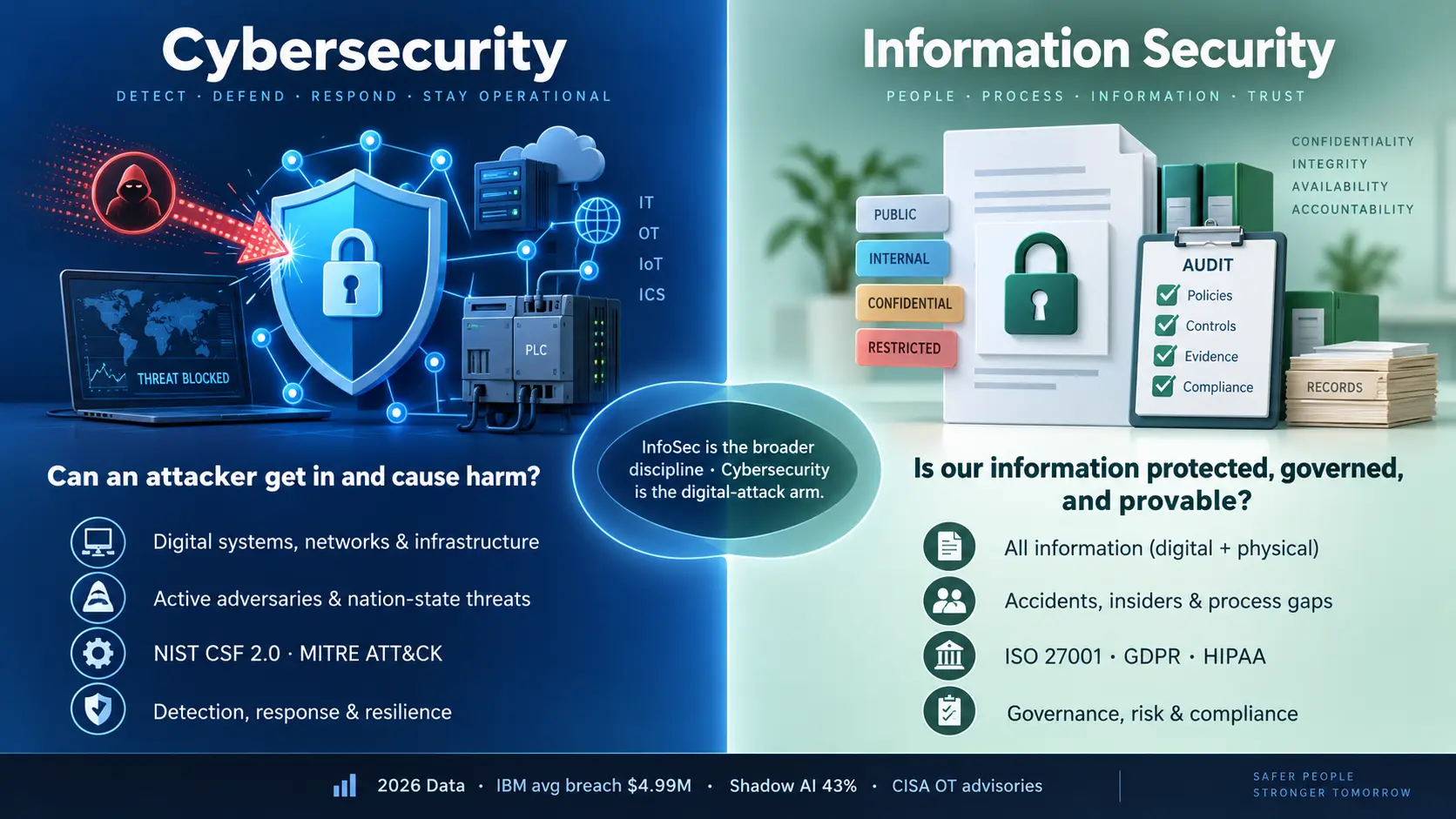
Ask ten security professionals to define “cybersecurity” and “information security,” and you will get twelve answers. Most end with a shrug and “they’re basically the same thing now.”
They are not, and in 2026 the gap between them costs real money. Four reasons why:
- The threats split in two directions. Federal advisories in 2026 warned about attacks on operational technology, PLCs, water systems, hospital building management (CISA Joint Advisory, April 2026). Meanwhile regulators kept issuing penalties for something entirely different: missing risk analyses and unencrypted records.
- The budgets split with it. Gartner projects global end-user spending on information security at $244.2 billion in 2026, up 13.3%. Where that money lands, detection tooling or governance programmes, depends on which discipline owns the roadmap.
- The frameworks split with it. NIST CSF 2.0, ISO/IEC 27001:2022, the HIPAA Security Rule, GDPR, CIRCIA, each sits closer to one discipline than the other. Pick the wrong anchor and your programme audits badly.
- AI made both harder at once. One in four malicious breaches were AI-enabled, and shadow AI affected 43% of breached organisations, up from 20% a year earlier (IBM 2026 Data Breach Cost). Shadow AI is not a firewall problem. It is a governance problem wearing a technology costume.
AI has widened the gap further. One in four malicious breaches in 2026 were AI-enabled, and shadow AI affected 43% of breached organisations. The way these threats land is different depending on whether you are doing cybersecurity or information security. A detailed breakdown of the real 2026 AI threats and how each discipline must respond is covered here: AI threats in cybersecurity vs information security.
If you are studying for a certification, building a programme, or writing a job description, you need to know which discipline you are in. Let’s draw the line.
What Is Cybersecurity?
Cybersecurity is the practice of defending systems, networks, devices, and infrastructure from digital attack.
The operative word is attack. Cybersecurity assumes an adversary actively trying to get in, stay in, disrupt, or destroy. It is a defensive discipline against a thinking opponent.
What cybersecurity covers in 2026
- Network defence: segmentation, zero trust architecture, microsegmentation of clinical and industrial networks
- Endpoint and device security: EDR/XDR, MDM, and the 2026 problem of unmanaged IoT and medical devices on flat networks
- OT and critical infrastructure: PLCs, SCADA, building controls, water treatment, energy distribution
- Detection and response: SOC operations, threat hunting, incident response, digital forensics
- Identity as a perimeter: MFA, PAM, and defending against the help-desk impersonation and MFA-fatigue attacks prominent in 2026 breach data
- Resilience engineering: CISA’s 2026 guidance leaned hard on isolation and recovery: can you keep operating when a nation-state actor is already inside? (CISA, CI Fortify guidance, May 2026)
Understanding the difference between cybersecurity and information security helps you choose the right certification and career path.
The 2026 centre of gravity
Two shifts define the discipline this year.
Attacks got faster; defence got slower. Mean time to identify and contain rose to 247 days in 2026, reversing five consecutive years of improvement (IBM 2026 Data Breach Cost). Adversaries using AI for reconnaissance and exploitation are outrunning manual detection.
Disruption replaced theft as the goal. Federal advisories repeatedly described nation-state activity aimed at operational disruption rather than espionage, pre-positioning inside energy, water, and healthcare networks. That is a pure cybersecurity problem: no data needs to leave the building for the attack to succeed.
Quick test: if your primary question is “can someone break in, and can we stop them?”; you are doing cybersecurity.
What Is Information Security?
Information security (InfoSec) is the practice of protecting information, in any form, from unauthorised access, disclosure, alteration, or destruction.
Note what is missing: any mention of computers. InfoSec predates the internet. It covers the printed chart left on a ward trolley, the contractor who still holds building access a year after their project ended, and the analyst emailing a customer list to personal webmail.
It is organised around the CIA triad: confidentiality, integrity, availability.
What information security covers in 2026
- Data governance and classification: what you hold, where it lives, who owns it, when it gets deleted
- Privacy and regulatory compliance: GDPR, HIPAA, CCPA/CPRA, state privacy laws, and the growing stack of AI governance requirements
- Risk management: documented risk analysis, still the most-cited failure in regulatory enforcement actions (HHS OCR enforcement data, 2026)
- Policy, training, and human controls: acceptable use, insider risk, third-party and vendor risk
- Cryptographic governance: a 2026 weak point: only 37% of breached organisations encrypt sensitive data both at rest and in transit, and just 34% have visibility into their cryptographic assets (IBM 2026 Data Breach Cost)
- Physical and administrative safeguards: clean desks, locked records rooms, offboarding checklists
The 2026 centre of gravity
The defining InfoSec problem of 2026 is ungoverned AI. When 43% of breached organisations report shadow AI incidents, no control was broken, employees fed sensitive data into tools nobody approved, inventoried, or restricted. There is no firewall rule for that.
The second is quantum-safe readiness. Cryptographic inventory is an information governance exercise before it is an engineering one.
Quick test: if your primary question is “do we know what we hold, who can reach it, and can we prove it to an auditor?”, you are doing information security.
Side-by-Side: 8 Key Differences
| # | Dimension | Cybersecurity | Information Security |
|---|---|---|---|
| 1 | Primary scope | Digital systems, networks, devices, infrastructure | All information; digital, physical, verbal, printed |
| 2 | Core question | “Can an attacker get in and cause harm?” | “Is our information protected, governed, and provable?” |
| 3 | Threat model | Active adversaries: nation-states, ransomware crews, hacktivists | Any loss of confidentiality, integrity, or availability; including accident, insider error, process failure |
| 4 | Anchor frameworks | NIST CSF 2.0, MITRE ATT&CK, CIS Controls v8, CIRCIA reporting | ISO/IEC 27001:2022, NIST SP 800-53, GDPR, HIPAA, SOC 2 |
| 5 | Typical controls | Firewalls, EDR/XDR, segmentation, SIEM, threat hunting, patching | Classification, retention schedules, DLP, access reviews, risk analysis, vendor contracts |
| 6 | Success metrics | Dwell time, MTTD/MTTR, blocked intrusions, attack surface reduction | Audit outcomes, policy coverage, inventory accuracy, regulatory findings |
| 7 | Usual reporting line | CISO/SOC leadership, often under IT or engineering | CISO, Chief Privacy Officer, GRC, Legal, or Risk |
| 8 | Certification path | CompTIA Security+, CySA+, PenTest+, OSCP, GCIH | CISSP, CISM, CISA, ISO 27001 Lead Implementer, CIPP |
The relationship in one line: information security is the broader discipline; cybersecurity is the part of it that deals with digital attack. Cybersecurity also stretches slightly outside InfoSec, defending a water pump from being switched off is a cybersecurity job even though no information is at stake.
The difference between cybersecurity and information security also shows up clearly in the frameworks each discipline relies on. NIST CSF 2.0 is the practical, risk-based language most organisations use for day-to-day cybersecurity, while ISO/IEC 27001:2022 is the formal, certifiable standard for building an information security management system. A full side-by-side explanation of how these two frameworks map to each discipline is available here:
NIST vs ISO 27001 for cybersecurity and information security.
When to Use Each: The 4-Step Decision Tree
Most organisations need both. The question is which one leads, which discipline sets the budget, owns the roadmap, and names the top job. Work through four steps:
Step 1: What happens first when things go wrong?
- Systems stop and people can’t work (or can’t be treated, or can’t get water) → cyber leads
- Data leaves the building and a regulator calls → InfoSec leads
Step 2: Who is your most likely adversary?
- A funded, targeted, persistent actor → cyber leads
- Your own staff, a vendor, or a process gap → InfoSec leads
Step 3: What does your worst realistic day cost you?
- Downtime, safety, and recovery → cyber leads
- Fines, litigation, notification, and lost contracts → InfoSec leads
Step 4: What does the business ask you for?
- “Prove we can withstand an attack” → cyber leads
- “Prove we’re compliant and get us certified” → InfoSec leads
Three or more in one column is your answer. A split result means you need genuine parity; the correct answer for most regulated mid-size organisations.
Three worked examples
A hospital: InfoSec leads on paper, cyber gets the budget.
Regulators do not penalise you for being attacked. They penalise you for failing to conduct an accurate, thorough risk analysis, the most consistent finding in recent Security Rule settlements (HHS OCR, 2026).
But the operational risk is unambiguously cyber: ransomware hitting a flat network of unpatchable medical devices, timed for a weekend night shift. A hospital that builds only a compliance programme gets breached; one that builds only a SOC gets fined. Workable structure: a CISO owning risk analysis and vendor agreements, with a funded detection-and-recovery capability underneath.
A startup: cyber first, formalise InfoSec earlier than feels comfortable.
At seed stage you have no records room and no legacy OT. Your risk is narrow: credential theft, exposed cloud storage, one phishing email to the person with production access. Spend on SSO, MFA, endpoint protection, and tested backups.
Then your first enterprise customer arrives and InfoSec becomes the gating function, no security questionnaire, data map, or SOC 2 report means no signature. Founders who treat compliance as a Series B problem discover it is a Series A revenue problem.
A government agency: both, with InfoSec as the legal spine.
Agencies carry classification obligations, records retention statutes, FOIA exposure, and citizen privacy duties that no amount of network defence satisfies, while also ranking among the most-targeted nation-state objectives in the country.
The workable model: an InfoSec governance layer (classification, authorisation to operate, continuous monitoring evidence) over a cyber operations layer (SOC, threat intelligence, incident response). That is essentially how NIST SP 800-53 and FISMA are structured.
Real 2026 Examples
CISA in 2026: cybersecurity as national defence
CISA’s public posture this year was almost entirely cybersecurity, not information security.
In April 2026, the agency and federal partners issued a joint advisory on Iranian-affiliated activity targeting US critical infrastructure, energy, water, healthcare, manufacturing, focused on internet-facing operational technology including programmable logic controllers. It flagged insecure remote access, credential compromise, and poor visibility into legacy and hybrid environments (CISA Joint Advisory, 7 April 2026).
In May 2026, CISA followed with resilience guidance urging critical sectors to invest in isolation and recovery; documented systems, tested backups, and the ability to fall back to manual operation (CISA CI Fortify, May 2026).
Not one of those recommendations concerns data governance. They are about surviving an attack.
IBM Cost of a Data Breach 2026: information security as economics
IBM’s 2026 report, its 21st annual edition, covering 602 breached organisations; put the global average breach cost at a record $4.99 million, up 12% year over year, with the US average at $11.5 million. Healthcare topped the industry table at $6.64 million, its thirteenth consecutive year in first place.
The findings that matter most to InfoSec practitioners:
- Mean time to identify and contain reached 247 days. Breaches running past 200 days averaged $5.65M versus $4.32M for shorter ones.
- AI-enabled attacks made up one in four malicious breaches and cost roughly $1M more each.
- Shadow AI affected 43% of breached organisations, up from 20%.
- Only 37% encrypt sensitive data both at rest and in transit.
Three of those four are governance failures. You do not fix shadow AI or encryption gaps with a better firewall; you fix them with inventory, policy, classification, and enforcement.
A hospital case: where both disciplines meet
In May 2026, the HHS Office for Civil Rights announced penalties against four regulated entities after ransomware attacks exposed the health data of roughly 427,000 individuals, totalling $1,165,000. Separately, OSF Healthcare agreed to pay $552,250 to settle alleged HIPAA violations following a ransomware attack affecting 53,907 patients.
Read the pattern carefully:
- The ransomware was the cybersecurity failure.
- The penalty was for the information security failure, inadequate risk analysis and insufficient safeguards, gaps that existed on paper long before any attacker arrived.
Regulators punish the governance gap the attack revealed, not the attack itself. That is the entire argument for knowing the difference, compressed into one enforcement action.
Once you understand the difference between the two disciplines, the next practical question is which career path fits you better. The day-to-day work, required skills, salary ranges, and promotion tracks are quite different. A clear side-by-side comparison of cybersecurity vs information security careers, including 2026 salary data and a simple self-assessment, is available here: how to choose between cybersecurity and information security.
Conclusion: Know the Difference, Then Build Both
The 2026 evidence is consistent:
- Cybersecurity is where attacks land: faster adversaries, AI-enabled intrusions, OT in the crosshairs, detection times moving the wrong way.
- Information security is where the bill arrives: regulatory penalties, shadow AI exposure, encryption blind spots, undocumented risk.
- Mature programmes run both: cyber as the operational arm, InfoSec as the governance spine.
For exam candidates the guidance is simpler. Security+, CySA+, and OSCP test cybersecurity thinking: threats, controls, detection, response. CISSP, CISM, and CISA test information security thinking: risk, governance, policy, assurance. Study the mindset, not just the acronyms, that is where marks get lost.
Get the Free 2026 Quick Reference PDF
The comparison table, the four-step decision tree, every 2026 statistic with its source, and a one-page cheat sheet mapping each domain to its certifications.
Download the PDF from PassitExams.com
Frequently Asked Questions FAQ’s
Is information security the same as cybersecurity?
No. Information security is the broader discipline, protecting information in every form; including paper, conversations, and physical records. Cybersecurity is the subset defending digital systems and networks against attack. Job titles use the terms interchangeably; frameworks and regulators do not.
Which should I learn first in 2026?
Learn cybersecurity fundamentals first. Networking, identity, endpoints, and attack techniques are concrete, and give governance something to attach to later. Most successful paths run Security+ → CySA+ → CISSP or CISM. Starting with governance produces candidates who can quote a framework but not defend a network.
Which pays more; cybersecurity or information security roles?
Senior information security and governance roles (CISO, InfoSec Manager, GRC Lead) typically out-earn equivalent technical cyber roles because they carry organisational accountability. Early-career technical roles usually pay more than early-career compliance roles. Technical depth gets you in; governance breadth gets you promoted.
Does a small business need both?
Yes, but not in equal measure. Start with cybersecurity basics; MFA, patching, endpoint protection, tested backups and add information security formality when a customer, insurer, or regulator asks for evidence. That trigger usually arrives sooner than expected.
Which certification proves which discipline?
Cybersecurity: CompTIA Security+, CySA+, PenTest+, OSCP, GCIH. Information security: CISSP, CISM, CISA, ISO/IEC 27001 Lead Implementer, CIPP. CISSP sits closest to the boundary, it is a governance exam with technical breadth, which is why candidates from purely technical backgrounds often underestimate it.
Is NIST CSF 2.0 a cybersecurity or information security framework?
Technically cybersecurity, but CSF 2.0 blurred the line deliberately. Adding the Govern function in 2024 brought organisational risk, roles, and policy into scope, pulling a cybersecurity framework into information security territory. That convergence is exactly why the distinction still needs explaining.
Sources & References
- IBM Security / Ponemon Institute. Cost of a Data Breach Report 2026.
- Newsroom summary: IBM Study: One in Four Malicious Breaches Are AI-Enabled. 602 organisations breached March 2025 – February 2026.
- CISA, FBI, and federal partners. Joint Cybersecurity Advisory on Iranian-affiliated activity targeting US energy, water, healthcare, and manufacturing infrastructure and internet-facing OT/PLC devices. 7 April 2026.
- CISA. CI Fortify initiative guidance on isolation, recovery, and operating through disruption for critical infrastructure. May 2026.
- US Department of Health and Human Services, Office for Civil Rights. HIPAA Enforcement Actions; resolution agreements and civil monetary penalties, 2026, including ransomware-related settlements.
- Gartner, Inc. Forecast: Information Security, Worldwide, 2023–2029 and Forecast Analysis: Information Security, Worldwide, 2026 (G00838442). Global end-user spending projected at $244.2 billion in 2026, up 13.3%.
- NIST. The NIST Cybersecurity Framework (CSF) 2.0, NIST CSWP 29, February 2024; including the new Govern function.
- DOI: 10.6028/NIST.CSWP.29.
- ISO/IEC. ISO/IEC 27001:2022 — Information security, cybersecurity and privacy protection — Information security management systems — Requirements. ISO/IEC. ISO/IEC 27002:2022 — Information security controls, the reference control set supporting ISO/IEC 27001 Annex A.
- NIST. SP 800-53 Rev. 5 — Security and Privacy Controls for Information Systems and Organizations. DOI: 10.6028/NIST.SP.800-53r5.
- Verizon. 2026 Data Breach Investigations Report ; 19th edition; over 31,000 incidents and 22,000+ confirmed breaches across 145 countries.
- CISA. Cyber Incident Reporting for Critical Infrastructure Act (CIRCIA; rulemaking materials and 2026 sector town halls.
Joel Charlton is a cybersecurity educator and lead content author at PassitExams, where he writes exam-focused guides for candidates pursuing CompTIA Security+, CySA+, CISSP, and CISM. He specialises in turning regulatory frameworks and threat intelligence into material people can sit an exam on, and apply the following Monday. After more than a decade across security operations and GRC, Joel holds that most security failures are documentation failures wearing a technical disguise.
Questions or corrections? Reach the PassitExams team through our contact page, we update our 2026 guides as new data lands.
More Certification Comparisons
Compare scope, difficulty, prep time, and career impact—side by side.
PassITExams vs ExamTopics
Which Platform is Best for IT Certification Exam Preparation?
PassITExams vs Skillcertpro
The Ultimate Guide to Choosing Your IT Certification Success Partner
PassITExams vs Pass4sure
A Critical Examination of Certification Preparation Platforms
CTFA vs CFP
Choosing the Right Financial Designation for a Career in Fiduciary and Wealth Management
Splunk vs Elastic
The Ultimate Comparison for Logging, SIEM, and Observability
IBM QRadar vs Splunk
The Ultimate SIEM Comparison for Modern Security Operations
SageMaker vs Bedrock
Choosing the Right Engine for Your AI Strategy in 2026
az-104 vs az-400
our Definitive Azure Career Path for 2026 (Admin vs. DevOps)
AZ-104 vs AI-900
Azure Admin Associate Or AI Fundamentals?
AZ-104 vs PL-300
Azure Admin or Data Analyst? (Salary & Jobs)
AZ-104 vs AZ-500
Which Azure Certification Is Right for Your Career?
AZ-900 vs CLF-C02
Which Foundational Cloud Cert Unlocks the Best Jobs and Salaries?
AZ-900 vs SAA-C03
Which Cloud Certification is Right for You?
RHIT vs RHIA
Which Health Information Credential Is Right for You?
AZ-900 vs DP-900
Which Azure Certification Should You Take First?
AZ-900 vs SC-900
Choose Your Microsoft Certification Path
AZ-900 vs AI-900
Which Azure Fundamentals Certification Is Your Launchpad?
AZ-204 vs AZ-305
The Builder vs. The Architect
AZ-900 vs AZ-204
Which Microsoft Azure Certification is Right for You?
az-204 vs pl-300
Building the Engine or Charting the Course?
AZ-900 vs AZ-400
Foundational vs. Expert: Complete Guide for Your Azure Career
601 vs 601
CompTIA Security+ 601 vs 701: The Ultimate Comparison Guide
Data Engineer vs Data Scientist
The Ultimate Comparison Guide
AWS vs Azure
The Ultimate Comparison for Certification & Career
CISSP vs SecurityX
Which Certification Will Define Your Cybersecurity Career?
AWS vs Azure
Who is Leading the Cloud Race?
AWS vs Azure
Which Cloud Certification is Paying High?
AZ-104 vs AZ-305
Administrator vs. Architect – Your Ultimate Azure Guide
AZ-104 vs AZ-204
The Ultimate Guide for Your Azure Career
ISSA vs NASM
Which Personal Trainer Certification Is Best for You?
Salesforce Admin vs Salesforce Developer
Unlocking Your Earning Potential in the Salesforce Ecosystem
CISSP vs CCSP
Your Ultimate Guide to a Career in Cloud Security
CRISC vs CISSP
Mastering Risk Management and Information Security
CISSP vs CEH
Your Guide to Mastering Offensive and Defensive Security
CISSP vs PMP
Unlocking Dual Expertise in Security and Project Management
CISSP vs Security+
Choosing the Right Certification to Boost Your Earning Potential
CISSP vs OSCP
Choosing the Right Certification for a Six-Figure Cybersecurity Career
CISSP vs CISM
Which Certification Will Truly Elevate Your Cybersecurity Career?
Azure vs AWS
How to Choose the Right Cloud Platform for Your Business
AZ-900 vs AZ-700
MIcrosoft Career Blueprint: From Azure Fundamentals to Networking
AZ-900 vs AZ-104
Azure Career Blueprint: Your Path from Azure Fundamentals to Azure Administrator
AZ-104 vs SAA-C03
Azure Administrator vs. AWS Architect: Which Career Path Wins?
AZ-900 vs MS-900
Your ultimate Microsoft fundamentals showdown.
