
In today’s economy, data is the new oil, and the demand for professionals who can manage and interpret it is exploding. As the world is projected to generate over 394 zettabytes of data by 2028, businesses are in a race to turn this raw information into a competitive advantage. This has created two of the most critical and sought-after roles in the tech industry: the Data Engineer and the Data Scientist.
While both roles are essential to the data lifecycle, they are fundamentally different. Many aspiring professionals find themselves at a crossroads, asking a crucial question: Should I build the systems that handle the data, or should I be the one to analyze it and uncover its secrets?
This ultimate guide, brought to you by PassITExams, will provide an exhaustive, side-by-side comparison of the Data Engineer and Data Scientist roles. We will dissect their responsibilities, the skills and tools they use, their salary potential, and their career paths to help you make the strategic decision that best aligns with your skills and ambitions.
Key Takeaways: Data Engineer vs. Data Scientist at a Glance
- The Data Engineer is the architect and builder. They design, build, and maintain the data infrastructure—the pipelines and databases—that makes data available and usable.
- The Data Scientist is the analyst and strategist. They use the data prepared by engineers to perform statistical analysis, build predictive models, and extract insights that drive business decisions.
- Core Difference: A simple analogy is that the Data Engineer builds the kitchen, ensuring all the plumbing works and the ingredients are properly stored. The Data Scientist is the chef who uses that kitchen and those ingredients to create a meal.
- Job Outlook: The demand for both roles is incredibly high. The U.S. Bureau of Labor Statistics projects a 36% growth for data scientists and related roles between 2023 and 2033.
What is a Data Engineer? The Architect of the Data World
A Data Engineer is a highly technical professional who lays the groundwork for all data-related activities in an organization. They are responsible for creating, constructing, testing, and maintaining the complete data architecture, which includes databases and large-scale processing systems. In short, they ensure that data is accessible, reliable, and secure for everyone who needs it.
Data rarely arrives in a clean or usable form. It comes from dozens of different sources, like apps, sensors, websites, and transactions. The Data Engineer’s primary job is to build and manage the systems that collect this raw data, transform it into a standardized format, and load it into a centralized repository like a data warehouse or a data lake.
Key Responsibilities of a Data Engineer:
- Designing and Building Data Pipelines: Creating the automated processes (often called ETL/ELT pipelines) that extract data from various sources and move it to a central location.
- Data Modeling and Database Management: Structuring databases and data warehouses to ensure data is stored efficiently and can be queried quickly.
- Data Cleaning and Transformation: Writing code to clean up messy, inconsistent data and transform it into a usable format.
- Ensuring Data Quality and Reliability: Implementing processes to monitor data quality and ensure the data pipelines are robust and reliable.
- Managing Cloud Data Infrastructure: Working with cloud platforms like AWS vs Azure, or Google Cloud to build and manage scalable data storage and processing systems.
What is a Data Scientist? The Interpreter of the Data World
A Data Scientist is a professional who works with the clean, prepared data provided by data engineers to uncover hidden patterns, trends, and insights that can inform business decisions. They are a unique blend of statistician, computer scientist, and business strategist.
Data scientists are the ones who answer the big questions. They use a variety of tools and techniques, such as machine learning, statistical analysis, and data visualization, to transform raw data into actionable intelligence. Their goal is to help an organization understand what’s happening, why it’s happening, and what is likely to happen next.
Key Responsibilities of a Data Scientist:
- Exploratory Data Analysis: Diving into datasets to understand their characteristics and identify interesting patterns and anomalies.
- Building Predictive Models: Using machine learning algorithms to build models that can predict future outcomes, such as customer churn or product sales.
- Hypothesis Testing and Experimentation: Designing and running experiments (like A/B tests) to answer specific business questions.
- Data Visualization and Storytelling: Creating compelling charts, graphs, and dashboards to communicate their findings to non-technical stakeholders.
- Collaborating with Business Leaders: Working closely with product, marketing, and executive teams to translate data insights into actionable business strategies.
Head-to-Head: Comparing Skills and Tools
While both roles require a strong foundation in programming and data, their specialized skills and the tools they use are quite different.
Skills Comparison: Engineer vs. Scientist
| Skill Category | Data Engineer | Data Scientist |
|---|---|---|
| Programming | Expert-level in SQL and Python/Java/Scala for building robust systems. | Strong proficiency in Python or R for analysis and modeling. |
| Databases | Deep knowledge of database architecture, both SQL (e.g., PostgreSQL) and NoSQL (e.g., MongoDB, Cassandra). | Strong ability to query databases with SQL. Less focus on architecture. |
| Big Data Tech | Expertise in frameworks like Apache Spark, Hadoop, and Kafka for large-scale data processing and streaming. | Familiarity with frameworks like Spark for distributed data analysis. |
| Cloud Computing | Advanced skills in using cloud platforms (AWS, Azure, GCP) to build data warehouses and pipelines. | Experience using cloud platforms to train and deploy machine learning models. |
| Software Engineering | Strong foundation in software engineering principles, CI/CD, and automation. | Basic understanding of software development practices. |
| Statistics & ML | Basic understanding is helpful for data validation. | Deep expertise in statistical modeling, machine learning algorithms, and experimental design. |
| Data Visualization | Not a primary focus. | Core skill. Expertise in tools like Matplotlib, Seaborn, and Tableau to create insightful visualizations. |
| Soft Skills | Strong problem-solving, logical thinking, and collaboration with data scientists. | Excellent communication, storytelling, and the ability to translate technical findings into business value. |
Tools of the Trade
| Tool Category | Data Engineer | Data Scientist |
|---|---|---|
| Languages | SQL, Python, Java, Scala | Python, R, SQL |
| Big Data Frameworks | Apache Spark, Hadoop, Kafka, Airflow | Pandas, NumPy, Scikit-learn, TensorFlow, PyTorch |
| Databases | PostgreSQL, MySQL, MongoDB, Cassandra, Redis | Primarily query databases using SQL. |
| Cloud Platforms | AWS (Redshift, S3, Glue), Azure (Synapse, Data Factory), GCP (BigQuery) | AWS (SageMaker), Azure (Machine Learning), GCP (AI Platform) |
| Visualization Tools | Minimal usage. | Tableau, Power BI, Matplotlib, Seaborn |
Real-World Job Market Insights: Data Engineer vs Data Scientist Trends
At PassITExams, our research team understands the importance of staying ahead in a dynamic job market. To bring you the most relevant and up-to-date insights, we’ve performed extensive, in-depth analysis across major job portals, including a deep dive into Glassdoor’s vast database. We’ve meticulously curated the latest data to provide you with a clear picture of the current demand, required skills, and salary expectations for both Data Engineers and Data Scientists in 2025.
Data Scientist Job Trends: High Demand for Insightful Analysts
Our research into the Data Scientist job market reveals robust demand, with thousands of opportunities across the United States. Companies are actively seeking professionals who can transform complex data into actionable strategies.
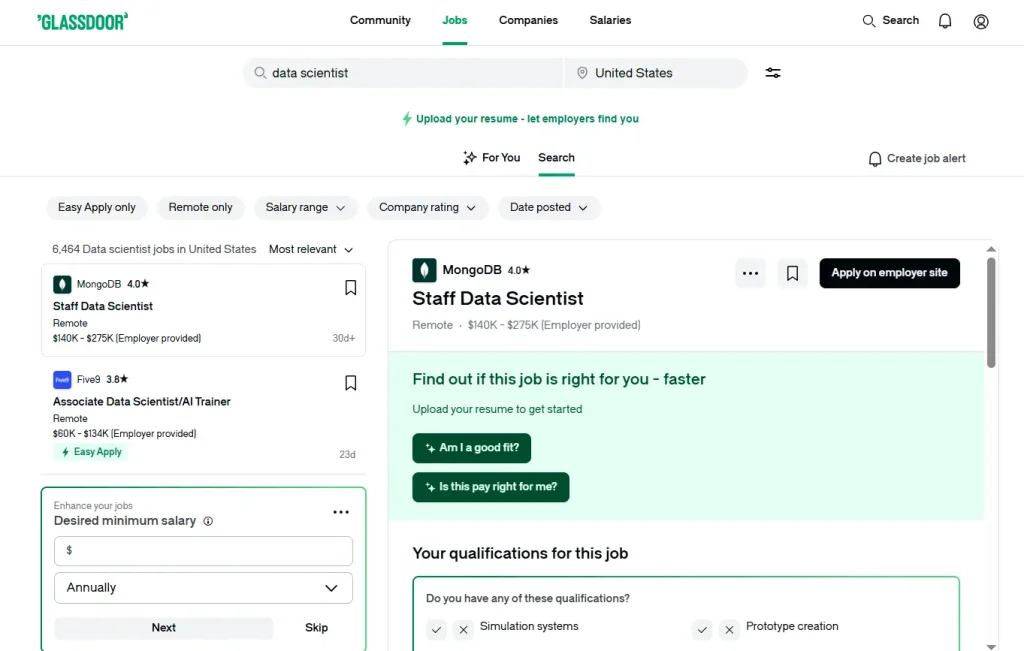
As illustrated in the screenshot above from Glassdoor, as of our recent analysis, there are over 6,000 data scientist jobs available in the U.S. This high volume underscores the critical need for experts in data interpretation and predictive modeling. Key qualifications frequently highlighted in these listings include:
- Research Findings Presentation: The ability to articulate complex analytical results clearly to various stakeholders.
- Presentation Creation: Crafting compelling visual narratives to communicate insights effectively.
- SQL: Essential for querying and manipulating data from various sources.
- Simulation Systems: Experience with building and utilizing models to simulate scenarios and predict outcomes.
This data strongly emphasizes that while analytical prowess is paramount, the ability to communicate those insights is equally crucial for a successful Data Scientist.
Data Engineer Job Trends: The Backbone of Data-Driven Organizations
Parallel to the Data Scientist boom, our research confirms an equally vital and growing demand for Data Engineers. These professionals are the architects of the data ecosystem, ensuring that data is accessible, reliable, and performant for all downstream analytical tasks.

Our Glassdoor analysis, depicted in the second screenshot, shows over 4,000 data engineer jobs currently available in the U.S. While the sheer volume might appear lower than data scientists, the demand is incredibly strong and often represents more specialized, infrastructure-critical roles. The core qualifications sought after by employers consistently include:
- SQL: A non-negotiable skill for interacting with and managing data in relational databases.
- Cloud Data Warehouses: Expertise in designing, implementing, and managing data storage solutions on cloud platforms (e.g., Azure Synapse, AWS Redshift, Google BigQuery).
- Data Integration (Data Management): The ability to effectively consolidate data from disparate sources into a unified system.
- Data Architecture Design Skills: The capability to blueprint scalable and efficient data systems that meet business requirements.
This data underscores that Data Engineers are foundational to modern data initiatives, with roles spanning from Senior Data Engineer positions at established software firms to roles within healthcare and media companies.
Salary and Career Paths
Salary Comparison
Both careers offer highly competitive salaries. Certifications can significantly impact earning potential, with some of the highest-paying Azure certifications boosting compensation. While numbers vary by location and role, understanding the salary differences between platforms like AWS and Azure can also be insightful.
| Role | Entry-Level Salary Range (USA) | Mid-Senior Level Salary Range (USA) |
|---|---|---|
| Data Engineer | $76,000 – $100,000 | $100,000 – $200,000+ |
| Data Scientist | $86,000 – $141,000 | $150,000 – $210,000+ |
According to Indeed Salaries, the average national salary for a data engineer is $125,335 per year, while the average for a data scientist is $119,577 per year. However, other sources suggest that the total compensation for data scientists, including bonuses, is often higher.
Career Paths and Future Prospects
- Data Engineer Career Path: A data engineer often starts their career as a software engineer or a business intelligence analyst. As they gain experience, they can progress to roles like Senior Data Engineer, Data Architect, or a management position like Manager of Data Engineering. With additional skills, a transition to a data scientist role is also possible.
- Data Scientist Career Path: A data scientist often starts with a strong academic background in a quantitative field. They can progress to roles like Senior Data Scientist, Machine Learning Engineer, or specialize in areas like Natural Language Processing or Computer Vision. Leadership roles include Lead Data Scientist or Chief Data Officer.
Which Role is Right for You?
Choosing between these two exciting careers depends on your personality, skills, and what kind of problems you enjoy solving.
Choose the Data Engineer path if:
- You enjoy building and optimizing systems.
- You are passionate about writing efficient, production-ready code.
- You prefer solving problems related to structure, scale, and reliability.
- You would rather design the tools that others use to find insights.
Choose the Data Scientist path if:
- You enjoy exploring data and asking “what if” questions.
- You have a strong aptitude for statistics, mathematics, and experimental design.
- You prefer solving problems related to strategy, prediction, and ambiguity.
- You are passionate about translating complex data into a compelling story that drives business action.
Conclusion
While the roles of data engineer and data scientist are distinct, they are deeply interconnected and equally critical to the success of any data-driven organization. The data engineer builds the reliable data foundation, and the data scientist builds on that foundation to uncover the insights that propel a business forward.
Whether your passion lies in building structured systems or in open-ended problem-solving, there is a place for you in this thriving field. By understanding the key differences in their skills, tools, and responsibilities, you can choose the path that best aligns with your strengths and build a rewarding and future-proof career.
Frequently Asked Questions (FAQs)
Is data engineering harder than data science?
Not necessarily, it depends on your strengths. Data engineering is more demanding in terms of software engineering and systems architecture, while data science requires a deeper expertise in statistics and machine learning. Neither is objectively “harder”.
Can a data engineer become a data scientist (and vice versa)?
Absolutely. Many professionals transition between the two roles with additional learning and project experience, especially since they share foundational skills in programming and big data technologies.
Which role is more in demand?
Currently, there is an incredibly high demand for both roles. Some sources suggest that there is a more acute shortage of skilled data engineers, as a strong data science team cannot function without a solid data infrastructure in place.
What educational background is required?
Data engineers often have degrees in computer science or software engineering. Data scientists frequently come from backgrounds in statistics, mathematics, data science, or other quantitative fields. Advanced degrees (Master’s or PhD) are more common for data scientists.
Do both roles require certifications?
While not always mandatory, certifications are highly valued. Data engineers often pursue certifications from cloud providers like AWS or Azure(e.g., Azure Data Engineer Associate). For instance, understanding if an Azure certification is worth it is a common consideration. Following a defined Azure certification path can provide a structured approach. Data scientists may pursue certifications in machine learning or specific analytical tools.
