
Yes and no; it depends entirely on which organization certified you.
There is no single, universal Six Sigma authority, so there’s no single expiration rule. Some certifying bodies require renewal every three years. Others issue credentials that never expire.
Quick answer:
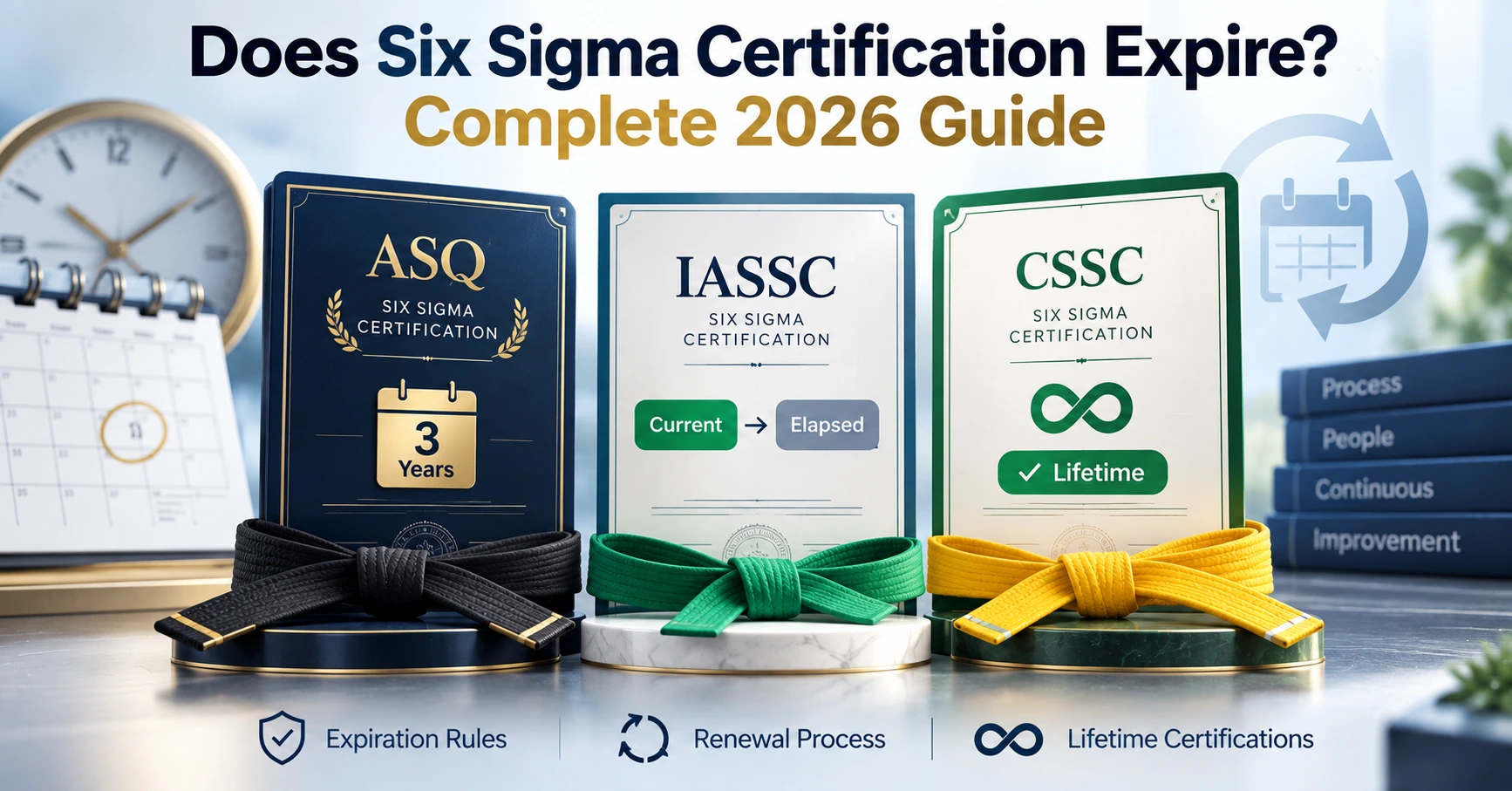
- ASQ; Black Belt and Master Black Belt expire and require renewal every 3 years. Green Belt and Yellow Belt are lifetime credentials.
- IASSC; Certifications never technically “expire,” but shift from “Current” to “Elapsed” status after 3 years without recertification.
- CSSC; No certification expires at any belt level. No renewal required, ever.
If you already hold a certification and aren’t sure which category you fall into, check with the issuing body directly; the rules genuinely differ that much.
Certification Expiration at a Glance
| Certifying Body | Belt Levels | Expiration Rule | Renewal Method | Typical Cost |
|---|---|---|---|---|
| ASQ | Black Belt, Master Black Belt | Expires every 3 years | 18 recertification units (RUs) or retake exam | 120–160 (journal) / 485–1,399 (exam) |
| ASQ | Green Belt, Yellow Belt | Never expires (lifetime) | Not applicable | $0 |
| IASSC | Yellow, Green, Black Belt | Doesn’t expire, but shifts to “Elapsed” after 3 years | Retake proctored exam only (no CEU option) | ~175–268 depending on belt |
| CSSC | White, Yellow, Green, Black, Master Black Belt | Never expires at any level | Not applicable | $0 |
How Different Bodies Handle Expiration (ASQ, IASSC, CSSC, and Others)
ASQ (American Society for Quality)
ASQ’s policy is belt-specific rather than blanket.
- Black Belt and Master Black Belt must be renewed every three years to maintain the same level of knowledge demonstrated at initial certification, according to ASQ’s official recertification page.
- Green Belt and Yellow Belt are explicitly listed as lifetime certifications with no recertification requirement, per ASQ’s recertification FAQ.
Why the split? ASQ ties its advanced, practice-based credentials to ongoing competence under ISO 17024 conformity standards; the same standard it applies to certifications like Quality Engineer and Quality Auditor. Green Belt and Yellow Belt are treated as foundational knowledge credentials, so ASQ doesn’t require ongoing proof for those.
IASSC (International Association for Six Sigma Certification)
IASSC takes a hybrid approach.
- A certificate carries “Current” status for three years from its issue date.
- If you don’t recertify within that window, the status changes to “Elapsed.”
- Your certification isn’t revoked; it simply loses its “current” label, which can matter if an employer verifies your status directly.
Recertification is exam-only. There’s no continuing-education option. You retake a shorter, timed exam through IASSC’s certification and recertification catalog, administered via PeopleCert. Pricing and question counts vary by belt level, generally landing in the 175–268 range with a required passing score of 70%.
CSSC (Council for Six Sigma Certification)
CSSC is the simplest of the three.
- Certifications issued by The Council for Six Sigma Certification do not expire at any level.
- There’s no recertification exam, no unit tracking, and no status change over time.
- Once certified, you’re certified indefinitely.
Other and Corporate-Issued Certifications
Beyond the “big three,” you’ll find Six Sigma certificates from universities, private training companies, and consulting firms (Villanova, GreyCampus, Simplilearn, and others).
These are typically certificates of completion, not third-party certifications. Their expiration policies vary by institution; usually none, since there’s no ongoing competency requirement to enforce. Credibility here rests more on the issuing institution’s reputation than on a formal renewal cycle.
Does Expiration Affect Job Value?
The honest answer: usually, only a little; but lapsed status can matter in specific situations.
- Your experience doesn’t expire:
An employer evaluating you for a process-improvement role cares primarily about the projects you’ve led and the results you’ve delivered. A technically lapsed certification doesn’t erase that track record.
- Status checks are rare but not unheard of:
Some employers; particularly in regulated industries like pharmaceuticals, aerospace, or medical devices; verify certifications directly with the issuing body. If your ASQ Black Belt has lapsed or your IASSC credential shows “Elapsed,” that could raise a question during a background check.
- Accuracy matters more than the exam itself:
ASQ is explicit that certified individuals may not imply their certification is current once it has lapsed. Listing an inactive credential as active is a bigger credibility risk than the lapse itself.
- Lifetime credentials remove the issue entirely:
If you hold an ASQ Green Belt, ASQ Yellow Belt, or any CSSC certification, there’s no clock running in the background; this concern simply doesn’t apply.
- Most Black Belts recertify without much friction:
Since ASQ counts routine full-time employment toward recertification units, many working professionals accumulate enough credit passively just by staying in a relevant role.
Bottom line: expiration rarely tanks job prospects on its own, but letting a Black Belt-level credential go stale; especially while still listing it as active; is a small, avoidable risk.
How to Maintain Your Certification
If you hold a certification that requires renewal:
- Know your recertification date. Log into your ASQ or IASSC account now and check your status and deadline.
- Track activities as you go. Log conferences, courses, mentoring, and committee work in ASQ’s online recertification journal throughout the three-year cycle, rather than scrambling at the end.
- Use your job itself. Full-time employment in a relevant role counts toward ASQ’s RU requirement.
- Set a reminder well before the grace period. ASQ’s 60-day grace window and IASSC’s exam-only renewal path both get less forgiving the longer you wait; build in a 4–6 month buffer.
- Update your resume and LinkedIn if status changes. Don’t list a credential as active if it isn’t.
- Synchronize multiple ASQ certifications onto a single renewal date if you hold more than one, so you’re managing one deadline instead of several.
Key Takeaways
- Whether Six Sigma certification expires depends entirely on the issuing body; there’s no universal rule.
- ASQ Black Belt and Master Black Belt expire every 3 years; ASQ Green Belt and Yellow Belt are lifetime credentials.
- IASSC certifications shift from “Current” to “Elapsed” after 3 years without a recertification exam.
- CSSC certifications never expire at any belt level.
- A lapsed certification rarely disqualifies you for a job, but don’t list it as active if it isn’t current.
- If long-term maintenance matters to you, factor expiration policy into which body you choose to certify with in the first place.
Frequently Asked Questions FAQ’s
Does a Six Sigma Green Belt expire?
Not through ASQ or CSSC; both treat Green Belt as a lifetime credential. IASSC Green Belts follow the same three-year “Current” to “Elapsed” cycle as their other belts.
Does a Six Sigma Black Belt expire?
Through ASQ, yes; it requires renewal every three years via RUs or exam. Through IASSC, it shifts to “Elapsed” status after three years without a recertification exam. Through CSSC, no.
How much does ASQ Black Belt recertification cost?
Recertifying by journal (RU documentation) costs $120 for members with one certification, or $160 for non-members. Recertifying by exam costs $485 for members or $585 for non-members. Master Black Belt exam recertification runs significantly higher, around $1,399.
Can I still list an expired or “Elapsed” certification on my resume/LinkedIn?
You shouldn’t list it as current or active. ASQ specifically prohibits stating or implying an expired certification is still current, and using the associated acronym after lapsing violates its policy. The safer approach: list the credential with the year earned (e.g., “ASQ CSSBB, 2021”) and note if it’s since lapsed or is in the process of renewal, rather than presenting it as an active credential.
What happens if I don’t recertify with ASQ in time?
You get a 60-day grace period to recertify by journal. After that, you can still recertify by exam, but only within one year of your original recertification date. Miss that window and you’ll need to reapply as a brand-new candidate.
Can I recertify without retaking the exam?
With ASQ, yes; earning 18 recertification units is the more common route. With IASSC, no; recertification is exam-only. With CSSC, recertification isn’t required at all.
Which certification body has the simplest long-term maintenance?
CSSC, since none of its credentials require renewal. If you want a one-and-done credential, that’s worth weighing when deciding where to certify.
Related Reading
If you’re still deciding whether certification is worth the investment, our guide on Is Six Sigma Certification Worth It? walks through the return on investment by career stage and industry.
And if expiration policy is one of the factors shaping which body to choose, our Best Six Sigma Certification Guide compares ASQ, IASSC, CSSC, and other providers side by side on cost, difficulty, recognition, and renewal requirements; so you can pick the path that fits how much ongoing maintenance you’re willing to take on.
