

“How long should I study for the CISSP?” This is, without question, the first and most frequent question aspiring cybersecurity leaders ask. The internet is filled with generic answers ranging from a breezy “six weeks” to a daunting “full year.” As a CISSP instructor who has guided thousands of professionals to certification success, I can tell you that a one-size-fits-all answer is not only unhelpful, it’s misleading.
The Certified Information Systems Security Professional (CISSP) is not a test of memorization; it is an assessment of your professional judgment, risk management mindset, and ability to think like a senior security advisor. Therefore, your preparation timeline is deeply personal, hinging on a unique combination of your professional experience, existing knowledge, and study discipline.
This in-depth guide moves beyond generic timelines. We will dissect the factors that actually determine your study duration, provide persona-based study plans, and offer an architectural framework for building your personal roadmap to CISSP success in 2025. You will leave with a clear, actionable understanding of what it will take for you to pass this career-defining exam.
The Quick Answer vs. The Real Answer
Most successful CISSP candidates study for 3 to 6 months, dedicating 150 to 250 total hours of focused preparation. This typically breaks down to 8-12 hours per week. However, this is merely a statistical average. Your personal journey will vary significantly based on the factors we’ll explore next.
The real answer is that your study time is a function of the gap between your current expertise and the breadth of the (ISC)² Common Body of Knowledge (CBK). Your goal is not to clock hours; it’s to master concepts and, more importantly, the CISSP mindset.
See also: How much does cissp increase salary?
Architecting Your Timeline: Key Factors Influencing Your CISSP Study Plan
To determine how long you need to study for the CISSP, you must first perform a self-assessment. Your preparation timeline is not a fixed number but a variable equation. Here are the primary inputs to that equation.
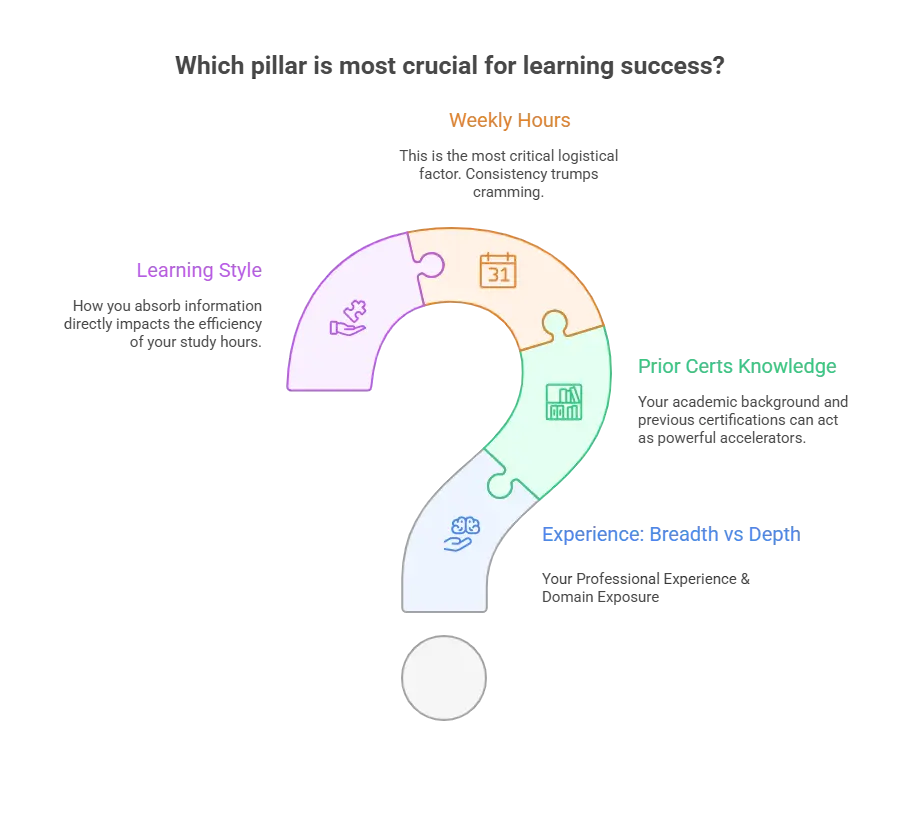
Factor 1: Your Professional Experience & Domain Exposure
The CISSP requires a minimum of five years of cumulative, paid, full-time work experience in two or more of the eight CBK domains. However, not all experience is created equal.
- Direct vs. Indirect Experience: If you’ve spent your career as a Security Architect designing systems based on risk assessments (Domain 1), your study time for that domain will be minimal. Conversely, if you’re a Network Engineer who has never touched software development security (Domain 8), you have a significant knowledge gap to fill.
- Breadth vs. Depth: A CISO with 10 years of broad experience across governance, risk, and compliance (GRC) October need less time than a penetration tester with 10 years of deep, but narrow, technical expertise.
Real-World Scenario: A Senior Network Security Engineer with 8 years of experience October be an expert in Domain 4 (Network Security) and parts of Domain 3 (Security Architecture). However, they might have zero practical experience with Domain 7 (Security Operations) incident response planning or Domain 8 (Software Development Security). Their study plan must aggressively target these weaker domains, potentially adding 40-60 hours compared to a candidate with a more balanced background.
Factor 2: Your Existing Knowledge and Prior Certifications
Your academic background and previous certifications can act as powerful accelerators.
- Foundational Knowledge: A degree in Computer Science or Cybersecurity provides a strong theoretical base.
- Relevant Certifications: Holding certifications like Security+, CySA+, or even vendor-specific certs (e.g., CCNA Security) means you’ve already mastered certain concepts that overlap with the CISSP CBK. Someone with a CompTIA Security+ certification has a head start on foundational security principles, potentially reducing their overall study time by 20-30 hours.
Factor 3: Your Weekly Study Commitment & Discipline
This is the most critical logistical factor. Consistency trumps cramming.
- 10 hours/week: A sustainable pace for most professionals. At this rate, a 200-hour plan takes approximately 5 months.
- 20 hours/week: An aggressive pace, often requiring significant personal sacrifice. This can shorten a 200-hour plan to 2.5 months but carries a high risk of burnout.
- < 5 hours/week: A slow pace that can be detrimental. The CISSP requires building conceptual momentum; studying too little each week can lead to forgetting material faster than you learn it.
Expert Tip: Use the concept of “Spaced Repetition.” It’s far more effective to study for 1.5 hours every day than to cram for 10 hours on a Saturday. This technique embeds concepts in your long-term memory.
Factor 4: Your Learning Style
How you absorb information directly impacts the efficiency of your study hours.
- Visual Learner: Benefits most from video courses, mind maps, and diagrams.
- Auditory Learner: Excels with audiobooks, lectures, and creating audio notes to review during commutes.
- Reading/Writing Learner: Thrives on official textbooks like the (ISC)² Official Study Guide (OSG) and creating detailed written summaries.
Get Indepth knowledge on: CISSP vs CRISC: Which Security Certification Should You Get?

Understanding the CISSP Exam: Logistics and What to Expect
Before finalizing your study timeline, it’s crucial to understand the structure and logistics of the exam itself. Knowing these details prevents surprises and helps you tailor your preparation for exam day.
- Exam Format: The English CISSP exam is a Computerized Adaptive Test (CAT).1 This means the difficulty of your next question is determined by your answer to the previous one. You cannot skip questions or go back to change answers.
- Number of Questions: The exam presents between 125 and 175 questions.2 100 of these are scored, and 25 are unscored research questions. The exam ends when the engine is 95% confident that you have passed or failed.
- Exam Duration: You have a maximum of 4 hours to complete the exam. Effective time management is key.
- Passing Score: You must achieve a score of 700 out of a possible 1000 points.3
- Cost: The exam fee is a significant investment (check our latest CISSP cost guide for current pricing). Factoring in training materials, books, and practice exams, you should budget accordingly. This financial commitment underscores the importance of a well-structured study plan.
- After the Exam: Passing the exam is the first step. You must then complete the endorsement process, where another (ISC)² certified professional verifies your work experience. Once certified, you are required to earn Continuing Professional Education (CPE) credits to maintain your certification.
Read more: CISSP vs CEH: Which Certification Is Best for You?
Persona-Based CISSP Study Timelines: Real-World Scenarios
Let’s move from theory to practice. Here are three common personas I encounter in my training courses, along with their likely study timelines and strategic focus areas.

Persona 1: “The Seasoned Manager” (10+ Years Broad Experience)
- Role: IT Director, Security Manager, Senior GRC Analyst.
- Experience Profile: Strong in Domain 1 (Security and Risk Management), Domain 7 (Security Operations), and Domain 2 (Asset Security). Already thinks in terms of risk, policy, and business alignment.
- Weaknesses: Often rusty on deep technical details in Domain 3 (Security Architecture – e.g., cryptographic specifics) and Domain 4 (Communication and Network Security – e.g., obscure protocol details).
- Estimated Study Time: 100-150 hours (2-3 months at 10-12 hours/week).
- Strategic Focus:
- Quick Skim: A rapid pass through a primary resource like the OSG to identify and flag weak technical areas.
- Targeted Deep Dives: Spend 60% of the time drilling into the technical weeds of cryptography, network protocols, and secure software development lifecycles.
- Mindset Mastery: Spend the remaining 40% on practice questions, focusing not on getting the right answer, but on understanding why the correct answer is the most “managerial” choice.
Persona 2: “The Technical Specialist” (5-8 Years Deep Experience)
- Role: Network Engineer, Systems Administrator, Security Analyst.
- Experience Profile: Deep expertise in one or two domains, such as Domain 4 (Networking) or Domain 5 (Identity and Access Management). Very comfortable with the “how.”
- Weaknesses: The managerial mindset. They tend to “fix” the problem technically instead of managing the risk. Major gaps in GRC-heavy domains like Domain 1 (Risk Management Frameworks) and Domain 6 (Security Assessment and Testing).
- Estimated Study Time: 200-250 hours (4-5 months at 10-12 hours/week).
- Strategic Focus:
- Mindset Shift (Crucial): Spend the first 2-3 weeks exclusively watching videos and reading articles on the “CISSP mindset.” This is a de-programming and re-programming effort. Mnemonic: Always think like a CISO. Choose the answer that is most concerned with due care, due diligence, life safety, and aligning security with business objectives.
- Bridging Gaps: Dedicate 70% of study time to the non-technical domains (1, 6, 7, 8). For you, the OSG is not for skimming; it’s for meticulous study.
- Question Deconstruction: When answering practice questions, explicitly ask, “Am I answering as a technician or as a risk advisor?” This conscious self-correction is vital.
Persona 3: “The Aspiring Professional” (5 Years Minimum Experience)
- Role: Junior Security Administrator, IT professional transitioning to a dedicated security role.
- Experience Profile: Meets the 5-year requirement, but the experience October be spread thin or lack depth in core security functions.
- Weaknesses: Broad conceptual gaps across multiple domains and has not yet fully developed the senior-level judgment the exam requires.
- Estimated Study Time: 250-350+ hours (6-9 months at 8-10 hours/week).
- Strategic Focus:
- Build the Foundation (No Shortcuts): Start with a foundational certification like Security+ if you haven’t already. Then, plan a systematic, cover-to-cover study of the OSG or a comprehensive video course. This phase will take 50% of your total time.
- Layered Learning: First pass: Learn the vocabulary and core concepts. Second pass: Focus on how the concepts interrelate across domains.
- High-Volume Practice: This persona benefits most from doing thousands of practice questions to see how the concepts are tested and to train the analytical part of their brain. Aim for 2,000-3,000 questions, with thorough review of every answer, right or wrong.
see also: CCSP vs CISSP: Choosing the Right Certification Path
Voices from the Field: Real-World CISSP Success Stories
Theory and frameworks are essential, but nothing is more motivating than hearing from those who have successfully navigated the journey. Here are our 3 candidates case studies based on the experiences of real exam.
Case Study 1: The Technical Specialist’s Mindset Shift
- Candidate: “Maria,” a senior network engineer with 10 years of deep experience in routing, switching, and firewalls.
- Initial Challenge: Maria initially failed the exam. Her score report showed she was below proficiency in Domain 1 (Risk Management) and Domain 7 (Security Operations). She admitted, “I went into every question thinking ‘how do I fix this?’ I was answering like an engineer, not a manager.”
- The Strategy: For her second attempt, Maria dedicated 90 days (approx. 120 hours) almost exclusively to non-technical domains. Her new strategy was:
- Resource Change: She switched from solely relying on a technical book to watching Kelly Handerhan’s “Why you will pass the CISSP” video and reading Luke Ahmed’s “How to Think Like a Manager” book.
- Active Questioning: During practice tests, she would verbally ask herself for each question: “What is the risk here? What is the business impact?”
- Focus on Process: She created flowcharts for key processes like Incident Response and Disaster Recovery, forcing herself to think in phases rather than immediate actions.
- Outcome: Maria passed comfortably at 125 questions. Her takeaway: “The CISSP isn’t a technical exam; it’s a risk advisory exam disguised with technical terms. My experience got me in the door, but changing my perspective got me the pass.”
Case Study 2: The Determined Career Changer
- Candidate: “David,” a systems administrator with 6 years of experience who wanted to move into a formal cybersecurity role.
- Initial Challenge: David had broad IT knowledge but lacked deep security experience. He felt overwhelmed by the sheer volume of the CBK.
- The Strategy: David adopted a slow and steady 9-month plan (approx. 300 hours).
- Structured Learning: He treated it like a university course. He dedicated 8-10 hours every week, reading one chapter of the OSG, then watching the corresponding video from the Mike Chapple LinkedIn Learning course.
- Community Engagement: He was an active member of the r/cissp subreddit, asking questions and reading the success stories of others to stay motivated.
- Layered Practice: He started with end-of-chapter questions (Phase 1), moved to domain-specific quizzes using the LearnZapp app (Phase 2), and finished with full Boson practice exams in the final month (Phase 3).
- Outcome: David passed on his first attempt. His advice: “Don’t be intimidated. If you come from a general IT background, you know more than you think. But respect the process. Consistency over a long period beats cramming every time.”
Case Study 3: The Fast-Track Professional
- Candidate: “Chen,” a security consultant with 8 years of broad GRC and architecture experience. His employer required him to get certified within 90 days.
- Initial Challenge: An extremely compressed timeline while balancing a demanding full-time job.
- The Strategy: Chen executed an aggressive 10-week, 200-hour “sprint.”
- Assessment First: He spent the first week doing a 125-question practice exam to brutally assess his weak areas, which were Domain 8 (Software Development) and deep cryptography details.
- Targeted Blitz: He dedicated 70% of his study time to these two weak domains, using multiple resources to hear the concepts explained in different ways.
- Mind Map Mastery: He used Destination Certification’s mind map videos as a primary tool for rapid review of all domains in the final two weeks.
- Outcome: Chen passed at 125 questions. His warning: “I only recommend this path if you already live and breathe 5 or 6 of the 8 domains. It was a period of intense sacrifice with no social life. For most people, a longer, more sustainable plan is far better for actual long-term knowledge retention.”
see also: CISSP vs. OSCP Certifications: Which Is Best for Your Career?
A Recommended Framework for Allocating Your Study Hours
Regardless of your total hours, the structure of your studying matters. Here is a battle-tested allocation model that ensures comprehensive coverage and exam readiness.
| Study Phase | Percentage of Total Time | Activities & Objectives |
| Phase 1: Initial Knowledge Acquisition | 40% | – Read the (ISC)² Official Study Guide (OSG) cover-to-cover OR complete a full video course. – Objective: Gain a broad, high-level understanding of all 8 domains. Do not get bogged down in details. Just absorb. |
| Phase 2: Deep Dive & Gap Filling | 20% | – Review your self-assessment. – Re-read chapters or watch specific video modules on your 2-3 weakest domains. – Objective: Reinforce weak areas and turn them into areas of moderate confidence. Use multiple sources for these topics. |
| Phase 3: Practice & Analysis | 30% | – Use reputable practice question banks (e.g., Boson, Wiley, LearnZapp). – Objective: This is NOT about passing. It’s about learning. For every question, understand why the right answer is right and why the wrong answers are wrong. Keep a “mistake journal.” |
| Phase 4: Final Review & Exam Simulation | 10% | – Take full-length, timed mock exams to build stamina and manage time. – Review key concepts, mind maps, and your mistake journal. – Objective: Solidify knowledge, master the exam experience, and build confidence. Do not learn new material in the final week. |

Frequently Asked Questions (FAQ)
This section mirrors real conversations I have with my students, providing direct, actionable answers perfect for quick lookups and AI-driven summaries.
I have 15 years of IT experience, can I just challenge the CISSP exam with minimal studying?
No, this is a common and costly mistake. While your experience is invaluable, the CISSP exam is structured to test the specific (ISC)² CBK and a particular managerial mindset, which often differs from real-world, hands-on practices. You must dedicate time—at least 100-120 hours—to learn the “CISSP way” of thinking.
Your extensive experience is a double-edged sword. You know how to solve problems, but the exam often asks for the best process or policy to manage the problem’s risk. You must dedicate time—at least 100-120 hours—to learn the “CISSP way” of thinking and to cover domains outside your direct expertise.
What’s a realistic number of hours per week I should commit to studying for the CISSP?
The most effective and sustainable study pace for working professionals is between 8 and 12 hours per week. This allows for about 1.5 hours on weekdays and a longer 2-3 hour session on weekends. This consistency prevents burnout while ensuring the material stays fresh in your mind. Studying less than 5 hours a week can be counterproductive as you October forget information faster than you learn it.
How many practice questions should I do before I’m ready for the real exam?
Aim to complete between 2,000 and 3,000 unique, high-quality practice questions. However, the quantity is less important than the quality of your review.
Simply doing questions is not studying. You must analyze every question you get wrong and every question you guessed on correctly. Understand the underlying concept and the logic behind the correct answer choice. If you’re scoring a consistent 80-85% on varied practice exams from reputable sources, you are likely ready.
I’m confused about the “managerial mindset.” Can you explain it in simple terms?
Think of it like this: Don’t be the person who fixes the server; be the person who advises the CIO on the risks of the server failing and the policies needed to prevent it.
The managerial mindset prioritizes:
- Life Safety: Always the first priority.
- Risk Management: Choose the answer that identifies, assesses, or mitigates risk according to a formal process.
- Business Alignment: Security exists to support the business’s goals, not to be a roadblock.
- Due Care & Due Diligence: Acting as a reasonable and prudent person would.
- Policy & Process: Favoring long-term, scalable solutions (like policy changes or training) over immediate technical fixes.
Is it better to use a video course or read the Official Study Guide (OSG)?
The best approach is to use both, as they cater to different learning phases. Start with a video course to get a high-level, engaging overview of all domains. Then, use the Official Study Guide (OSG) as your primary reference book for deep dives and clarifying concepts. The OSG is the authoritative source, while videos excel at making complex topics digestible.
How long should I spend on each CISSP domain?
Allocate your time based on the official exam weights and your personal weaknesses. The current (as of 2025) domain weights are:
- Security and Risk Management: 15%
- Asset Security: 10%
- Security Architecture and Engineering: 13%
- Communication and Network Security: 13%
- Identity and Access Management (IAM): 13%
- Security Assessment and Testing: 12%
- Security Operations: 13%
- Software Development Security: 11%
Start by allocating time proportional to these weights, then add extra time to your 2-3 weakest domains.
I failed my first CISSP attempt. How long should I wait and what should I change before trying again?
First, analyze your score report. It will show you which domains you were below proficiency in. (ISC)² requires a 30-day waiting period after the first fail. Use this time to refocus your studies exclusively on your weakest domains. Don’t just re-read the book; find a new resource (a different video course, another textbook) to gain a fresh perspective. Your second attempt should be scheduled 45-90 days after your first, allowing enough time for targeted remediation without losing momentum.
Can I pass the CISSP just by using brain dumps?
Absolutely Yes. If you will use a reliable source for your exam preparation, most of websites are offering CISSP questions but mostly questions are outdated, if you will use authentic resource like PassITExams which offer Latest Practice questions for CISSP exam you October increase your chances of success, but you should not only rely on only dumps for this certification, CISSP exam question pool is massive, and the Computerized Adaptive Testing (CAT) format adjusts the difficulty based on your answers.
My new job requires me to get CISSP certified in 90 days. Is this possible?
It is possible, but it requires an extremely aggressive and disciplined study plan. A 90-day timeline means you need to commit 15-20 hours per week, consistently. This is a “full-time job” level of commitment. To succeed, you must already have a strong, broad background in cybersecurity. If you are starting with significant knowledge gaps, a 90-day timeline is unrealistic and sets you up for failure.
What is the most common mistake people make when budgeting their CISSP study time?
The most common mistake is underestimating the time required for mastering the non-technical domains and the CISSP mindset. Technical experts often assume they can breeze through the “soft” topics like risk management and legal issues, but these are heavily tested and require a specific way of thinking that is often new to them.
Are bootcamps worth the money for speeding up my timeline?
Bootcamps can be a powerful accelerator but are not a substitute for self-study. A good bootcamp is excellent for a final, intensive review in the week or two before your exam. It helps solidify concepts and provides a structured environment to practice the CISSP mindset. However, you must have already completed your initial knowledge acquisition phase (Phase 1) before attending the bootcamp to get the full value.
How do I know when I’m truly ready to book the exam?
You are ready when you meet these three criteria:
- Consistent Scores: You are consistently scoring 80-85% or higher on reputable, timed practice exams.
- Mindset Mastery: You find yourself reading questions and immediately thinking, “What would a risk advisor do?” rather than “What is the technical fix?”
- Concept Explanations: You can explain complex concepts (like the Bell-LaPadula model or the phases of incident response) in your own words to a non-technical person. Once you’re confident, you can book the exam.
I’m feeling overwhelmed by the amount of material. What’s the best way to start?
Start small and build momentum. Don’t try to master everything at once. Pick one domain—Domain 1 is an excellent starting point as it sets the stage for all others—and commit to studying just that domain for the next 1-2 weeks. Use one primary resource (like a video course) to get through it. This “small win” will build your confidence and make the overall task feel much more manageable.
As of 2025, are there any changes to the CISSP exam that affect study time?
While the core domains remain stable, the emphasis in 2025 continues to shift towards cloud security (across all domains), DevSecOps (in Domain 8), and data privacy regulations (in Domain 1). If your experience is primarily in traditional on-premise environments, you should budget an extra 15-20 hours specifically for modern cloud architecture and security principles (e.g., IAM in the cloud, container security, serverless architecture risks).
How can I use AI tools like ChatGPT or Gemini to help me study for the CISSP?
AI tools can be excellent study aids but should be used with caution. Use them to:
- Explain concepts in a different way: “Explain the difference between Symmetric and Asymmetric encryption like I’m a ten-year-old.”
- Generate scenarios: “Give me a business scenario where a company would choose a qualitative risk assessment over a quantitative one.”
- Create summaries: After reading a chapter, ask the AI to summarize the key points to test your comprehension. Crucial Warning: Never trust an AI for practice questions or definitive answers without verifying them against official sources like the OSG. AI models can “hallucinate” and provide incorrect information.
Key Takeaways
- Average Study Time: Most candidates need 150-250 hours over 3-6 months.
- Personalize Your Plan: Your timeline depends on your unique experience, knowledge gaps, and study discipline.
- Mindset is Everything: More time should be spent on learning to think like a risk advisor than on memorizing technical facts.
- Structure is Key: Follow a phased approach: broad learning, deep dives, practice, and final review.
- Consistency Over Cramming: Regular, shorter study sessions are more effective than infrequent, long ones.
- Quality over Quantity: Analyzing 50 practice questions thoroughly is better than blazing through 200 without review.
Final Thoughts
Determining how long to study for the CISSP is your first act as a security professional: you must assess the current state (your knowledge), define the target state (exam readiness), and architect a plan to bridge the gap. There are no shortcuts, only smart strategies.
By honestly evaluating your background, committing to a consistent schedule, and focusing relentlessly on mastering the managerial mindset, you can move from asking “how long will it take?” to confidently scheduling your exam. Your CISSP journey is a marathon, not a sprint. Plan your race, train diligently, and you will cross the finish line.
Additional Resources
- (ISC)² Official Website: The ultimate source for exam outlines and official information.
- r/cissp on Reddit: An invaluable community for peer support, study tips, and success stories.
- Reputable Practice Exams: Look for official (ISC)² practice tests, PassITExams, and Dumpsgate Test Banks.
