
Every junior business analyst posting seems to want 1–3 years of experience. You can’t get the experience without the job, and that loop stops most career changers before they start.
It doesn’t have to stop you. Learning how to become a business analyst with no experience is realistic, because employers hire on proof, not job titles. Most BAs came from customer service, operations, finance, teaching, or QA and simply showed they could do the work.
This guide shows you how to build that proof in 90 days: six skills to learn first, a four-piece portfolio, a week-by-week plan, resume rewrites, and interview answers. It’s also honest about timelines and pay.
The candidates who get interviews are the ones who start building now. Start with the plan below.
What a Business Analyst Actually Does
A business analyst (BA) helps a company decide what to change, then makes sure the change solves the real problem. You sit between the people who have the problem (sales, operations, customers) and the people who deliver the fix (developers, vendors, process owners).
In a typical week, you might:
- Interview stakeholders to find out what’s actually going wrong
- Map how a process works today and how it should work
- Write requirements so developers know what to build
- Analyze data to confirm the problem and measure whether the fix worked
You don’t code the solution or manage the budget. You make sure everyone agrees on the problem before money gets spent.
If you’re researching how to become a business analyst, that’s the mindset to build: mostly asking, structuring, and documenting.
Business Analyst vs Product Owner vs Data Analyst
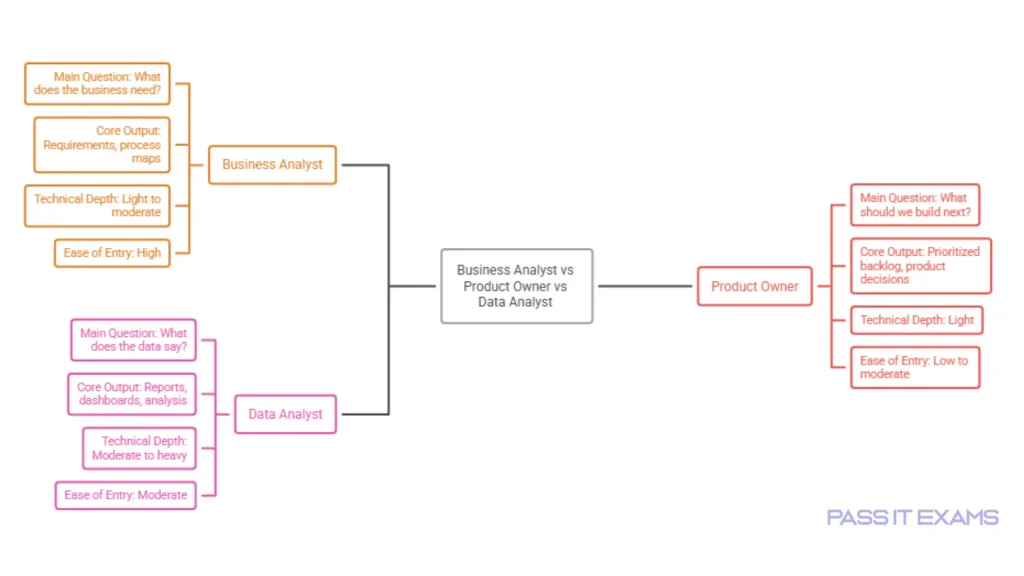
| Business Analyst | Product Owner | Data Analyst | |
|---|---|---|---|
| Main question | What does the business need, and how do we deliver it? | What should we build next? | What does the data say? |
| Core output | Requirements, process maps, recommendations | Prioritized backlog, product decisions | Reports, dashboards, analysis |
| Technical depth | Light to moderate | Light | Moderate to heavy |
| Ease of entry with no experience | High | Low to moderate | Moderate |
For most beginners, the BA role is the most accessible of the three because it rewards communication and business knowledge, not just technical skill.
Do You Need a Degree to Become a Business Analyst?
Helpful, but not required. The degree needed for a business analyst role depends on the employer. Large banks, insurers, and government agencies often filter by education. Startups, mid-size companies, and internal hiring managers care far more about what you can show.
If you’re pursuing a business analyst path with no degree, expect it to be harder at big enterprises and easier at smaller companies and at your current employer.
What employers value more than the degree:
- Evidence you can structure a messy problem. A portfolio shows this better than a diploma.
- Clear writing and speaking. BAs live in meetings and documents.
- Domain knowledge. Insider knowledge of insurance, healthcare, logistics, or retail is a real advantage.
- Tool basics. Excel, a diagramming tool, and ideally SQL.
- Follow-through. Managers want someone who asks good questions and finishes things.
No degree? Lean on three things: a portfolio, one beginner certification, and one target industry.
Transferable Skills You Already Have
The transferable skills for a business analyst role are probably already on your resume. You’re just describing them in the wrong language.
| Your current background | What you already do | BA skill it maps to |
|---|---|---|
| Customer service / support | Spot recurring complaints, escalate issues, explain fixes | Root cause analysis, stakeholder communication, requirements gathering |
| Operations / logistics | Manage workflows, fix bottlenecks, track KPIs | Process mapping, process improvement, metrics |
| Finance / accounting | Reconcile data, build reports, flag anomalies | Data analysis, Excel modeling, business case building |
| QA / testing | Write test cases, find defects, verify against specs | Acceptance criteria, requirements validation, UAT |
| Project coordination | Track tasks, run meetings, manage stakeholders | Stakeholder management, documentation, facilitation |
| Teaching | Break down complex ideas, adapt to audiences | Elicitation, facilitation, clear documentation |
| Sales / account management | Uncover client needs, translate them to internal teams | Needs analysis, requirements elicitation |
| Administration / HR | Run processes, maintain records, handle exceptions | Process documentation, policy knowledge, attention to detail |
Three Before-and-After Resume Bullets
Example 1: Customer service
- Before: Answered customer questions and resolved complaints in a call center.
- After: Identified the top three recurring complaint types across 200+ weekly tickets and proposed a knowledge base update that reduced repeat contacts by 18%.
Example 2: Operations
- Before: Responsible for scheduling and warehouse workflow.
- After: Mapped the end-to-end order fulfillment process, identified a two-day handoff delay, and redesigned the workflow, cutting average fulfillment time by 22%.
Example 3: Project coordination
- Before: Helped manage projects and attended team meetings.
- After: Gathered requirements from five department heads, documented them in a shared tracker, and facilitated weekly reviews that kept a cross-team software rollout on schedule.
The pattern is a verb that shows analysis (identified, mapped, gathered), a specific problem, and a measurable result. If you don’t have exact numbers, use honest estimates or scope. Never invent figures you can’t defend in an interview.
The 6 Essential Skills to Build First
Getting started as a business analyst doesn’t mean learning everything. These six skills cover most entry-level job descriptions.
1. Communication and Stakeholder Questioning
This is the core skill. Good BAs ask questions that reveal the real problem behind the requested solution.
- Ask “why” until you reach the root. A manager says, “We need a new dashboard.” Ask what decision it will support and what they do today.
- Confirm understanding out loud. “What I’m hearing is X. Did I get that right?”
- Send a summary within 24 hours with decisions and next steps.
Try this: Before your next work meeting, write three questions starting with “what happens if…” or “who decides…”. Afterward, note which answers surprised you.
2. Process Mapping
A process map shows who does what, in what order, and where handoffs and delays happen. Learn two levels: the As-Is map (how things work today, including workarounds) and the To-Be map (the improved version).
Start with simple swimlane flowcharts, one lane per person or team. A clean map with a clear finding beats a perfect BPMN diagram with none.
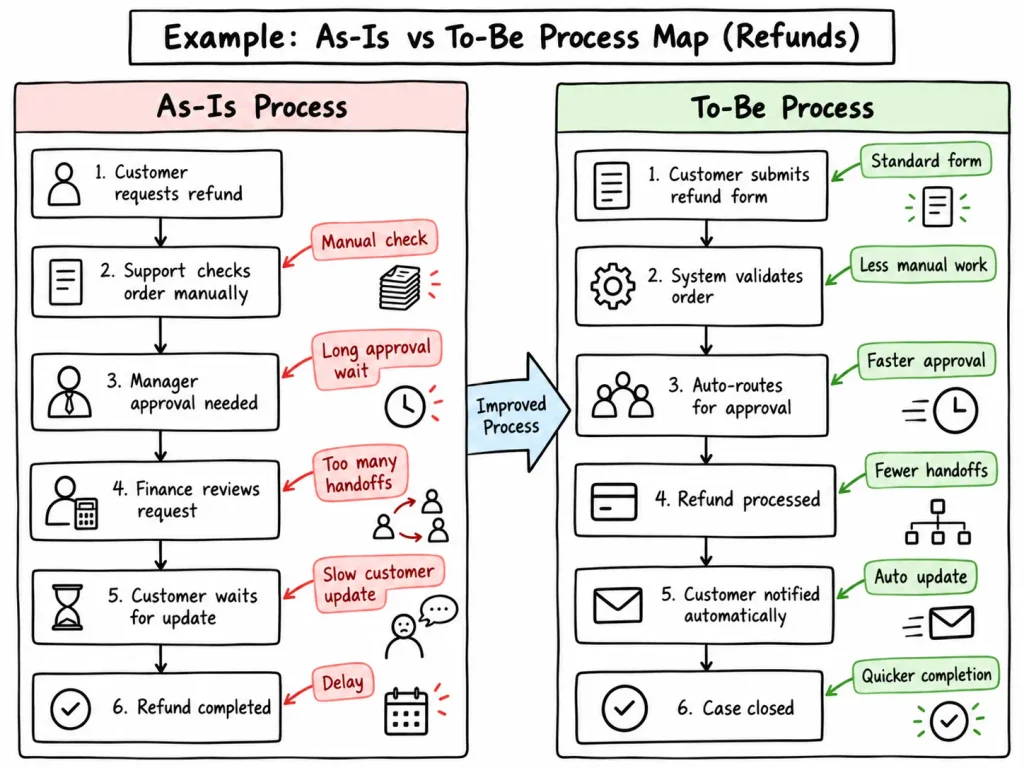
Try this: Map how a customer complaint travels through your team using 5–8 boxes. Then circle the step where work waits longest. That’s usually your finding.
3. Requirements Writing (User Stories and Acceptance Criteria)
Requirements turn business needs into something a team can build. The standard beginner format is the user story:
As a customer service manager, I want to see all open refund requests in one view so that I can prioritize the oldest ones.
Acceptance criteria define “done” in testable terms:
- Given a manager is logged in, when they open the Refunds page, then all “open” requests are listed.
- Requests are sorted oldest first.
Also learn the difference between functional requirements (what the system does) and non-functional ones (speed, security, availability).
Try this: Check every acceptance criterion by asking whether a stranger could mark it pass or fail. “Loads quickly” fails. “Loads in under three seconds” passes.
4. Excel / Google Sheets
You don’t need macros. You need lookups (XLOOKUP or VLOOKUP), pivot tables, SUMIFS and COUNTIFS, conditional formatting, clear charts, and the ability to clean messy data.
If you can turn a raw export into a summary a manager understands in 60 seconds, you’re ready.
Try this: Download a free sample support-ticket dataset and answer one question with a pivot table, such as which category generates the most repeat contacts.
5. One Data Visualization Tool (Power BI or Tableau)
Pick one, Power BI Desktop is free and common in corporate settings (it runs on Windows). Tableau Public is free and ideal for a shareable portfolio.
Learn the fundamentals: connect to data, build 3–5 clear visuals, add filters, and state the insight behind each. Depth in one tool beats surface knowledge of three.
Try this: Give every chart a headline that states the finding (“Refunds taking over five days doubled in Q3”) instead of a label (“Refund time by month”).
6. Basic SQL (Optional but High Value)
Not every BA job requires SQL, but it separates you from other beginners. Learn SELECT, WHERE, ORDER BY, JOINs, and GROUP BY with COUNT, SUM, and AVG. Two to three weeks of steady practice gets you to a useful level.
Try this: Practice on one question: “Which five customers placed the most orders last quarter?” It uses SELECT, JOIN, GROUP BY, and ORDER BY in a single query.
How to Build a Business Analyst Portfolio with Zero Experience
If you only act on one section of this guide, make it this one.
Why a Portfolio Beats “No Experience”
Hiring managers don’t reject you because you lack a BA title. They reject you because they can’t tell whether you can do the work. A portfolio removes that doubt.
It shows your thinking, not just your claims. Few applicants for business analyst jobs without experience include one, so even a modest portfolio makes you stand out.
The 4 Artifacts Every Beginner Should Create
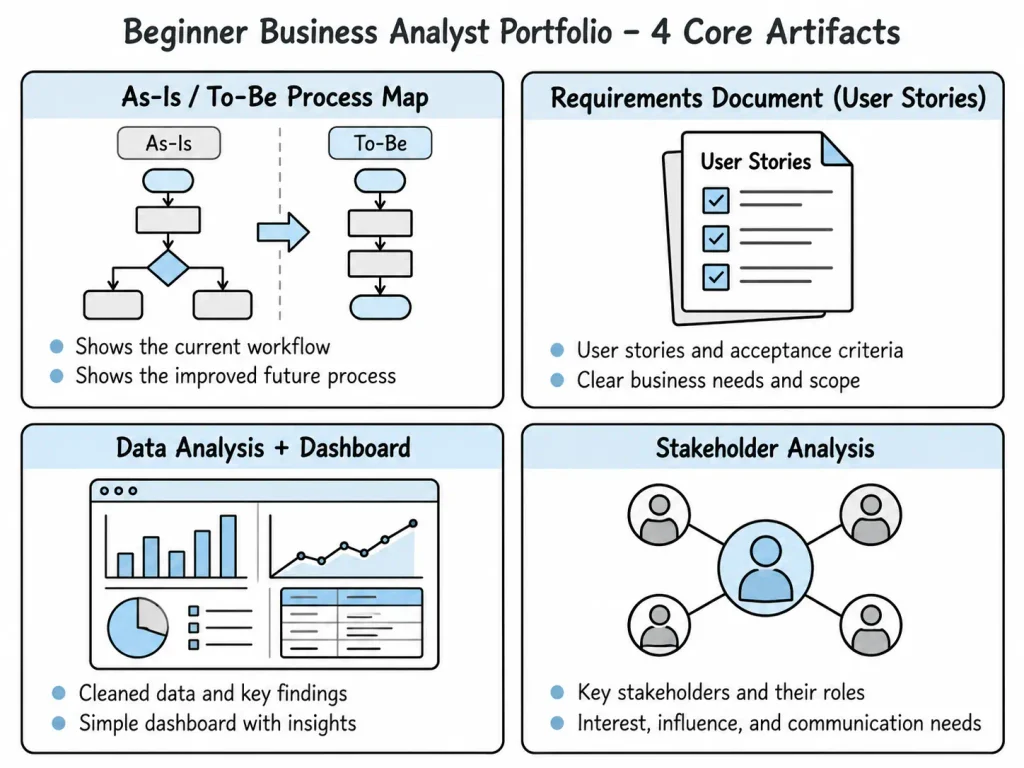
Artifact 1: As-Is / To-Be Process Map with a Problem Statement
Document a real process: current flow, pain points, proposed flow, and expected benefit.
- A one-paragraph problem statement
- The As-Is swimlane map
- 3–5 pain points, each with evidence
- The To-Be map and a short summary of what changes and why
Artifact 2: Requirements Document (Lightweight BRD or User Story Set)
Write requirements for a small improvement to the same process.
- Business objective and scope (what’s in, what’s out)
- 8–12 user stories with acceptance criteria
- Assumptions, open questions, and 2–3 non-functional requirements
Artifact 3: Data Analysis and Dashboard with an Insights Memo
Take a public dataset and answer a business question.
- The question you’re answering
- A dashboard (Power BI, Tableau Public, or Sheets) with 3–5 visuals
- A one-page memo: what you found, what it means, what you recommend
Good free data sources include Kaggle, government open-data portals, and city or public-health datasets.
Artifact 4: Stakeholder Analysis and Elicitation Plan
Show that you can plan the people side of a project.
- A stakeholder map (who’s affected, who decides, who influences)
- Interview questions for each group
- A short meeting summary from a real or practice interview
Bonus: If you can, add a one-page, anonymized case study of a real improvement you made at work. Real beats hypothetical every time.
Two Example Problem Statements You Can Model
A strong problem statement names who’s affected, what’s going wrong, the evidence, and what success looks like. The numbers below are illustrative. If you use a hypothetical scenario, label your assumptions clearly.
Example 1: Online store refunds
Customers who request refunds wait an average of nine days, and about 30% contact support at least twice to ask for status. The delay appears to come from a manual approval step with no owner or deadline. This project maps the current process, identifies where refunds stall, and proposes a redesigned workflow with automatic status updates and a two-day approval target.
Example 2: Clinic no-shows
A small clinic loses roughly 15% of appointment slots to no-shows, leaving providers idle and lengthening waits for other patients. Reminders are sent manually by one receptionist and only for some appointments. This project documents the current scheduling process, analyzes no-show patterns by day and appointment type, and recommends a reminder and rescheduling workflow.
Free Tools and Scenarios
- Process maps: diagrams.net, Lucidchart free tier, Miro free tier
- Requirements docs: Google Docs, Notion, Confluence free tier
- Dashboards: Power BI Desktop, Tableau Public
- SQL practice: SQLBolt, DB Browser for SQLite, BigQuery sandbox
- Hosting: Google Sites, a public Notion page, GitHub Pages, or a simple PDF
Other scenarios that work well: new-employee onboarding, late food deliveries, gym membership cancellations, and room double-bookings. Use one scenario across artifacts 1, 2, and 4 so the portfolio reads like a single project.
What a Strong Beginner Portfolio Looks Like
- 3–4 pieces, not 12. Clarity wins.
- One line of context on each: the problem, your role, the outcome.
- Easy to open. One link, no login, works on a phone.
- Shows your reasoning, including why you chose that fix.
- Honest. Practice projects are labeled as practice.
Put the link in your resume header, under your name, and in your LinkedIn Featured section so recruiters see your proof within seconds.
90-Day Action Plan: How to Become a Business Analyst with No Experience
Plan for 8–10 hours a week. With more time, you’ll move faster; with less, stretch each phase.
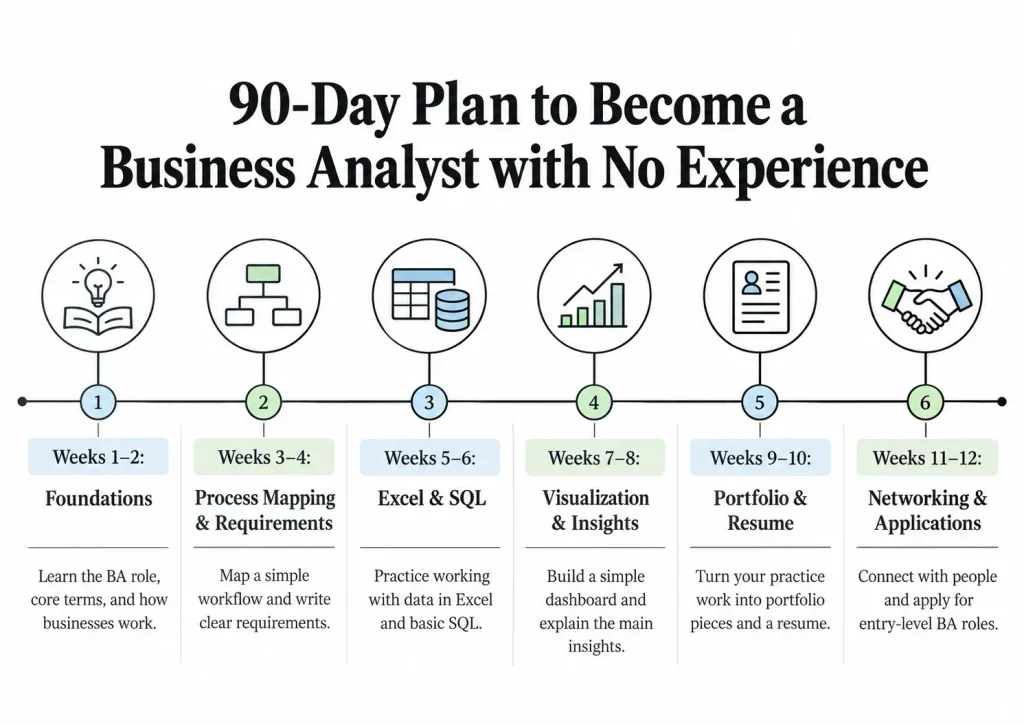
| Weeks | Focus | Main output |
|---|---|---|
| 1–2 | Foundations and role clarity | Skills gap list, chosen target industry |
| 3–4 | Process mapping and requirements | Artifacts 1 and 2 (drafts) |
| 5–6 | Excel, SQL, and data basics | Cleaned dataset and first analysis |
| 7–8 | Visualization and insights | Artifacts 3 and 4 |
| 9–10 | Portfolio polish, resume, LinkedIn | Finished portfolio, rewritten resume and profile |
| 11–12 | Networking, applications, interviews | 30+ applications, 10+ conversations |
Weeks 1–2: Foundations and Direction
- Read 15–20 junior BA and process analyst postings. Highlight repeated skills and tools.
- Build a skills gap list: what you have, what you need.
- Choose a target industry based on your background.
- Learn the vocabulary: stakeholder, requirement, scope, As-Is/To-Be, UAT, backlog, KPI.
- Pick your portfolio scenario.
Weeks 3–4: Process Mapping and Requirements
- Build your As-Is and To-Be swimlane maps.
- Write your problem statement with at least three pain points and evidence.
- Draft 8–12 user stories with acceptance criteria.
- Interview one real person about a process they use and write it up.
- Get feedback from someone who works in the domain.
Weeks 5–6: Excel, SQL, and Data Basics
- Practice pivot tables, lookups, and cleaning on a messy dataset.
- Work through a beginner SQL course (SELECT through JOINs and GROUP BY).
- Choose a public dataset and list five business questions it could answer.
- Pick one question and do a first pass at the analysis.
Weeks 7–8: Visualization and Insights
- Build your dashboard with 3–5 visuals, each tied to a specific insight.
- Write the one-page insights memo. If a reviewer can’t summarize it in two sentences, simplify it.
- Build your stakeholder map and interview question list.
Weeks 9–10: Polish and Positioning
- Assemble your portfolio on one page with short context for each piece.
- Rewrite your resume and update your LinkedIn headline, About section, and skills.
- Decide whether to pursue a certification and, if so, schedule the exam.
- Prepare five STAR stories (situation, task, action, result) from past work.
Weeks 11–12: Networking, Applications, and Interviews
- Message 10–15 people in BA roles or hiring positions.
- Apply to 30+ roles that match your target titles, tailoring your summary each time.
- Do at least two mock interviews and practice answers out loud.
- Track everything: company, role, date, contact, status.
If you’re still employed, ask your manager for small analysis or process projects. Even one internal project gives you a real case study.
Certifications Worth Considering for Beginners
ECBA (Entry Certificate in Business Analysis)
The ECBA from IIBA is designed for people just starting out. IIBA’s certification FAQ states there are no specific eligibility requirements to sit for the exam, beyond agreeing to its ethics code and terms. That makes it one of the few credentials open to true beginners.
On cost, one 2026 guide puts the exam at roughly $395 or less depending on region, with the first year of IIBA membership included. Prices change, so confirm on IIBA’s site before you budget. Optional prep courses cost extra.
When the ECBA helps:
- You have no degree or no business background and need a credibility signal
- You’re applying to large companies or consultancies that screen for credentials
- You want structured learning and a study deadline
When it doesn’t help much:
- You already have a strong portfolio and relevant domain experience
- You’re targeting startups that care mostly about what you can show
- You’re treating it as a replacement for practical work
The ECBA won’t get you hired on its own. Paired with a portfolio, it strengthens a thin profile.
What to Skip (For Now)
- CBAP and CCBA: These require documented BA work experience.
- Bootcamps that guarantee job placement: Your portfolio and network matter more.
- Collecting many certificates: One targeted credential beats five generic ones.
- PMP and advanced Agile certifications: Useful later, not needed to start.
A short Power BI, Tableau, or SQL course certificate is enough to add alongside your portfolio.
How to Write a Resume and LinkedIn Profile with No BA Experience
Resume Structure That Works
- Headline and summary (3 lines)
- Portfolio link at the top
- Skills, grouped as analysis, tools, and documentation
- Projects, with outcomes
- Work experience, rewritten with BA language
- Education and certifications
Sample summary:
Operations professional with 5 years of process improvement experience transitioning into business analysis. Skilled in process mapping, requirements documentation, Excel, and SQL. Completed portfolio projects covering As-Is/To-Be analysis, user stories, and dashboard reporting.
More Before-and-After Examples
Retail supervisor
- Before: Managed a team of 10 and handled inventory.
- After: Analyzed weekly stock discrepancy reports, traced 60% of errors to one receiving step, and introduced a scan-and-confirm check that cut discrepancies by roughly a third.
Finance assistant
- Before: Prepared monthly reports for management.
- After: Rebuilt the monthly reporting workbook with pivot tables and lookups, reducing preparation time from two days to four hours.
Best Adjacent Job Titles to Target
Entry-level business analyst jobs with no experience requirement often go by other names. Don’t only search “business analyst.”
| Title | Why it’s a good entry point |
|---|---|
| Junior Business Analyst | Direct match, open to early-career candidates |
| Process Analyst | Workflow-focused, easier from operations |
| Business Improvement Analyst | Common in operations-heavy industries |
| Operations Analyst | Fits logistics, retail, and support backgrounds |
| Reporting Analyst | Entry through Excel, SQL, and dashboards |
| Junior Business Systems Analyst | Fits technical or QA backgrounds |
| Implementation / Product Support Analyst | Common in SaaS, often converts to BA |
Also search “associate analyst” and “requirements analyst.” A related role with real analysis work is a legitimate stepping stone.
LinkedIn Checklist
- Headline: “Aspiring Business Analyst | Process Mapping | SQL | Power BI” beats “Seeking opportunities.”
- Featured section: your portfolio link and best artifact.
- Experience: rewritten with the same BA-style bullets.
- Skills: requirements gathering, process improvement, stakeholder management, SQL, Excel.
- Open to Work: set your target titles and locations.
How to Get a Business Analyst Job with No Experience: Landing Interviews
Most interviews for career changers come from people, not job boards. Applications still matter, but conversations multiply your odds.
A Practical Networking Approach
- Start with your existing network. Ask former coworkers and classmates who works with analysts.
- Find 20 BAs on LinkedIn in your target industry, ideally 1–5 years into the role. They remember the transition.
- Send a short, specific message. Don’t ask for a job.
Hi [Name], I’m moving from [your field] into business analysis and noticed you made a similar shift at [Company]. I’d appreciate 15 minutes to ask how you got started. I’ve built a small portfolio and would value your take on it. No worries if you’re busy.
- Ask useful questions. What does a typical week look like? What made your resume or portfolio stand out?
- Follow up with a thank-you, and a brief update a few weeks later.
Ask for referrals only after building rapport. Also try internal moves: tell your manager you want analysis work and volunteer for process or reporting tasks.
How to Answer the “You Have No Experience” Objection
Don’t get defensive, and don’t apologize. Acknowledge it, then redirect to evidence.
“You’re right that I haven’t held the BA title. What I have done is [specific analysis, requirements, or process work], and I built [portfolio project] to practice the full cycle. Here’s what I found and how I’d approach your team’s problems.”
The formula: acknowledge, show proof, connect to their needs.
Three Sample Interview Answers
Question 1: “Why should we hire you with no BA experience?”
“I’ve spent five years in operations, so I understand how the work actually gets done, which helps when gathering requirements. Over the last three months I built a portfolio that includes a process redesign, a set of user stories with acceptance criteria, and a dashboard analysis. I’d bring domain knowledge and a structured approach, and I learn fast. I’m happy to walk you through one of the projects.”
Question 2: “Tell me about a time you gathered requirements.”
“In my last role, our team’s weekly reporting was taking too long. I met with the three managers who used it and asked what decisions they made from it. Two of them ignored half the columns. I documented what each needed, confirmed it in a one-page summary, and rebuilt the report around those needs. Prep time dropped from two days to four hours.”
Question 3: “Walk me through how you’d approach an unclear problem.”
“First I’d clarify the goal and who’s affected. Then I’d talk to the people closest to the problem and check the data to confirm what I’m hearing. I’d document the As-Is, find the root cause instead of the symptoms, and propose options with trade-offs. I’d confirm the direction with stakeholders before writing detailed requirements. In my portfolio project on refund delays, that approach showed the real bottleneck was an approval step, not the system.”
Practice each answer aloud until it sounds natural, not memorized.
Realistic Timeline, Salary Expectations, and Job Market in 2026
How Long It Typically Takes
- Structured plan at 8–10 hours a week: about 3 months to become interview-ready, then 2–4 months of active searching.
- Realistic total: 4–8 months for most career changers.
- Faster: internal transfers, or strong domain experience with existing analysis work.
- Slower: competitive metros, no degree, or a limited network.
A slow stretch doesn’t mean the plan isn’t working. Track conversations and interviews, not just offers.
Entry-Level Salary Ranges (0–2 Years)
Published figures vary by source, so treat these as ballparks:
- United States: One 2026 salary guide says most entry-level BA roles land between about $65,000 and $82,000.
- United Kingdom: One UK dataset shows entry-level business analysis salaries spanning £35,000 to £75,000. Junior roles usually sit toward the lower half.
- India: One 2026 overview lists fresher pay at roughly ₹4–7 LPA.
- Global median (entry level): One comparison puts median total compensation for entry-level BAs at about $55,000–$65,000.
Career changers who land adjacent titles like operations or reporting analyst often start near the lower end. Finance, insurance, healthcare, and technology tend to pay more than nonprofit or public sector roles.
Check current local data before you set expectations or negotiate. Search your city or country on Glassdoor, Indeed, or Payscale, check your government’s labor statistics, and look at postings that list pay. Recruiters in your target industry can also tell you what junior offers look like right now.
Where Opportunities Actually Exist
- Financial services and insurance: heavy process and regulatory work
- Healthcare and health tech: systems implementation, compliance, workflow improvement
- Government and public sector: steady demand, sometimes with degree requirements
- SaaS and tech: implementation, product operations, and systems analyst roles
- Consulting and IT services: high volume and strong training, often lower entry pay
- Logistics, retail, and manufacturing: operations-focused analyst roles
Entry-level competition is real, and AI tools are absorbing some of the routine drafting and reporting that juniors once did. That raises the value of skills AI doesn’t replace: talking to stakeholders, judging which problem is worth solving, and confirming a fix actually worked. That’s what this guide trains.
Frequently Asked Questions to Become A Business Analyst Without Experience
Can I become a business analyst with no experience?
Yes. Most people enter business analysis without a prior BA title. Build core skills (process mapping, requirements writing, Excel, basic SQL), create a portfolio of 3–4 projects, and reframe your existing work in BA language.
Then target junior and adjacent roles like process analyst or operations analyst, and use networking to get your portfolio in front of people. Proof of skill matters more than a previous job title.
Do I need a degree to become a business analyst?
No, but it helps. A degree can make it easier to pass resume filters at large companies and government agencies. Without one, you can compete with a strong portfolio, a beginner certification like the ECBA, and relevant experience in your target industry.
How long does it take to become a business analyst with no experience?
Typically 4–8 months. That’s about three months of focused study and portfolio building (8–10 hours a week), followed by two to four months of applications and networking.
Internal transfers can be faster. Competitive job markets, no degree, or a small network can make it slower. Your progress depends more on consistent weekly work than on any single course.
What are the best entry-level business analyst jobs?
The best starting titles are:
- Junior Business Analyst
- Process Analyst
- Business Improvement Analyst
- Operations Analyst
- Reporting Analyst
- Junior Business Systems Analyst
- Implementation or Product Support Analyst
Choose based on your background: operations experience points toward process or operations analyst, and technical or QA experience toward systems analyst.
Is the ECBA certification worth it for beginners?
It can be, if you pair it with a portfolio. The ECBA gives you structured knowledge and a credibility signal, especially without a degree or BA background. It’s less valuable on its own, and unnecessary if you already have strong projects and domain experience. Confirm current exam pricing on IIBA’s website before you commit.
Conclusion
You don’t need permission, a title, or a perfect plan to start. You need proof, and proof gets built one artifact at a time.
The whole path in five steps:
- Start from what you already have. Your current job likely includes analysis, documentation, or stakeholder work. Reframe it with the resume patterns above.
- Build the six core skills in order, beginning with questioning and process mapping, and treat SQL as your edge.
- Create four portfolio pieces (process map, requirements, dashboard with memo, stakeholder plan) from a single scenario, so your work tells one clear story.
- Apply to junior and adjacent titles like process analyst, operations analyst, or reporting analyst, not only “business analyst.”
- Talk to people while you apply. A short conversation with a working BA often does more than ten cold applications.
It won’t be instant. Expect roughly 4–8 months, with slow stretches that feel like nothing is happening. The people who make it keep producing work and keep talking to others in the field.
Your next step, today: choose one scenario from the portfolio section and write a one-paragraph problem statement. Say who has the problem, what’s going wrong, what evidence you’d look for, and what a better outcome looks like. Give yourself 20 minutes, then save it as the first page of your portfolio.
