
You open a scenario question, four answers look plausible, and the clock is running. That’s the moment AZ-104 practice tests are actually training you for; not memorizing facts, but making fast, correct decisions under pressure. Grinding through question after question isn’t a strategy, though; it’s a habit. Candidates who pass on their first attempt use AZ-104 mock exams as part of a deliberate system that turns each test into a diagnostic tool, a skill-builder, and a genuine readiness check.
This guide gives you that system. You’ll learn why mock exams matter more for AZ-104 than for most certifications, how to structure your AZ-104 practice test strategy across four deliberate phases, how to actually learn from wrong answers instead of just re-reading them, and how to know; with evidence, not guesswork; that you’ve reached real AZ-104 exam readiness.
Before you start any mock exams, make sure you have a solid foundation. The full AZ-104 study guide walks through the current skills outline, recommended learning path, and free companion resources.
Why Mock Exams Are Essential for AZ-104
AZ-104 is not a trivia exam. Microsoft designs it around real administrative scenarios.
A company has a hybrid identity setup and something is misconfigured. A VM needs to be resized without downtime. A storage account needs specific redundancy for compliance reasons. You’re not asked “what is an availability zone”; you’re asked to pick the correct sequence of actions given a constrained, messy situation.
That format shows up in a few recurring question styles:
- Scenario-based single/multi-select questions where you must weigh trade-offs (cost vs. availability, security vs. convenience) rather than recall a definition.
- Case studies that present a company profile with multiple requirements, then ask several questions against that same context.
- Best-answer and “select all that apply” formats, which punish partial understanding more harshly than simple recall questions.
- Drag-and-drop and ordering questions, common for deployment sequences and troubleshooting steps.
The exam gives you 100 minutes for 40–60 questions, which works out to under two minutes per question once you account for case studies that take longer to read.
That time pressure is exactly why timed AZ-104 mock exams matter. Reading comprehension speed, elimination technique, and decision confidence are skills you build through repetition under a clock; not by reading Microsoft Learn modules a second time.
Passive review teaches you facts. Timed mocks teach you to apply facts fast enough to finish the exam with time left to review flagged questions.
This is also why the best AZ-104 mock exams are the ones that mirror the real exam’s difficulty and phrasing style. An easy multiple-choice bank filled with pure definitions won’t train the skill you’re actually being tested on. And no amount of question volume replaces hands-on practice; the strongest AZ-104 practice test strategy pairs mock questions with actually performing the tasks in a real or sandboxed Azure environment, a point worth keeping in mind as you build your study plan, not just something to bolt on at the end.
The strongest AZ-104 practice test strategy always pairs mock questions with real hands-on work. You can find a complete collection of free and paid AZ-104 labs, including the official Microsoft GitHub labs and community challenges, in this dedicated guide: AZ-104 labs.
Official AZ-104 Domains & Weightings
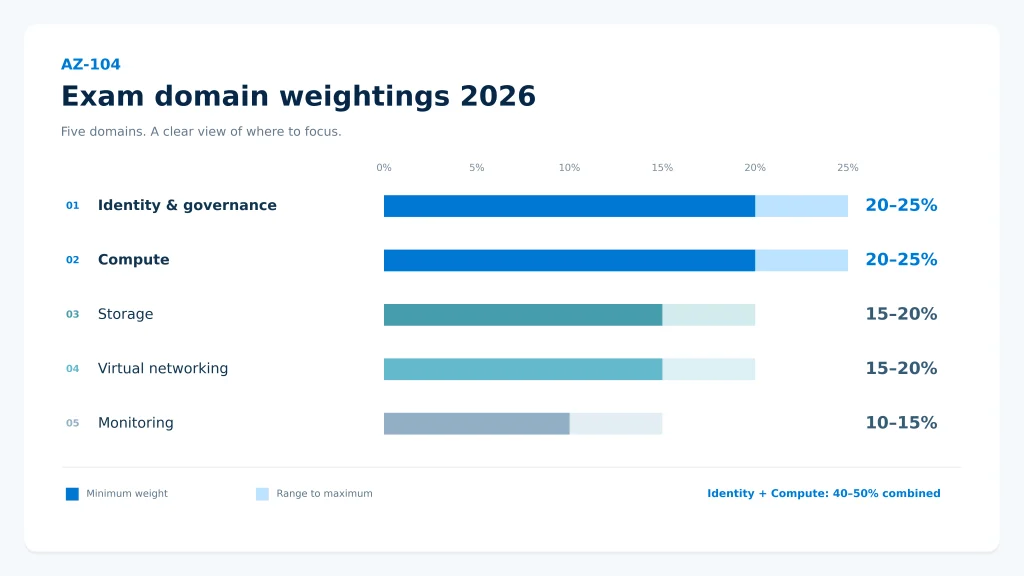
Before you touch a single AZ-104 practice test, you need to know where the exam actually puts its weight. Microsoft periodically updates the AZ-104 skills-measured outline, and the current version emphasizes identity and compute more heavily than in past years, with virtual networking’s Private Link and Private Endpoint coverage also expanding.
| Domain | Weighting | What It Covers |
|---|---|---|
| Manage Azure identities and governance | 20–25% | Microsoft Entra ID objects, RBAC, Conditional Access basics, subscriptions, management groups, Azure Policy, cost management |
| Deploy and manage Azure compute resources | 20–25% | VMs, availability sets/zones, containers and Azure Container Apps, App Service, ARM templates and Bicep |
| Implement and manage storage | 15–20% | Storage accounts, redundancy options, blob lifecycle, Azure Files, access control |
| Implement and manage virtual networking | 15–20% | VNets, peering, NSGs, load balancing, DNS, Private Link and Private Endpoints, Azure Bastion, Network Watcher |
| Monitor and maintain Azure resources | 10–15% | Azure Monitor, alerts and Log Analytics queries, Azure Backup and Site Recovery, update management |
For a full breakdown of every skill area inside these five domains, see the complete AZ-104 exam topics guide updated for the 2026 outline.
What this means for your practice time: Identities/governance and compute together account for up to half of your total score. If your AZ-104 mock exam results show weak spots in either domain, that’s a priority to fix before you move on to broader timed practice; not a minor gap to patch later.
Networking and storage deserve solid, even coverage since they’re heavily scenario-based and easy to under-practice. Monitoring is the smallest domain by weight, but don’t skip it entirely; a handful of easy points here are often left on the table by candidates who assumed it wasn’t worth studying.
Free vs. Paid Practice Tests: What Actually Matters
The free-vs-paid debate misses the real question. Price isn’t what separates a useful mock exam from a waste of time; quality does. Here’s what to actually evaluate:
- Currency of content. Azure changes fast, and AZ-104’s skills-measured outline gets revised periodically. A question bank built two years ago and never updated will train you on retired features or outdated portal layouts. Check for an explicit “last updated” date.
- Explanation depth. A good practice question doesn’t just tell you the right answer; it explains why the other three options are wrong. That’s where the actual learning happens.
- Domain-weighted distribution. A quality test bank mirrors the real exam’s domain, not an even 20% across all five domains.
- Realistic difficulty and phrasing. Scenario-based questions with multi-step requirements, not simple one-line recall questions.
- Case study format availability. Since real AZ-104 includes case studies, a bank that only tests isolated questions is missing a whole exam skill.
A few additional signals are worth checking before you commit time to any provider:
- Answer accuracy you can verify. Spot-check a handful of explanations against Microsoft Learn directly. If a provider gets basic facts wrong or cites deprecated portal steps, treat the rest of the bank with suspicion.
- Terminology consistency. A bank that still refers to “Azure Active Directory” throughout, rather than Microsoft Entra ID, is a strong signal it hasn’t been meaningfully updated for the current exam.
Red flags to walk away from: question banks with no visible update date, explanations that just restate the question instead of teaching the reasoning, marketing language promising “guaranteed pass” or “real exam questions,” and reviews mentioning answers that don’t match current Azure portal behavior.
Free resources (Microsoft Learn’s own practice assessment, community-built question sets, forum-shared samples) are genuinely useful for the diagnostic and early domain-drill phases, and Microsoft Learn’s official practice assessment is particularly valuable because it’s built by the exam’s own publisher. Their limitation is usually volume and lack of full-length timed case-study simulations.
Paid platforms (MeasureUp, well-reviewed Udemy practice test packs, and other structured mock exam providers) tend to offer larger question pools, closer-to-real exam interfaces, and more rigorous explanations. Their value shows up most in Phase 3 and Phase 4 of the system below, where realism and volume matter more than in early diagnostics.
For a deeper comparison of quality practice options and how to combine them with labs, see the dedicated AZ-104 practice tests resource.
The honest recommendation for anyone comparing the best AZ-104 practice tests for 2026: use free resources to diagnose and drill, and invest in one reputable paid mock exam product for your full-length timed simulations in the final one to two weeks. Avoid anything that markets itself around “actual exam questions” or “verified dumps”; beyond being against Microsoft’s certification agreement, dump-based prep teaches memorization of specific wording rather than the reasoning skill the real exam tests, which means it collapses the moment a question is rephrased.
The 4-Phase Mock Exam System
Here’s the part most guides skip: a structured progression, not just a pile of AZ-104 practice tests to work through in random order. This is the system most first-attempt passers follow, whether or not they’d describe it in these exact terms; diagnose first, rebuild weak domains in isolation, add time pressure gradually, then rehearse the full exam experience.
Skipping phases; especially jumping straight to full timed tests; is the single most common reason candidates plateau or get surprised on exam day.
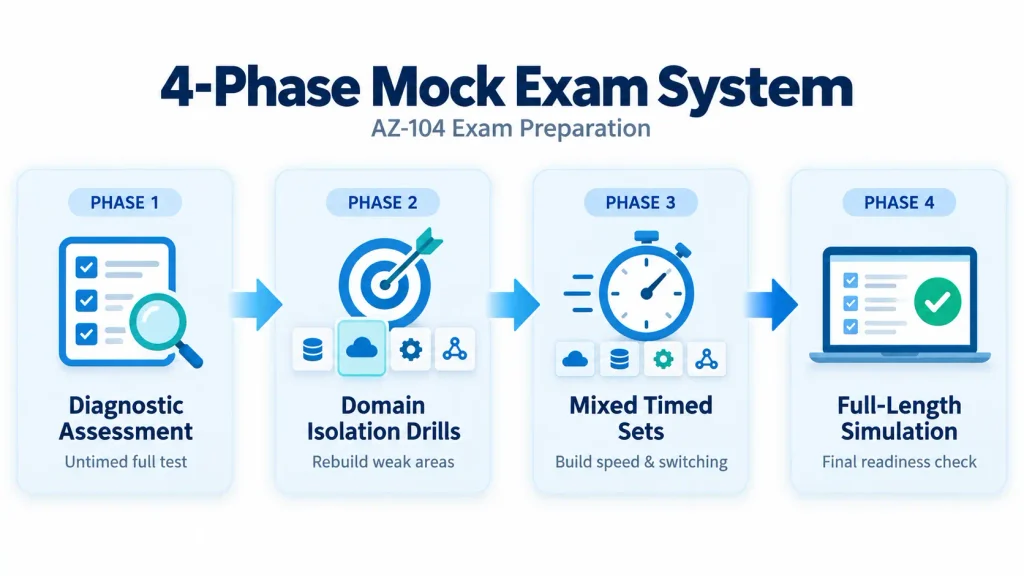
Phase 1: Diagnostic Assessment (Untimed)
Goal: Find out what you actually know before you waste time studying things you’ve already mastered.
- Take one full-length, untimed practice test covering all five domains.
- Don’t guess-and-move-on; for every question, note your confidence level (sure / unsure / guessed) alongside your answer.
- Score the result by domain, not just overall percentage.
- Build a simple domain scorecard: percentage correct, and how many were “confident but wrong” (a red flag for a misconception, not just a knowledge gap).
This phase should take no more than a weekend. Its only job is to produce a prioritized list of weak domains for Phase 2.
Phase 2: Domain Isolation Drills
Goal: Rebuild weak domains one at a time, without the noise of unrelated topics.
- Starting with your weakest domain from Phase 1, take domain-specific question sets (most quality banks let you filter by topic).
- Work in untimed, small batches of 15–20 questions.
- After each batch, review every question; right or wrong; and write a one-line explanation in your own words for why the correct answer is correct.
- Move to the next domain only once you’re consistently scoring 80%+ on that domain’s isolated questions.
- Revisit strong domains briefly too; a lighter touch, just enough to confirm they haven’t decayed.
What this looks like in practice: Say Phase 1 revealed you’re weakest in networking. Instead of taking another mixed 50-question test, you’d pull 15–20 networking-only questions covering VNet peering, NSG rules, and Private Endpoints, work through them untimed, and review every single one; including the ones you got right; before moving to your next weakest domain. If you’re still missing questions on, say, effective NSG rule evaluation after two batches, that’s a sign to go back to Microsoft Learn or a hands-on lab on that specific subtopic before drilling further.
This phase typically takes one to two weeks depending on your starting point and is where most of your actual knowledge-building happens. Mock exams here are a teaching tool, not a scorekeeping tool.
Phase 3: Mixed Timed Sets
Goal: Rebuild the muscle of switching between domains under time pressure, the way the real exam forces you to.
- Take mixed-domain question sets of 25–40 questions, timed at the real exam’s pace.
- Practice active time management: flag-and-move-on for anything you’re not confident about within 90 seconds, rather than getting stuck.
- Score by domain again; this checks whether your Phase 2 gains hold up when topics are interleaved and the clock is running.
- Track your flagged-question rate over successive sets; it should trend down as your recognition speed improves.
What flag-and-move-on looks like: You hit a case-study question about choosing between Availability Zones and an Availability Set for a specific compliance requirement. You’ve read both answers twice and you’re still unsure at the 90-second mark. Rather than second-guessing further, you make your best-guess selection, flag it, and move to the next question immediately. At the end of the set, if you finish with time remaining, you return to flagged questions with a clearer head rather than losing five extra minutes mid-test on one question you weren’t going to resolve quickly anyway.
Run several of these sets, spaced over a week, rather than one long cram session. Spaced repetition under time pressure is what builds exam-day composure.
Phase 4: Full-Length Simulation + Final Readiness Check
Goal: Rehearse the entire exam experience, end to end, at least twice.
- Take a full 40–60 question timed mock in one uninterrupted 100-minute sitting, including any case-study-style questions.
- Simulate real conditions: no notes, no pausing, same environment (or as close as possible) you’ll use on exam day if testing online.
- Review the full test afterward using the mistake-analysis framework below.
- Repeat once more, ideally from a different question bank than your first full simulation, to confirm your score holds up against unfamiliar phrasing.
- Run the readiness checklist in the section below before booking your exam date.
How long the entire process takes depends heavily on your starting experience. You can see realistic timelines for beginners, intermediate, and experienced candidates in this breakdown of how long it takes to prepare for AZ-104.
How to Analyze Every Mistake Properly
The value of an AZ-104 mock exam isn’t the score; it’s what you extract from the questions you got wrong. Use this four-step framework for every miss:
- Scope; What was actually being asked? Many wrong answers come from misreading the requirement (e.g., “least cost” vs. “least administrative effort” vs. “highest availability”), not from lacking the knowledge.
- Security/Identity Boundary; Does the correct answer hinge on an RBAC role, a Conditional Access policy, a subscription/management group boundary, or an Entra ID concept you misunderstood? Identity and governance mistakes are usually boundary confusion, not missing facts.
- Network Path; For networking and connectivity questions, trace the actual traffic or resource path the correct answer implies. If you can’t draw it, you don’t fully understand it yet.
- Recovery Decision; For monitoring, backup, and troubleshooting questions, ask: what would the next step be if this answer didn’t work? This surfaces whether you understand the decision tree or just memorized one branch of it.
When you review misses, it helps to work with carefully curated scenario-style AZ-104 exam questions that focus on reasoning rather than pure memorization.
Keep a running mistake log (a simple spreadsheet works fine) with four columns: question topic, which of the four framework steps you got wrong, the correct concept in your own words, and a confidence rating on retest. Revisit this log before every subsequent mock exam; recurring entries are your real study list, more useful than any generic topic outline.
Ready-to-Use Practice Schedules
Pick the plan that matches your timeline. Both assume 1.5–2 hours of study per day.
7-Day Final Sprint Plan
| Day | Focus |
|---|---|
| 1 | Phase 1 diagnostic (untimed, full domain coverage) + build weak-domain priority list |
| 2 | Phase 2 drills: weakest domain (identities/governance or compute, whichever scored lower) |
| 3 | Phase 2 drills: second weakest domain + light review of strong domains |
| 4 | Phase 2 drills: remaining domains + start mistake log review |
| 5 | Phase 3 mixed timed set (30 questions) + mistake analysis |
| 6 | Phase 4 full-length timed simulation #1 + full review using the four-step framework |
| 7 | Phase 4 full-length timed simulation #2 (different bank) + run readiness checklist + light review only |
14-Day Intensive Plan
| Days | Focus |
|---|---|
| 1–2 | Phase 1 diagnostic + domain scorecard + study plan built from results |
| 3–6 | Phase 2 domain isolation drills, one to two domains per day, prioritized by weakness |
| 7 | Rest or light review; consolidate mistake log |
| 8–9 | Phase 2 continued: revisit any domain still below 80% + light pass on strong domains |
| 10–11 | Phase 3 mixed timed sets (2–3 sets), tracking flagged-question rate |
| 12 | Phase 4 full-length simulation #1 + deep mistake review |
| 13 | Targeted re-drilling on anything the simulation exposed |
| 14 | Phase 4 full-length simulation #2 + readiness checklist + light review only |
Both plans deliberately end with a full simulation followed by light review only; cramming new material the day before the exam tends to erode confidence more than it adds knowledge.
When You Are Actually Ready to Book the Exam
A single high mock score can happen by luck, or on a bank you’ve already seen too many times, so treat it as one input rather than the finish line. Real AZ-104 exam readiness looks like consistency across several of the signals below, not one good day:
| Readiness Signal | Target |
|---|---|
| Score on mixed timed sets (Phase 3) | 80%+ consistently across at least 3 separate sets |
| Score on full-length simulations (Phase 4) | 80%+ on at least two simulations from different sources |
| Domain-level consistency | No single domain below 70%, even on off days |
| Mistake explanation ability | Can explain why the correct answer is correct; not just recognize it; for the vast majority of previously-missed questions |
| Time management | Finishing full-length mocks with at least 10–15 minutes to spare for flagged-question review |
| Flagged-question rate | Trending downward across successive Phase 3 sets, not stuck flat |
| Confidence-vs-accuracy gap | Minimal “confident but wrong” answers remaining in your mistake log |
If you’re hitting all seven consistently across more than one sitting, you’re ready to book. If one or two are still shaky, that’s a specific, fixable gap; not a reason to delay indefinitely.
Recommended Practice Resources (Balanced & Honest)
No single resource covers everything well, so plan to combine a couple of these across the phases above.
- Microsoft Learn’s official practice assessment; Free, built by the exam’s own publisher, and a reliable Phase 1/Phase 2 starting point. Question volume is more limited than paid banks, so don’t rely on it alone for Phase 4.
- Paid practice test platforms and courses (for example, MeasureUp or strong Udemy options); These can provide larger question pools, better exam stamina training, and more detailed explanations than free resources. MeasureUp is often seen as one of the closer-to-real-exam experiences for AZ-104, while some Udemy practice test courses can offer solid value if they are recently updated, highly reviewed, and explain why each answer choice is right or wrong. Since quality varies widely, especially on course marketplaces, review recency and explanation depth before buying.
- Additional third-party practice test options: Platforms such as PassITExams, Dumpsgate, and Edurely can be useful for expanding your AZ-104 question exposure, especially when you want more scenario variety and extra reps across weak domains. They work best as supplemental resources alongside a stronger primary mock exam source and hands-on Azure labs.
- Community-driven free question banks and study groups; Useful for supplementing domain drills and catching edge-case scenarios other resources miss, but treat consistency and explanation quality with more scrutiny since these aren’t professionally maintained.
- Hands-on Azure labs (free tier or sandbox); Pairing practice questions with actually performing the tasks; creating a VNet peering, configuring RBAC, setting up a backup policy; cements the “why” behind exam answers far more effectively than question banks alone, and is worth building into every phase above, not treating as an optional extra.
You can also use the structured AZ-104 exam guide as a quick reference while moving through the four phases.
Whatever you choose, avoid platforms that advertise “leaked” or “actual” exam questions. Beyond violating Microsoft’s certification agreement, that content trains memorization of exact wording rather than the underlying reasoning; which is exactly what the real, rephrased exam question will expose.
Common Mistakes Candidates Make With Practice Tests
- Jumping straight to full timed exams. Skipping the diagnostic and drill phases means you’re testing knowledge you haven’t built yet, which mostly produces frustration rather than learning.
- Only tracking overall score, not domain-level performance. A 75% overall score can hide a domain sitting at 40%, which is exactly the kind of gap that sinks a first attempt.
- Re-taking the same question bank until you’ve memorized answers. This inflates your score without building real understanding, and gives you false confidence going into the real exam.
- Not reviewing correct answers, only wrong ones. Sometimes you get the right answer for the wrong reason; a review pass on correct answers catches that.
- Ignoring time management practice entirely. Untimed mastery doesn’t automatically translate to finishing 50+ questions in 100 minutes.
- Relying solely on free, unverified question dumps. Outdated or inaccurate questions teach wrong information with false confidence.
- Treating case studies like standalone questions. Case studies require holding multiple requirements in mind across several questions; skipping practice with this format leaves you unprepared for a meaningful chunk of the exam.
- Booking the exam based on a single good score. One strong simulation can be an outlier; real exam readiness comes from consistency across multiple sittings, not a single lucky run.
Frequently Asked Questions FAQ’s
How many AZ-104 practice tests should I take before the exam?
There’s no fixed number; what matters is progression through the four phases. Most candidates need one diagnostic, several domain-drill sessions per weak area, two to four mixed timed sets, and at least two full-length simulations before they’re consistently hitting the readiness checklist above.
Are free AZ-104 mock exams enough to pass?
They’re a strong foundation for diagnosis and domain drilling, especially Microsoft Learn’s own practice assessment. Most candidates benefit from adding at least one reputable paid resource for full-length, timed simulations, since free banks often lack volume and realistic case-study formatting.
What score on AZ-104 practice tests means I’m ready for the real exam?
Consistently scoring 80% or higher across multiple full-length simulations from more than one source, combined with no domain below 70% and the ability to explain your past mistakes.
Should I use AZ-104 exam dumps to prepare faster?
No. Beyond violating Microsoft’s certification policies, dumps teach memorized answers to specific wording rather than the reasoning skill the real, rephrased exam actually tests; which tends to fail candidates the moment a question is presented differently.
How is the AZ-104 exam actually scored?
You need a scaled score of 700 out of 1000 to pass. The exact number of questions you need correct isn’t published, since different question types and difficulty levels are weighted differently.
What are the best AZ-104 mock exams for the current 2026 domain updates?
Look for providers that explicitly reference Microsoft Entra ID naming, the current domain weightings, and newer topics like Azure Container Apps and Private Link; many older question banks still reference “Azure Active Directory” or outdated weightings and haven’t caught up.
How long before the exam should I start taking mock exams?
As soon as you’ve covered the basics of all five domains at least once. Mock exams work best as a diagnostic and drilling tool throughout your prep, not just a final check in the last week.
What’s the difference between domain drills and full mock exams?
Domain drills isolate one topic area to build focused knowledge without time pressure. Full mock exams test everything together, under real time constraints, to build the mixed-topic recall and pacing skills the actual exam demands. You need both; one without the other leaves a real gap.
Passing AZ-104 opens clear career paths. You can explore current AZ-104 jobs and salary expectations and the types of roles that most often require this certification.
Conclusion: Your Next Step
Passing AZ-104 on the first attempt isn’t about finding the single best AZ-104 practice tests provider; it’s about running mock exams through a deliberate system: diagnose your gaps, isolate and rebuild weak domains, layer in timed pressure, then rehearse the full exam experience until your scores are consistent, not lucky.
Your next action today: Open Microsoft Learn’s free practice assessment right now, take one full-length untimed diagnostic, score it by domain, and write down your two weakest areas. That fifteen-minute scoring exercise is the single highest-leverage thing you can do before your next study session; every phase of the system above builds directly from it.
Free Downloadable AZ-104 Resources
To support the mock exam system above, we created three free companion PDFs you can download and use offline:
