

UiPath certification represents one of the most recognized credentials in robotic process automation. With RPA skills ranking among the fastest-growing in the technology sector, earning your UiPath certification opens doors to advanced developer roles, solution architect positions, and competitive salaries. This guide provides a structured approach to certification preparation, drawing from successful candidates and industry best practices.
What UiPath Certification Validates
UiPath certifications confirm your ability to design, develop, and deploy automation solutions using the UiPath platform. The certification program follows a role-based structure aligned with real-world automation responsibilities.
Associate level demonstrates foundational competency in building simple automation solutions independently or contributing u Framework (REFramework). This tier requires extensive hands-on experience and deep understanding of error handling, queue management, and enterprise-scale deployment.
All UiPath certifications maintain a three-year validity period from the date you earn them, encouraging continuous skill development as the platform evolves.
Understanding UiPath Certification Levels and Paths
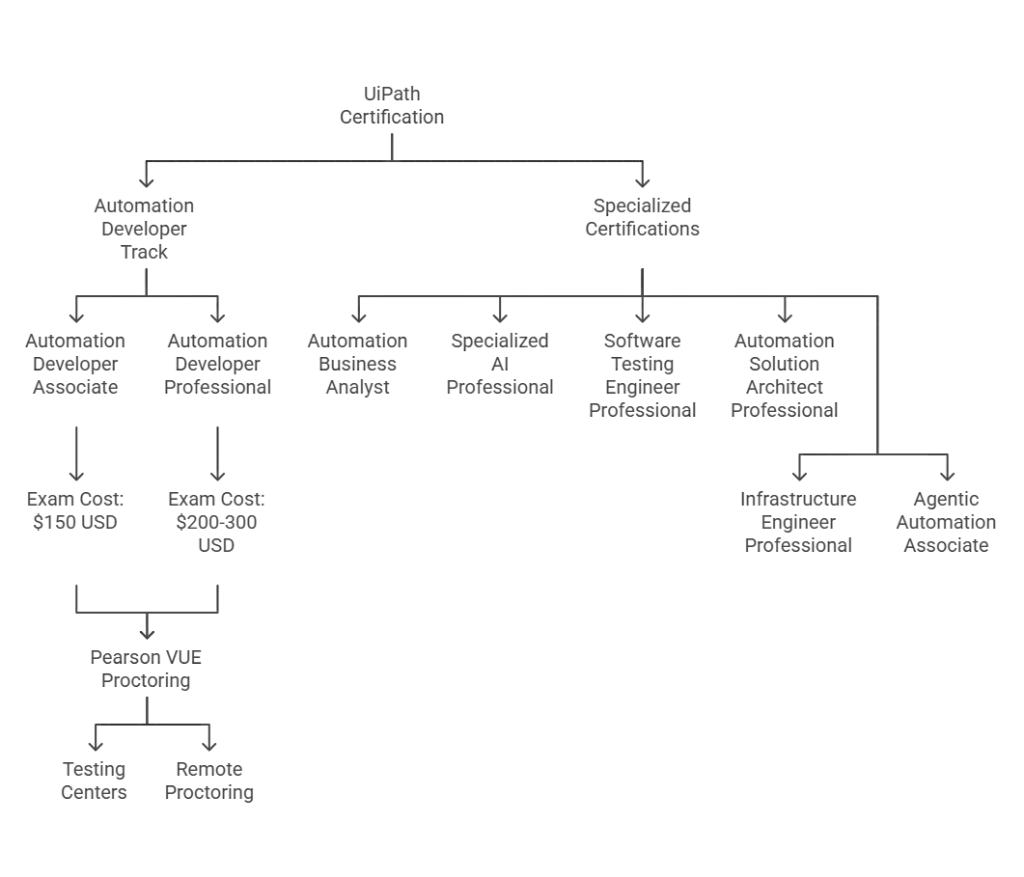
Automation Developer Track
The Developer track serves as the primary pathway for technical professionals building automation solutions.
Automation Developer Associate targets junior developers, business analysts, and anyone beginning their automation journey. The 90-minute exam contains approximately 60 questions covering RPA fundamentals, variables and data types, control flow, selectors, debugging, and workflow design. You need a 70% passing score.
This certification suits citizen developers, junior RPA developers, solution architects in training, business analysts, and recent graduates entering the automation field.
Automation Developer Professional assesses your ability to independently build enterprise-grade automation using advanced UiPath features. The 120-minute exam tests advanced selectors, REFramework implementation, comprehensive error handling, integration patterns, and scalable automation architecture. Passing requires 70% or higher.
Target candidates typically have 6+ months of RPA development experience and have deployed production automations.
Specialized Certifications
Beyond the core developer track, UiPath offers specialized credentials:
- Automation Business Analyst (Associate and Professional levels)
- Specialized AI Professional (document processing and communications mining)
- Software Testing Engineer Professional
- Automation Solution Architect Professional
- Infrastructure Engineer Professional
- Agentic Automation Associate (AI agent collaboration)
Each specialization addresses specific roles within automation centers of excellence.
Certification Costs and Logistics
Associate and Professional level exam costs from $150-$300 USD. Some corporate training programs include exam vouchers.
Exams are proctored through Pearson VUE, available either at 6,000+ global testing centers or remotely from home via OnVUE online proctoring. Home testing offers scheduling flexibility and the comfort of your own environment, though you must meet technical requirements and workspace standards.
Building Your Foundation with UiPath Academy
UiPath Academy provides the complete, free curriculum needed for certification success. The platform’s role-based learning paths align directly with certification requirements.
Leveraging Academy Learning Plans
Each certification has a corresponding learning plan combining multiple courses into a structured pathway.
For Associate preparation, complete:
- RPA Starter (RPA fundamentals and business process concepts)
- RPA Developer Foundation (Studio basics, variables, control flow, data manipulation)
- Orchestrator training (robot management, queue concepts, scheduling)
- Workflow Testing and Logging documentation
For Professional preparation, add:
- RPA Developer Advanced course (REFramework deep dive, advanced error handling)
- Advanced data manipulation techniques
- Integration Service fundamentals
- Git/source control in UiPath
Academy content is structured in digestible chapters with estimated completion times. Video demonstrations cater to visual learners while transcripts and code examples serve technical learners who prefer text.
How to Use Academy Effectively
- Don’t just watch: actively follow along. Download UiPath Studio and replicate every demonstration. Build the sample automations yourself rather than passively consuming content.
- Take notes on exam-relevant topics: Academy courses cover breadth, but certification exams focus on specific concepts. The exam description document lists exact topics tested. Cross-reference your Academy study with these requirements.
- Complete all exercises and quizzes: Academy assessments reveal knowledge gaps. A low quiz score signals areas needing review before attempting the actual exam.
- Leverage multiple formats: If a concept isn’t clicking through video, read the documentation. Try UiPath Forum discussions for alternative explanations from practitioners.
The Academy is comprehensive; you genuinely don’t need expensive third-party study materials. Everything required for passing is freely available.
Developing Real-World Automation Skills
Theoretical knowledge alone won’t carry you through certification exams. UiPath tests practical application ability.
Build Your Own Automations
Create automations beyond Academy exercises. Identify repetitive tasks in your daily work or personal life and automate them.
- Start simple: Automate Excel report generation, email filtering, web data extraction, or file organization. These foundational projects solidify basic concepts.
- Progress to complexity: Build workflows involving API integration, database connections, exception handling scenarios, or multi-application orchestration.
- Use real data rather than sample datasets. Working with messy, real-world data exposes you to edge cases and error scenarios that exam questions often address.
Download and Explore UiPath Products
Install UiPath Studio and Orchestrator Community Edition—both are free. Familiarity with the interface, where features are located, and how tools interconnect is essential.
- For Associate candidates: Focus on Studio capabilities. Know how to create sequences and flowcharts, configure activity properties, use the Object Repository, implement logging, and publish projects.
- For Professional candidates: Master Orchestrator thoroughly. Understand queue management, robot configuration, asset management, process deployment, trigger scheduling, and monitoring capabilities.
Simply clicking through interfaces builds the muscle memory needed to answer questions about where specific features are located or how configurations work.
Study UiPath Documentation
Official UiPath documentation is the authoritative source for activity properties, best practices, and feature specifications. Exam questions often test nuanced details found in documentation.
When you learn a new activity in Academy, read its documentation page. Note optional parameters, common use cases, and any version-specific considerations.
Mastering the Practice Test Strategy
UiPath provides free official practice tests for each certification. These are your most valuable preparation resource.
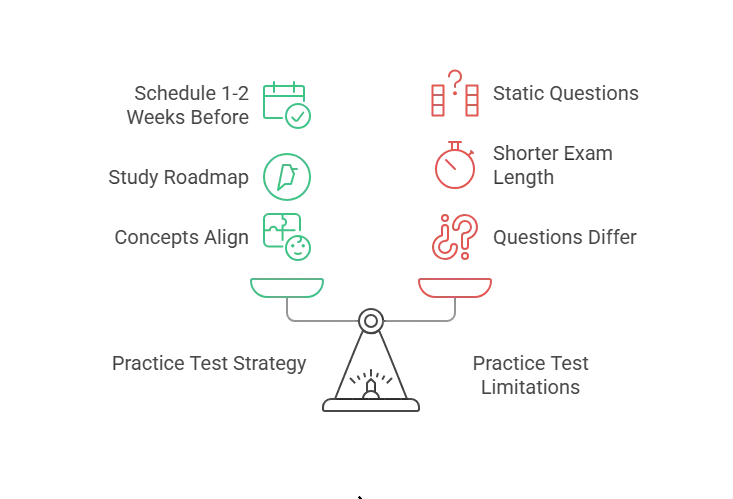
When to Take Practice Tests
- Don’t rush into practice tests: Complete your Academy training and hands-on practice first. Taking a practice test before you’re ready wastes its value—questions are static and repeat each time you retake it.
- Schedule your practice test 1-2 weeks before your planned exam date: This timing allows you to identify weak areas and target additional study where needed.
How to Use Practice Test Results
Practice tests generate detailed score reports showing performance by topic area. Treat this as your study roadmap.
- 70% or below: You’re not ready. Return to Academy content for topics scoring under 70%. Build additional hands-on projects focusing on weak areas.
- 70-85%: You’re close. Focus specifically on lowest-scoring topics. Review related documentation. Create flashcards or notes for concepts you’re forgetting.
- Above 85%: You’re ready to schedule your actual exam. Don’t become overconfident—the real exam has different questions, but you’ve demonstrated solid knowledge.
Understanding Practice Test Limitations
- Practice tests have static questions: Taking them repeatedly until you memorize answers creates false confidence. The actual exam draws from a larger question pool with different scenarios.
- Practice tests are shorter: Associate practice tests may have fewer questions than the 60-question actual exam. Professional practice tests similarly represent a subset. Pace yourself accordingly in the real exam.
- Questions differ but concepts align: Practice tests won’t give you actual exam questions, but they accurately represent question style, difficulty level, and topic distribution.
Some candidates supplement official practice tests with reputable third-party platforms like Udemy or PassITExams for additional question exposure. Avoid “dumps” websites claiming to have actual exam questions; these violate UiPath policies and often contain incorrect answers.
Deep Dive: REFramework for Professional Certification
The Robotic Enterprise Framework (REFramework) dominates Professional certification content. Many candidates underestimate how thoroughly they need to know it.
What the Exam Tests About REFramework
- Structural understanding: Know the four states (Initialization, Get Transaction Data, Process Transaction, End Process) and the flow between them.
- Configuration mastery: Understand how Config.xlsx drives framework behavior, what belongs in settings versus assets, and how configuration values are consumed.
- Error handling architecture: Distinguish business exceptions from system exceptions. Understand retry logic, how exceptions move workflows between states, and when transactions get marked as failed.
- Queue integration: Know how the framework consumes Orchestrator queues, what happens when queues are empty, how transaction data passes through the framework, and queue item status updates.
- Customization points: Identify where to add custom logic—which workflows handle initialization, where business rules get implemented, how to add new configuration items.
Study Approach for REFramework
- Don’t just read about it; build with it: Create a new project using the REFramework template. Walk through each workflow file understanding what executes and when.
- Modify the framework intentionally: Add custom configuration items. Implement different business rules. Force various exception scenarios and observe framework responses.
- Understand “why” not just “what.” For each framework component, ask yourself why UiPath designed it this way. What problem does this solve? What would break if this weren’t here?
- Practice converting scenarios: The exam may present a business process and ask how you’d implement it in REFramework. Practice mentally mapping requirements to framework components.
If REFramework still feels unclear after Academy training, UiPath’s community has excellent video walkthroughs. The official documentation also contains detailed framework explanations.
Common Preparation Mistakes to Avoid
Learning from others’ failures accelerates your success. These mistakes repeatedly appear in community discussions from unsuccessful candidates.
Skipping Hands-On Practice
- The mistake: Watching Academy videos without building anything yourself. Assuming theoretical knowledge translates to practical ability.
- Why it fails: Certification exams include scenario-based questions requiring you to know what happens when you configure activities certain ways. Without hands-on experience, you’re guessing.
- The fix: After each Academy module, build something. Even small 10-minute automations reinforce concepts better than passive watching.
Starting Too Advanced
- The mistake: Attempting Professional certification without Associate-level experience. Jumping to advanced topics before mastering fundamentals.
- Why it fails: Professional exams assume you have Associate knowledge as a baseline. Questions won’t re-test basics—they build on them. Gaps in foundational knowledge compound.
- The fix: Be honest about your experience level. If you have under six months of automation development, start with Associate certification. The progression builds confidence and fills knowledge gaps.
Relying on Brain Dumps
- The mistake: Purchasing “guaranteed pass” question collections from dubious websites claiming to have actual exam questions.
- Why it fails: These sites often contain outdated, incorrect, or irrelevant questions. UiPath actively monitors for exam compromise and may invalidate certifications obtained through cheating. The content doesn’t actually teach you to use UiPath.
- The fix: Use only official UiPath resources plus reputable practice platforms. Genuine learning creates lasting skills beyond just passing an exam.
Neglecting Documentation
- The mistake: Never reading official UiPath documentation, relying solely on Academy videos.
- Why it fails: Exam questions test specific details often covered in documentation but glossed over in videos. Activity parameters, configuration options, and edge cases appear in docs.
- The fix: For every major activity or concept, spend 10 minutes reviewing its documentation page. Make notes of non-obvious details.
Poor Time Management
- The mistake: Not tracking how long Academy courses actually take. Scheduling exams before completing preparation. Cramming everything into two weeks.
- Why it fails: Quality preparation requires time for information to sink in and for hands-on practice. Rushed studying leads to superficial understanding.
- The fix: Plan 4-6 weeks of dedicated preparation. Even if Academy estimates 20 hours of content, factor in practice time, review, and inevitable interruptions.
Ignoring Weak Areas
- The mistake: Continuing to practice topics you already understand while avoiding challenging concepts.
- Why it fails: Exams test comprehensively. One weak topic area can drop your score below passing.
- The fix: Use practice test results to identify gaps. Spend disproportionate time on your weakest areas until they improve.
Skipping Practice Tests
- The mistake: Going straight to the paid exam without taking the free practice test.
- Why it fails: You miss the opportunity to identify knowledge gaps and adjust your study plan. The practice test format also familiarizes you with question styles.
- The fix: Always complete the official practice test before scheduling your actual exam. Treat it as a diagnostic tool.
Exam Day: Logistics and Final Preparations
Proper exam day preparation reduces anxiety and sets you up for success.
Technical Setup for Remote Testing
If testing from home, verify your setup 3-4 days before the exam.
- Run the system check provided by Pearson VUE. This tests your computer’s compatibility with their proctoring software. Address any technical issues immediately—don’t discover problems on exam day.
- Prepare your workspace: Clear your desk of everything except your computer. Remove dual monitors or disconnect them. Have plain walls visible to your webcam (no posters, papers, or whiteboards). Ensure good lighting so your face is clearly visible.
- Test your internet connection: A stable, high-speed connection is essential. Wired connections are more reliable than WiFi. Have a backup internet option (mobile hotspot) available in case of issues.
- Close all unnecessary programs: The proctoring software requires full control. Other applications can cause conflicts or appear as suspicious activity.
Mental Preparation
- Review your notes the morning of the exam, not the night before. A 30-minute review of key concepts and areas you flagged as challenging refreshes your memory without overwhelming you.
- Don’t cram new material. If you don’t know it by exam day, last-minute studying creates confusion rather than clarity.
- Manage your energy. Associate exams are 90 minutes, Professional are 120 minutes. Eat a proper meal beforehand. Stay hydrated. Use the bathroom before starting.
- Read questions carefully. Many candidates fail by misreading questions, not by lacking knowledge. Exam questions sometimes include subtle qualifiers like “which is NOT correct” or “what happens if you DON’T configure this parameter.”
During the Exam
- Pace yourself. Track time remaining versus questions remaining. For a 60-question, 90-minute exam, you have roughly 90 seconds per question. Don’t spend five minutes on one question while others get rushed.
- Flag uncertain questions. If you’re genuinely torn between two answers, flag it and move on. Return to flagged questions if time permits after completing others.
- Trust your preparation. Second-guessing correct answers causes more mistakes than sticking with your initial instinct when you’ve prepared thoroughly.
- Don’t panic over unfamiliar questions. Even well-prepared candidates encounter questions on topics they didn’t emphasize. Use logical reasoning and eliminate obviously incorrect options.
Maintaining Your Certification and Career Growth
Earning your certification marks the beginning, not the end, of your UiPath journey.
Three-Year Validity and Renewal
All UiPath certifications expire three years from the date earned. To maintain your credential:
- Retake the latest version of your certification exam before expiration. Exams are periodically updated to reflect new UiPath features and platform versions.
- Alternatively, complete UiPath’s Continuing Education Program requirements (available for some certifications). This involves completing training hours and passing an assessment.
Schedule renewal 3-4 months before expiration. This buffer prevents your certification from lapsing while you prepare.
Progression Paths
- From Associate to Professional: After 6-12 months of hands-on automation development, pursue Professional certification. This demonstrates career progression and qualifies you for senior developer roles.
- Specialized certifications: Based on your organization’s needs, consider Specialized AI, Business Analyst, or Solution Architect credentials. These open new career trajectories beyond pure development.
- Contribute to the community: Share knowledge on UiPath Forum, create helpful content, or mentor newer practitioners. Community involvement deepens your expertise and builds your professional network.
Applying Certification to Your Career
- Update your resume and LinkedIn profile immediately. Add your credential, certification number, and validity period. Enable LinkedIn profile badges through UiPath CertMetrics.
- Discuss certification with your manager. Certified professionals often command higher salaries and gain first consideration for automation projects.
- Join UiPath partner networks or user groups. Certification opens doors to exclusive communities, early access to new features, and networking with other certified professionals worldwide.
- Stay current with platform updates. UiPath releases new features regularly. Follow release notes, Academy updates, and community discussions to remain proficient beyond your certification requirements.
Creating Your Personal Study Plan
Effective preparation requires structure. Here’s a proven 6-week timeline adaptable to your schedule:
Weeks 1-2: Foundation Building
- Complete Associate Academy learning plan (RPA Starter, Developer Foundation)
- Install Studio and Orchestrator
- Build 3-5 simple automations (Excel, email, web scraping)
- Read exam description document thoroughly
Weeks 3-4: Advanced Skills and Practice
- Complete Professional Academy courses (if applicable)
- Study REFramework in depth (Professional only)
- Build 2-3 complex automation projects
- Review UiPath documentation for exam topics
- Identify weak areas and focus additional study there
Week 5: Practice Testing and Review
- Take official practice test
- Analyze results and create targeted review list
- Study weak topic areas intensively
- Build practice projects specifically for challenging concepts
- Review exam logistics and technical requirements
Week 6: Final Preparation
- Light review of notes and key concepts
- Take practice test again (if retake provides value)
- Verify testing environment setup
- Schedule exam for end of week
- Maintain confidence—you’ve prepared thoroughly
This timeline assumes 8-10 hours weekly study commitment. Adjust based on your available time and existing UiPath experience.
Leveraging PassITExams for Additional Practice
While UiPath Academy provides comprehensive preparation materials, supplementing with additional practice questions can strengthen your readiness. PassITExams offers practice tests specifically designed to mirror UiPath certification exam patterns.
These materials help you:
- Experience additional question scenarios beyond the official practice test
- Identify remaining knowledge gaps
- Build stamina for the full exam duration
- Gain confidence through repeated practice
Use such resources as supplements, not replacements, for official UiPath materials. The foundation remains Academy training and hands-on development experience.
Frequently Asked Questions
How long does UiPath certification preparation take?
For Associate certification, plan 4-6 weeks with 8-10 hours weekly if you’re new to RPA. With existing UiPath experience, 2-3 weeks may suffice. Professional certification typically requires 6-8 weeks of dedicated preparation plus 6+ months of practical development experience.
Can I pass UiPath certification without programming experience?
Yes, particularly for Associate certification. UiPath is designed for low-code automation. The platform uses visual workflows rather than extensive coding. However, basic logic understanding (if/then, loops, variables) helps significantly.
What happens if I fail the certification exam?
You can retake the exam after purchasing a new exam voucher. There’s no mandatory waiting period, though waiting 2-4 weeks to address knowledge gaps makes more sense than immediate retake. Review your score report to identify weak areas before attempting again.
Are UiPath certifications recognized globally?
Yes. UiPath maintains strong brand recognition across North America, Europe, Asia-Pacific, and emerging markets. The certifications are vendor-specific but widely respected in the RPA industry.
Do I need to renew my UiPath certification?
Yes. Certifications are valid for three years from the date earned. Renewal requires either retaking the current version of the exam or completing continuing education requirements. Plan renewal 3-4 months before expiration.
What’s the difference between UiPath Academy courses and certification exams?
Academy courses provide comprehensive training covering platform features broadly. Certification exams test specific competencies defined in exam description documents. You need Academy knowledge plus targeted exam preparation and hands-on practice.
Can I take the exam from home?
Yes. UiPath offers remote proctoring through Pearson VUE OnVUE. You can test from home, office, or anywhere meeting their technical and environmental requirements. Alternatively, test at any of 6,000+ Pearson VUE testing centers globally.
How much do UiPath certifications cost?
Associate-level exams cost approximately $150 USD. Professional-level exams range from $200-300 USD depending on the specific certification. Prices may vary slightly by region and testing provider.
What score do I need to pass?
UiPath certification exams require a 70% passing score. Both Associate and Professional levels use this threshold. You’ll receive preliminary pass/fail notification immediately after completing the exam.
Should I get Associate certification before Professional?
It’s highly recommended. Professional exams assume Associate-level knowledge as a baseline. Without that foundation, professional content will be overwhelming. The progression builds skills systematically and prevents knowledge gaps.
Conclusion
UiPath certification validates your automation expertise in a rapidly growing field. Success requires combining structured Academy learning, extensive hands-on practice, strategic use of practice tests, and understanding of exam-specific topics like REFramework.
The certification journey offers more than a credential; it builds genuine skills for designing and deploying enterprise automation solutions. Organizations worldwide need these capabilities as automation adoption accelerates.
Start your preparation today by registering for UiPath Academy, downloading Studio, and building your first automation. With focused effort and the strategies outlined in this guide, you’ll join thousands of certified UiPath professionals advancing the future of work.
Your next step: Choose your certification level, review the exam description document, and create your personalized study schedule. The RPA industry awaits your contribution.
