
Process improvement, defect reduction, and waste elimination are the critical backbones of modern organizational excellence. Regardless of the industry; be it manufacturing, healthcare, finance, or cloud computing; companies globally rely on standardized methodologies to streamline complex workflows and maximize profitability. The premier framework for achieving this operational maturity is Lean Six Sigma.
However, becoming a recognized expert in this methodology is not achieved through a single exam. The training is structured as a progressive roadmap. If you are planning to validate your skills in process optimization, understanding the Lean Six Sigma certification levels is your critical first step.
What are the Certification Levels?
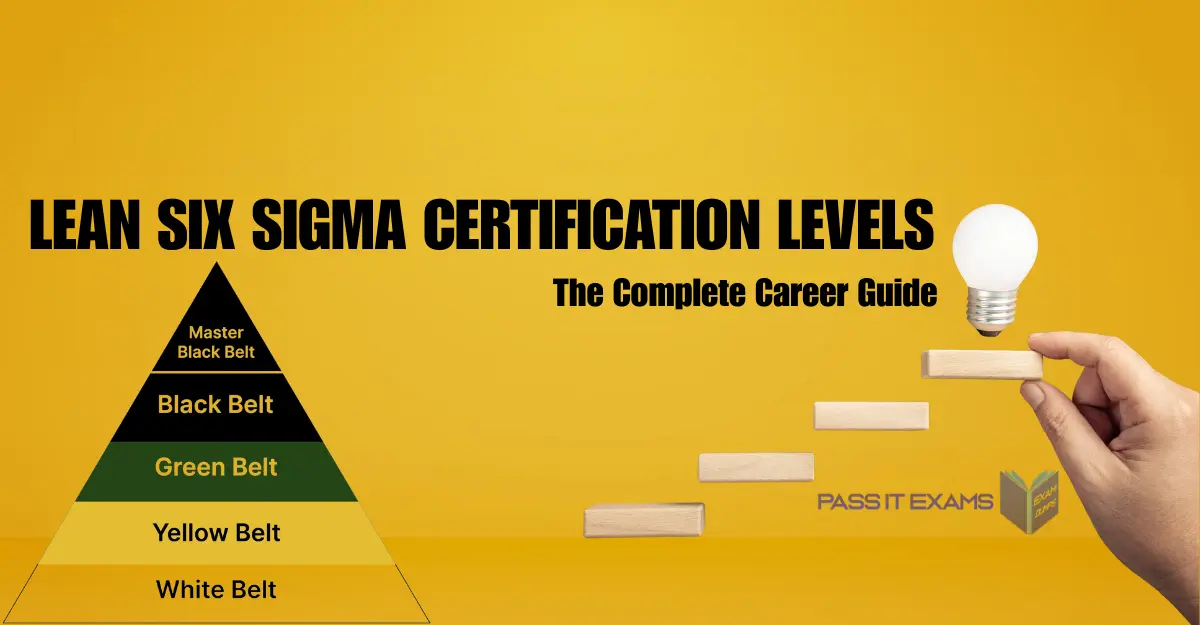
The Lean Six Sigma certification levels are a tiered educational framework modeled after martial arts belts. The hierarchy consists of five official levels: White Belt, Yellow Belt, Green Belt, Black Belt, and Master Black Belt. Each consecutive tier validates a progressively deeper mastery of statistical analysis, the DMAIC (Define, Measure, Analyze, Improve, Control) methodology, and enterprise-level change management leadership.
The 5 Lean Six Sigma Belts: A Complete Breakdown
Choosing the correct starting point ensures you do not waste time or money on material that is misaligned with your current career responsibilities. Below is the definitive, highly detailed breakdown of each belt in the Lean Six Sigma certification hierarchy.
1. White Belt (The Foundation)
The White Belt is the absolute entry point. It is strictly an awareness-level certification designed for professionals who need to understand the basic vocabulary of Lean Six Sigma without the expectation of ever executing data-driven projects.
- Target Audience: Entry-level employees, students, and C-suite executives who need a high-level overview to sponsor projects.
- Core Curriculum: The history of Six Sigma, the 8 Wastes of Lean (DOWNTIME), and a conceptual overview of the DMAIC framework.
- Expected Training Time: Typically 2 to 4 hours of self-paced reading or video modules.
- Operational Role: Supporting change management initiatives by understanding the “why” behind organizational process shifts. White Belts do not lead projects.
- Average Exam Cost: Often $0 (Free through independent organizations like the Council for Six Sigma Certification).
2. Yellow Belt (The Contributor)
The Yellow Belt moves beyond basic awareness into foundational, practical application. Yellow Belts do not lead projects; instead, they serve as essential subject matter experts (SMEs) who assist Green and Black Belts in data collection and initial process mapping.
- Target Audience: Core project team members, operations analysts, and quality assurance staff.
- Core Curriculum: Basic data collection techniques, creating process maps, and participating in root cause analysis sessions using introductory tools like Ishikawa (Fishbone) diagrams and the 5 Whys.
- Expected Training Time: 10 to 20 hours of instruction.
- Operational Role: Participating actively in project teams, recording baseline metrics, and sustaining localized process improvements on the operational floor.
- Average Exam Cost: $99 – $250.
3. Green Belt (The Project Leader)
The Green Belt is the most popular and commercially valuable milestone among the Lean Six Sigma certification levels. Green Belts are the workhorses of process improvement. They lead small-to-medium-sized projects within their specific departments while maintaining their normal operational job duties.
- Target Audience: Mid-level managers, IT project managers, data analysts, and process engineers.
- Core Curriculum: Full execution of the DMAIC cycle, hypothesis testing (T-tests, ANOVA), basic control charts, and graphical data analysis using statistical software like Minitab or SigmaXL.
- Expected Training Time: 40 to 80 hours of rigorous instruction.
- Operational Role: Leading departmental projects, analyzing statistical process data, and implementing measurable, sustained solutions. For example, a Green Belt might lead a project to reduce IT helpdesk ticket resolution time by 15%.
- Average Exam Cost: $295 – $500 (Exam only) or up to $2,000 for full university instructor-led training.
4. Black Belt (The Process Expert)
The Black Belt represents a mastery of advanced statistical tools and elite change management leadership. Black Belts operate as full-time change agents, leading complex, cross-functional projects that carry massive financial impacts for the enterprise.
- Target Audience: Senior quality managers, continuous improvement consultants, and enterprise operations directors.
- Core Curriculum: Advanced statistics (Multiple Regression, Design of Experiments – DOE), advanced organizational change management, and coaching/mentoring Green Belts.
- Expected Training Time: 100 to 160+ hours of advanced instruction.
- Operational Role: Identifying enterprise-wide process flaws, leading critical improvement initiatives that span multiple departments (e.g., global supply chain optimization), and acting as an internal consultant for the C-suite.
- Average Exam Cost: $395 – $600 (Exam only) or $3,000+ for comprehensive bootcamps.
5. Master Black Belt (The Strategic Leader)
The Master Black Belt (MBB) is the absolute pinnacle of the Lean Six Sigma hierarchy. MBBs rarely run individual, granular projects; instead, they design the organization’s overarching quality strategy and manage the entire portfolio of Six Sigma initiatives.
- Target Audience: C-suite executives, global continuous improvement directors, and principal independent consultants.
- Core Curriculum: Strategic enterprise deployment, executive leadership, advanced program governance, and curriculum design.
- Requirements: At least 5 years of experience as an active Black Belt, completion of 10+ high-impact projects, and a rigorous peer-reviewed portfolio assessment.
- Operational Role: Mentoring Black Belts, aligning process improvement metrics directly with corporate financial goals, and leading sweeping organizational transformations.
- Average Exam Cost: $1,500 – $4,000+ (Requires extensive portfolio review and board interviews).
How Different Belt Levels Interact with the DMAIC Methodology
To progress through the certification levels, candidates must prove an intimate understanding of the DMAIC methodology. This five-phase roadmap is the backbone of every Six Sigma project. However, each belt level interacts with this methodology differently.
- Define: Green/Black Belt: Writes the Project Charter, translates the Voice of the Customer (VOC), and creates the SIPOC diagram.
- Yellow Belt: Helps map the current state process.
- Measure: Green/Black Belt: Performs a Measurement System Analysis (MSA) or Gage R&R to ensure data reliability.
- Yellow Belt: Physically collects the time-tracking or defect data on the operational floor.
- Analyze: Black Belt: Uses advanced hypothesis testing to mathematically prove root causes.
- Green Belt: Creates Pareto charts and scatter plots to identify trends.
- Improve: Black Belt: Utilizes Design of Experiments (DOE) to find optimal process settings.
- Green Belt: Pilots the new workflow and records the improvement metrics.
- Control: Green/Black Belt: Implements Statistical Process Control (SPC) charts.
- Yellow/White Belt: Follows the newly established Standard Operating Procedures (SOPs) to ensure the defect does not return.
ASQ vs. IASSC vs. CSSC: Choosing the Right Accrediting Body
Unlike IT certifications owned by a single vendor (like AWS or Cisco), Lean Six Sigma is an open methodology. Therefore, multiple independent accrediting bodies issue certifications. Understanding the nuances between them is vital for protecting your career investment.
The American Society for Quality (ASQ)
ASQ is widely considered the global gold standard for traditional, highly rigorous Six Sigma credentialing.
- Format: Proctored, open-book exams (but all reference materials and notes must be physically bound). The Black Belt exam is 165 questions over 4.5 hours.
- Project Requirement: ASQ strictly requires a signed, verified affidavit proving you have completed one or two real-world Six Sigma projects to achieve Green and Black Belt status.
- Best For: Manufacturing, healthcare, aerospace, and engineering professionals where strict, traditional quality control is paramount.
The International Association for Six Sigma Certification (IASSC)
IASSC focuses strictly on assessing your knowledge of the universally accepted Lean Six Sigma Body of Knowledge (BoK).
- Format: Proctored, strictly closed-book online exams.
- Project Requirement: None. IASSC issues pure, knowledge-based certifications.
- Best For: Consultants, IT professionals, and independent contractors who want to prove their theoretical mastery but may not have immediate access to corporate financial data to run a formal, sponsored project.
The Council for Six Sigma Certification (CSSC)
CSSC is the largest independent accreditation provider, offering highly flexible pathways and free digital training materials.
- Format: Open-book, self-paced online exams.
- Project Requirement: CSSC offers two paths: a standard knowledge-based certification, and a “Level II” certification for candidates who submit a completed, graded project.
- Best For: Professionals seeking an affordable, highly flexible, and widely recognized entry into the methodology without the rigid scheduling of ASQ.
2026 Global Salary Expectations by Belt Level
Investing your time into the higher Lean Six Sigma certification levels yields a highly significant Return on Investment (ROI). Organizations willingly pay executive premiums for professionals who can definitively prove they save the company money through waste reduction.
Below is the 2026 average salary breakdown for Green and Black Belts across major global markets. Job titles at this level frequently include Process Engineer, Continuous Improvement Manager, Quality Assurance Director, and Senior Operations Analyst.
| Country | Green Belt Average Salary | Black Belt Average Salary | Master Black Belt |
|---|---|---|---|
| United States | $85,000 – $105,000 USD | $115,000 – $145,000+ USD | $160,000 – $190,000+ USD |
| United Kingdom | £45,000 – £60,000 GBP | £65,000 – £95,000+ GBP | £100,000 – £130,000+ GBP |
| Australia | $100,000 – $120,000 AUD | $135,000 – $180,000+ AUD | $190,000 – $230,000+ AUD |
| India | ₹1,000,000 – ₹1,800,000 INR | ₹2,000,000 – ₹3,800,000+ INR | ₹4,500,000 – ₹6,000,000+ INR |
| Pakistan | Rs. 2,500,000 – 4,000,000 PKR | Rs. 5,000,000 – 8,500,000+ PKR | Rs. 10,000,000+ PKR |
Note: Salaries fluctuate based on the candidate’s core industry. Technology, financial services, and pharmaceutical sectors typically offer the highest compensation for certified continuous improvement professionals.
A Day in the Life: What Do Six Sigma Belts Actually Do?
To put these certification levels into perspective, consider a real-world scenario in a massive e-commerce fulfillment center. The problem: 12% of customer orders are shipping with the incorrect item.
- The Master Black Belt looks at the annual financial reports, identifies that shipping errors cost the company $4 million last year, and formally sponsors a strategic initiative to reduce errors to under 2%. They assign the project to a Black Belt.
- The Black Belt defines the project scope and uses advanced statistical modeling to determine that the errors primarily correlate with temporary workers assigned to “Zone C” during the night shift.
- The Green Belt leads the actual floor investigation. They use Minitab software to analyze scanner data and realize the barcode scanners in Zone C have a 1.5-second lag, causing workers to double-scan items.
- The Yellow Belt (a floor supervisor) physically maps out the walking paths of the workers to show the Green Belt exactly how the scanning process is currently being executed.
- The White Belt (a warehouse associate) receives training on the new, optimized scanning process and understands why the new Standard Operating Procedure (SOP) is critical to customer satisfaction.
Lean Six Sigma in IT: Integrating with Agile and DevOps
While Lean Six Sigma originated on the manufacturing floor at Motorola and Toyota, its fastest-growing adoption sector in 2026 is Information Technology (IT).
Modern IT departments must manage complex software development lifecycles, cloud infrastructure migrations, and global service desks. Lean Six Sigma certification levels pair exceptionally well with existing IT frameworks:
- ITIL (IT Infrastructure Library): ITIL dictates what services should be provided to maintain IT health. Lean Six Sigma provides the analytical tools to figure out how to improve those services when they fail (e.g., reducing Mean Time to Resolution for server outages).
- Agile and DevOps: Agile focuses on rapid, iterative software delivery. Lean Six Sigma focuses on removing the “waste” (bottlenecks) from the CI/CD pipeline, ensuring that the software delivered quickly is also defect-free.
Because of this profound overlap, highly compensated IT enterprise architects frequently hold a Lean Six Sigma Green or Black Belt alongside their vendor-specific technical credentials.
Step-by-Step Guide to Choosing Your Belt Level
Achieving a high-level certification requires a structured approach. Follow these actionable steps to navigate your path efficiently.
- Step 1: Assess Your Career Trajectory
Before you begin, evaluate your end goal. If you are a standard IT helpdesk manager or a frontline nurse, a Green Belt is highly sufficient. If you aim to be a VP of Global Operations, you must commit to the Black Belt path.
- Step 2: Choose Your Provider and Format
Decide if you need the rigorous, project-backed ASQ certification, the theoretical IASSC credential, or the flexible CSSC program. Purchase the specific Body of Knowledge (BoK) associated with that provider.
- Step 3: Master the Statistics
Do not underestimate the mathematical requirements of the Green and Black Belt exams. You will need to understand standard deviations, process capability (Cp/Cpk), and complex probability distributions.
- Step 4: Leverage Authentic Practice Materials
Do not rely solely on reading heavy textbooks. The exams from ASQ and IASSC feature highly complex, scenario-based statistical questions designed to test your application, not your memory. Utilizing rigorously tested practice tests and targeted study guides is the absolute most effective way to identify your weak points in topics like hypothesis testing before sitting for the actual exam.
Common Mistakes to Avoid in Your Certification Journey
- Skipping Directly to Black Belt: While some independent bodies allow you to take the Black Belt exam without holding an active Green Belt, it is highly discouraged. The Black Belt exam assumes you have already mastered foundational Green Belt statistics. Skipping steps usually results in failure.
- “Boiling the Ocean”: The most common reason a Six Sigma project fails is a poorly defined scope. If your project goal is to “Fix the entire supply chain,” you will fail. A proper project scope is narrow and measurable: “Reduce packaging errors on Assembly Line B by 20% in Q3.”
- Focusing Solely on Statistics over People: You can build the most mathematically perfect solution in Minitab, but if the operational staff refuses to adopt the new workflow, the project fails. Black Belts must prioritize human psychology and organizational change management just as much as data analysis.
- Memorizing Without Understanding Application: You cannot pass a rigorous Six Sigma exam by simply memorizing definitions. You must fundamentally understand when to use an ANOVA test versus a Chi-Square test based on the specific data types provided in a scenario question.
FAQs About Lean Six Sigma Certification Levels
Do I have to start at the White Belt level?
No. Most professionals with a few years of basic corporate or technical experience skip the White Belt entirely and begin their formal training directly at the Yellow or Green Belt level.
Does a Lean Six Sigma certification expire?
It depends entirely on the accrediting body. ASQ requires Green and Black Belts to recertify every three years by earning Recertification Units (RUs) through continued education or by retaking the exam. IASSC certifications are generally recognized perpetually, though they offer an optional recertification classification.
Can I self-study for a Lean Six Sigma certification?
Yes. If you choose a knowledge-based exam like IASSC or CSSC, you can self-study using textbooks and online resources. However, self-studying the advanced statistics required for the Black Belt is notoriously difficult without an instructor or comprehensive prep materials.
What is a “Champion” in Six Sigma?
A Champion is not a belt level; it is a role. A Champion is typically a senior executive or upper-level manager who sponsors a Six Sigma project. They do not do the statistical work; rather, they remove organizational roadblocks, secure funding, and ensure the Green/Black Belt has the authority needed to implement changes.
How long does it take to get a Green Belt?
On average, a dedicated professional can complete the coursework, study for the exam, and pass a Green Belt certification within 4 to 8 weeks of consistent part-time study.
Do I need to buy statistical software for the exam?
For the actual exam, no. Exams are multiple-choice. However, you will need access to software like Minitab, JMP, or SigmaXL to complete the mandatory projects required by bodies like ASQ or university programs.
Is a university Lean Six Sigma certificate better than ASQ?
Many top-tier universities (like Purdue or Villanova) offer continuing education certificates in Lean Six Sigma. While these carry immense institutional prestige, they are generally the most expensive route. Most hiring managers still consider ASQ the ultimate gold standard for the industry.
What is the difference between Six Sigma and Lean Six Sigma?
Six Sigma focuses purely on reducing mathematical variation and defects to ensure consistent quality. Lean focuses entirely on eliminating waste (non-value-adding activities) to increase speed. Lean Six Sigma combines both philosophies for maximum organizational efficiency.
Conclusion: Accelerate Your Career Progression
Understanding the different Lean Six Sigma certification levels is the first step toward becoming a transformative leader in your organization. From the foundational awareness of a White Belt to the strategic, enterprise-wide vision of a Master Black Belt, this certification path is one of the most proven and reliable ways to elevate your career and increase your global earning potential. By deeply understanding the DMAIC methodology and carefully selecting the right accrediting body, you can strategically map out a highly lucrative professional development plan.
In today’s hybrid technology landscape, process improvement does not exist in a vacuum. A modern Six Sigma professional is frequently tasked with optimizing digital workflows, cloud deployments, and complex IT service management pipelines. Because of this deep integration, ambitious professionals often combine their Six Sigma process credentials with top-tier technical IT certifications from vendors like Microsoft, AWS, Cisco, and ISC2.When you are ready to expand your expertise into these complementary technical domains, thorough and precise preparation is mandatory.
Platforms like PassITExams provide the highly accurate practice tests, comprehensive study guides, and authentic exam prep materials you need to master complex IT vendor exams. Whether you are aiming for an AWS Solutions Architect credential or utilizing premium practice materials to pair your Six Sigma process excellence with elite cybersecurity knowledge (like the CISSP), leveraging trusted resources ensures you pass on your first attempt; saving you time, reducing anxiety, and protecting your professional certification budget.
