
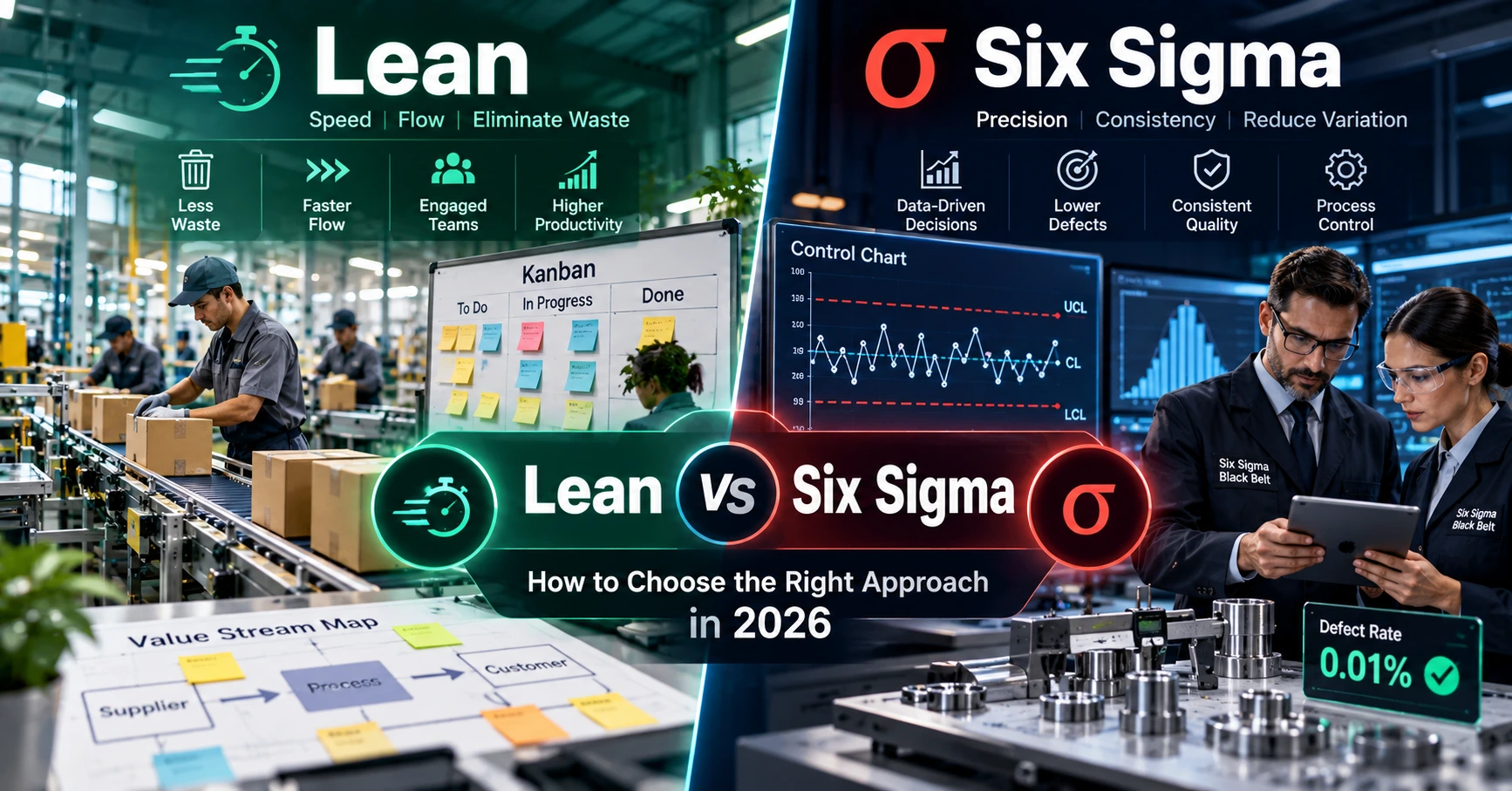
The Lean vs Six Sigma debate confuses more people than almost any other topic in process improvement. The two terms get used interchangeably in job postings, consulting pitches, and training decks, but they solve different problems, use different tools, and produce different results.
Both approaches share a goal; making organizations perform better; and both rely on data. But Lean and Six Sigma diverge sharply underneath that shared surface: one is built around speed, the other around precision.
Picking the wrong one, or combining them without understanding why, wastes effort and erodes trust in improvement programs. Picking correctly delivers measurable ROI instead of paperwork.
This guide covers what each methodology actually is, where they diverge, when to use each one alone, when to combine them, and how to match the right approach to your industry in 2026.
Quick Answer:
Lean vs Six Sigma at a Glance Lean optimizes flow and speed by eliminating waste; Six Sigma optimizes consistency by reducing variation and defects. Choose Lean when the problem is slow, inefficient, or bottlenecked. Choose Six Sigma when the problem is inconsistent quality or high defect rates. Choose Lean Six Sigma when both speed and quality need to improve together.
Core Philosophy of Lean vs Core Philosophy of Six Sigma
The Core Philosophy of Lean
Lean’s central obsession is waste elimination. It originated from the Toyota Production System (TPS), developed in Japan after World War II, and it asks one recurring question: does this step add value for the customer?
Lean identifies eight classic forms of waste (often remembered by the acronym DOWNTIME): Defects, Overproduction, Waiting, Non-utilized talent, Transportation, Inventory, Motion, and Extra-processing. Anything that doesn’t directly contribute value to the end customer is a candidate for removal or reduction.
Lean is fundamentally about flow and speed. It focuses on shortening the time between a customer request and its fulfillment, reducing bottlenecks, and empowering frontline employees to identify and fix problems continuously (a philosophy known as kaizen, or continuous improvement).
In short: Lean optimizes flow and speed. If you’re weighing whether formal training is worth the time investment, see our guide on the best Lean certifications for a breakdown of options by career stage.
The Core Philosophy of Six Sigma
Six Sigma’s central obsession is variation reduction. It was developed at Motorola in the 1980s and later popularized by General Electric under Jack Welch. Its core belief is that inconsistency; not necessarily inefficiency; is the enemy of quality.
The name itself refers to a statistical target: a process operating at “six sigma” produces no more than 3.4 defects per million opportunities. To get there, Six Sigma relies on a structured, data-heavy problem-solving framework called DMAIC (Define, Measure, Analyze, Improve, Control), supported by statistical tools like control charts, hypothesis testing, regression analysis, and process capability studies.
Six Sigma is fundamentally about precision and predictability. It doesn’t ask “how do we go faster?” so much as “why does this process sometimes produce a bad outcome, and how do we make sure it never does again?”
In short: Six Sigma optimizes consistency and reduces defects. For a full breakdown of certification costs and expected payback, see Is Six Sigma Worth It?
Key Differences Table
| Dimension | Lean | Six Sigma |
|---|---|---|
| Primary Focus | Eliminating waste, improving flow and speed | Reducing variation and defects |
| Guiding Question | “Does this add value?” | “Why does this vary?” |
| Origin | Toyota Production System (Japan) | Motorola / General Electric (USA) |
| Core Framework | Kaizen, value stream mapping, 5S, Kanban | DMAIC, DMADV (for new processes) |
| Toolkit | Visual management, pull systems, standard work, poka-yoke | Statistical process control, hypothesis testing, regression, FMEA |
| Skill Levels | Lean practitioner, Lean leader, Lean sensei | White Belt, Yellow Belt, Green Belt, Black Belt, Master Black Belt |
| Timeframe | Often fast; improvements in days or weeks | Typically longer; weeks to months per project |
| Data Intensity | Moderate; observation and process mapping | High; statistical analysis and hypothesis testing |
| Typical Results | Reduced lead time, lower inventory, less rework, faster delivery | Reduced defect rates, tighter tolerances, more consistent quality |
| Best Suited For | Process speed, workflow bottlenecks, employee engagement | Complex processes with high variation, precision-critical outputs |
| Risk if Misapplied | May tolerate variation as long as flow improves | Can over-engineer simple problems, slower time-to-result |
Lean Six Sigma; Why the Combination Exists
If Lean makes things faster and Six Sigma makes things more consistent, the natural question is: why not do both?
That’s exactly the reasoning behind Lean Six Sigma (LSS), a hybrid methodology that emerged in the late 1990s and early 2000s as organizations realized that speed without quality just produces fast defects, and quality without speed produces slow, expensive perfection.
Lean Six Sigma typically borrows the DMAIC structure from Six Sigma as its backbone, but injects Lean tools; value stream mapping, 5S, waste analysis; at each phase. The result is a methodology that:
- Uses Lean’s speed to quickly identify and remove obvious waste before deploying expensive statistical analysis.
- Uses Six Sigma’s rigor to solve the deeper, less obvious causes of variation that simple observation can’t catch.
- Applies a shared belt-based certification system (Yellow, Green, Black Belt) so practitioners can be trained in a common language across an organization.
The combination exists because most real-world problems aren’t purely about waste or purely about variation; they’re usually a mix of both. A hospital emergency room might have both a flow problem (patients waiting too long) and a variation problem (inconsistent triage decisions). Lean Six Sigma gives practitioners a toolkit for addressing both dimensions within a single project.
Before committing to a belt-based training path, it’s worth understanding the investment involved; see our breakdown of Lean Six Sigma certification costs for a realistic look at pricing by belt level.
When to Choose Pure Lean
Choose pure Lean when the core problem is speed, flow, or wasted effort; not inconsistent quality.
Signs Lean Is the Right Fit
- Speed and flow are the primary complaint. “Things take too long” or “too much work-in-progress” points to Lean’s flow-focused tools: value stream mapping, Kanban, pull systems.
- The process is relatively stable but inefficient. Outputs are generally correct; just slow or resource-heavy; so you don’t need Six Sigma’s statistical machinery.
- You need fast, visible wins. Lean events (Kaizen blitzes) can produce measurable improvements in days, building momentum for a broader improvement culture.
- Frontline engagement is a priority. Lean empowers employees closest to the work to spot and fix problems, making it a strong fit for building a bottom-up improvement culture.
- Resources for statistical training are limited. Lean’s tools are intuitive and visual, requiring less specialized training than Six Sigma’s belt curricula.
Typical Lean Use Cases
Warehouse and logistics flow, administrative process redesign, software development workflows (Lean has heavily influenced Agile and DevOps), retail operations, and office workflow bottlenecks.
When to Choose Pure Six Sigma
Choose pure Six Sigma when the core problem is inconsistent quality or a high defect rate; not overall speed.
Signs Six Sigma Is the Right Fit
- Defects or inconsistency are the core problem. A process that’s fast enough but produces unpredictable outcomes; scrap rates, complaints, compliance failures; needs Six Sigma’s root-cause statistical tools.
- The root cause isn’t obvious. With multiple interacting variables, tools like regression analysis, design of experiments (DOE), and hypothesis testing isolate which factors actually matter.
- Precision and compliance are non-negotiable. In regulated industries (pharmaceuticals, aerospace, medical devices), Six Sigma’s rigor is often necessary; and sometimes required by regulators.
- The organization already has stable, efficient processes. If waste is already addressed but quality still needs work, Six Sigma is the natural next step rather than repeating Lean exercises with diminishing returns.
- Leadership needs statistically defensible results. Six Sigma projects produce quantifiable, auditable evidence of improvement for regulatory or board-level reporting.
Typical Six Sigma Use Cases
Semiconductor manufacturing, pharmaceutical production, aerospace component tolerances, financial transaction accuracy, call center error rates, and clinical process consistency in healthcare.
When Lean Six Sigma Is the Best Path
Choose Lean Six Sigma when a process has both a speed problem and a quality problem at the same time; which describes most complex, cross-functional workflows.
Signs Lean Six Sigma Is the Right Fit
- The problem has both a speed dimension and a quality dimension, common in complex, cross-functional processes.
- The organization is building a long-term continuous improvement program, not just solving one isolated problem. LSS’s belt structure gives companies a scalable way to build internal capability over time.
- Stakeholders need both fast wins and long-term statistical rigor. Teams can use Lean’s quick-win tools early to build momentum, then apply Six Sigma’s DMAIC discipline to lock in sustainable, validated improvement.
- Processes are large-scale and cross-departmental, such as end-to-end supply chains, hospital patient journeys, or enterprise software delivery pipelines, where waste and variation both compound across handoffs.
The Tradeoff to Consider
Lean Six Sigma projects typically take longer to execute than a pure Lean event, and certification pathways (particularly Black Belt) require a meaningful time commitment. Treat LSS as a strategic capability to build, not a quick fix to deploy.
Real-World Examples
- Toyota (Lean): The origin story of Lean itself. Toyota’s Production System introduced just-in-time manufacturing, kanban pull systems, and jidoka (automation with a human touch) to minimize inventory waste and maximize flow, becoming the template that virtually every modern Lean program still references today.
- Motorola (Six Sigma): Motorola developed Six Sigma in the mid-1980s to combat inconsistent product quality, aiming for the 3.4-defects-per-million standard. The methodology was credited with saving the company billions of dollars over the following decade and became the model other manufacturers replicated.
- General Electric (Six Sigma): Under Jack Welch, GE mandated Six Sigma training across the organization in the 1990s, embedding belt certifications into performance reviews and promotion criteria, which helped popularize the approach well beyond manufacturing into finance and services.
- Amazon (Lean-influenced operations): Amazon’s fulfillment center design borrows heavily from Lean principles; minimizing unnecessary movement, standardizing work, and continuously refining pick-and-pack workflows to reduce cycle time at massive scale.
- Healthcare systems (Lean Six Sigma): Numerous hospital systems have applied Lean Six Sigma to emergency department patient flow, using Lean tools to reduce waiting-room bottlenecks while applying Six Sigma’s statistical rigor to standardize triage accuracy and reduce diagnostic variation; addressing both the speed and quality dimensions of patient care simultaneously.
Recommendation Guide Based on Industry and Goals
| Industry / Goal | Recommended Approach | Why |
|---|---|---|
| Software development / DevOps | Lean | Focus on flow, cycle time, and reducing handoff waste |
| Manufacturing with high defect costs | Six Sigma | Precision and defect reduction are mission-critical |
| Pharmaceuticals / medical devices | Six Sigma or Lean Six Sigma | Regulatory tolerance for variation is extremely low |
| Logistics and warehousing | Lean | Flow, throughput, and inventory reduction dominate |
| Healthcare operations | Lean Six Sigma | Both patient flow and clinical consistency matter |
| Financial services / transaction processing | Six Sigma | Errors carry direct financial and compliance risk |
| Retail and customer service | Lean | Speed and customer experience are the priority |
| Aerospace / defense manufacturing | Six Sigma | Tolerances are safety-critical and heavily regulated |
| Large enterprise transformation programs | Lean Six Sigma | Combines quick wins with long-term statistical capability |
| Startups and small teams | Lean | Lower overhead, faster iteration, less formal training needed |
As a general rule: if your bottleneck is speed, start with Lean. If your bottleneck is consistency, start with Six Sigma. If you’re not sure which one it is; or if it’s clearly both; Lean Six Sigma is the safer long-term investment.
Frequently Asked Questions FAQ’s
What is the main difference between Lean and Six Sigma?
Lean focuses on eliminating waste and improving speed and flow, while Six Sigma focuses on reducing variation and defects to improve consistency. Lean asks “does this add value?” and Six Sigma asks “why does this vary?” Both use data, but Six Sigma relies more heavily on statistical analysis.
When should I use Lean vs Six Sigma?
Use Lean when the main problem is slow, inefficient, or bottlenecked processes. Use Six Sigma when the main problem is inconsistent quality, high defect rates, or unpredictable outcomes. If you’re unsure which one applies, the process is likely suffering from both, which points toward Lean Six Sigma.
Is Lean Six Sigma better than pure Lean or pure Six Sigma?
Not universally; it depends on the problem. Lean Six Sigma is stronger for complex, cross-functional processes with both flow and quality issues, but it requires more time and training investment than either methodology alone. For a narrow, single-dimension problem, pure Lean or pure Six Sigma is usually faster and simpler.
Which is better for manufacturing, healthcare, or software?
Manufacturing with high defect costs typically benefits most from Six Sigma or Lean Six Sigma, especially in regulated segments like pharmaceuticals and aerospace. Healthcare operations usually benefit from Lean Six Sigma, since patient flow and clinical consistency both matter. Software development teams generally lean toward Lean, since cycle time and workflow efficiency are the primary bottlenecks.
Can I use both Lean and Six Sigma together?
Yes; this combination is called Lean Six Sigma, and it’s widely used specifically because it addresses both speed and quality within a single framework. Lean Six Sigma typically uses Six Sigma’s DMAIC structure as a backbone while incorporating Lean tools like value stream mapping and 5S at each phase.
Conclusion
Lean and Six Sigma aren’t competing methodologies so much as complementary lenses for looking at the same underlying goal: better processes. Lean asks whether every step adds value and works to eliminate what doesn’t. Six Sigma asks why outcomes vary and works to make processes statistically predictable. Neither one is inherently “better”; the right choice depends entirely on which problem you’re actually trying to solve.
For organizations dealing with pure speed or flow issues, Lean alone often delivers fast, visible results. For organizations wrestling with defects, compliance, or unpredictable quality, Six Sigma’s rigor is worth the additional time investment. And for the many organizations facing both problems at once; which describes most complex, cross-functional processes; Lean Six Sigma offers a structured way to tackle speed and consistency together.
Before committing resources to either methodology, it’s worth asking honestly whether the investment will pay off for your specific situation, team size, and industry constraints. That’s exactly what our companion guide in the Worth It pillar covers next: Is Lean Six Sigma Certification Worth It? breaks down real costs, expected payback periods, and who benefits most from formal training versus in-house process improvement; read it before you commit to a certification path.
