
Quick Answer Box
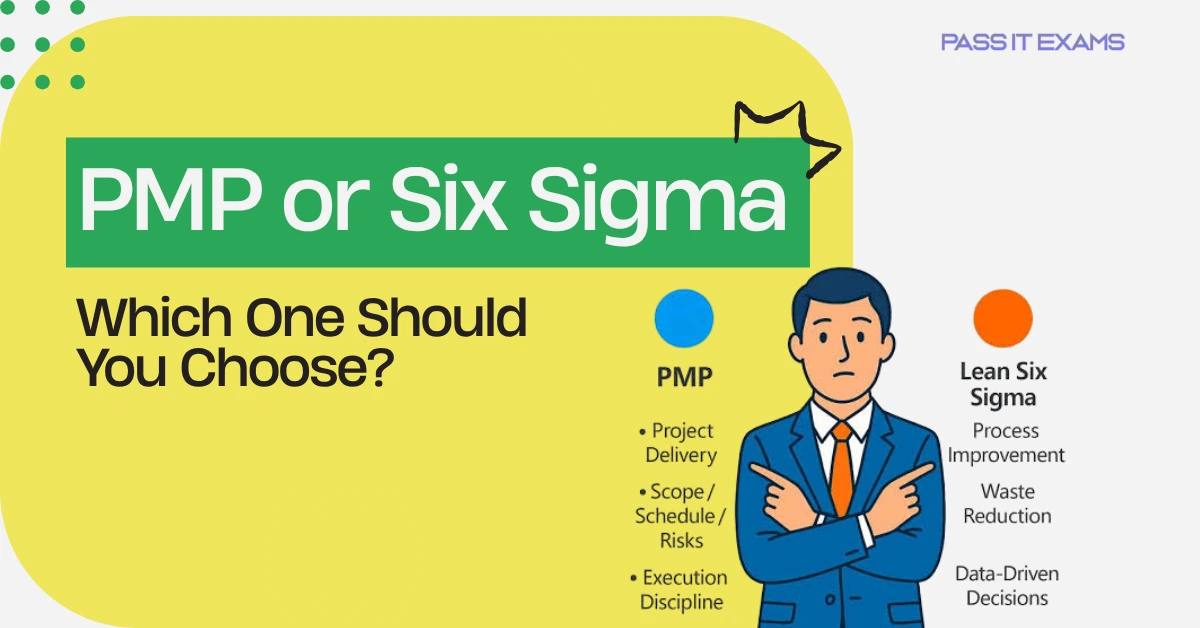
There is no single “better” certification between PMP and Six Sigma; the right choice depends entirely on what your job actually measures. If your work centers on leading teams, managing timelines, budgets, and stakeholders, PMP is the stronger fit. If your work centers on improving processes, reducing defects, and using data to eliminate waste, Six Sigma (or Lean Six Sigma) fits better. Many operations and engineering professionals eventually hold both, since the two skill sets complement rather than compete with each other.
What PMP Focuses On vs. What Six Sigma Focuses On
PMP (Project Management Professional), issued by the Project Management Institute (PMI), certifies your ability to plan, execute, and close out projects. It covers the full project lifecycle: scope definition, scheduling, budgeting, risk management, stakeholder communication, resource allocation, and team leadership. Following PMI’s 2026 exam update, the current exam blends predictive (traditional/waterfall), agile, and hybrid approaches, with heavier emphasis on real-world scenarios, business outcomes, and even AI-driven project tools rather than pure memorization.
PMP answers the question: “Can you take a project from kickoff to delivery, on time, on budget, with the right people doing the right things?“
Six Sigma, most commonly certified through ASQ (American Society for Quality) or IASSC (International Association for Six Sigma Certification), certifies your ability to reduce variation and defects in a process using statistical tools. It’s organized into “belts”; Yellow, Green, Black, and Master Black Belt; each representing a deeper level of statistical and leadership capability. The methodology most often used is DMAIC (Define, Measure, Analyze, Improve, Control), and many programs today are actually Lean Six Sigma, which folds in Lean’s waste-elimination principles alongside Six Sigma’s statistical rigor. When people search for “PMP vs Lean Six Sigma,” they’re usually comparing PMP against this same Green/Black Belt track, since Lean Six Sigma has largely become the default way the certification is taught.
Six Sigma answers a different question: “Is this process producing consistent, high-quality output, and if not, what data-driven change will fix it?”
The core distinction: PMP is about delivering a project. Six Sigma is about fixing or optimizing a process. A project has a start and end date; a process runs continuously. That single difference explains almost everything else about how these two credentials diverge.
Side-by-Side Comparison Table
| Category | PMP | Six Sigma (Green/Black Belt) |
|---|---|---|
| Core focus | Managing projects: scope, schedule, budget, stakeholders | Improving processes: reducing defects, variation, waste |
| Methodology | Predictive, Agile, and hybrid delivery frameworks (PMBOK Guide) | DMAIC, statistical process control, Lean tools |
| Best-fit roles | Project manager, program manager, PMO lead, technical/IT project manager | Process/quality engineer, operations manager, continuous-improvement lead |
| Best-fit industries | IT, construction, consulting, finance, virtually any project-driven org | Manufacturing, healthcare, logistics, supply chain, high-volume operations |
| Skills emphasized | Leadership, communication, risk management, scheduling, budgeting | Statistical analysis, root-cause analysis, data interpretation, process control |
| Governing body | PMI (Project Management Institute) | ASQ, IASSC, or employer-run programs (no single global authority) |
| Eligibility requirements | 36–60 months of project leadership experience + 35 contact hours of training | Green Belt: often none for IASSC; ASQ prefers ~3 years of relevant experience. Black Belt: 2 completed projects or ~3 years experience |
| Exam difficulty | High; scenario-heavy, 180 questions, roughly 4-hour exam | Moderate to high; Green Belt is accessible; Black Belt requires solid statistics (hypothesis testing, regression, control charts) |
| Typical cost (exam only) | $425 (PMI member) to $675 (non-member); rising to roughly 445/675 after PMI’s August 2026 fee change | Green Belt: 300–500 exam-only, 1,000–5,000 with training. Black Belt: 500–800 exam-only, 3,000–15,000 with training |
| Renewal | Every 3 years; 60 PDUs required | Generally no formal renewal (varies by certifying body) |
| U.S. salary impact | Median around 120,000–135,000; roughly 17–29% above non-certified peers, per PMI’s Earning Power Salary Survey | Green Belt averages roughly 85,000–120,000; Black Belt commonly 115,000–150,000+, per Salary.com and Glassdoor data |
| Global recognition | Extremely high; treated as the default standard for project management worldwide | Strong within operations/manufacturing/quality circles; less universally recognized outside those fields, and fragmented across certifying bodies |
Salary figures above are based on PMI’s Earning Power Salary Survey along with 2026 compensation data from Salary.com and Glassdoor; cost figures reflect PMI’s published exam fees (including the August 2026 fee change) and typical Green Belt/Black Belt training pricing reported by ASQ-affiliated and independent training providers. On the specific question of which certification pays more, PMP and Six Sigma, the honest answer is that they land in comparable pay bands at senior levels; PMP median pay tends to edge out Green Belt pay, but Black Belt compensation is competitive with PMP once you factor in industry and seniority. Because both figures vary by role, industry, and geography, treat the ranges as directional rather than exact.
Key Takeaways
- PMP is the better fit if you’re measured on delivery dates, budgets, and stakeholder outcomes.
- Six Sigma is the better fit if you’re measured on defect rates, process consistency, or cost-per-unit.
- Cost and entry barrier favor Six Sigma Green Belt as a faster, cheaper starting point than PMP.
- Salary ranges overlap significantly at senior levels; industry and role matter more than which credential you hold.
- PMP has one governing body and one exam; Six Sigma is split across ASQ, IASSC, and employer programs, so credibility varies by issuer.
- Holding both is common for engineers and operations leaders who move between process diagnosis and project execution.
When PMP Is the Better Choice
PMP tends to be the stronger pick if:
- Your job title already involves “project” or “program.” If you’re managing timelines, budgets, and cross-functional teams, PMP is the recognized industry credential for that work, and hiring managers actively screen for it.
- You work in IT, software, construction, consulting, or finance. These industries treat PMP as close to a baseline requirement for mid-to-senior project management roles.
- You want maximum name recognition. PMP is the most widely known project management certification globally, and it travels well across industries and countries; useful if you might change sectors later.
- You need agile and hybrid delivery skills, not just traditional waterfall. PMI has steadily rebuilt the exam to reflect how modern teams actually work, blending Agile, hybrid, and predictive approaches rather than assuming one methodology fits all projects.
- You want a faster path to a leadership title. PMP is commonly the gateway credential toward Program Manager, PMO Director, or Portfolio Manager roles.
If none of your daily work involves defect rates, process capability, or statistical control; and instead revolves around Gantt charts, stakeholder updates, and delivery deadlines; PMP is the clearer fit.
When Six Sigma (or Lean Six Sigma) Is the Better Choice
Six Sigma tends to be the stronger pick if:
- You work in manufacturing, healthcare, logistics, or any high-volume operational environment. These sectors live and die by defect rates, cycle times, and process consistency; exactly what Six Sigma is built to address.
- Your job involves analyzing data to find root causes. If you’re regularly asked “why is this process inconsistent?” rather than “how do we deliver this on time?”, Six Sigma’s statistical toolkit (control charts, hypothesis testing, regression, FMEA) is directly applicable in a way PMP’s toolkit isn’t.
- You want to demonstrate cost savings and efficiency gains. Six Sigma projects are typically tied to measurable financial impact; reduced defects, reduced cycle time, reduced waste; which resonates strongly with operations leadership.
- You’re already deep in a quality or continuous-improvement career track. Titles like Quality Engineer, Process Engineer, or Continuous Improvement Manager weight Six Sigma credentials heavily, sometimes more than PMP.
- You want a lower entry barrier to start. Green Belt certification, especially through IASSC, often has no formal experience requirement, making it more accessible than PMP for someone earlier in their career.
If your daily work is closer to “make this production line more consistent” than “deliver this initiative by the deadline,” Six Sigma is the better-aligned credential.
Can You Do Both? (Synergies)
Yes; and for a specific segment of professionals, holding both is genuinely valuable rather than redundant. PMP and Six Sigma don’t compete for the same explanation of your job; they cover two different halves of how improvement work actually happens in organizations.
Here’s the practical synergy: Six Sigma tells you what to fix and why, using data. PMP tells you how to organize the work to actually fix it, on schedule and within budget. A process-improvement initiative discovered through a DMAIC analysis still has to be planned, resourced, and delivered; that’s a project, and PMP skills are exactly what’s needed to execute it well.
This combination is common in:
- Manufacturing and operations leadership, where you need to both diagnose quality issues (Six Sigma) and run the improvement initiatives that fix them (PMP).
- Healthcare administration, where clinical process improvement (Six Sigma) often becomes a formal, budgeted project (PMP) once leadership signs off.
- Supply chain and logistics, where continuous improvement programs are typically run as a portfolio of discrete projects.
The usual sequencing advice: most people earn Six Sigma Green Belt first (lower cost, lower barrier, quick signal of process-improvement competence), then decide whether to pursue PMP once they’re managing multi-person initiatives, or Black Belt if they’re staying on the technical/statistical improvement track. Very few professionals need Master Black Belt and PMP unless they’re aiming for a senior operational-excellence leadership role.
Which One Should Engineers / Operations Professionals Choose?
This is where the two credentials most directly compete for the same audience, so it deserves a direct answer.
PMP or Six Sigma for Engineers?
Choose Six Sigma first if you’re an engineer or operations professional whose primary responsibility is process performance; throughput, defect rate, cycle time, yield. Green Belt is the natural entry point: it’s cheaper, faster to earn, and directly applicable to the analytical work you’re likely already doing informally.
Choose PMP first if you’re an engineer who has moved (or is moving) into a role managing other people’s work; coordinating cross-functional teams, owning budgets, or being accountable for delivery timelines rather than just technical output. This is a common transition point for senior engineers stepping into project or program leadership.
A useful rule of thumb: if your performance reviews mention “process” and “quality” more than “deadlines” and “budget,” start with Six Sigma. If it’s the reverse, start with PMP. If both show up equally, you’re likely a candidate for both credentials over time, and the order matters less than eventually having both.
One caution specific to engineers: don’t earn Black Belt purely for the credential if your role doesn’t actually involve running statistically rigorous improvement projects. The certification carries the most weight when it’s backed by real completed projects (which ASQ’s Black Belt track requires via affidavits); a credential with no supporting project history is a weaker signal to employers than a Green Belt you’ve actually used.
Final Recommendation Framework
Use this decision framework to cut through the noise:
- What does your job actually measure you on? Delivery dates and budgets → PMP. Defect rates, cycle times, cost-per-unit → Six Sigma.
- What industry are you in, or targeting? IT, construction, consulting, general corporate → PMP carries more weight. Manufacturing, healthcare operations, logistics → Six Sigma carries more weight.
- What’s your entry-level access right now? If you lack the 36–60 months of project leadership experience PMP requires, Six Sigma Green Belt is a faster, cheaper credential you can earn now; and it still builds relevant analytical skill.
- What’s your 5-year career target? Aiming for Program Manager, PMO Director, or general management → PMP is closer to mandatory. Aiming for Director of Operational Excellence, VP of Quality, or Master Black Belt roles → Six Sigma is the deeper track, though PMP still helps once you’re running large improvement portfolios.
- Budget and time available now. According to PMI, PMP is a single, defined cost (roughly 425–675 for the exam, plus prep) with a clear one-time path. Six Sigma costs vary widely by belt level and provider; Green Belt is often cheaper and faster than PMP; Black Belt with full training can run more expensive than PMP once you include coaching and project support.
If you only take one action after reading this: map the framework above against your actual job description, not your job title. Titles are inconsistent across companies; the day-to-day work you’re evaluated on is not.
Frequently Asked Questions FAQ’s
Is PMP harder than Six Sigma?
PMP’s exam is generally considered harder to pass on the first attempt, since it tests judgment across ambiguous, scenario-based questions rather than fixed formulas. Six Sigma Green Belt is comparatively accessible, but Black Belt introduces real statistical rigor; hypothesis testing, regression, design of experiments; that can rival PMP’s difficulty for non-quantitative professionals.
Which certification pays more, PMP or Six Sigma?
According to PMI’s salary survey, PMP holders in the U.S. report a median salary of 120,000–135,000, about 17–29% above non-certified peers. Six Sigma Black Belts report similar territory (115,000–150,000+, per Salary.com and Glassdoor), with Green Belts lower (85,000–120,000). At senior levels, both land in comparable pay bands.
Do I need work experience for either certification?
PMP requires a four-year degree with 36 months of project leadership experience, or a high school diploma/associate degree with 60 months, plus 35 hours of formal training. Six Sigma requirements vary by body: IASSC generally has none, while ASQ prefers around 3 years of experience for Green Belt and requires completed projects for Black Belt.
Can a beginner start with Six Sigma instead of PMP?
Yes. Six Sigma Yellow or Green Belt, especially through IASSC, has no formal experience requirement, making it more accessible than PMP for early-career professionals. It’s a reasonable way to build a credential and analytical skill set while accumulating the project experience PMP eventually requires.
Is Lean Six Sigma different from regular Six Sigma?
Yes. Lean Six Sigma combines traditional Six Sigma’s statistical, defect-reduction focus with Lean’s waste-elimination principles from Toyota’s production system. Most Six Sigma training today is actually branded Lean Six Sigma, since the two methodologies are commonly taught together rather than as separate tracks.
Does PMP expire?
Yes. PMP must be renewed every three years by earning 60 Professional Development Units (PDUs) through continuing education and professional activity. Six Sigma certifications generally carry no formal renewal requirement, though this varies by the certifying body (ASQ, IASSC, or employer-run programs).
Should I get both certifications at the same time?
Generally no. Most professionals earn them sequentially, since each demands distinct study focus; leadership frameworks for PMP versus statistical tools for Six Sigma. A common path is Six Sigma Green Belt first, then PMP once managing larger initiatives, or Black Belt if staying on the technical improvement track.
For a broader look at whether a professional certification is worth the cost and time for your specific career stage, see our Is a Certification Worth It? decision hub. To go deeper on each credential individually, see our complete PMP certification guide covering eligibility, exam prep, and renewal, and our Six Sigma and Lean Six Sigma certification guide covering belt levels, ASQ vs. IASSC, and training costs.
