
If you are looking to advance your career in quality management, process improvement, or operational excellence, obtaining a Six Sigma or Lean Six Sigma certification is one of the highest-ROI decisions you can make. However, unlike IT certifications from specific vendors like Microsoft or Cisco, there is no single, centralized governing body that owns “Six Sigma.”
Because multiple independent organizations offer credentials, the Six Sigma certification requirements can be incredibly confusing. Depending on where you apply, you might need years of professional experience and signed project affidavits, or you might only need to pass a single multiple-choice exam.
This comprehensive guide breaks down the exact prerequisites, work experience mandates, and exam rules for every Six Sigma belt level across the industry’s top certifying bodies in 2026.
What are the Basic Requirements?
Six Sigma certification requirements depend entirely on the belt level and the organization issuing the credential. Lower belts (White and Yellow) have no prerequisites. Mid-level and advanced belts (Green, Black, and Master Black) typically require a combination of full-time work experience (1 to 5 years), successful completion of real-world DMAIC projects, and a passing score on a comprehensive final exam.
Why Do Six Sigma Certification Requirements Vary?
To navigate your certification journey, you must first understand the landscape. Because Six Sigma is a methodology (like Agile or DevOps) rather than a trademarked software product, any organization can technically issue a certificate. Over the decades, a few globally recognized accreditation bodies have emerged, but they operate on fundamentally different philosophies:
- Experiential/Project-Based: Organizations like the American Society for Quality (ASQ) believe you cannot be certified in Six Sigma unless you have physically proven you can use it to save a company money. They require strict proof of past projects and full-time employment.
- Knowledge-Based: Organizations like the International Association for Six Sigma Certification (IASSC) believe certification should test your mastery of the theoretical Body of Knowledge (BoK). They require no past experience, but their closed-book exams are exceptionally rigorous.
Choosing the right path depends on your current job status, your access to corporate financial data (to run a project), and your ultimate career goals.
Requirements by Belt Level: From White to Master Black Belt
Regardless of the accrediting body you choose, the Six Sigma hierarchy is standardized into martial arts-style belts. Here are the general industry expectations and requirements for each tier.
1. White Belt Requirements
The White Belt is a purely foundational, awareness-level credential. It is designed for entry-level staff or executives who simply need to understand the basic vocabulary of Six Sigma without leading projects.
- Work Experience: None required.
- Project Requirements: None required.
- Exam: A brief, basic multiple-choice assessment (often free).
2. Yellow Belt Requirements
Yellow Belts act as subject matter experts (SMEs) and data-gatherers who support Green and Black Belts on active projects.
- Work Experience: None required.
- Project Requirements: None required.
- Exam: A foundational exam covering basic data collection, process mapping (SIPOC), and root cause analysis concepts (e.g., Fishbone diagrams).
3. Green Belt Requirements
The Green Belt is where professional requirements become strict. Green Belts lead department-level projects while maintaining their normal job duties.
- Work Experience (ASQ): Requires three years of full-time, paid work experience in one or more areas of the Green Belt Body of Knowledge. Internships and part-time jobs do not count.
- Work Experience (IASSC): No prerequisites.
- Project Requirements: Depending on the provider, you may need to submit proof of a completed continuous improvement project.
4. Black Belt Requirements
Black Belts are full-time process improvement experts who lead complex, cross-functional projects and mentor Green Belts. The Six Sigma certification requirements at this level are highly rigorous.
- Work Experience (ASQ): Requires three years of full-time work experience.
- Project Requirements (ASQ): You must submit a signed affidavit proving the completion of two Six Sigma projects. Alternatively, you can submit one completed project if you also have three years of relevant work experience.
- Work Experience/Projects (IASSC): No prerequisites, but candidates are heavily advised to have practical experience due to the extreme difficulty of the exam.
5. Master Black Belt Requirements
Master Black Belts (MBB) are strategic leaders who design the organization’s quality strategy and manage the Six Sigma portfolio.
- Prerequisites: You must hold an active Black Belt certification.
- Work Experience: Usually requires a minimum of five years acting in a Black Belt role.
- Project Requirements: Requires a portfolio demonstrating the successful completion of 10 or more significant Black Belt projects, plus proof of coaching/training lower belts.
The Big Three: ASQ vs. IASSC vs. CSSC Requirements
To make an informed decision, you must compare the specific rules of the top three global accrediting bodies.
| Feature | ASQ (American Society for Quality) | IASSC (Intl. Association for Six Sigma Certification) | CSSC (Council for Six Sigma Certification) |
|---|---|---|---|
| Philosophy | Experiential (Theory + Proven Application) | Knowledge-Based (Strict Theory) | Flexible (Offers both pathways) |
| Green Belt Prerequisites | 3 years full-time experience. | None. | None for standard; Project required for Level II. |
| Black Belt Prerequisites | 3 years experience + 1 project, OR 2 projects. | None. | None for standard; Project required for Level II. |
| Exam Format | Open-book (physical notes only), Proctored. | Closed-book, Proctored. | Open-book, non-proctored, self-paced. |
| Best Suited For | Manufacturing, engineering, and corporate professionals. | Consultants, IT professionals, and students. | Those seeking an affordable, highly flexible option. |
Understanding Work Experience and Project Affidavits
For professionals pursuing the prestigious ASQ certification path, understanding what qualifies as “experience” and “projects” is the biggest hurdle.
What Counts as Work Experience?
To meet the ASQ requirements for Green or Black Belts, your work experience must be:
- Full-Time and Paid: Internships, co-ops, volunteer work, and part-time positions are strictly excluded.
- Relevant to the BoK: Your job duties must align with the Six Sigma Body of Knowledge. You do not need the title of “Quality Engineer,” but your role must involve data analysis, process monitoring, quality assurance, or project management.
What is a Project Affidavit?
A project affidavit is a legal document verifying that you successfully led a Six Sigma project.
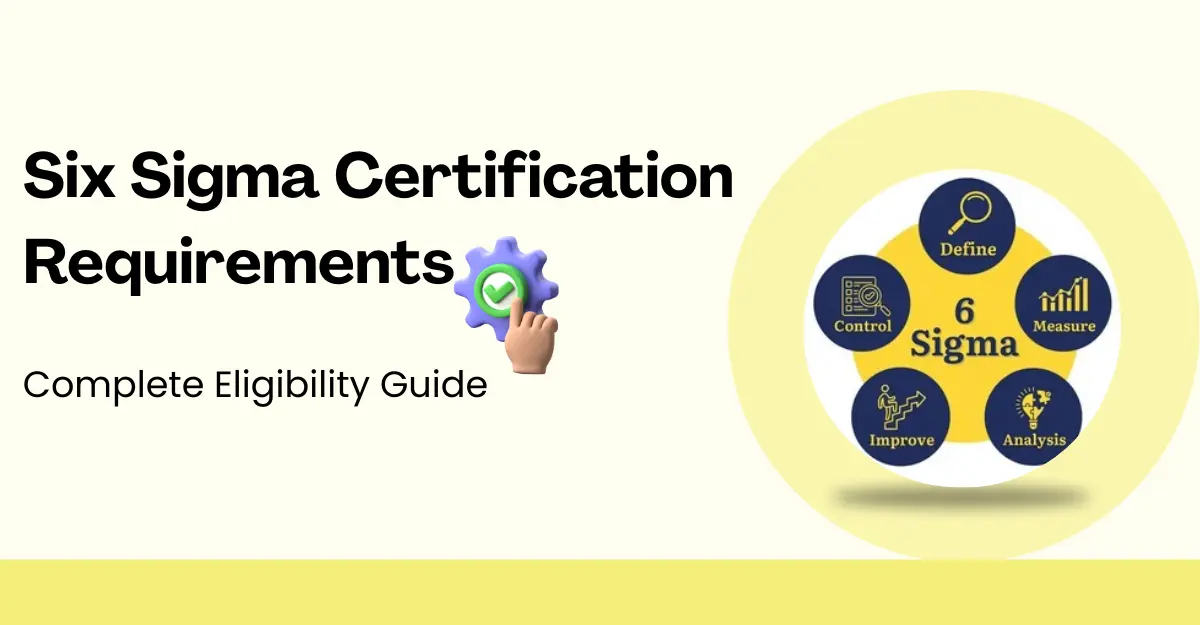
- It must follow the DMAIC methodology (Define, Measure, Analyze, Improve, Control).
- It must show measurable results (e.g., “Reduced shipping defects by 14%, saving $45,000 annually”).
- It must be signed by a Project Champion (usually an executive or upper-level manager at your company) who can verify your claims and the financial impact.
Exam Formats, Passing Scores, and Body of Knowledge
Meeting the application requirements is only half the battle. You must still pass the certification exam, which tests your mastery of the Body of Knowledge (BoK).
1. The Open-Book vs. Closed-Book Divide
- ASQ Exams are Open-Book: However, this is a trap for unprepared candidates. The questions are incredibly complex and scenario-based. If you have to look up the formula for a two-sample T-test during the exam, you will run out of time. Furthermore, all reference materials must be bound (no loose papers) and electronic devices are prohibited.
- IASSC Exams are Closed-Book: You must memorize all formulas, control chart rules, and lean definitions.
2. The Exam Content (What You Must Know)
Regardless of the body, advanced exams require a deep understanding of:
- Applied Statistics: Probability distributions, hypothesis testing (ANOVA, Chi-Square), and regression analysis.
- Measurement System Analysis (MSA): Gage R&R studies to ensure data integrity.
- Process Control: Calculating Cp and Cpk, and implementing Statistical Process Control (SPC) charts.
- Lean Tools: 5S, Kanban, Value Stream Mapping, and the 8 Wastes.
3. Passing Scores
Most Six Sigma exams require a minimum passing score of 70%. Exams range from 100 questions (Green Belt) to 165 questions (ASQ Black Belt), taking between 3 and 4.5 hours to complete.
Validity and Recertification Requirements
Once you meet all the Six Sigma certification requirements and pass the exam, you must maintain your credential.
Do Six Sigma Certifications Expire?
- ASQ: Yes. Green, Black, and Master Black Belts must be renewed every three years. You must earn 18 Recertification Units (RUs) by attending conferences, taking courses, or completing new projects. If you fail to earn the RUs, you must retake the exam.
- IASSC: No. IASSC certifications are considered valid for life. However, they do offer an optional recertification process for professionals who want to demonstrate their skills are current, which involves taking an abbreviated exam every three years.
- CSSC: No. Certifications issued by the Council for Six Sigma Certification do not expire and require no renewal fees.
How to Prepare to Meet the Certification Requirements
Because the exams are statistically heavy and the application process requires attention to detail, candidates must prepare systematically.
- Audit Your Experience Early: Before buying a study guide, review the ASQ or IASSC requirements. If you do not have three years of full-time experience, do not apply for ASQ; choose the IASSC path instead.
- Secure a Project Champion: If your path requires a project affidavit, secure executive buy-in at your current workplace before you start studying. Ensure your company will allow you to share high-level (sanitized) financial data to prove your project’s success.
- Master the Statistical Software: Advanced exams assume you know how to interpret outputs from statistical software. While you won’t use software during a closed-book exam, understanding how tools like Minitab or SigmaXL generate P-values is critical for the project requirements.
- Use Authentic Practice Materials: The number one reason candidates fail Six Sigma exams is the format of the questions. They are deeply scenario-based (e.g., “Given this dataset and a non-normal distribution, which non-parametric test should the Black Belt apply?”).
To bridge the gap between reading a textbook and passing a grueling 4-hour exam, leveraging highly accurate practice tests is non-negotiable. Whether you are expanding your process improvement skills or integrating them with IT frameworks, using reliable study guides and authentic practice tests from platforms like PassITExams ensures you are ready. PassITExams provides the rigorous, scenario-based preparation needed to build your confidence, identify your weak points in statistical analysis, and ensure you pass on your first attempt.
FAQ’s: Six Sigma Eligibility and Prerequisites
Can I jump straight to the Black Belt without getting a Green Belt?
Yes. Neither ASQ nor IASSC strictly mandate that you hold a Green Belt before testing for a Black Belt. However, the Black Belt exam assumes you have already mastered Green Belt statistics. If you do not have a strong background in data analysis, skipping the Green Belt is highly discouraged.
Does a college degree count toward the work experience requirement?
For ASQ, a degree can waive a portion of the experience requirement for some certifications, but generally, for the Green and Black Belt, strict full-time, paid work experience is required. Educational waivers are rarely granted for the Six Sigma Black Belt.
What if my company won’t let me share project data for the affidavit?
ASQ understands corporate confidentiality. You are allowed to sanitize the data (e.g., using percentages instead of exact dollar amounts, or labeling products as “Product X”). The accrediting body only needs to see the methodology applied and the signed verification from your Champion.
Are Six Sigma requirements the same as Lean Six Sigma requirements?
Essentially, yes. Lean focuses on waste reduction, while Six Sigma focuses on defect reduction. Most modern certifying bodies (including IASSC and CSSC) test a combined “Lean Six Sigma” Body of Knowledge. ASQ offers standard Six Sigma belts but incorporates heavy Lean principles into the exams.
How much does it cost to get certified?
In 2026, exam fees typically range from $295 to $350 for a Green Belt, and $395 to $500 for a Black Belt, depending on the provider and whether you are a registered member of their organization.
Do I need to be a math genius to meet the requirements?
No, but you must be comfortable with high-school-level algebra and understand the concepts behind probability and statistics. You don’t need to manually calculate a complex regression curve, but you must know when to use it and how to interpret the software’s output.
Conclusion and Next Steps
Understanding the Six Sigma certification requirements is the essential first step in planning your career progression. Whether you choose the strict, project-proven path of the ASQ or the rigorous, theory-tested path of the IASSC, earning a Six Sigma credential proves to employers that you possess the elite analytical skills needed to drive operational excellence.
Determine which accrediting body aligns with your current work experience, secure your project champion if necessary, and begin mastering the DMAIC framework.As you advance in your career, you will likely find that process improvement heavily overlaps with IT infrastructure, cybersecurity, and cloud management.
Employers highly value professionals who pair a Six Sigma Black Belt with elite IT credentials (such as AWS Solutions Architect, CompTIA Security+, or Cisco networking certs). When you are ready to tackle these complementary technical exams, integrating high-quality practice materials and verified exam dumps from PassITExams into your study routine will protect your budget, save you weeks of study time, and ensure you achieve certification success on your first try.
