

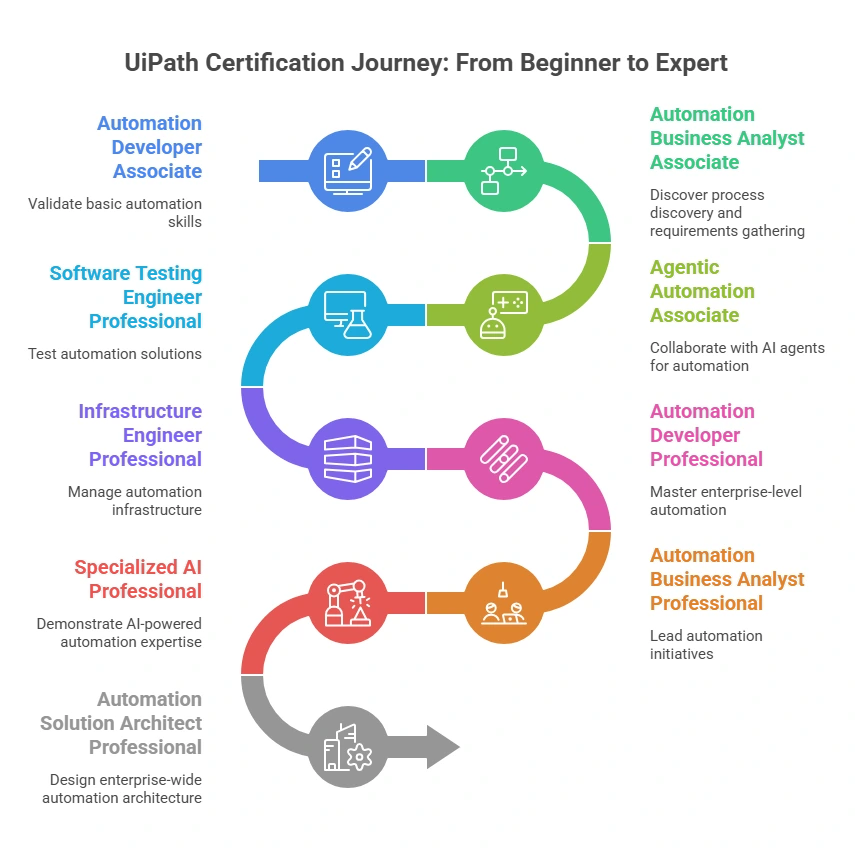
The UiPath certification path offers structured progression routes across five career tracks: Development, Business Analysis, Specialized AI, Testing, and Infrastructure. Each track features Associate-level entry points leading to Professional-level credentials, with clear prerequisites and recommended experience levels.
This guide maps the complete certification journey, showing which credentials to pursue based on your role, how to progress from beginner to expert, and proven multi-certification strategies that maximize career impact.
What Is the UiPath Certification Path?
UiPath structures its certifications around real-world automation roles rather than generic skill levels. The certification path follows a two-tier system:
- Associate Level: Entry-point certifications validating foundational skills. Minimal experience required.
- Professional Level: Advanced certifications demonstrating production-ready expertise. Typically require 6+ months hands-on experience.
Within this structure, UiPath offers five distinct career tracks:
- Automation Developer Track – Core RPA development skills
- Business Analyst Track – Process discovery and requirements
- Specialized AI Track – Document Understanding and Communications Mining
- Testing Track – Test automation with UiPath Test Cloud
- Infrastructure Track – Platform deployment and maintenance
Additionally, cross-functional certifications like Solution Architect Professional and Agentic Automation Associate serve professionals who span multiple roles.
Understanding UiPath Certification Tracks
Each track addresses specific job functions within an automation Center of Excellence. Understanding these tracks helps you choose the right starting point and progression route.
| Track | Entry Certification | Advanced Certification | Typical Career Goal |
|---|---|---|---|
| Developer | Automation Developer Associate | Automation Developer Professional | Senior RPA Developer, Team Lead |
| Business Analysis | Automation Business Analyst Associate | Automation Business Analyst Professional | Senior BA, CoE Lead |
| Specialized AI | Specialized AI Associate | Specialized AI Professional | AI Automation Specialist |
| Testing | None (begins at Professional) | Software Testing Engineer Professional | Test Automation Lead |
| Infrastructure | None (begins at Professional) | Infrastructure Engineer Professional | DevOps Engineer, Infrastructure Lead |
| Cross-Functional | Agentic Automation Associate | Automation Solution Architect Professional | Solution Architect, Enterprise Architect |
Most professionals begin with either the Developer or Business Analyst track, then add specialized credentials as their career evolves.
Entry-Level Certification Paths by Role
Your first certification should align with your current role and immediate career goals. Here are the recommended entry points:
For Technical Professionals (Developers, Engineers)
Best Starting Point: Automation Developer Associate
This certification validates ability to design simple automation solutions using UiPath Studio, Robots, and Orchestrator. No prerequisites required, but UiPath recommends completing the free Automation Developer Associate training on UiPath Academy.
Time Investment: 40-80 hours of preparation for beginners.
Next Steps After Passing:
- Gain 6+ months hands-on development experience
- Progress to Automation Developer Professional
- Consider adding Specialized AI Associate for AI capabilities
For Business Professionals (Analysts, Project Managers)
Best Starting Point: Automation Business Analyst Associate
This certification covers process discovery, requirements gathering, and automation design without requiring deep technical skills. Ideal for business analysts, project managers, and CoE leads.
Time Investment: 30-60 hours of preparation with business process background.
Next Steps After Passing:
- Build 6+ months experience in automation projects
- Progress to Automation Business Analyst Professional
- Consider Agentic Automation Associate to understand AI agents
For Mixed Technical/Business Roles
Best Starting Point: Agentic Automation Associate
Launched in 2026, this certification validates skills in collaborating with AI agents for automation. Suitable for both technical and non-technical professionals exploring how AI agents enhance workflows.
Unique Advantage: No prior automation experience required.
Time Investment: 15-30 hours using the UiPath Studio Web training path.
Next Steps After Passing:
- Depending on your role, add either Developer Associate or Business Analyst Associate
- Progress to Professional-level certifications in your chosen track
For Experienced Professionals Entering Automation
If you have significant experience in testing, infrastructure, or architecture but are new to UiPath:
- Testing Background: Software Testing Engineer Professional (no Associate level exists for this track)
- Infrastructure Background: Infrastructure Engineer Professional (no Associate level exists)
- Architecture Background: Complete Automation Developer Associate first, then progress toward Solution Architect Professional
Developer Track: Complete Progression Path
The Developer track is the most popular certification path, serving as foundation for multiple advanced roles.
Step 1: Automation Developer Associate
What You’ll Validate:
- Ability to independently design simple automation solutions
- Productive contribution to automation teams
- Understanding of UiPath Studio, Robots, and Orchestrator basics
Prerequisites: None (though UiPath Academy training strongly recommended).
Exam Details:
- Duration: 90 minutes
- Fee: $150
- Question types: Multiple choice, drag-and-drop, lab simulations
Recommended Preparation:
- Complete UiPath Academy’s Automation Developer Associate learning plan (free)
- Build 3-5 practice automation projects
- Take the official practice test
- Schedule exam when consistently scoring 75%+ on practice tests
Step 2: Gain Hands-On Experience (6+ Months)
Before attempting Professional-level certification, accumulate real-world experience:
- Build production-ready automations using the Robotic Enterprise Framework (REFramework)
- Work with Orchestrator queues and triggers
- Handle exception management and logging
- Debug complex workflows
- Collaborate on team automation projects
This experience is not formally required, but Professional exams assume this knowledge depth.
Step 3: Automation Developer Professional
What You’ll Validate:
- Proven understanding and extensive hands-on experience with UiPath technologies
- Ability to independently build or lead production-level automations in REFramework
- Advanced skills in UI automation, data manipulation, and Orchestrator integration
Prerequisites: None formally required, but candidates typically hold Developer Associate and have 6+ months experience.
Exam Details:
- Duration: 120 minutes
- Fee: $300
- Significantly harder than Associate level with complex lab scenarios
Key Topics:
- Robotic Enterprise Framework (REFramework) mastery
- Advanced UI automation techniques
- Complex data manipulation
- AI Computer Vision
- Remote debugging
- Coded automation
- Orchestrator triggers and queues
Recommended Preparation:
- Complete UiPath Academy’s Automation Developer Professional learning plan (90+ hours)
- Build multiple enterprise-level automations using REFramework
- Master all exam topics through hands-on practice
- Take the official practice test multiple times
- Schedule when scoring 80%+ consistently
Optional: Add Specialized AI Professional
After achieving Developer Professional, many developers add the Specialized AI Professional certification to demonstrate expertise in AI-powered automation.
Why Add This:
- Validates Document Understanding and Communications Mining skills
- Positions you for higher-value projects involving intelligent document processing
- Increasingly important as automation incorporates more AI capabilities
Prerequisite:
At least Associate-level certification in the Developer track (which you already have).
Advanced Option: Automation Solution Architect Professional
The ultimate Developer track progression leads to Solution Architect Professional, which validates:
- Automation architecture design
- Enterprise technology integration
- Strategic automation planning
- End-to-end business process automation
Prerequisites: While not formally required, candidates typically need:
- Multiple years of automation experience
- Developer Professional certification
- Experience designing complex automation solutions across multiple applications and environments
This represents 3-5+ years of career progression from Developer Associate.
Business Analyst Certification Pathway
The Business Analyst track serves professionals who bridge business needs and technical solutions.

Step 1: Automation Business Analyst Associate
Target Roles: Business analysts, project managers, CoE leads, transformation managers entering automation.
What You’ll Validate:
- Process discovery techniques
- Requirements documentation
- Process analysis and optimization
- Automation solution design with UiPath products
Exam Details:
- Duration: 90 minutes
- Fee: $150
Recommended Background: 2+ years of business analysis experience (though not formally required).
Step 2: Build Automation Project Experience
Work on automation initiatives in roles such as:
- Business analyst supporting automation teams
- Project manager overseeing RPA implementations
- CoE lead managing automation pipelines
- Change manager facilitating automation adoption
Target: 6-12 months of hands-on involvement in automation projects.
Step 3: Automation Business Analyst Professional
What You’ll Validate:
- Advanced requirements gathering skills
- Complex process discovery and analysis
- Solution design using UiPath Suite
- Automation implementation planning
Prerequisites: None formally, but candidates preferably complete UiPath Academy training and optionally hold Associate-level Developer certification.
Exam Details:
- Duration: 90 minutes
- Fee: $300
Recommended Preparation: Complete the Business Analyst Professional learning path (40-60 hours) after gaining project experience.
Career Progression Option
Business Analysts often pursue multi-certification strategies:
Common Path: Business Analyst Associate → Business Analyst Professional → Agentic Automation Associate → Solution Architect Professional
This progression builds comprehensive skills bridging business strategy and technical execution.
Specialized AI Certification Pathway
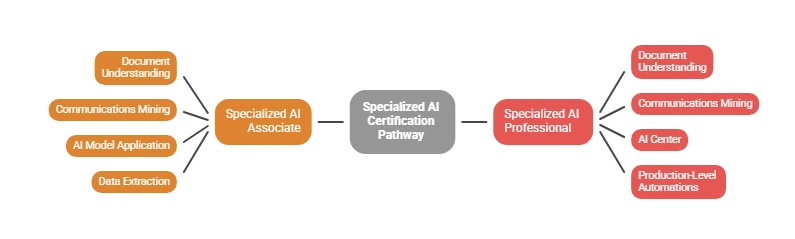
The Specialized AI track validates expertise in AI-powered automation using Document Understanding and Communications Mining.
Step 1: Specialized AI Associate
Who Should Start Here:
- Developers with basic AI and automation experience
- Professionals working with document processing
- Automation developers expanding into intelligent document processing (IDP)
What You’ll Validate:
- Document Understanding basics
- Communications Mining fundamentals
- AI model application in automation
- Data extraction and classification
Prerequisites: Essential understanding of AI and process automation development (recommended but not enforced).
Exam Details:
- Duration: 90 minutes
- Fee: $150
Step 2: Specialized AI Professional
Prerequisites: At least Associate-level certification in the Developer track (Developer Associate or Specialized AI Associate).
What You’ll Validate:
- Extensive hands-on experience with Document Understanding, Communications Mining, and AI Center
- Ability to independently build and lead AI-powered production-level automations
- Advanced intelligent document processing capabilities
Exam Details:
- Duration: 120 minutes
- Fee: $300
Recommended Experience: 6+ months working specifically with UiPath AI technologies.
Typical Career Path:
Automation Developer Associate → Specialized AI Associate → Automation Developer Professional → Specialized AI Professional
This creates a powerful credential combination for roles like AI Automation Specialist or Senior RPA Developer with AI expertise.
Testing and Infrastructure Paths
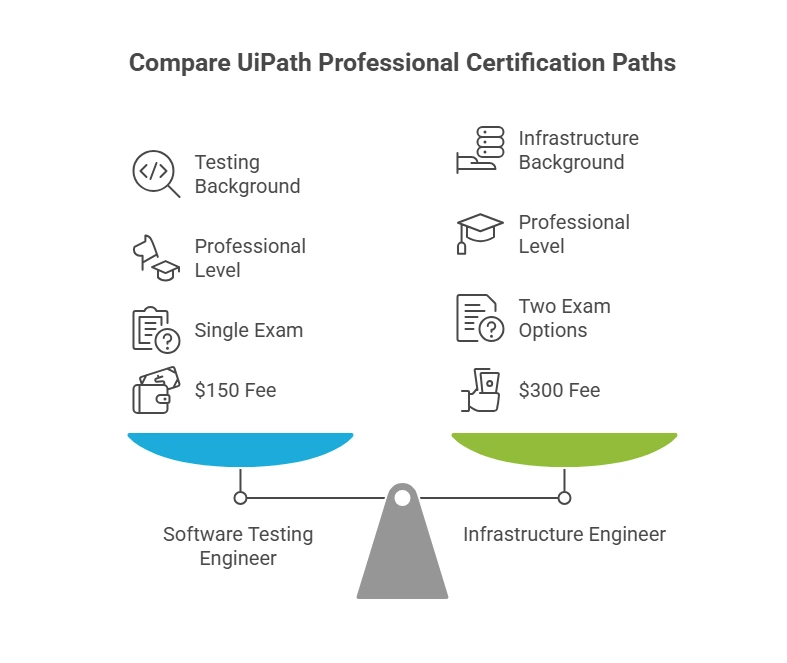
These specialized tracks begin at Professional level without Associate entry points.
Software Testing Engineer Professional Path
Entry Requirements:
- Testing background or automation development experience
- Understanding of test automation principles
- Familiarity with UiPath Test Cloud (formerly Test Suite)
Standalone Certification: No prerequisite certifications formally required.
Preparation:
- Complete the Software Testing Engineer Professional learning plan (22+ hours)
- Build experience with UiPath Test Cloud
- Understand CI/CD pipeline integration
Exam Details:
- Duration: 90 minutes
- Fee: $150 (despite being Professional-level)
Career Integration: Many Automation Developers add this certification to offer comprehensive development and testing capabilities.
Infrastructure Engineer Professional Path
Two Exam Options:
Option 1: Automation Suite Track (Linux)
- Single exam covering Automation Suite deployment on Linux
- Multi-node and single-node configurations
- High availability setups
- Fee: $300
Option 2: Standalone Track (Windows)
- Two-part exam (Part 1 and Part 2)
- Windows-based enterprise automation infrastructure
- Fee: $300 per part ($600 total)
Entry Requirements:
- Infrastructure engineering or DevOps background
- Experience with Linux (Automation Suite) or Windows (Standalone) environments
- Understanding of enterprise software deployment
No Prerequisite Certifications Required
This track serves infrastructure engineers, DevOps professionals, and system administrators managing UiPath platforms at enterprise scale.
Multi-Certification Career Strategies
Professionals pursuing leadership or specialized roles often hold multiple UiPath certifications. Here are proven multi-certification strategies:

Strategy 1: Full-Stack Automation Professional
Progression:
- Automation Developer Associate
- Automation Developer Professional
- Specialized AI Professional
- Software Testing Engineer Professional
Career Target: Senior RPA Developer capable of handling development, AI integration, and testing.
Time Investment: 18-24 months from start to completion.
Salary Impact: Professionals with 3+ certifications report 20-40% higher compensation than single-certification holders.
Strategy 2: Solution Architect Path
Progression:
- Automation Developer Associate
- Automation Business Analyst Associate
- Automation Developer Professional
- Specialized AI Professional
- Automation Solution Architect Professional
Career Target: Enterprise Solution Architect designing large-scale automation implementations.
Time Investment: 3-5 years including required hands-on experience.
Why This Works: Combines technical depth (Developer track) with business understanding (BA track) and architectural thinking (Solution Architect).
Strategy 3: CoE Leadership Path
Progression:
- Agentic Automation Associate
- Automation Business Analyst Associate
- Automation Business Analyst Professional
- Automation Solution Architect Professional
Career Target: Center of Excellence Lead managing automation programs.
Time Investment: 2-3 years.
Rationale: Business Analyst credentials validate process expertise while Solution Architect demonstrates strategic thinking needed for program leadership.
Strategy 4: AI Automation Specialist
Progression:
- Automation Developer Associate
- Specialized AI Associate
- Automation Developer Professional
- Specialized AI Professional
Career Target: AI-focused automation professional specializing in intelligent document processing and communications mining.
Time Investment: 18-24 months.
Market Demand: High demand for professionals combining RPA and AI capabilities.
Prerequisites and Experience Requirements by Certification
Understanding what’s truly required versus recommended helps you plan your path effectively.
| Certification | Formal Prerequisites | Recommended Experience | Typical Preparation Time |
|---|---|---|---|
| Agentic Automation Associate | None | None | 15-30 hours |
| Automation Developer Associate | None | None (basic programming helpful) | 40-80 hours |
| Automation Business Analyst Associate | None | 2+ years business analysis | 30-60 hours |
| Specialized AI Associate | None | Some AI/automation experience | 40-70 hours |
| Automation Developer Professional | None | 6+ months RPA development | 80-120 hours |
| Automation Business Analyst Professional | None | 6-12 months automation projects | 40-80 hours |
| Specialized AI Professional | Associate-level Developer cert | 6+ months with UiPath AI tools | 60-100 hours |
| Solution Architect Professional | None | Multiple years, multiple certs | 80-150 hours |
| Software Testing Engineer Professional | None | Testing or development background | 40-70 hours |
| Infrastructure Engineer Professional | None | Infrastructure/DevOps experience | 50-90 hours per exam |
Key Insight: While UiPath keeps formal prerequisites minimal, the Professional-level exams are designed with the assumption that you have the recommended experience. Attempting Professional certifications without adequate hands-on practice typically results in failure.
How to Plan Your UiPath Certification Journey
Follow these steps to create your personalized certification roadmap:

Step 1: Identify Your Starting Role
Determine which track aligns with your current position:
- Software developer / IT professional → Developer track
- Business analyst / project manager → Business Analyst track
- Testing professional → Testing track
- Infrastructure engineer → Infrastructure track
- Mixed role or new to automation → Agentic Automation Associate
Step 2: Set Your Career Goal (12-36 Months Out)
Define where you want to be:
- Senior RPA Developer
- Solution Architect
- CoE Lead
- AI Automation Specialist
- Enterprise Architect
Step 3: Map the Required Certifications
Work backward from your goal to identify which certifications you need.
Example: Goal is Solution Architect
- Required: Solution Architect Professional
- Foundation: Developer Professional + Business Analyst Professional (or similar combination)
- Entry: Developer Associate + Business Analyst Associate
Step 4: Create a Timeline
Space certifications realistically:
- Allow 2-4 months between Associate and Professional in same track
- Build in hands-on experience periods
- Account for exam preparation time
- Plan retakes if needed (budget 2-week wait periods)
Sample 24-Month Timeline:
- Months 1-2: Prepare for and pass Developer Associate
- Months 3-8: Hands-on development work (build experience)
- Months 9-11: Prepare for and pass Developer Professional
- Months 12-17: Continue development + study Business Analyst Professional
- Months 18-19: Pass Business Analyst Professional
- Months 20-24: Prepare for and pass Solution Architect Professional
Step 5: Leverage Free Resources
UiPath Academy provides everything needed:
- Role-based learning paths
- Video courses
- Hands-on exercises
- Practice tests
- Assessment quizzes
Commit to completing recommended learning paths before scheduling exams.
Step 6: Build Practical Experience Concurrently
Don’t just study—build real automations:
- Use UiPath Community Edition (free)
- Automate personal tasks
- Volunteer for automation projects at work
- Contribute to UiPath Community Forum
Hands-on practice accelerates learning and prepares you for lab-based exam questions.
Common Mistakes to Avoid
- Rushing to Professional Level
Attempting Professional certifications without adequate experience wastes money and damages confidence. Build the recommended 6+ months of hands-on practice first.
- Ignoring Prerequisites for Specialized AI Professional
You must hold at least Associate-level Developer certification before attempting Specialized AI Professional. Verify prerequisites before scheduling.
- Choosing Too Many Tracks Simultaneously
Focus on depth in one track before adding breadth. Master Developer or Business Analyst track completely before branching into multiple specializations.
- Skipping UiPath Academy Training
The free learning paths are specifically designed to prepare you for exams. Skipping them means missing critical knowledge and practice opportunities.
- Not Building a Learning Portfolio
Document your automation projects, share them on GitHub, and maintain a portfolio. This demonstrates practical skills to employers beyond just certification badges.
- Letting Certifications Expire
UiPath certifications expire after three years. Plan recertification timelines to maintain active credentials, especially if you hold multiple certifications.
Training Resources for Each Path
- UiPath Academy (Free – Primary Resource)
Access comprehensive training for all certification paths:
- Automation Developer Associate Training (40+ hours)
- Automation Developer Professional Training (90+ hours)
- Business Analyst Professional Training (40+ hours)
- Specialized AI Professional Training (60+ hours)
- Solution Architect Professional Training (80+ hours)
- Software Testing Engineer Professional Training (22+ hours)
- UiPath Community Forum
Ask questions, review discussions, learn from certified professionals. Active community with thousands of automation practitioners.
- Official Practice Tests (Free)
UiPath provides official practice tests for each certification. Take these multiple times until you consistently score 75-80%+.
- UiPath Product Documentation
Comprehensive technical documentation covering all UiPath products. Essential reference during both preparation and real-world work.
- Third-Party Resources
Platforms like Udemy, LinkedIn Learning, and Pearson offer supplemental courses. Verify they align with current UiPath product versions (platform updates frequently).
- UiPath Community Certification Framework Program
Limited-availability program offering free comprehensive training and certification resources. Check UiPath Community for enrollment periods.
Career Impact of Following the Certification Path
Following a structured certification path delivers measurable career benefits:
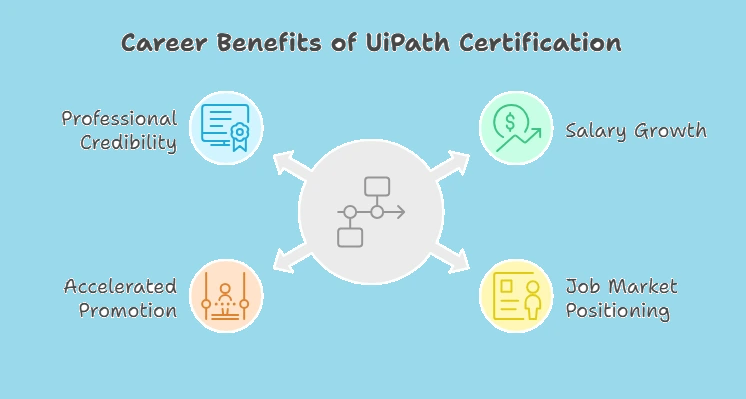
Salary Growth
Industry data shows certified UiPath professionals earn 10-30% more than non-certified counterparts at similar experience levels. Multi-certified professionals see even higher premiums.
Job Market Positioning
Many automation positions now require or strongly prefer UiPath certification. Following a complete certification path positions you for:
- RPA Developer roles ($65,000-$120,000)
- Senior RPA Developer positions ($90,000-$140,000)
- Solution Architect roles ($110,000-$160,000+)
- CoE Lead positions ($100,000-$150,000+)
Accelerated Promotion Timelines
Certified professionals report faster progression to senior and leadership roles. Certifications provide objective validation of capabilities that accelerate internal advancement.
Professional Credibility
Certification demonstrates commitment to professional development and validates practical, hands-on ability, not just theoretical knowledge.
FAQs About UiPath Certification Paths
Do I need to complete certifications in a specific order?
While UiPath doesn’t enforce a strict order for most certifications, following the natural progression (Associate → Professional within each track) is strongly recommended. The only formal prerequisite is that Specialized AI Professional requires at least Associate-level Developer certification.
Can I skip the Associate level and go directly to Professional?
Technically yes, as most Professional certifications have no formal prerequisites. However, this approach typically fails. Professional exams assume 6+ months of hands-on experience and are significantly harder than Associate exams. Start with Associate to build foundations.
How long does it take to complete a full certification path?
A complete path from beginner (Associate) to expert (Professional or Solution Architect) typically takes 18-36 months including study time and hands-on experience requirements. Your timeline varies based on existing background and time commitment.
Which certification path pays the most?
Solution Architect Professional holders typically command highest salaries ($110,000-$160,000+), followed by multi-certified professionals with Developer Professional + Specialized AI Professional combinations. However, salary depends heavily on location, experience, and employer.
Can I pursue multiple certification tracks simultaneously?
While possible, this approach often spreads effort too thin. Most successful professionals master one track completely (Associate → Professional) before adding certifications from other tracks. Exception: Agentic Automation Associate can complement any path without significant time investment.
Do certifications expire? How does recertification work?
All UiPath certifications expire three years from achievement date. Recertification requires retaking the current version of the exam. Plan recertification timelines to maintain active credentials.
What’s the best certification path for complete beginners?
Start with Agentic Automation Associate (easiest entry, no prerequisites) or Automation Developer Associate (technical foundation). Both provide solid entry points. Choose based on whether your role is more business-focused (Agentic) or technical (Developer).
Is work experience required before taking any UiPath certification?
No work experience is formally required for Associate-level certifications, though practical hands-on experience significantly improves pass rates. Professional-level certifications typically assume 6+ months of relevant experience even though it’s not formally enforced.
Should Business Analysts also get Developer certifications?
This depends on career goals. Business Analysts aiming for Solution Architect or CoE Lead roles benefit significantly from adding Developer Associate certification to understand technical constraints. Pure BA roles may not require it.
How many certifications do most successful automation professionals hold?
Surveys of automation professionals show successful practitioners typically hold 2-4 certifications. The most common combination is Developer Professional + one or more specialized certifications (Specialized AI Professional, Business Analyst Professional, or Solution Architect Professional).
Conclusion: Start Your UiPath Certification Journey
The UiPath certification path provides clear progression routes from beginner to expert across five distinct career tracks. Success requires matching your starting point to your current role, following the natural Associate-to-Professional progression, and building hands-on experience between certifications.
Start with the appropriate Associate certification for your role—Developer Associate for technical professionals, Business Analyst Associate for business-focused roles, or Agentic Automation Associate for those exploring AI-powered automation. Build 6+ months of practical experience before attempting Professional-level certifications.
For long-term career growth, consider multi-certification strategies aligned with your goals: full-stack automation professional, solution architect, or CoE leadership paths all offer strong career trajectories.
