

UiPath certification commands attention in the RPA industry, but the real question isn’t whether it exists; it’s whether investing $150-$300 and months of preparation delivers measurable returns for your career.
The short answer: Yes, for most automation professionals, but the value depends heavily on your career stage, goals, and how you leverage the credential post-certification.
What is UiPath Certification?
UiPath certifications are industry-recognized credentials that validate your expertise in designing, developing, and deploying robotic process automation solutions using the UiPath platform. Unlike generic IT certifications, these are role-based credentials maintained by UiPath itself, aligned with real-world job functions from entry-level developers to enterprise solution architects.
These aren’t participation trophies. The exams are proctored, combining multiple-choice questions with simulation-based scenarios. You cannot use notes or internet searches during testing, which gives the certification legitimate weight among employers who need verifiable proof of competence.
According to UiPath’s 2024 State of the Automation Professional survey of over 1,900 professionals, certification holders reported tangible career benefits including salary increases, role transitions, and enhanced credibility with clients and peers.
UiPath Certification Types and Costs (2026)
The UiPath certification ecosystem underwent significant changes in 2023, retiring the older RPA Associate and Advanced RPA Developer certifications. Understanding the current landscape is essential for making an informed investment decision.
Current Certification Tracks
Foundational Level:
- Agentic Automation Associate: Entry point for both technical and non-technical roles working with AI agents in automation
- Automation Developer Associate: Foundation for automation development careers ($150 exam fee)
Professional Level:
- Automation Developer Professional: Advanced development skills ($300 exam fee)
- Automation Business Analyst Professional: Business analysis and process discovery ($300 exam fee)
- Automation Solution Architect Professional: Enterprise architecture and deployment strategies ($300 exam fee)
- Software Testing Engineer Professional: Test automation with UiPath Test Suite ($300 exam fee)
Specialized Certifications:
- Specialized AI Professional: AI-powered automation combining intelligent document processing and communications mining (requires Associate-level prerequisite)
Cost Breakdown
| Certification Level | Exam Fee | Validity Period | Retake Cost |
|---|---|---|---|
| Associate | $150 | 3 years | $150 |
| Professional | $300 | 3 years | $300 |
| Specialized | $300 | 3 years | $300 |
Important context: The $300 professional exam fee represents an increase from previous pricing. UiPath cites rising program maintenance costs and the need to reinvest in high-quality certification experiences. Student vouchers are available (valid for 3 months), and bulk discounts apply for organizations certifying 100+ professionals.
The total investment extends beyond exam fees. Factor in:
- Preparation time (50-150 hours depending on experience)
- Practice resources (free through UiPath Academy)
- Potential training courses ($500-$2,000 if purchased)
- Retake fees if needed
The Financial Case: Salary Impact and ROI
Hard numbers matter when evaluating certification worth. Let’s examine the salary data.
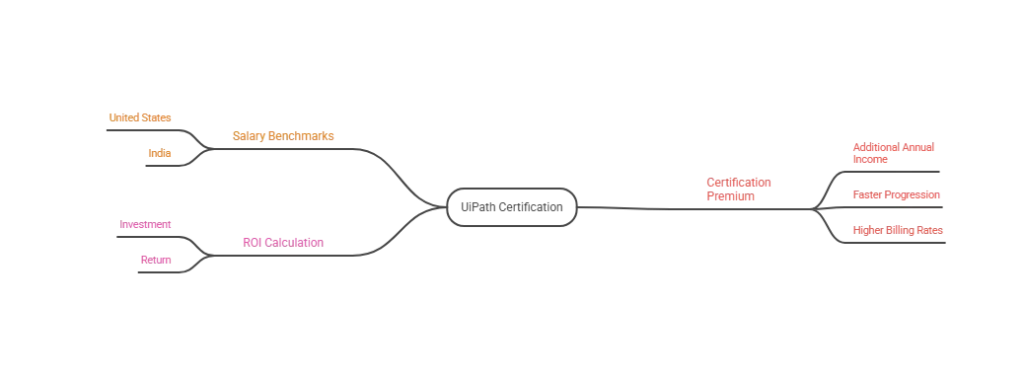
Salary Benchmarks for UiPath Professionals
Research from multiple sources reveals consistent patterns:
United States:
- UiPath Developers (average): $85,000-$104,000 annually
- RPA Architects: $165,000 average (Indeed data)
- RPA Consultants: $113,000 average
- Mid-level UiPath professionals: $54.32/hour median wage
India:
- Entry-level (0-2 years): ₹3,90,000-₹7,26,000 annually
- Experienced (10-20 years): ₹11,30,000-₹15,70,000 annually
Certification Premium
Multiple studies indicate certified RPA professionals earn 20-30% more than non-certified peers with similar experience levels. This translates to:
- $17,000-$31,000 additional annual income for US-based professionals
- Faster progression to senior roles (Solution Architect, RPA Lead)
- Higher billing rates for consultants and contractors
ROI Calculation
Let’s calculate concrete ROI:
Investment:
- Associate exam: $150
- Professional exam: $300
- Preparation time: 100 hours at $50/hour opportunity cost = $5,000
- Total investment: $5,450
Return (Conservative estimate for mid-level US professional):
- Annual salary increase: $20,000 (20% of $100k base)
- First-year return: 267% ROI
- Lifetime career earnings increase: $200,000+ over 10 years
The math becomes even more compelling when you factor in accelerated promotions and access to high-visibility projects that certified professionals receive.
Career Advantages Beyond Salary
Money tells part of the story. Certification delivers several non-monetary benefits that compound over your career.
Enhanced Credibility
Certification serves as third-party validation in situations where your resume alone falls short. When competing for projects or roles against candidates with similar years of experience, certification acts as a tiebreaker. This proves particularly valuable when:
- Transitioning from other IT domains into RPA
- Working as a consultant pitching to new clients
- Applying for roles at organizations with strict certification requirements
- Seeking promotions to technical leadership positions
Structured Learning Path
UiPath’s certification tracks provide clear progression from foundational to expert-level competency. This structured approach benefits professionals who:
- Need to fill knowledge gaps systematically
- Want to ensure they’re learning current best practices (not outdated methods)
- Prefer a defined curriculum over random online tutorials
- Require externally validated milestones for career planning
Network Access
Certification connects you to a global community of verified professionals. The UiPath Community Forum, regional meetups, and professional networks become more valuable when you share verified credentials with other members. These connections lead to:
- Knowledge sharing on complex implementation challenges
- Job referrals and contract opportunities
- Mentorship relationships
- Visibility for thought leadership opportunities
Job Market Mobility
Recruiter searches on LinkedIn and job boards frequently filter by certification status. Without the credential, your profile may never surface in relevant searches, regardless of your actual skills. Certification ensures you’re discoverable when opportunities arise.
According to LinkedIn 2020 Emerging Jobs Report, RPA Developer ranked as the #2 emerging job in the United States with 40% annual growth. While that specific statistic is from 2020, the trend has continued, with automation adoption accelerating across industries from finance to healthcare to manufacturing.
Exam Difficulty and Preparation Requirements
Understanding what you’re signing up for prevents false starts and wasted exam fees.
Exam Structure
Associate Level:
- 60 multiple-choice questions
- 90-minute time limit
- 70% passing score required
- Topics: RPA fundamentals, UiPath Studio, variables, selectors, control flow, data manipulation, automation concepts
Professional Level:
- 45-60 questions (format varies by certification type)
- 90-120 minute time limit
- 70% passing score required
- Multiple-choice, drag-and-drop, and simulation-based scenarios
- Advanced topics: REFramework, Orchestrator integration, exception handling, architectural patterns
Real Difficulty Assessment
The exams are not trivial. The 70% threshold means you cannot skip major topic areas. Common failure points include:
- Selectors and UI automation specifics
- REFramework workflow logic
- Orchestrator queue management
- Exception handling patterns
Candidates report that simulation-based questions prove most challenging because they require applied knowledge, not just memorization. You must actually know how to solve automation problems, not just recognize terminology.
Preparation Timeline
Associate Certification:
- Complete beginners: 8-12 weeks with dedicated study
- Developers with programming background: 4-6 weeks
- RPA professionals from other platforms: 3-4 weeks
Professional Certification:
- Associate-level holders: 8-12 weeks
- Experienced developers (6+ months hands-on): 6-8 weeks
- Advanced professionals: 4-6 weeks for focused review
These timelines assume 10-15 hours weekly preparation including:
- UiPath Academy courses (free, official training)
- Hands-on practice building automation projects
- Official practice tests
- Community forum participation for complex scenarios
Preparation Resources
UiPath provides substantial free resources:
- UiPath Academy: Complete training courses aligned to certification exams
- Practice Tests: Free, with scoring reports identifying weak areas
- Community Forum: Active discussions with 500,000+ members
- Documentation: Comprehensive technical references
Third-party resources like PassITExams offer additional practice materials that simulate exam conditions, helping candidates build confidence and time management skills under pressure.
Job Market Demand for UiPath Professionals
Certification only matters if the job market values it. Let’s examine current demand.
Industry Adoption Trends
RPA adoption continues accelerating across sectors:
- Manufacturing, healthcare, and financial services lead in RPA investment
- 85% of organizations using automation report faster project delivery (Automation Anywhere 2024 report)
- Gartner names UiPath a Magic Quadrant Leader in RPA for multiple consecutive years
- Brand Essence Research projects RPA tools market reaching 1.8 million USD by 2027
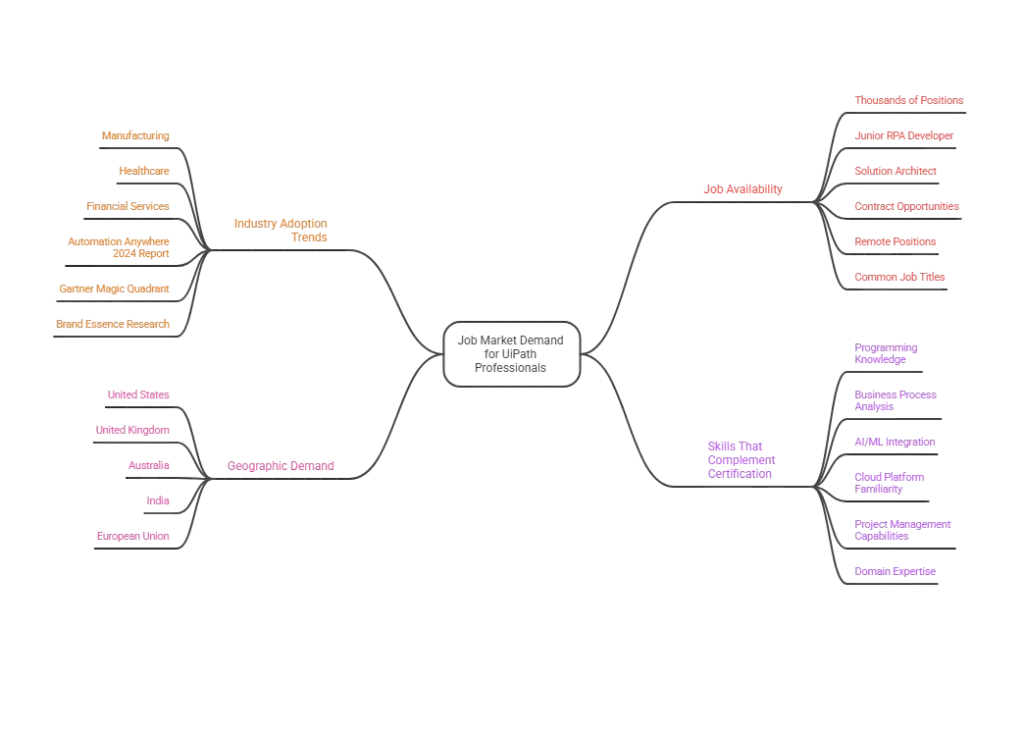
Job Availability
A quick search across major job platforms reveals:
- Thousands of active UiPath-related positions in the US alone
- Roles span from Junior RPA Developer to Solution Architect
- Contract opportunities paying $47-$95/hour
- Remote positions increasingly common
Common job titles requiring UiPath expertise:
- RPA Developer
- Automation Engineer
- RPA Solution Architect
- RPA Business Analyst
- Process Automation Specialist
- RPA Consultant
- Automation Team Lead
- RPA Project Manager
Geographic Demand
High-demand regions:
- United States (particularly major tech hubs and financial centers)
- United Kingdom
- Australia
- India (especially for development and support roles)
- European Union (Germany, Netherlands, France)
The global nature of RPA work means certified professionals can often secure remote positions with international companies, expanding their employment options beyond local markets.
Skills That Complement Certification
Employers value certification most when combined with:
- Programming knowledge (Python, C#, VB.NET, Java)
- Business process analysis skills
- Understanding of AI/ML integration
- Cloud platform familiarity (Azure, AWS)
- Project management capabilities
- Domain expertise (finance, healthcare, supply chain)
Certification proves you know the tool. Combining it with business acumen and complementary technical skills makes you genuinely competitive for senior roles.
When UiPath Certification Makes Sense
Certification isn’t universally necessary. Strategic timing matters.
Strong Candidates for Certification:
- Career Changers: If you’re transitioning from QA, business analysis, or general development into automation, certification provides the fastest path to credibility. It signals serious commitment and validated competence.
- Junior Developers: With 0-2 years of experience, certification helps you stand out in competitive entry-level markets. It compensates for limited work history.
- Consultants and Contractors: Certification serves as portable proof of expertise when pitching to new clients who don’t know you. It reduces their perceived hiring risk.
- Professionals at Certification-Required Organizations: Some enterprises mandate certification for automation team members. If your target employer has this policy, certification is non-negotiable.
- Career Accelerators: If you’re targeting promotion to senior developer or architect roles, professional-level certification demonstrates you’re ready for increased responsibility.
When to Skip or Delay Certification:
- Highly Experienced RPA Professionals: If you have 5+ years building production automation solutions and a strong portfolio, some employers will value demonstrated capability over credentials. Certification may add marginal benefit.
- Budget-Constrained Situations: If $300 creates financial strain, invest first in building real projects and gaining hands-on experience. Certification can come later when you’re more financially stable.
- Career Focus Outside RPA: If automation is tangential to your primary role and you’re not seeking RPA-specific positions, certification may not justify the time investment.
- Learning Phase: If you’re still in early learning stages, focus on building foundational skills first. Take the certification when you’re confident in your abilities, not as a teaching tool.
Common Mistakes to Avoid
Learning from others’ failures saves time and money.
- Mistake 1: Taking Advanced Exams Too Early
The professional-level certifications require substantial hands-on experience. Taking them immediately after Associate-level certification often results in failure and wasted exam fees. Build real-world experience first. The official guidance suggests 6+ months of development work before attempting professional certifications.
- Mistake 2: Relying Solely on Exam Dumps
Online “dumps” and memorization-focused study materials create false confidence. The proctored exams include simulation scenarios that require applied understanding, not just recognition. Professionals who rely exclusively on dumps typically fail when confronted with scenario-based questions.
- Mistake 3: Ignoring Hands-On Practice
Reading documentation and watching videos cannot replace building actual automation projects. The exam tests your ability to solve real problems. Set up UiPath Studio Community Edition (free) and build at least 10-15 complete automation projects before attempting certification.
- Mistake 4: Skipping Official Resources
Third-party courses can supplement learning, but skipping UiPath Academy’s official training means missing content specifically aligned to exam objectives. Always complete the recommended official courses for your certification track.
- Mistake 5: Poor Time Management During Exams
With 60 questions in 90 minutes (Associate level), you have 1.5 minutes per question. Spending 10 minutes on one difficult question sabotages your performance. Practice with timed mock exams to build pacing discipline.
- Mistake 6: Letting Certification Expire
Certifications now have 3-year validity periods. Letting them lapse means retaking exams and repaying fees. Set calendar reminders 6 months before expiration to plan renewal.
- Mistake 7: Certification Without Application
The credential alone doesn’t change your career. You must actively apply to roles, update your LinkedIn profile, engage in the community, and pursue projects that leverage your certification. Passive hope doesn’t generate results.
UiPath Certification vs. Competing Platforms
RPA isn’t a one-vendor market. How does UiPath certification stack up?
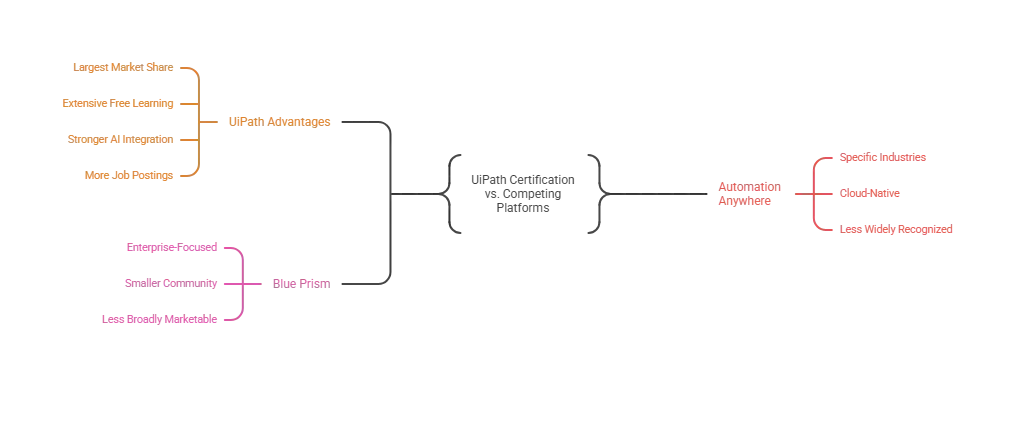
UiPath vs. Automation Anywhere vs. Blue Prism
UiPath Advantages:
- Largest market share and community
- Most extensive free learning resources
- Stronger AI integration roadmap
- More job postings specifically requiring UiPath
Automation Anywhere:
- Strong in specific industries (banking, insurance)
- Cloud-native architecture appeal
- Certification less widely recognized than UiPath
Blue Prism:
- Enterprise-focused positioning
- Smaller community and fewer resources
- Certification valuable in certain industries but less broadly marketable
Strategic Choice: Check job postings in your target market. If 70%+ require UiPath, that’s your answer. Multi-platform expertise has value, but starting with the market leader makes sense for most professionals.
The Three-Year Value Proposition
Certifications now expire after three years. This changes the ROI calculation.
Renewal Requirements: You must pass the current version of your certification exam to renew. This means staying current with platform updates and potentially relearning sections where UiPath has evolved.
Validity Period Value: Three years provides ample time to:
- Leverage certification for 1-2 job changes
- Build a portfolio of certified projects
- Establish yourself in the RPA field
- Recoup your investment through salary increases
Maintenance Mindset: Treat certification as a recurring investment, not a one-time achievement. Budget time and money for recertification cycles if you plan to remain in the RPA field long-term.
Preparing for Success: A Practical Roadmap
Strategic preparation maximizes your chances of first-attempt success.
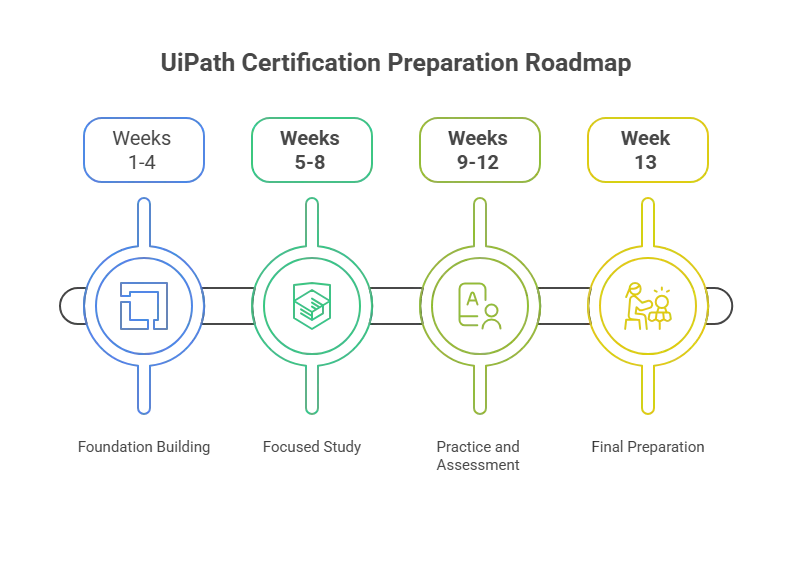
Phase 1: Foundation Building (Weeks 1-4)
- Complete UiPath RPA Developer Foundation course on Academy
- Install UiPath Studio Community Edition
- Build 5 simple automation projects (email automation, web scraping, data extraction)
- Join UiPath Community Forum and review common questions
Phase 2: Focused Study (Weeks 5-8)
- Complete certification-specific Academy courses
- Study REFramework in depth (for Professional level)
- Build 5 intermediate projects using framework patterns
- Review exam description document thoroughly
- Identify weak areas through practice exercises
Phase 3: Practice and Assessment (Weeks 9-12)
- Take official practice test (without notes for realistic experience)
- Analyze score report and focus on low-scoring sections
- Build 3-5 projects specifically addressing weak areas
- Retake practice test to measure improvement
- Review UiPath documentation for topics you struggle with
Phase 4: Final Preparation (Week 13)
- Light review of all major topics
- Practice time management with timed quizzes
- Ensure technical setup for remote proctoring (if applicable)
- Get adequate rest before exam day
Exam Day Strategy
- Read each question completely before answering
- Flag difficult questions and return to them after completing easier ones
- Watch the clock but don’t panic
- Double-check answers if time permits
- Remember: 70% is passing; perfection isn’t required
Beyond Certification: Maximizing Your Investment
Earning the credential is step one. Converting it to career value requires active follow-through.
Immediate Post-Certification Actions:
Update Your Professional Profiles:
- Add certification to LinkedIn with badge
- Update resume with certification details
- Include certification in email signature
- Update profiles on job boards
Share Your Achievement:
- Post on LinkedIn about passing (with lessons learned)
- Write a blog post about your preparation journey
- Answer questions in UiPath Community Forum using your certified status
- Join certified professional groups and networks
Leverage for Opportunities:
- Apply to roles that require certification
- Request salary review if employed (with certification as justification)
- Volunteer for high-visibility automation projects
- Offer to mentor junior team members
Continue Learning:
- Stay current with UiPath platform updates
- Build increasingly complex automation projects
- Consider complementary certifications (AI, cloud platforms)
- Track your portfolio projects for future interviews
Real-World Perspectives: Certified Professionals Speak
Anonymous testimonials from UiPath’s certification program reveal recurring themes:
“Having UiPath certifications increased my credibility as an automation professional in the eyes of my customers and peers. I got a raise.” – IT Consulting Professional
“The certification program was exceptionally well-structured and comprehensive, covering all essential aspects needed for a Solution Architect role. I shifted into a new role.” – Banking/Financial Professional
These patterns repeat across hundreds of testimonials: certification serves as a career accelerator for professionals who actively leverage it.
The Role of Practice Resources
Quality preparation resources significantly impact success rates.
UiPath Academy (Official):
- Completely free
- Aligned exactly to exam objectives
- Regularly updated for platform changes
- Includes hands-on exercises
Third-Party Platforms: Organizations like PassITExams offer supplemental practice exams that simulate actual test conditions. These resources help candidates:
- Build confidence through realistic practice
- Identify knowledge gaps before paying exam fees
- Develop time management skills
- Reduce test anxiety through familiarity
Community Resources:
- UiPath Forum discussions on exam experiences
- Study groups on LinkedIn and Discord
- YouTube tutorial series
- GitHub repositories with example projects
Strategic Use: Combine official and third-party resources. Use official materials for learning and third-party practice exams for assessment and confidence building.
Industry-Specific Value
Certification value varies by industry sector.
High-Value Industries:
- Financial Services: Banks and insurance companies heavily invest in RPA. Certification often required for automation teams. High salary potential.
- Healthcare: Regulatory compliance and documentation automation drive demand. Certification provides credibility in sensitive environments.
- Manufacturing: Supply chain and quality control automation expanding rapidly. Certified professionals command premium compensation.
- Business Process Outsourcing (BPO): Core business model increasingly built on automation. Certification essential for client-facing roles.
Moderate-Value Industries:
- Retail: Growing automation adoption but often smaller-scale implementations. Certification helpful but not always required.
- Government: Slow adoption but increasing. Certification valuable when positions become available.
- Education: Limited automation currently but potential for growth. Early movers have advantage.
Certification and Remote Work
The global shift to remote work amplifies certification value.
Remote Position Advantages:
- Certification provides credibility without in-person relationship building
- Global job opportunities regardless of location
- Higher competition makes certification a differentiator
- Clients/employers need verification method for distributed teams
Remote Exam Considerations:
- OnVUE remote proctoring available for most locations
- Requires webcam, stable internet, private room
- Technical requirements more stringent than testing centers
- Scheduling flexibility appeals to working professionals
The Future of UiPath Certification
Understanding the roadmap helps with long-term planning.
Recent Changes:
- Shift from product-version-specific to role-based certifications
- Introduction of AI-focused specialization tracks
- Three-year validity period implementation
- Regular exam updates aligned to platform evolution
Emerging Trends:
- Greater emphasis on AI agent orchestration
- Integration with cloud platforms and modern tech stacks
- Expanded focus on automation governance and CoE practices
- Potential new certifications as UiPath expands product portfolio
Strategic Implication: Certification will remain relevant but require ongoing commitment to stay current. The three-year renewal cycle ensures credentials reflect current platform capabilities.
Frequently Asked Questions
Can I pass the certification without prior RPA experience?
For Associate level, yes with dedicated study. For Professional level, hands-on development experience is practically essential. Most professionals need 6+ months of real project work to succeed at professional level.
How long is the certification valid?
All UiPath certifications now have a 3-year validity period from the issue date.
Is the certification recognized globally?
Yes. UiPath certifications are recognized worldwide, though specific market demand varies by region.
What happens if I fail the exam?
You receive a detailed score report showing section performance. You can retake the exam immediately by paying the full exam fee again. There’s no waiting period.
Do I need to take Associate before Professional?
Not mandatory for most tracks, but official guidance strongly recommends it. The knowledge progression matters more than the credential sequence.
Can I use the certification if I switch to a different RPA tool?
The credential remains valid and demonstrates automation competency generally, though tool-specific value decreases if you permanently move to Automation Anywhere or Blue Prism.
Does certification guarantee a job?
No. Certification increases your competitiveness and visibility but doesn’t replace the need for job searching skills, interview preparation, and relevant experience.
How does UiPath certification compare to learning Python or other programming languages?
They’re complementary, not competitive. Strong programming skills enhance your automation capabilities. Certification validates your ability to apply those skills using UiPath specifically.
Is there a student discount?
Student vouchers exist but have limited availability and strict eligibility requirements. Check with UiPath’s academic program or your educational institution.
Can I get reimbursed by my employer?
Many employers reimburse certification costs, especially if the role involves automation work. Submit a business case showing how certification benefits the organization.
The Verdict: Is UiPath Certification Worth It?
After examining costs, benefits, market demand, and ROI data, here’s the conclusion:
UiPath certification is worth it if:
- You’re actively pursuing or currently in an automation career
- The $150-$300 investment won’t create financial hardship
- You commit to hands-on preparation beyond just exam cramming
- You plan to actively leverage the credential through job applications, networking, and project pursuit
- Your target job market shows strong UiPath demand
The investment pays off through:
- 20-30% average salary increase for certified professionals
- Access to roles that filter by certification status
- Faster career progression to senior and architect positions
- Enhanced credibility with employers and clients
- Structured learning path for skill development
Skip or delay certification if:
- You have extensive proven RPA experience and strong portfolio
- Budget constraints make $300 exam fee prohibitive currently
- You’re still in early learning phases
- Your career focus lies outside automation
- You work in an organization that explicitly doesn’t value certifications
The Bottom Line: For most professionals serious about RPA careers, UiPath certification delivers measurable ROI within the first year through increased salary and improved job prospects. The credential alone won’t transform your career, but combined with genuine skill development and active job market engagement, it serves as a powerful accelerator.
The real question isn’t whether certification has value—data clearly shows it does. The real question is whether you’re positioned to capture that value through preparation, application, and ongoing skill development.
Your Next Steps
If you’ve decided certification makes sense for your situation:
- Assess your current skill level – Take a free practice test to understand where you stand
- Choose your certification track – Start with Associate unless you have 6+ months hands-on experience
- Budget time and money – Allocate 10-15 hours weekly for 8-12 weeks plus exam fee
- Access official resources – Create UiPath Academy account and begin recommended courses
- Build a study plan – Follow the roadmap outlined in this guide
- Leverage quality practice resources – Use platforms like PassITExams to build exam confidence
- Schedule your exam – Set a target date 10-12 weeks out to create commitment
- Prepare to leverage – Plan how you’ll update profiles and pursue opportunities post-certification
Certification isn’t magic, but it’s a proven tool in the career advancement toolkit for automation professionals. Approached strategically with realistic expectations, it delivers consistent returns for those willing to invest the time and effort.
The RPA industry continues expanding. Certified professionals who combine credentials with genuine capability will find themselves well-positioned for the automation economy ahead.
