Home›Microsoft Exam Dumps›AZ-802 practice tests 2026 | Pass Microsoft Certified: Windows Server Hybrid Administrator Associate on Your First Attempt
# Verified question bank

AZ-802 practice tests 2026 | Pass Microsoft Certified: Windows Server Hybrid Administrator Associate on Your First Attempt

PassITExams brings you the latest, verified AZ-802 exam questions for the Microsoft Certified: Windows Server Hybrid Administrator Associate certification. Every question is built around the real exam scope, reviewed by certified Microsoft professionals, and paired with clear answer explanations covering hybrid identity, Windows Server management, networking, security, high availability, and migration. Our practice test simulator replicates actual exam conditions, so you walk in prepared and confident to pass on your first attempt.

$75.00 $30.00 60% OFF
Exam TitleMicrosoft Certified: Windows Server Administrator Associate (beta) Exam
Certification NameMicrosoft Certified: Windows Server Administrator Associate (beta)
Exam CodeAZ-802
Total Questions527
FREE DEMO
TRY DEMO EXAM
Last update Last Update Check November 6, 2026
100% Pass Guarantee
100% PassGuarantee
Secure Download
SecureDownload
100k+ satisfied students
100k+satisfied students
✔ 2026 Updated 🎧 24/7 Support 🛡 Pass Guarantee
100% Satisfaction Guaranteed

Your success comes first. Experts hand-select and verify authentic exam questions, delivering 98.99% pass rate. If your purchase isn’t as described or falls short, we’ll issue a full refund. Buy with confidence

What students say
★★★★★
“Incredible! The questions in this PDF were word-for-word identical to the actual exam.”
Christian Oyler (Verified Buyer)
★★★★★
“Passed first attempt — practice mirrored the exam and built my confidence.”
Keith Barnes (Verified Buyer)
★★★★★
“Clear explanations and realistic questions made studying fast and effective.”
Ananda Shrivastav (Verified Buyer)
★★★★★
“Accurate question bank, timely updates, and strong support — exactly what I needed.”
Shristi Gaur (Verified Buyer)
★★★★★
“Great value. I studied only with their PDF and passed the exam on my first try.”
Launa Taylor (Verified Buyer)
Mark Malloy
Reviewed by Mark Malloy
All the questions are reviewed by PassITExams team and Mark Malloy who is Microsoft Certified Windows Server Administrator Associate working with PassITExams.

PassITExams: The Smarter Way to Prepare for the AZ-802 Exam

If you are targeting the Microsoft Certified: Windows Server Hybrid Administrator Associate credential through the new AZ-802 exam, you are working toward one of the most practical and job-relevant certifications Microsoft offers. This single exam replaces the previous two-exam path (AZ-800 and AZ-801), which means the scope is broad — but the benefit is a streamlined path to a recognized, in-demand credential.

At PassITExams, we take exam preparation seriously. Our AZ-802 practice test materials are built from real exam knowledge — written and reviewed by working Microsoft Certified professionals who understand how hybrid Windows Server environments actually function. When you study with PassITExams, every question you answer is time well spent. No generic IT theory, no outdated content. Just focused, scenario-based preparation that matches the way Microsoft tests.

Here is the thing most candidates underestimate: knowing how to manage Windows Server or configure Azure services is only part of what gets you through a Microsoft exam. You also need to know how Microsoft frames questions, how scenario-based problems are set up, and how to choose between two answers that both sound correct. That gap is exactly what our AZ-802 brain practice tests and timed practice tests are built to close.

How PassITExams Prepares You for AZ-802

Our preparation materials are mapped directly to the official AZ-802 exam scope — the full range of hybrid Windows Server skills Microsoft expects candidates to demonstrate. Here is how the process works:

Every question in our library starts with the real skills that AZ-802 tests. Our team of active Microsoft Certified professionals writes scenario-based questions that reflect genuine admin situations — the kind where you need to pick the right tool, the right configuration approach, or the right Azure service for a specific hybrid scenario. A second reviewer checks both the question and its explanation for technical accuracy before anything goes live.

We offer two formats. The PDF Practice Questions are downloadable and printable, perfect for offline study or markup-as-you-go review. The online AZ-802 practice test puts you in a timed simulation that mirrors the actual Pearson VUE experience — same pressure, same interface feel, same question types. Both include the complete question bank and detailed answer explanations.

When Microsoft updates the AZ-802 exam objectives, your access updates too. Every purchase includes three months of free updates, so your study materials stay current with whatever Microsoft publishes.

You can always verify the latest exam details directly on the official Microsoft certification page for the Windows Server Hybrid Administrator Associate.

Microsoft Certified: Windows Server Hybrid Administrator Associate (AZ-802) — Complete Exam Guide

What Is AZ-802?

AZ-802 is Microsoft’s updated single-exam path to the Windows Server Hybrid Administrator Associate certification. It consolidates everything that was previously split across AZ-800 and AZ-801 into one comprehensive exam, reflecting the modern reality that hybrid Windows Server administration is a unified role — not two separate ones.

The exam covers the full lifecycle of managing Windows Server in hybrid environments: deploying and managing Active Directory and hybrid identity, administering servers using Azure tools, managing virtual machines and containers, securing on-premises and cloud infrastructure, implementing high availability and disaster recovery, migrating workloads, and monitoring and troubleshooting across the entire environment.

AZ-802 also brings updated content aligned with Windows Server 2025 capabilities and modern hybrid patterns, including Azure Arc for server governance, Microsoft Entra ID integration, Azure Update Manager, and AI-inclusive infrastructure management practices that reflect how organizations are running hybrid environments today.

The beta exam opened in June 2026, with the full exam and official training available from August 2026. You can also check Microsoft’s certification update announcements on Pearson VUE for the latest exam availability information.

Who Should Take the AZ-802 Exam?

AZ-802 is an Intermediate-Level Certification Designed for Professionals. Microsoft expects candidates to have several years of real-world Windows Server experience. If you have been managing Windows Server environments — even primarily on-premises — and are now working with or moving toward Azure hybrid services, this exam is built for your profile.

  • Windows Server Administrators with solid on-premises experience who are extending workloads into Azure. Their day-to-day work already involves the skills this exam tests — AZ-802 formalizes them into a recognized credential.
  • Hybrid Infrastructure Engineers managing mixed environments where Active Directory Domain Services runs on-premises, Microsoft Entra ID handles cloud identity, and workloads span both Hyper-V and Azure VMs. This is the certification that reflects that reality.
  • IT Generalists at small-to-mid-sized organizations who handle everything from AD management to server patching to backup and recovery — and who are being pulled into hybrid connectivity and Azure integration work.
  • Network and Security Engineers who want formal validation of their Windows Server-specific administration skills alongside their existing Microsoft or Azure credentials.
  • Systems Engineers and IT Leads in organizations running Windows Server 2019, 2022, or 2025 who are responsible for keeping hybrid environments healthy, secure, and aligned with organizational standards.

Job roles listed by Microsoft for this certification include Administrator, Identity and Access Administrator, Network Engineer, Security Engineer, Support Engineer, and Technology Manager.

AZ-802 Exam Format and Structure

  • Format: 40–60 questions
  •  Duration: Approximately 150 minutes 
  • Question types: Multiple choice, multiple response, drag-and-drop, case studies, and performance-based lab simulations 
  • Passing score: 700 out of 1,000 
  • Exam price: Approximately $165 USD (varies by country — confirm current pricing at registration) 
  • Delivery: Pearson VUE testing center or online proctored from home 
  • Availability: Full exam available from August 2026

The exam uses a scaled scoring system, so a 700 does not mean exactly 70% correct — the difficulty of the specific questions you receive affects your final score. Aim for genuine confidence across all topic areas, not just a bare minimum.

Once certified, the Windows Server Hybrid Administrator Associate credential is valid for one year. You can renew it at no cost by passing a shorter online renewal assessment on Microsoft Learn — you do not need to sit the full exam again. Manage your scheduled appointments, certificates, and transcripts through the Microsoft certifications portal.

AZ-802 Exam Domains and Skills Covered

AZ-802 draws from the full combined scope of hybrid Windows Server administration. Microsoft has confirmed the exam covers Windows Server management, hybrid networking, storage, identity management, security, high availability, disaster recovery, migration, and integration with Azure services. The official domain breakdown and percentage weights will be published by Microsoft when the full exam launches — you can always find the most current version in the official AZ-802 study guide on Microsoft Learn once it goes live.

Below is a full breakdown of the exam’s coverage areas, written based on the confirmed scope from Microsoft’s own announcements and the consolidated content from AZ-800 and AZ-801 that AZ-802 replaces.

Active Directory Domain Services and Hybrid Identity

This is the largest and most foundational area of the exam. You need to be fully comfortable with AD DS across on-premises and Azure environments — not just the basics, but the advanced scenarios Microsoft actually tests.

  • Expect questions on deploying and managing domain controllers on-premises and in Azure, including Read-Only Domain Controllers (RODCs) and managing FSMO roles. Multi-site, multi-domain, and multi-forest environments are tested in depth — including forest and domain trusts, AD DS site topology, and replication troubleshooting.
  • Hybrid identity is where many candidates struggle. You need to understand how Microsoft Entra Connect Sync, Entra Cloud Sync, Entra Domain Services, and Entra Connect Health work, when to use each, and how to manage authentication in hybrid environments. Staged rollout features and identity integration between on-premises AD DS and Microsoft Entra ID are tested with real-world scenarios.
  • Group Policy across both AD DS and Microsoft Entra Domain Services is also part of this area — including Group Policy Preferences and how to apply and troubleshoot policy in hybrid environments.

Service accounts, AD DS users and groups in multi-domain setups, and choosing the right account type (managed service accounts, group managed service accounts, virtual accounts) round this area out.

Windows Server Management in Hybrid Environments

This section covers how you actually manage servers day-to-day using modern Azure tooling alongside traditional Windows Server methods.

  • Remote management includes Windows Admin Center (both on-premises and Azure-deployed), PowerShell remoting with second-hop configurations, Just Enough Administration (JEA), SSH access, and RDP management.
  • On the Azure side, you need to know how to onboard machines to Azure Arc using the Connected Machine Agent, apply Azure Machine Configuration, deploy VM extensions on Arc-enabled servers, and use Azure Update Manager for patch management. Azure Automation runbooks for hybrid workloads are also tested.

Virtual Machines and Containers

This area splits across Hyper-V, container management, and Azure VM administration.

  • For Hyper-V, questions cover Enhanced session mode, PowerShell Direct, SSH Direct for Linux VMs, nested virtualization, memory and CPU configuration, integration services, Discrete Device Assignment, GPU partitioning, VM resource groups, checkpoints, virtual hard disk management, NIC teaming, Hyper-V Switch configuration, guarded fabric with shielded VMs, and moving secure VMs between hosts.
  • Containers include preparing Windows Server as a container host, using WSL for Linux containers, creating and managing Windows Server container images, container networking, managing container instances, and setting up Azure Kubernetes Service (AKS) on Windows Server.
  • Azure VM management covers storage, resizing, VM scale sets, availability sets and zones, Just in Time (JIT) VM access, Azure Bastion, and network configuration for Azure-hosted Windows Server VMs.

Networking — On-Premises and Hybrid

Networking questions test both classic Windows Server networking and Azure-integrated hybrid connectivity in the same scenarios.

  • Name resolution covers DNS integration with AD DS, managing zones and records, conditional forwarding, integration with Azure Public DNS, Azure Private DNS, and Azure DNS Private Resolver, DNS policies, and DNSSEC.
  • IP addressing includes IPAM, DHCP server configuration, DHCP scopes, reservations, and high availability, plus resolving IP issues in hybrid environments.
  • Hybrid connectivity is broad: the Remote Access role, Azure Network Adapter, Azure extended network, Network Policy and Access Services (NPAS), Web Application Proxy, site-to-site VPN, Azure Relay, Microsoft Entra Private Access, and Microsoft Entra Application Proxy.

Storage and File Services

Storage questions mix Windows Server fundamentals with Azure Files and hybrid file service scenarios.

  • Azure Files includes creating and managing file shares, permissions management, configuring and monitoring Azure File Sync, and migrating from DFS to Azure File Sync.
  • Windows Server file services cover FSRM, BranchCache, Distributed File System (DFS), SMB over QUIC, and SMB options and configuration.
  • Windows Server storage includes disk and volume management, Storage Spaces and Storage Spaces Direct (S2D), Storage Replica, Data Deduplication, SMB Direct, Storage QoS, file systems, and iSCSI configuration.

Security — On-Premises and Hybrid Infrastructures

Security is one of the most heavily weighted areas on AZ-802, combining OS hardening, AD security, Azure security services, network security, and storage security.

  • OS-level security includes Exploit Protection, Windows Defender Application Control, Credential Guard, SmartScreen, Group Policy-based OS hardening, OSConfig for security baselines, and Windows LAPS (Local Administrator Password Solution).
  • Active Directory security covers password policies, Microsoft Entra Password Protection for AD DS, protected users, RODC account security, hardening domain controllers, authentication policy silos, restricting DC access, AD delegation, Microsoft Defender for Identity, and NTLM auditing and disablement.
  • Azure security services include Microsoft Sentinel data ingestion for Windows Server, Microsoft Defender for Cloud, and Defender for Servers.
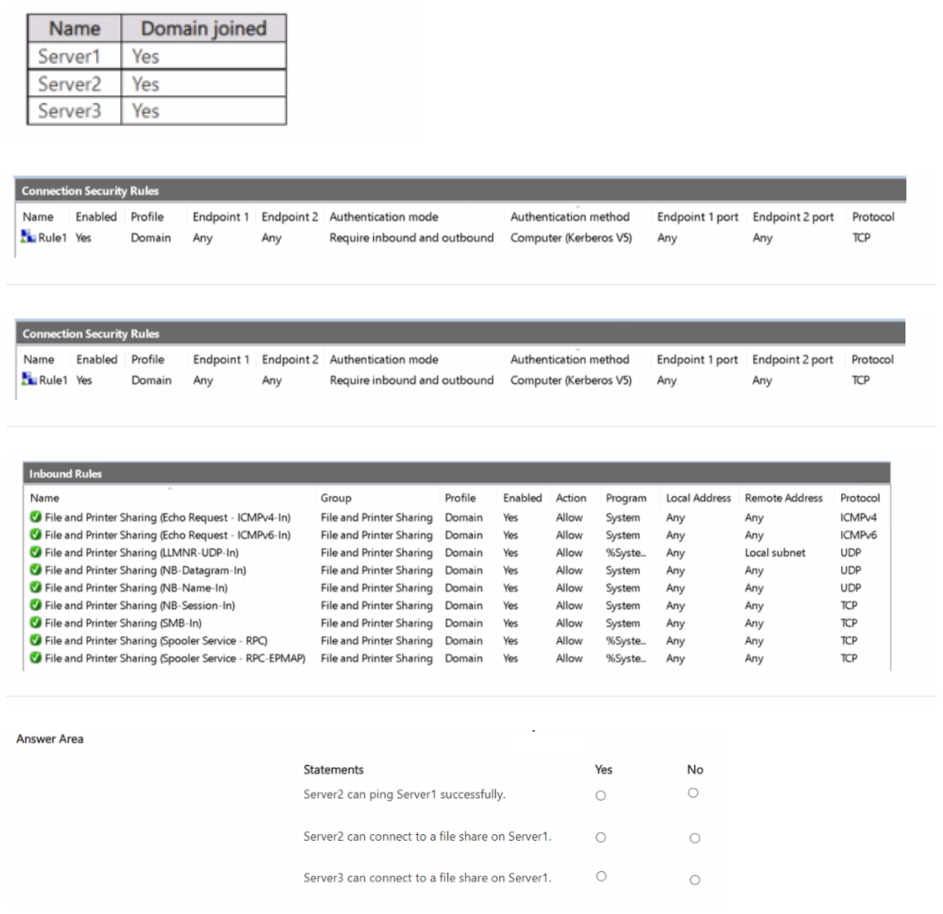
  • Network security covers Windows Defender Firewall, domain isolation, connection security rules, and NSGs for Azure VMs.
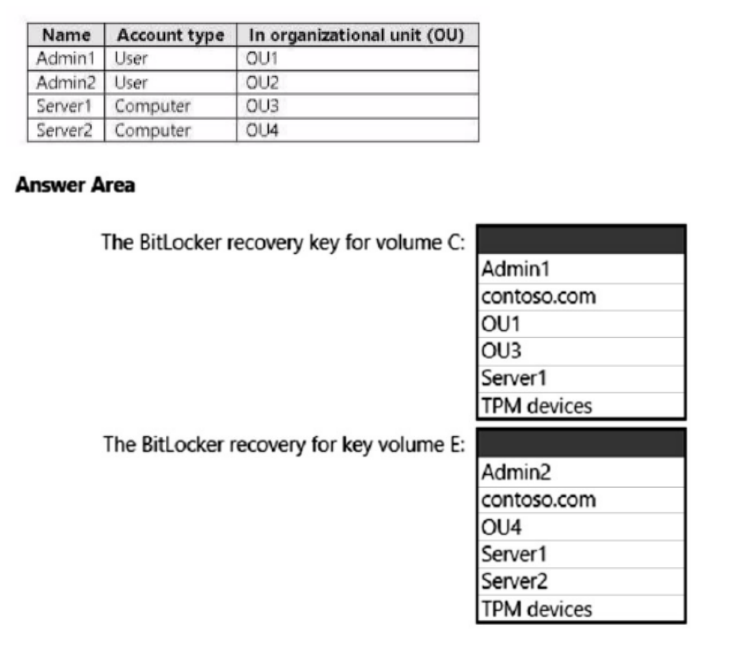
  • Storage security includes BitLocker Drive Encryption, Azure Disk Encryption, encrypted volume recovery, and managing disk encryption keys for IaaS VMs.

High Availability

High availability questions are highly practical. Lab experience with failover clustering is essential here — reading alone will not prepare you adequately.

  • Failover clustering covers building clusters on-premises, in hybrid configurations, and cloud-only — including workgroup clusters and stretch clusters across datacenters or Azure regions with S2D campus clusters. Quorum configuration, network adapters, Network ATC deployment, cluster workloads, Scale-Out File Servers, Azure witness, and floating IP addresses are all tested.
  • Cluster management includes cluster-aware updating, recovering failed nodes, upgrading cluster nodes, failing over workloads, patching, and using Windows Admin Center for cluster operations.
  • Storage Spaces Direct covers S2D configuration, networking, and node upgrade procedures.

Disaster Recovery

Though smaller in overall weight, DR questions are detailed and scenario-heavy.

  • Backup and recovery with Azure Backup covers Recovery Services Vault, Azure Backup Server, vault backup policies, instant recovery snapshots, recovering VMs to new Azure VMs, and restoring encrypted VMs.
  • Azure Site Recovery includes network mapping, configuring ASR for on-premises servers and Azure VMs, building recovery plans, VM replication to a secondary datacenter or Azure region, and configuring replication policies.
  • Hyper-V replicas cover host configuration, replica server management, VM replication configuration, and performing failovers.

Server and Workload Migration

Migration scenarios are always practical and require you to know which tool fits which situation.

  • Storage Migration Service (SMS) for transferring files, file shares, and security configurations, cutting over to new servers, and migrating to Azure VMs or Azure file shares.
  • Azure Migrate for deploying and configuring the appliance, migrating VM workloads to Azure, and migrating physical servers.
  • Workload migration from older Windows Server versions covers IIS workloads and configurations, Hyper-V hosts, Remote Desktop Services, DHCP servers, print servers, and in-place upgrades.
  • IIS to Azure: assessing with Azure Migrate, migrating to Azure Web Apps, and migrating to containers.
  • AD DS forest migration to Windows Server 2025 includes forest restructure, using AD Migration Tool for users, groups, and GPOs, migrating to a new forest, and upgrading existing forests including setting functional levels.

Monitoring and Troubleshooting

Monitoring and troubleshooting rounds out the exam with a broad mix of tools and practical scenarios.

  • Monitoring covers Performance Monitor, Data Collector Sets, Windows Admin Center alerts, System Insights, event log management, Azure Monitor data collection rules, alerts, and VM Insights for Azure VMs.
  • Troubleshooting includes connectivity, name resolution, Windows Update, Time Service, deployment failures, boot failures, performance issues, VM and Azure Arc extension issues, disk encryption issues, and storage problems.
  • Active Directory troubleshooting covers AD recycle bin object restoration, recovering the AD database using Directory Services Restore Mode, SYSVOL recovery, AD replication troubleshooting, hybrid authentication and sync issues, and on-premises AD troubleshooting.

Exam Cost, Prerequisites, and Retake Policy

The AZ-802 exam costs approximately $165 USD, with regional pricing variations. Confirm the exact price for your location at the time of registration via Pearson VUE.

There are no mandatory prerequisites or required training courses. Microsoft expects candidates to have several years of hands-on Windows Server experience, but you self-certify your readiness at registration. Practically speaking, candidates who are comfortable managing real Windows Server environments — on-premises and with some Azure exposure — are well positioned to succeed.

If you do not pass on your first attempt, Microsoft requires a 24-hour waiting period before retaking. You can sit the exam up to five times within any 12-month period. Microsoft’s Exam Replay bundle offers a discounted retake voucher at purchase — worth considering given the exam cost.

Why the AZ-802 Certification Is Worth Pursuing in 2026

Most organizations today are not cloud-only and they are not purely on-premises either. They are running Windows Server infrastructure alongside Azure services — identity synced between AD DS and Microsoft Entra ID, file storage split between on-prem shares and Azure Files, VMs running both on Hyper-V and in Azure. The Windows Server Hybrid Administrator is the person who keeps that environment running well. AZ-802 is the credential that proves you can do exactly that.

From a career standpoint, the numbers back it up. According to Glassdoor salary data, Windows Server Hybrid Administrator Associates in the United States earn an average of $128,582 per year, with experienced professionals at the 75th percentile reaching $173,625 and top earners exceeding $225,000. Common job titles include Hybrid Cloud Administrator, Windows Server Administrator, Infrastructure Engineer, Systems Engineer, and IT Operations Lead.

Demand is consistent. Over 21,000 active job listings on Indeed referenced hybrid Windows Server administration skills as of mid-2026, spanning industries from healthcare and finance to government and manufacturing. These organizations are not migrating away from Windows Server anytime soon — they are extending it into Azure, and they need skilled people to manage that transition.

AZ-802 also simplifies the path to certification. Instead of sitting two separate exams (AZ-800 and AZ-801), you now earn the full Windows Server Hybrid Administrator Associate credential by passing a single exam. That is a more efficient use of your time and study investment.

You can browse the full Microsoft certification catalog to compare paths and see where AZ-802 fits in the official Microsoft Certification Catalog.

A Realistic Study Plan That Actually Works

  • Start with the official exam scope: Before you open any prep material, review the official AZ-802 exam page on Microsoft Learn to understand what Microsoft tests. When the full skills measured document publishes, that becomes your primary blueprint — every line item is a potential exam question.
  • Build a lab environment: AZ-802 includes performance-based lab questions. You cannot pass these by reading alone. Set up Hyper-V VMs on a capable local machine and pair it with a free Azure trial account. Configure Azure File Sync, set up failover clusters, run Azure Migrate, work through Entra Connect Sync — doing it once in a lab locks it in far better than reading about it three times.
  • Weight your study time realistically: The combined scope of AZ-802 is broad. Active Directory and hybrid identity have historically carried the most weight in this certification path. Security comes in second. Give both areas proportionally more study time than smaller topics.
  • Recommended 8-week study plan:
    • Weeks 1–2: Focus on Active Directory, hybrid identity (Entra Connect Sync, Entra Domain Services), and Group Policy. Work through PassITExams practice questions as you go — not after.
    • Weeks 3–4: Work through security (OS hardening, AD security, Defender for Identity, Sentinel), then high availability and disaster recovery.
    • Week 5: Cover networking, storage, and Azure VM management. Use your lab environment throughout.
    • Week 6: Focus on migration tools (Azure Migrate, Storage Migration Service, in-place upgrades) and monitoring and troubleshooting.
    • Week 7: Full-length timed practice exams. Review every missed question in detail — not just the right answer, but why each wrong answer was wrong.
    • Week 8: Light review on weak areas only. Take one final full timed practice exam two to three days before your scheduled test date.
  • Use PassITExams practice tests as your readiness benchmark: When you are consistently scoring 85% or above on timed practice exams, you are ready to schedule. Below that, keep drilling the domains where you are losing points.

What Makes PassITExams the Right Choice

  • Questions built from real exam experience: Every question in our AZ-802 bank is written by people who understand how Microsoft tests hybrid Windows Server skills — through scenario-based situations that require judgment, not just recall. This is what gets you through the performance-based questions.
  • Three months of free automatic updates: When Microsoft revises the AZ-802 exam objectives, your access updates automatically. You never study against a stale version of the exam.
  • Full explanations for every answer: Not just “the correct answer is B.” Every question includes a complete breakdown of why the right answer is right and why each wrong option misses the mark. This builds genuine understanding — especially important for scenario questions where two choices seem close.
  • 100% money-back guarantee: Study our materials, take the exam, and if you do not pass, you get a full refund. We back our content completely because we know it works.
  • Written and reviewed by certified professionals: Every question set goes through review by active Microsoft Certified professionals with hands-on hybrid Windows Server experience. Not content writers working from documentation — actual practitioners.
  • PDF and online formats: Downloadable PDF practice tests for offline study and markup. Online practice test simulator for timed, interface-accurate exam simulation. Both formats work on laptop, tablet, and mobile.
  • Verified accuracy: Our quality assurance process validates every answer against official Microsoft documentation and real-world practice. We maintain 99%+ accuracy across our question bank — a single wrong explanation can cost you points on the real exam.
  • Domain-level performance tracking: Your online account shows your scores broken down by topic area, so you can see exactly where your time is best spent. Study smarter, not just harder.
  • 24/7 customer support: Our team is available around the clock — for technical account help and for study guidance when you get stuck on a specific topic.

Frequently Asked Questions About the AZ-802 Exam

What exactly is AZ-802 and how is it different from AZ-800 and AZ-801?

AZ-802 is Microsoft’s new single-exam path to the Windows Server Hybrid Administrator Associate certification. It consolidates the content that was previously split across two exams — AZ-800 (core infrastructure) and AZ-801 (advanced services) — into one updated exam. The scope is broad but the path is simpler: one exam, one credential. AZ-800 and AZ-801 both retire on September 30, 2026.

How hard is the AZ-802 exam?

It is a genuinely challenging intermediate-level exam. Microsoft builds it for experienced Windows Server administrators, and the question format — heavy on scenario-based and performance-based questions — requires real judgment, not just memorization. Candidates with solid hands-on experience and proper preparation typically pass within one or two attempts.

What score do I need to pass?

You need a 700 out of 1,000. Microsoft uses scaled scoring, so it is not a simple percentage of questions correct. The specific questions you get and their difficulty levels affect your final score. Aim to feel genuinely strong across all topic areas.

How long should I plan to study?

Most candidates with 2–5 years of Windows Server experience spend 6–8 weeks when studying consistently. If your Azure or hybrid environment exposure is limited, plan for 8–10 weeks. Building a hands-on lab environment is not optional — add that time to your plan.

Are PassITExams materials current for the AZ-802 exam?

Yes. Our AZ-802 question bank is built around the confirmed exam scope and updated whenever Microsoft publishes changes to the official objectives. You always study against current content.

What formats do the study materials come in?

You get PDF practice tests (downloadable, printable, offline-friendly) and access to the online practice test simulator (timed, formatted to match the Pearson VUE experience). Both include the full question bank with detailed explanations, and both work on laptop, tablet, and mobile.

What if I don’t pass after using PassITExams materials?

We offer a 100% money-back guarantee. If you study our content and do not pass, contact our support team for a full refund. No complicated process, no unnecessary back-and-forth.

Can I take the exam from home?

Yes. AZ-802 is available via Pearson VUE online proctoring, letting you test from home or the office with a reliable internet connection and a quiet workspace. Testing center options are also available.

What jobs does AZ-802 open up?

Common roles tied to this certification include Hybrid Cloud Administrator, Windows Server Administrator, Infrastructure Engineer, Systems Engineer (Azure), and IT Operations Lead. With over 21,000 active job listings referencing hybrid Windows Server skills, demand spans nearly every industry.

Do I need deep Azure knowledge to pass?

You do not need to be an Azure specialist, but you do need working knowledge of Azure tools used in hybrid scenarios: Azure Arc, Azure Monitor, Azure File Sync, Azure Site Recovery, Azure Migrate, Azure Update Manager, and Microsoft Entra ID. Pure on-premises Windows Server experience is not enough — hybrid integration is central to what this exam tests.

How do I renew the certification?

The credential expires after one year. You renew it for free by passing a shorter online assessment on Microsoft Learn — no need to sit AZ-802 again. Microsoft sends a reminder email before your expiration date.

4 reviews for AZ-802 practice tests 2026 | Pass Microsoft Certified: Windows Server Hybrid Administrator Associate on Your First Attempt

  1. 5 out of 5
    Verified Owner

    Nathan Brooks –

    Passed AZ-802 on my first attempt after six weeks of evening study. I used the PassITExams timed practice alongside my server lab, and it made me notice how often I rushed past a requirement in the question. My biggest improvement came from writing down why I had rejected each alternative before reading the explanation.

  2. 5 out of 5
    Verified Owner

    Aisha Malik –

    With two children and a full-time support job, my 2026 study plan has to fit into twenty-minute gaps. The downloadable PDF for the AZ-802 Practice Test on PassITExams suits that routine: I work through a small section, mark anything uncertain, then revisit it after bedtime. Five weeks in, I am still preparing, but at least my revision is happening consistently.

  3. 5 out of 5
    Verified Owner

    Leo Martinez –

    Ten days into the AZ-802 Practice Test from PassITExams, I have stopped treating every wrong answer as a disaster. I am a computing student, so plenty of the administration decisions are new to me. Working through az-802 exam questions gives me specific things to recreate in my university lab. For anyone studying alongside classes, how do you divide your time between questions and hands-on work?

  4. 5 out of 5
    Verified Owner

    Priya Shah –

    My first AZ-802 result was a fail. I had watched a course and convinced myself that recognizing the terminology meant I understood the decisions. It did not, especially when a question combined storage requirements with access permissions.
    For the retake, I added the PassITExams Practice Test to a four-week revision plan. Each evening I answered fifteen questions, then spent longer reviewing the reasoning than answering them. If I could not explain a choice without looking, that topic went back onto my list. I also tested the configuration in a lab whenever I could.
    I passed the retake. The useful change was having a repeatable review routine instead of starting another video playlist. The explanations gave me a starting point, and Microsoft Learn helped me check the details I was still unsure about. I would leave room for both in a study plan.

Add a review

Free demo

AZ-802 practice questions

80 free questions with answers and explanations · the full exam has 527

Question 1 D1 Deploy and manage AD DS

Your network contains the domains shown in the following exhibit: a forest rooted at contoso.com, with a child domain west.contoso.com, and a grandchild domain sub.west.contoso.com; a separate, unrelated domain fabrikam.com. You need to establish trust relationships as shown in the following exhibit: Trust1, directly between contoso.com and sub.west.contoso.com (bypassing the intermediate west.contoso.com); Trust2, between contoso.com and fabrikam.com. Which type of trust can you use for Trust1 and Trust2? To answer, select the appropriate options in the answer area.

NOTE: Each correct selection is worth one point.

Question 2 D1 Deploy and manage AD DS

Your organization has deployed a multi-site Active Directory infrastructure across three geographic locations.

You need to optimize replication traffic and ensure that users authenticate to domain controllers in their local site whenever possible. You are configuring Active Directory Sites and Services to support this requirement.

Which of the following should you configure to achieve this goal? (Choose two.)

Select 2 answers.

Question 3 D1 Deploy and manage AD DS

Your organization is planning to deploy a Read-Only Domain Controller (RODC) in a branch office to improve authentication performance while minimizing security risks. The branch office has limited IT staff and occasional connectivity issues to the main data center. You need to ensure that sensitive administrative credentials are not cached on the RODC, but still allow standard user authentication to function reliably.

Which two of the following actions should you take to meet these requirements?

Select 2 answers.

Question 4 D1 Deploy and manage AD DS

Your organization has deployed a Read-Only Domain Controller (RODC) in a branch office to reduce the attack surface at that location. You need to ensure that certain high-value service accounts—such as those used by critical applications—are not cached on the RODC. Which feature or setting should you configure to achieve this?

Question 5 D1 Deploy and manage AD DS

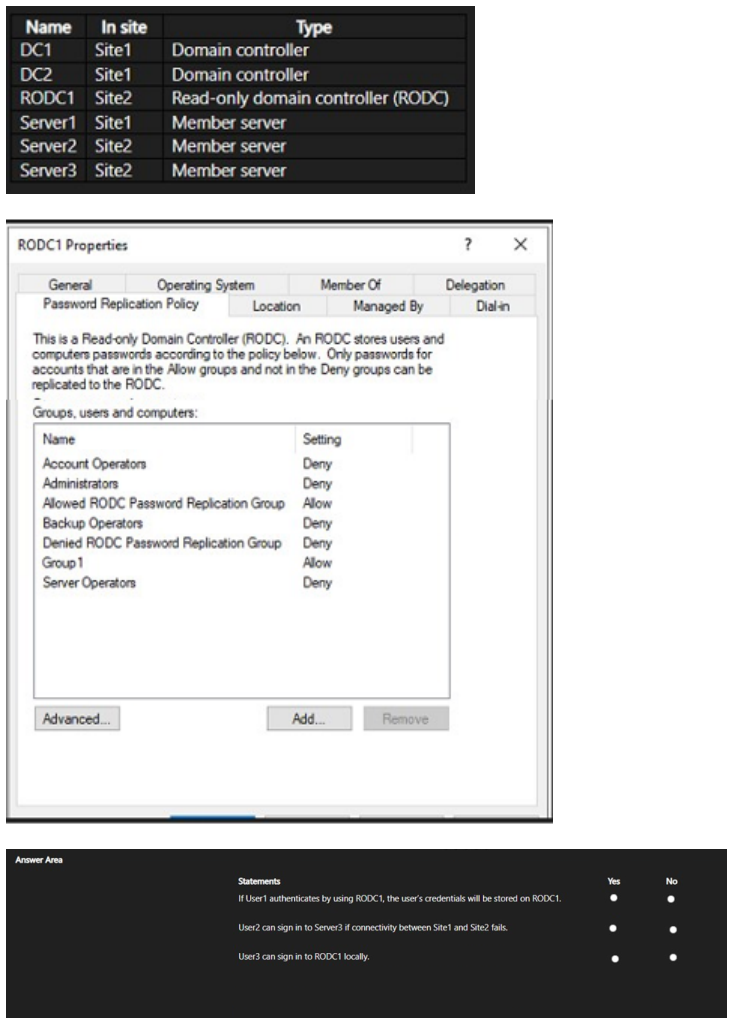
Your network contains an Active Directory Domain Services (AD DS) domain named contoso.com. The domain contains two sites named Site1 and Site2 and servers that run Windows Server and are configured as shown in the following table.

NameIn siteType
DC1Site1Domain controller
DC2Site1Domain controller
RODC1Site2Read-only domain controller (RODC)
Server1Site1Member server
Server2Site2Member server
Server3Site2Member server

The domain contains a group named Group1 that contains Server3.

RODC1 has the Password Replication Policy shown in the following exhibit.

The exhibit states: “This is a Read-only Domain Controller (RODC). An RODC stores users and computers passwords according to the policy below. Only passwords for accounts that are in the Allow groups and not in the Deny groups can be replicated to the RODC.”

NameSetting
Account OperatorsDeny
AdministratorsDeny
Allowed RODC Password Replication GroupAllow
Backup OperatorsDeny
Denied RODC Password Replication GroupDeny
Group1Allow
Server OperatorsDeny

Determine whether each statement is true.

  1. If User1 authenticates by using RODC1, the user's credentials will be stored on RODC1.

  2. User2 can sign in to Server3 if connectivity between Site1 and Site2 fails.

  3. User3 can sign in to RODC1 locally.

StatementYesNo
If User1 authenticates by using RODC1, the user's credentials will be stored on RODC1.
User2 can sign in to Server3 if connectivity between Site1 and Site2 fails.
User3 can sign in to RODC1 locally.
Question 6 D1 Deploy and manage AD DS

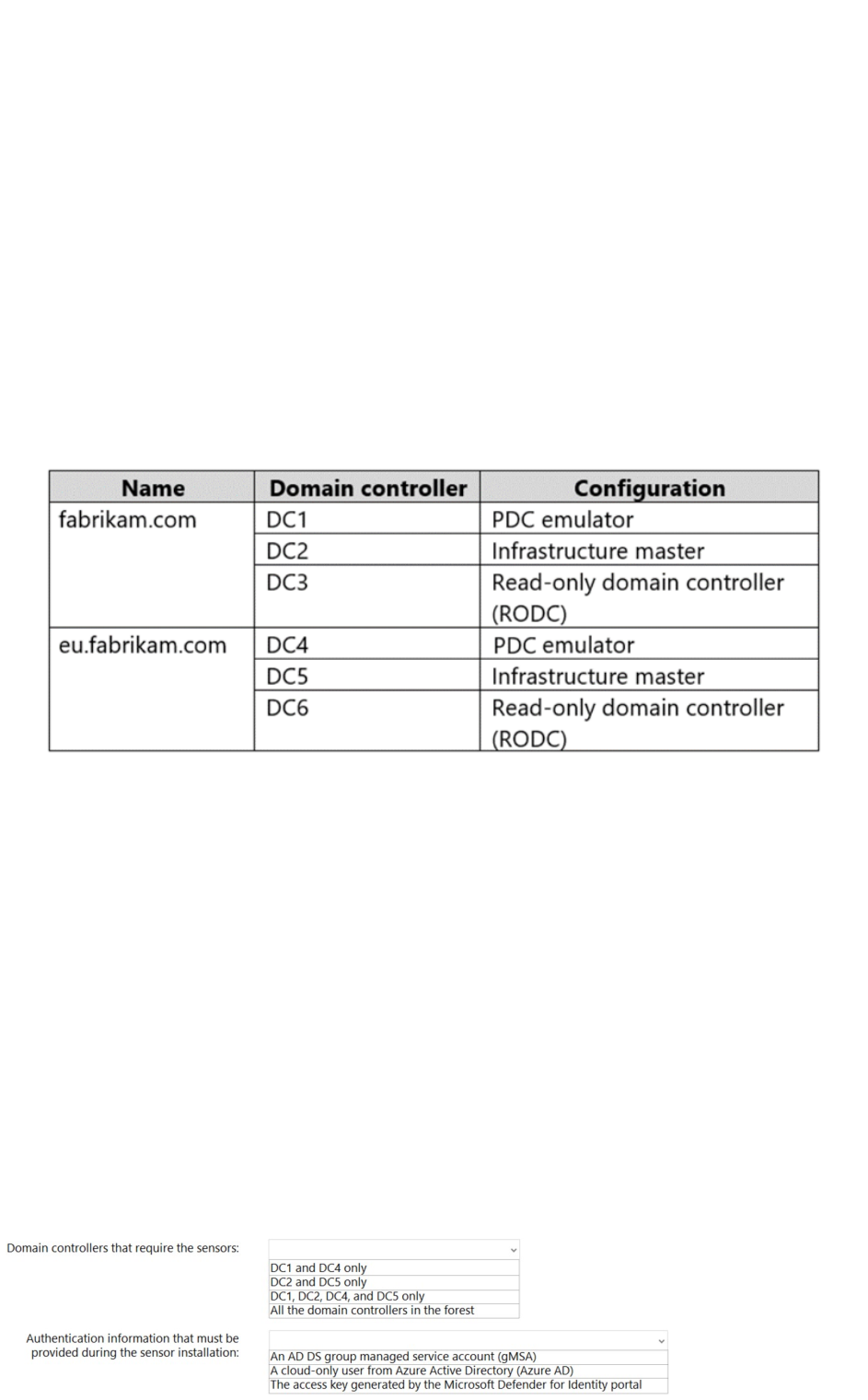
Your network contains an Active Directory Domain Services (AD DS) forest. The forest contains the domains shown in the following table.

NameDomain controllerConfiguration
fabrikam.comDC1PDC emulator
fabrikam.comDC2Infrastructure master
fabrikam.comDC3Read-only domain controller (RODC)
eu.fabrikam.comDC4PDC emulator
eu.fabrikam.comDC5Infrastructure master
eu.fabrikam.comDC6Read-only domain controller (RODC)

You are implementing Microsoft Defender for Identity sensors.

You need to install the sensors on the minimum number of domain controllers. The solution must ensure that Defender for Identity will detect all the security risks in both the domains.

What should you identify? To answer, select the appropriate options in the answer area.

NOTE: Each correct selection is worth one point.

Question 7 D1 Deploy and manage AD DS

Note: This question is part of a series of questions that present the same scenario. Each question in the series contains a unique solution that might meet the stated goals. Your network contains an Active Directory Domain Services (AD DS) domain named contoso.com. You need to identify which server is the PDC emulator for the domain. Solution: From Active Directory Sites and Services, you right-click Default-First-Sie-Name in the console tree, and then select Properties. Does this meet the goal?

Question 8 D1 Deploy and manage AD DS

Your network contains an Active Directory Domain Services (AD DS) domain named.

The domain contains a user named User1 and two global security groups named Group1 and Group2. User1 is a member of both groups.

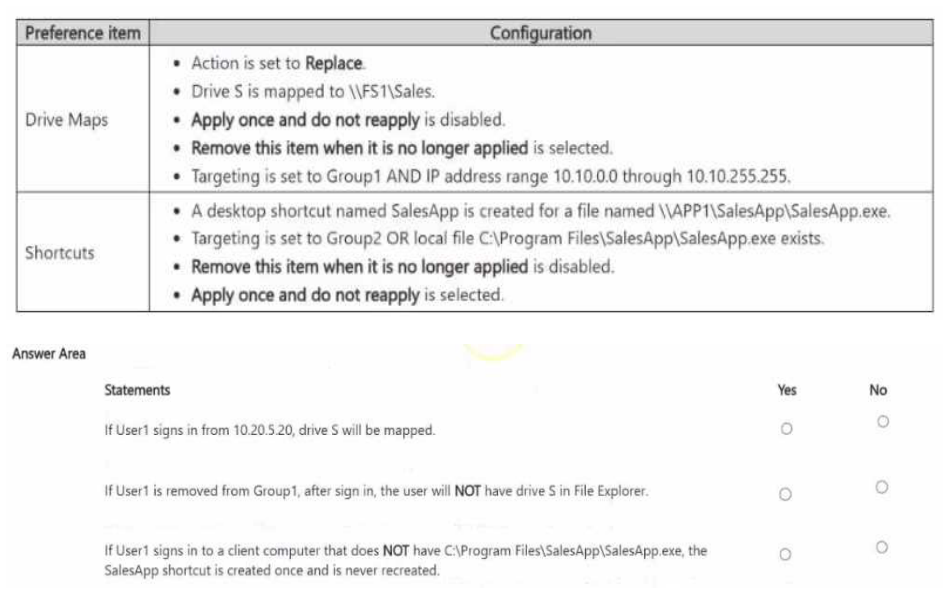
A Group Policy Object (GPO) named GP01 is linked to the domain. GP01 contains the following User Configuration preference items.

Preference itemConfiguration
Drive Maps• Action is set to Replace.<br>• Drive S is mapped to \FS1\Sales.<br>• Apply once and do not reapply is disabled.<br>• Remove this item when it is no longer applied is selected.<br>• Targeting is set to Group1 AND IP address range 10.10.0.0 through 10.10.255.255.
Shortcuts• A desktop shortcut named SalesApp is created for a file named \APP1\SalesApp\SalesApp.exe.<br>• Targeting is set to Group2 OR local file C:\Program Files\SalesApp\SalesApp.exe exists.<br>• Remove this item when it is no longer applied is disabled.<br>• Apply once and do not reapply is selected.

For each of the following statements, select Yes if the statement is true. Otherwise, select No.

NOTE: Each correct selection is worth one point.

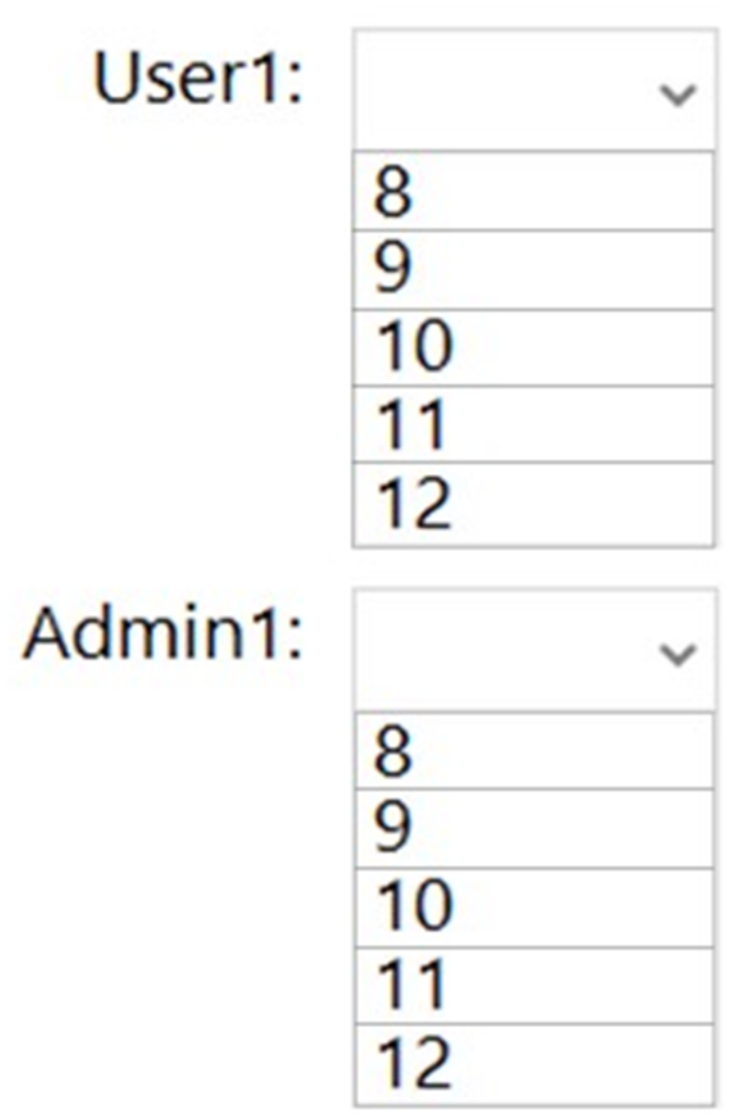
  1. If User1 signs in from 10.20.5.20, drive S will be mapped.

  2. If User1 is removed from Group1, after sign in, the user will NOT have drive S in File Explorer.

  3. If User1 signs in to a client computer that does NOT have C:\Program Files\SalesApp\SalesApp.exe, the SalesApp shortcut is created once and is never recreated.

StatementYesNo
If User1 signs in from 10.20.5.20, drive S will be mapped.
If User1 is removed from Group1, after sign in, the user will NOT have drive S in File Explorer.
If User1 signs in to a client computer that does NOT have C:\Program Files\SalesApp\SalesApp.exe, the SalesApp shortcut is created once and is never recreated.
Question 9 D1 Deploy and manage AD DS
Case study

Case study

Overview

This is a case study. Case studies are not timed separately. You can use as much exam time as you would like to complete each case. However, there may be additional case studies and sections on this exam. You must manage your time to ensure that you are able to complete all questions included on this exam in the time provided.

To answer the questions included in a case study, you will need to reference information that is provided in the case study. Case studies might contain exhibits and other resources that provide more information about the scenario that is described in the case study. Each question is independent of the other questions in this case study.

Overview: Fabrikam, Inc. is a manufacturing company that has a main office in Chicago and a branch office in Paris.

Existing Environment -- Identity Infrastructure: Fabrikam has an Active Directory Domain Services (AD DS) forest that syncs with a Microsoft Entra ID tenant. The AD DS forest contains two domains named corp.fabrikam.com and europe.fabrikam.com.

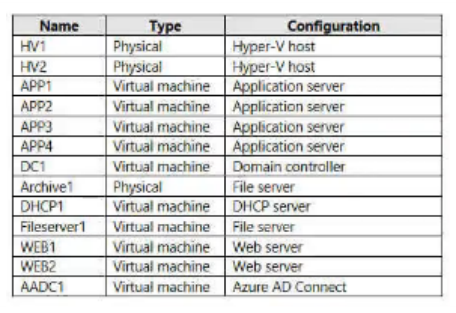
Chicago Office On-Premises Servers: The office in Chicago contains on-premises servers that run Windows Server 2016 as shown in the following table.

Chicago office on-premises servers

All the servers in the Chicago office are in the corp.fabrikam.com domain.

All the virtual machines in the Chicago office are hosted on HV1 and HV2. HV1 and HV2 are nodes in a failover cluster named Cluster1.

WEB1 and WEB2 run an Internet Information Services (IIS) website. Internet users connect to the website by using a URL of https://www.fabrikam.com.

All the users in the Chicago office run an application that connects to a UNC path of \Fileserver1\Data.

Paris On-Premises Servers: The office in Paris contains a physical server named dc2.europe.fabrikam.com that runs Windows Server 2016 and is a domain controller for the europe.fabrikam.com domain.

Network Infrastructure: The networks in both the Chicago and Paris offices have local internet connections. The Chicago and Paris offices are connected by using VPN connections. The client computers in the Chicago office get IP addresses from DHCP1.

Security Risks: Fabrikam identifies the following security risks:

    • Some accounts connect to AD DS resources by using insecure protocols such as NTLMv1, SMB1, and unsigned LDAP.
    • Servers have Windows Defender Firewall enabled. Server administrators sometimes modify firewall rules and allow risky connections.

Requirements -- Security Requirements: Fabrikam identifies the following security requirements:

    • Prevent server administrators from configuring Windows Defender Firewall rules.
    • Encrypt all the data disks on the servers by using BitLocker Drive Encryption (BitLocker).
    • Ensure that only authorized applications can be installed or run on the servers in the forest.
    • Implement Microsoft Sentinel as a reporting solution to identify all connections to the domain controllers that use insecure protocols.

On-Premises Migration Plan: Fabrikam plans to migrate all the existing servers and identifies the following migration requirements:

    • Move the APP1 and APP2 virtual machines in the Chicago office to a new Hyper-V failover cluster named Cluster2 that will run Windows Server 2022. Cluster2 will contain two new nodes named HV3 and HV4. All virtual machine files will be stored on a Cluster Shared Volume (CSV).
    • Migrate Archive1 to a new failover cluster named Cluster3 that will run Windows Server 2022. Cluster3 will contain two physical nodes named Node1 and Node2. The file shares on Cluster3 will be a failover cluster role in activepassive mode.
    • Migrate all users, groups, and client computers from europe.fabrikam.com to corp.fabrikam.com. User accounts will retain their existing password.
    • Migrate the data share from Fileserver1 to a new server named Fileserver2 that will run Windows Server 2022. After the migration, the data share must be accessible by using the existing UNC path.

Azure Migration Plan: Fabrikam plans to migrate some resources to Azure and identifies the following migration requirements:

    • Create an Azure subscription named Sub1 and an Azure virtual network named Vnet1. Use ExpressRoute to connect the Paris and Chicago offices to Vnet1.
    • License all servers for Microsoft Defender for Servers.
    • Migrate APP3 and APP4 to Azure.
    • Migrate the www.fabrikam.com website to an Azure App Service web app named WebApp1, then decommission WEB1 and WEB2.

DHCP Migration Plan: Fabrikam plans to replace DHCP1 with a new server named DHCP2 and identifies the following migration requirements:

    • Ensure that DHCP2 provides the same IP addresses that are currently available from DHCP1.
    • Prevent DHCP1 from servicing clients once services are enabled on DHCP2.
    • Ensure that the existing leases and reservations are migrated.

You are managing a multi-site Active Directory environment for Contoso Corporation with domain controllers located in New York, London, and Tokyo. Recently, you noticed that replication latency between the New York and London sites has increased significantly, and some password changes made in New York are taking 8+ hours to replicate to London. You need to investigate and optimize the replication topology. Which of the following actions would be most appropriate to address this issue?

Question 10 D1 Deploy and manage AD DS

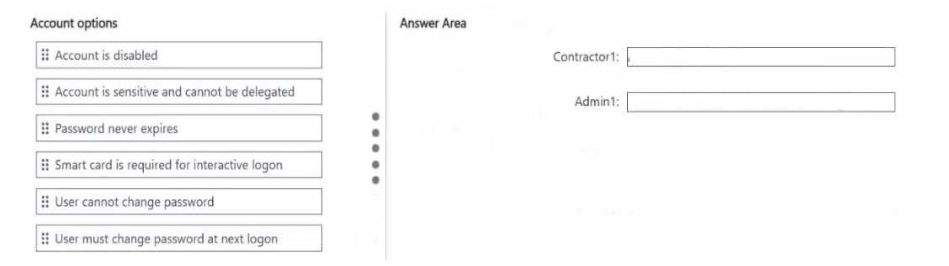
Your network contains an Active Directory Domain Services (AD DS) domain. The domain contains two users named Contractor1 and Admin1.

You need to configure Account options for the users. The solution must meet the following requirements:

  • Contractor1 must be prevented from signing in to their client computer until an administrator enables their account.

  • The credentials of Admin1 must NOT be usable by services that access network resources on behalf of users

What should you select for each user? To answer, drag the appropriate account options to the correct users. Each option may be used once, more than once, or not at all. You may need to drag the split bar between panes or scroll to view content.

NOTE: Each correct selection is worth one point.

Question 11 D1 Deploy and manage AD DS

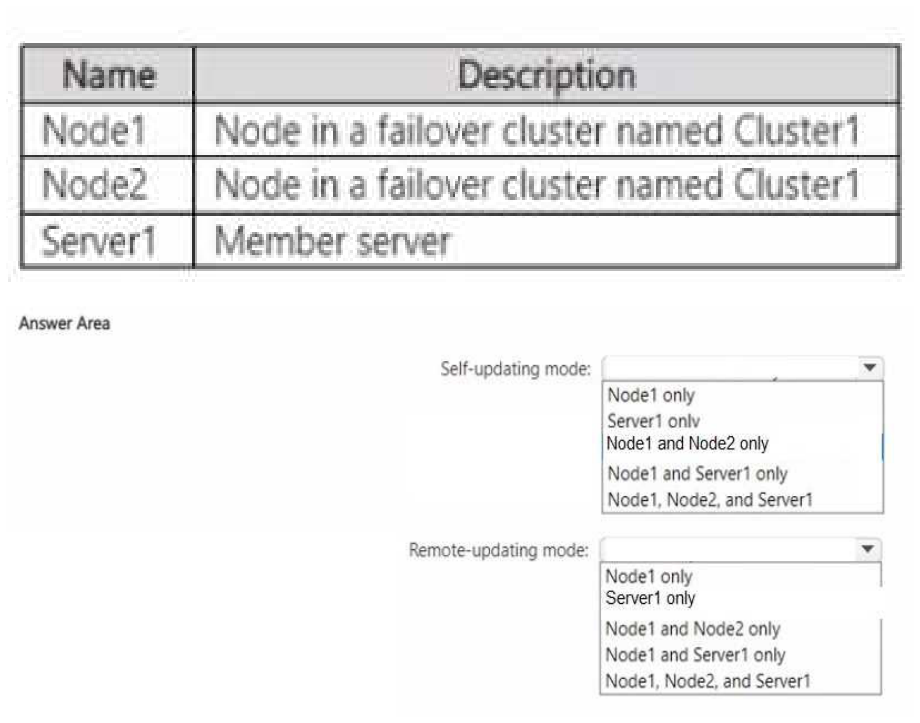
Your network contains an Active Directory Domain Services (AD DS) domain. The domain contains the servers shown in the following table.

NameDescription
Node1Node in a failover cluster named Cluster1
Node2Node in a failover cluster named Cluster1
Server1Member server

The Failover Clustering tools are NOT installed on the servers.

You plan to enable Cluster-Aware Updating (CAU).

On which servers should you install the Failover Clustering tools to implement CAU in self-updating mode, and on which servers should you install the Failover Clustering tools to implement remote-updating mode? To answer, select the appropriate options in the answer area.

NOTE: Each correct selection is worth one point.

Question 12 D1 Deploy and manage AD DS

Your network contains an Active Directory Domain Services (AD DS) forest. The forest contains a root domain named contoso.com and a child domain named branch.contoso.com. The forest contains the domain controllers shown in the following table: DC1 (contoso.com; a global catalog server that holds the schema master, domain naming master, PDC emulator, RID master, and infrastructure master roles); DC2 (contoso.com; NOT a global catalog server and does NOT hold any FSMO roles); DC3 (branch.contoso.com; a global catalog server that holds the PDC emulator and RID master roles); DC4 (branch.contoso.com; NOT a global catalog server and holds the infrastructure master role). You discover that cross-domain object references in contoso.com fail to update for objects in branch.contoso.com. You need to modify the FSMO role placement. The solution must minimize administrative changes. What should you do?

Question 13 D1 Deploy and manage AD DS

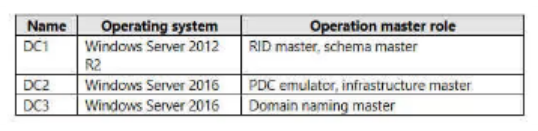
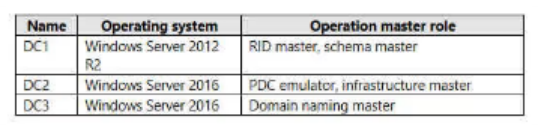
Your network contains an Active Directory Domain Services (AD DS) domain that has a Windows Server 2012 R2 forest and domain functional level. The domain contains the domain controllers shown in the following table. You need to ensure that you can deploy a new domain controller that runs Windows Server 2025. The solution must minimize administrative effort. Which two actions should you perform? Each correct answer presents part of the solution. NOTE: Each correct selection is worth one point.

Domain controllers and operating systems table

Select 2 answers.

Question 14 D1 Deploy and manage AD DS

You are administering a multi-site Active Directory environment with domain controllers distributed across three geographic locations. A new site has been added to the infrastructure, and you need to ensure that replication topology is optimized and that the Knowledge Consistency Checker (KCC) generates the appropriate connection objects between sites.

What should you do to verify and optimize the replication topology for the new site?

Question 15 D2 Manage Windows Server instances and workloads in a hybrid environment

Your company is implementing Azure Arc for Windows Server to manage 50 on-premises servers alongside 30 Azure VMs from a centralized portal. You need to deploy security updates using Azure Update Manager across both on-premises and Azure resources with consistent scheduling. However, you discover that 15 onpremises servers are in an isolated network segment with restricted outbound internet access.

What should you do to enable Azure Update Manager for those 15 isolated on-premises servers?

Question 16 D2 Manage Windows Server instances and workloads in a hybrid environment

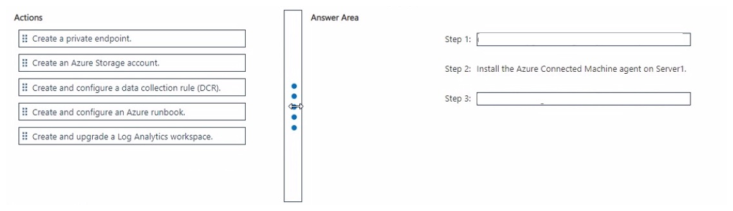
You have an on-premises server named Server1 that runs Windows Server.

You have an Azure subscription that uses Microsoft Defender for Cloud.

You need to onboard Server1 to Defender for Cloud.

Which actions should you perform in sequence? To answer, drag the appropriate actions to the correct order. Each action may be used once, more than once, or not at all. You may need to drag the split bar between panes or scroll to view content.

NOTE: Each correct selection is worth one point.

Actions:

  • Create a private endpoint.

  • Create an Azure Storage account.

  • Create and configure a data collection rule (DCR).

  • Create and configure an Azure runbook.

  • Create and upgrade a Log Analytics workspace.

Step 1: [blank]

Step 2: Install the Azure Connected Machine agent on Server1.

Step 3: [blank]

Question 17 D2 Manage Windows Server instances and workloads in a hybrid environment

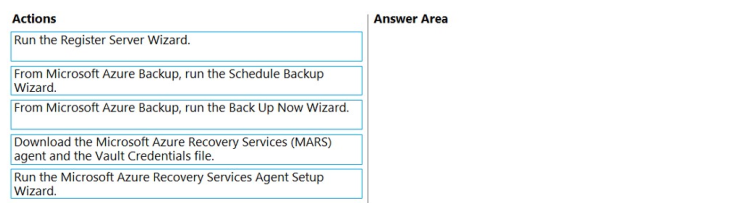
You have a server that runs Windows Server. You plan to back up the server to an Azure Recovery Services vault once per week starting on the next Saturday. You need to schedule the weekly backup and perform the initial backup as soon as possible. In which order should you perform the actions? To answer, move all actions from the list of actions to the answer area and arrange them in the correct order.

Actions:

  • Run the Register Server Wizard.

  • From Microsoft Azure Backup, run the Schedule Backup Wizard.

  • From Microsoft Azure Backup, run the Back Up Now Wizard.

  • Download the Microsoft Azure Recovery Services (MARS) agent and the Vault Credentials file.

  • Run the Microsoft Azure Recovery Services Agent Setup Wizard.

Question 18 D2 Manage Windows Server instances and workloads in a hybrid environment

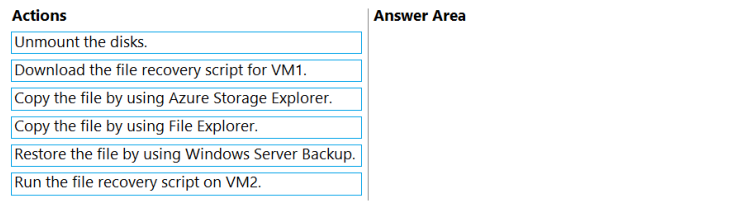
You have two Azure virtual machines named VM1 and VM2. VM1 is backed up to an Azure Recovery Services vault daily and retains backups for 30days.

You need to restore an individual file named C:\Data\Important.docx from VM1 to VM2. The solution must minimize administrative effort.

Which four actions should you perform in sequence? To answer, move the appropriate actions from the list of actions to the answer area and arrange them in the correct order.

Actions:

  • Unmount the disks.

  • Download the file recovery script for VM1.

  • Copy the file by using Azure Storage Explorer.

  • Copy the file by using File Explorer.

  • Restore the file by using Windows Server Backup.

  • Run the file recovery script on VM2.

Question 19 D2 Manage Windows Server instances and workloads in a hybrid environment

Your organization is implementing Azure Arc to manage Windows Server instances across multiple data centers and branch offices. You have deployed Azure Arc agents on 150 servers. Now you need to ensure consistent security configurations across these hybrid servers, enforce software updates, and deploy configuration changes without accessing each server individually. Which of the following Azure services would best enable you to accomplish these requirements? (Select all that apply.)

Select 2 answers.

Question 20 D2 Manage Windows Server instances and workloads in a hybrid environment
Case study

Case study

Overview

This is a case study. Case studies are not timed separately. You can use as much exam time as you would like to complete each case. However, there may be additional case studies and sections on this exam. You must manage your time to ensure that you are able to complete all questions included on this exam in the time provided.

To answer the questions included in a case study, you will need to reference information that is provided in the case study. Case studies might contain exhibits and other resources that provide more information about the scenario that is described in the case study. Each question is independent of the other questions in this case study.

Overview: Fabrikam, Inc. is a manufacturing company that has a main office in New York and a branch office in Seattle.

On-Premises Servers: The on-premises network contains the servers shown in the exhibit below. DC1 hosts all the operations master roles. WEB1 and WEB2 run an Internet Information Services (IIS) web app named Webapp1.

On-premises servers

On-Premises Network: The New York and Seattle offices are connected by using redundant WAN links. The client computers in each office get IP addresses from their local DHCP server. DHCP1 contains a scope named Scope1 that has addresses for the New York office. DHCP2 contains a scope named Scope2 that has addresses for the Seattle office.

Group Policy Objects (GPOs): The corp.fabrikam.com domain contains the organizational units (OUs) and custom Group Policy Objects (GPOs) shown in the exhibit below.

OUs and GPOs

Planned Changes: Fabrikam identifies the following planned changes:

  • Create a single Azure subscription named Sub1 that will contain a single Azure virtual network named Vnet1.

  • Replace the WAN links between the Seattle and New York offices by using Azure Virtual WAN and ExpressRoute. Both on-premises offices will be connected to Vnet1 by using ExpressRoute.

  • Create three Azure file shares named newyorkfiles, seattlefiles, and companyfiles.

  • Create a domain controller named dc3.corp.fabrikam.com in Vnet1.

  • Deploy an Azure Virtual Desktop host pool to Vnet1. The Azure Virtual Desktop session hosts will be hybrid Microsoft Entra joined.

  • License all servers for Microsoft Defender for Servers.

  • Use Azure Policy to enforce configuration management policies on the servers in Azure and on-premises.

Security Requirements: Fabrikam identifies the following security requirements:

  • Apply GPO4 to the Azure Virtual Desktop session hosts. Ensure that Azure Virtual Desktop user sessions lock after being idle for 10 minutes. Users must be able to control the lockout time manually from their client computer.

  • Ensure that server administrators request approval before they can establish a Remote Desktop connection to an Azure virtual machine. If the request is approved, the connection must be established within two hours.

  • Prevent user passwords from containing all or part of words that are based on the company name, such as Fab, fabrikam, or fabr1k.

  • Ensure that all instances of Webapp1 use the same service account. The password of the service account must change automatically every 30 days.

  • Prevent domain controllers from directly contacting hosts on the internet.

File Sharing Requirements: You need to configure the synchronization of Azure files to meet the following requirements:

  • Ensure that seattlefiles syncs to FS2.

  • Ensure that newyorkfiles syncs to FS1.

  • Ensure that companyfiles syncs to both FS1 and FS2.

You are implementing a hybrid identity and access strategy using Azure Arc for Windows Server. Your organization needs to manage device compliance for on-premises Windows Server instances that are not domain-joined, track configuration drift, and apply Azure policies. You want to enable automatic remediation for non-compliant servers. Which of the following approaches should you implement?

Question 21 D2 Manage Windows Server instances and workloads in a hybrid environment

You have 20 on-premises servers, including a server named Server1, that run Windows Server.

Server1 has Windows Admin Center deployed and is connected to the internet. You have an Azure subscription. You need to integrate Windows Admin Center with Azure so that you can use Azure services to manage and monitor the on-premises servers. What should you do first?

Question 22 D2 Manage Windows Server instances and workloads in a hybrid environment

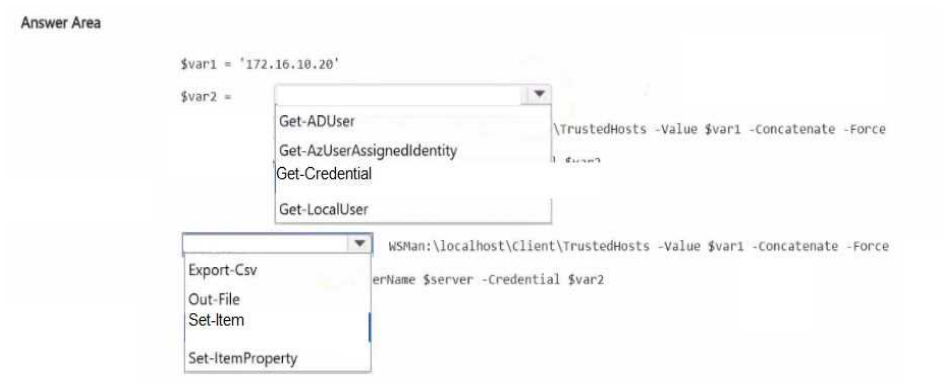
You have an administrative workstation named AdminPC in a workgroup.

AdminPC has existing entries in the WSMan TrustedHosts list.

You have a server named Server1 that has PowerShell remoting enabled and is reachable at an IP address of 172.16.10.20.

You need to create a remote PowerShell session from AdminPC to Server1. The solution must meet the following requirements:

  • Preserve the existing TrustedHosts entries on AdminPC.

  • Use the IP address of Server1 for the remote session.

How should you complete the script? To answer, select the appropriate options in the answer area. NOTE: Each correct selection is worth one point.

$var1 = '172.16.10.20'
$var2 = [Blank 1]
[Blank 2] WSMan:\localhost\Client\TrustedHosts -Value $var1 -Concatenate -Force
$s = New-PSSession -ComputerName $server -Credential $var2
Question 23 D2 Manage Windows Server instances and workloads in a hybrid environment

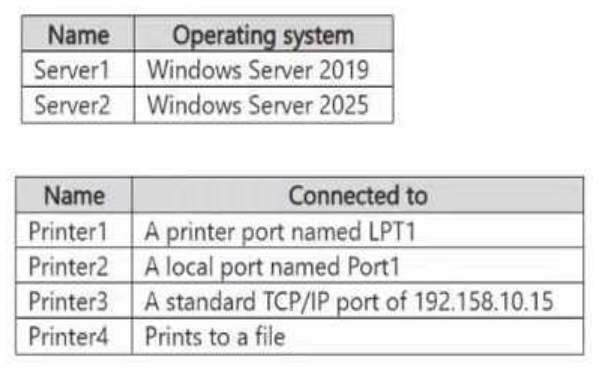
Your network contains an Active Directory Domain Services (AD DS) domain. The domain contains the servers shown in the following table. Server1 contains the printers shown in the following table.

You plan to use Print Management to migrate the printers to Server2. Which printers can be migrated and retain their current configuration? (Exhibits: servers table and printers table.)

Servers Printers on Server1

Question 24 D2 Manage Windows Server instances and workloads in a hybrid environment

You have an on-premises server named Server1 that runs Windows Server. Server1 has the Web Server (IIS) server role installed and hosts an ASP.NET web app named App1. You have an Azure subscription. You plan to migrate App1 to a container in Azure. You need to export App1 to a ZIP file.

What should you install on Server1?

Question 25 D3 Manage VMs

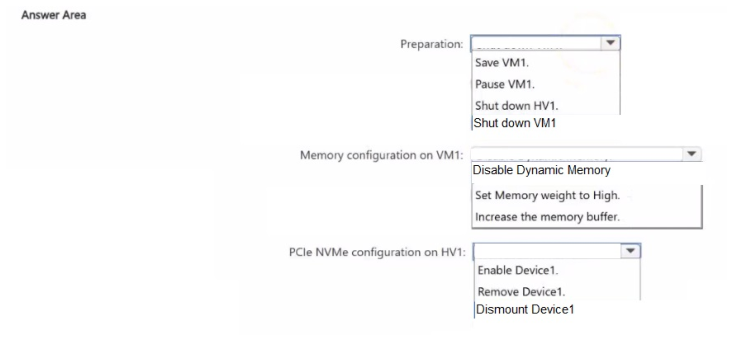
You have a Hyper-V host named HV1 that contains a virtual machine named VM1.

VM1 has Dynamic Memory enabled. HV1 contains a PCIe NVMe storage device named Device1 that supports Discrete Device Assignment (DDA) and is disabled on HV1.

You need to ensure that Device1 can be assigned directly to VM1 by using DD.

What should you do? To answer, select the appropriate options in the answer area. NOTE: Each correct selection is worth one point.

Question 26 D3 Manage VMs

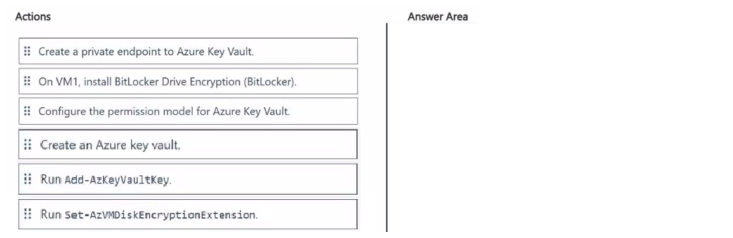
You have an Azure subscription. The subscription contains a virtual machine named VM1 that runs Windows Server.

You need to encrypt the disks connected to VM1 by using Azure Disk Encryption. The solution must use a key encryption key (KEK).

Which three actions should you perform in sequence? To answer, move the appropriate actions from the list of actions to the answer area and arrange them in the correct order.

Actions:

  • Create a private endpoint to Azure Key Vault.

  • On VM1, install BitLocker Drive Encryption (BitLocker).

  • Configure the permission model for Azure Key Vault.

  • Create an Azure key vault.

  • Run Add-AzKeyVaultKey.

  • Run Set-AzVMDiskEncryptionExtension.

Question 27 D3 Manage VMs

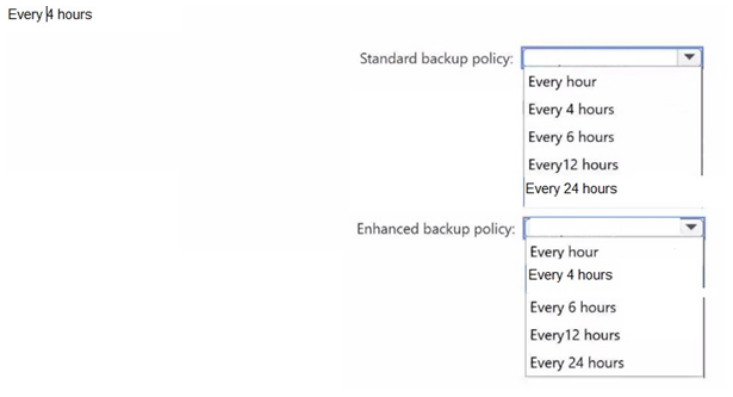
You have an Azure subscription. The subscription contains a virtual machine named VM1 that runs Windows Server.

You need to back up VM1 by using Azure Backup. The solution must minimize potential data loss.

What is the minimum backup interval you can configure for a standard backup policy and an enhanced backup policy? To answer, select the appropriate options in the answer area.

NOTE: Each correct selection is worth one point.

Question 28 D3 Manage VMs

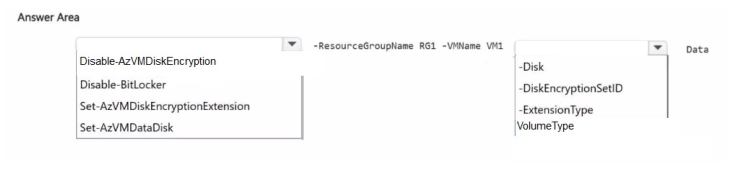
You have an Azure virtual machine named VM1 that runs Windows Server. The disks on VM1 are protected by using Azure Disk Encryption.

You need to use PowerShell to disable disk encryption on the data disks attached to VM1.

How should you complete the command? To answer, select the appropriate options in the answer area.

NOTE: Each correct selection is worth one point.

[Blank 1] -ResourceGroupName RG1 -VMName VM1 [Blank 2] Data
Question 29 D3 Manage VMs

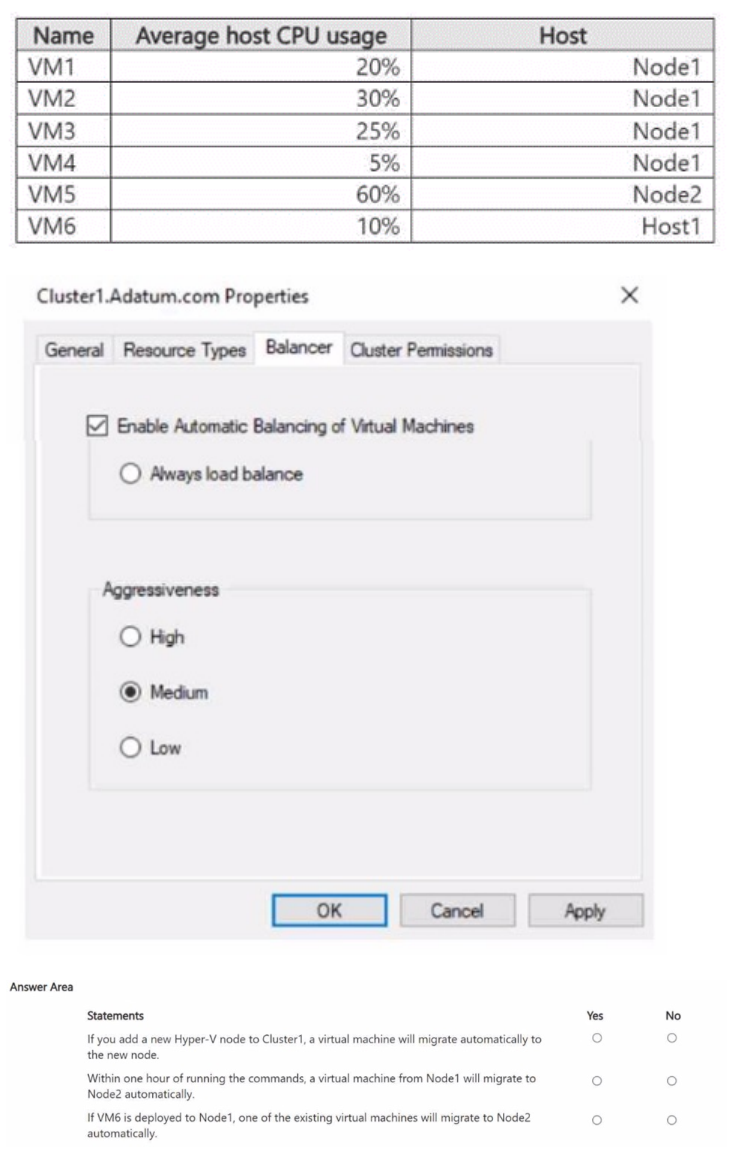
You have a Hyper-V failover cluster named Cluster1 that contains two nodes named Node1 and Node2, and a Hyper-V host named Host1.

You have the virtual machines shown in the following table.

NameAverage host CPU usageHost
VM120%Node1
VM230%Node1
VM325%Node1
VM45%Node1
VM560%Node2
VM610%Host1

The Balancer settings for Cluster1 are shown in the following exhibit.

Balancer settings:

  • Enable Automatic Balancing of Virtual Machines: enabled

  • Always load balance: not selected

  • Aggressiveness: Medium selected (High and Low are not selected)

For each of the following statements, select Yes if the statement is true. Otherwise, select No.

NOTE: Each correct selection is worth one point.

StatementYesNo
If you add a new Hyper-V node to Cluster1, a virtual machine will migrate automatically to the new node.
Within one hour of running the commands, a virtual machine from Node1 will migrate to Node2 automatically.
If VM6 is deployed to Node1, one of the existing virtual machines will migrate to Node2 automatically.
Question 30 D3 Manage VMs

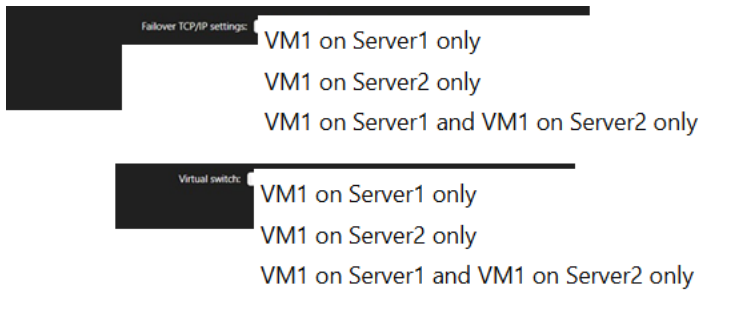
You have two on-premises Hyper-V hosts named Server1 and Server2. Server1 hosts a virtual machine named VM1 that uses a static IP address. VM1 replicates to Server2 by using Hyper-V Replica.

You plan to perform a failover test for VM1.

You need to configure the Failover TCP/IP settings and the virtual switch for the failover.

Where should you configure the Failover TCP/IP settings, and where should you configure the virtual switch?

To answer, select the appropriate options in the answer area.

NOTE: Each correct selection is worth one point.

Question 31 D3 Manage VMs

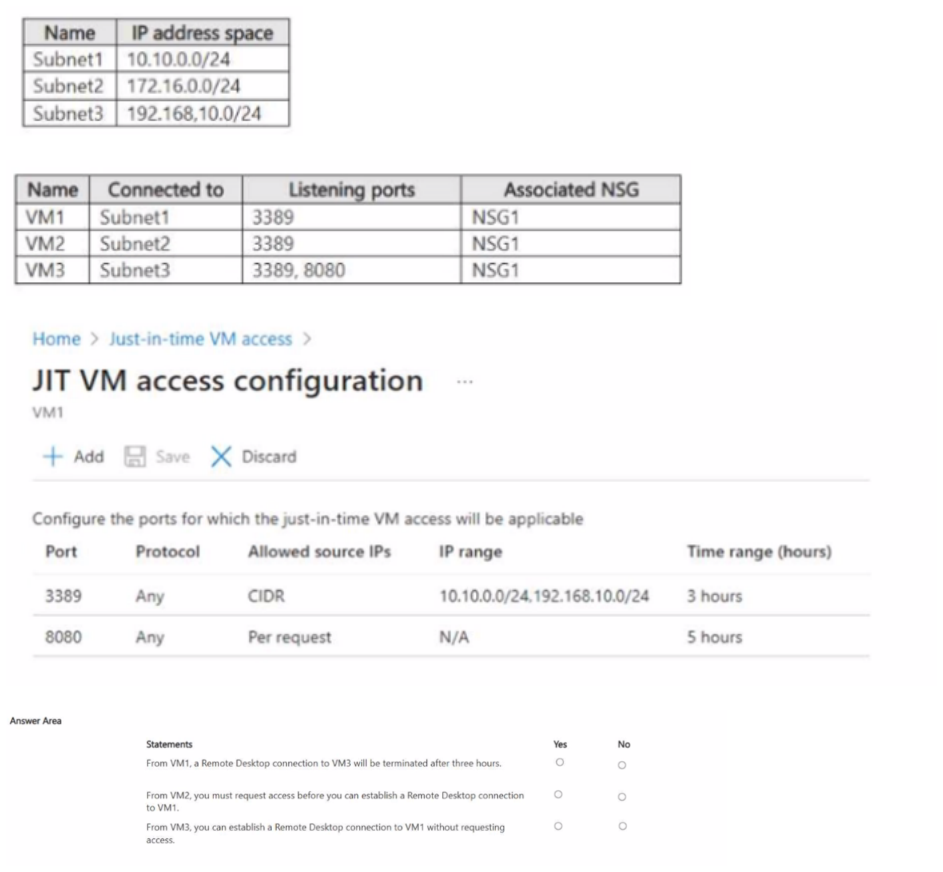
You have an Azure subscription that contains a network security group (NSG) named NSG1 and a virtual network named VNet1. NSG1 contains only default security rules. VNet1 contains the subnets shown in the following table.

NameIP address space
Subnet110.10.0.0/24
Subnet2172.16.0.0/24
Subnet3192.168.10.0/24

The subscription contains virtual machines that run Windows Server as shown in the following table.

NameConnected toListening portsAssociated NSG
VM1Subnet13389NSG1
VM2Subnet23389NSG1
VM3Subnet33389, 8080NSG1

You configure just-in-time (JIT) VM access as shown in the following exhibit.

JIT VM access configuration — VM1

PortProtocolAllowed source IPsIP rangeTime range (hours)
3389AnyCIDR10.10.0.0/24, 192.168.10.0/243 hours
8080AnyPer requestN/A5 hours

For each of the following statements, select Yes if the statement is true. Otherwise, select No.

NOTE: Each correct selection is worth one point

Statements:

  1. From VM1, a Remote Desktop connection to VM3 will be terminated after three hours.

  2. From VM2, you must request access before you can establish a Remote Desktop connection to VM1.

  3. From VM3, you can establish a Remote Desktop connection to VM1 without requesting access.

StatementYesNo
From VM1, a Remote Desktop connection to VM3 will be terminated after three hours.
From VM2, you must request access before you can establish a Remote Desktop connection to VM1.
From VM3, you can establish a Remote Desktop connection to VM1 without requesting access.
Question 32 D3 Manage VMs

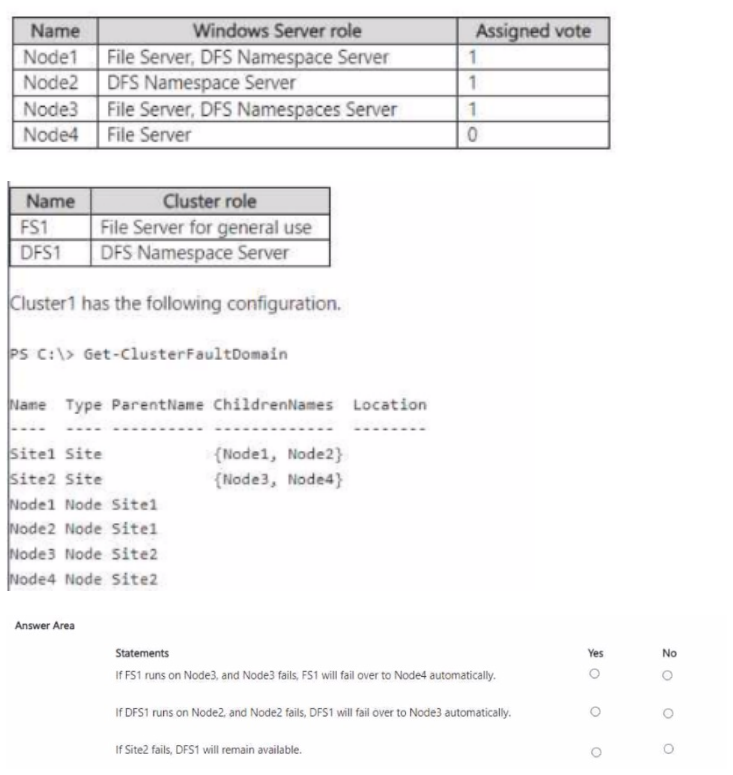
You have a Windows Server failover cluster named Cluster1 that has a cloud witness and the nodes shown in the following table.

NameWindows Server roleAssigned vote
Node1File Server, DFS Namespace Server1
Node2DFS Namespace Server1
Node3File Server, DFS Namespaces Server1
Node4File Server0

Cluster1 has the roles shown in the following table.

NameCluster role
FS1File Server for general use
DFS1DFS Namespace Server

Cluster1 has the following configuration.

PS C:\> Get-ClusterFaultDomain
Name  Type  ParentName  ChildrenNames  Location
----  ----  ----------  -------------  --------
Site1 Site              {Node1, Node2}
Site2 Site              {Node3, Node4}
Node1 Node  Site1
Node2 Node  Site1
Node3 Node  Site2
Node4 Node  Site2

For each of the following statements, select Yes if the statement is true. Otherwise, select No.

NOTE: Each correct selection is worth one point.

StatementYesNo
If FS1 runs on Node3, and Node3 fails, FS1 will fail over to Node4 automatically.
If DFS1 runs on Node2, and Node2 fails, DFS1 will fail over to Node3 automatically.
If Site2 fails, DFS1 will remain available.
Question 33 D3 Manage VMs

You have an Azure subscription that contains a virtual machine named VM1 and a Recovery Services vault named Vault1. VM1 runs Windows Server. You need to back up VM1 to Vault1 by using Azure Backup. The solution must minimize administrative effort. What should you do first?

Question 34 D3 Manage VMs

You are configuring a Windows Server Hyper-V environment and need to implement high availability for critical virtual machines. You plan to use Hyper-V Replica to provide disaster recovery between two onpremises data centers. During the configuration, you need to ensure that replica VMs are automatically triggered to failover when the primary VM becomes unavailable, and that you can test failover without interrupting production.

Which two features or capabilities should you implement to meet these requirements?

Select 2 answers.

Question 35 D3 Manage VMs

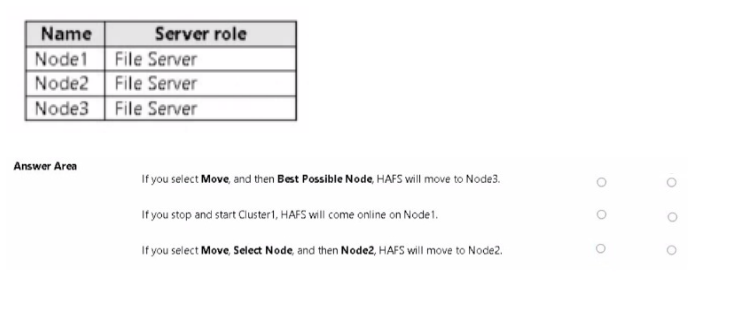
You have a failover cluster named Cluster1 that contains the nodes shown in the following table.

A File Server for general use cluster role named HAFS is configured as shown in the General exhibit (Click the General tab.)

NameServer role
Node1File Server
Node2File Server
Node3File Server

Exhibit

StatementYesNo
If you select Move, and then Best Possible Node, HAFS will move to Node3.
If you stop and start Cluster1, HAFS will come online on Node1.
If you select Move, Select Node, and then Node2, HAFS will move to Node2.
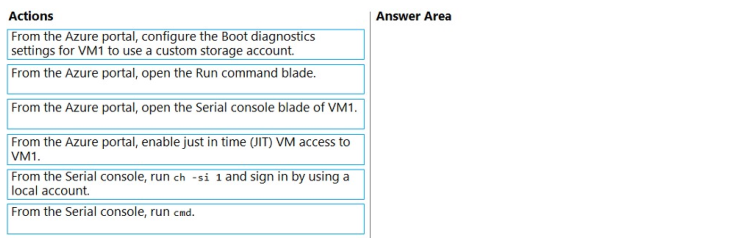
Question 36 D3 Manage VMs

You have an Azure virtual machine named VM1 that runs Windows Server. VM1 has boot diagnostics configured to use a managed storage account.

You are troubleshooting connectivity issue on VM1.

You need to run a PowerShell cmdlet on VM1 by using the Azure Serial Console.

Which four actions should you perform in sequence? To answer, move the appropriate actions from the list of actions to the answer area and arrange them in the correct order.

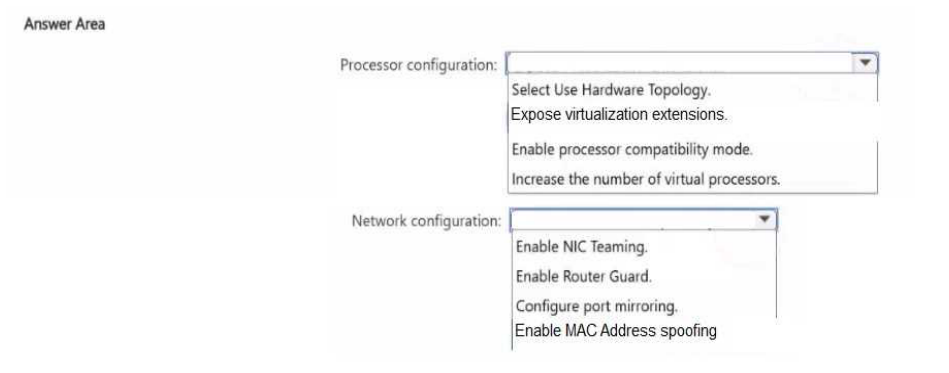
Question 37 D3 Manage VMs

You have a Hyper-V host named HV1 that contains a virtual machine named VM1. HV1 supports nested virtualization. VM1 is connected to an external virtual switch.

You plan to install the Hyper-V server role on VM1.

You need to prepare VM1 to host nested virtual machines. The solution must meet the following requirements:

  • Enable VM1 to run Hyper-V.

  • Enable nested virtual machines to communicate on the physical LAN.

How should you configure VM1? To answer, select the appropriate options in the answer area. Each correct selection is worth one point.

Processor configuration:

Network configuration:

Question 38 D3 Manage VMs

You have a Windows Server Failover Cluster (WSFC) that contains five nodes. You need to ensure that if a network link fails on one of the nodes, the workloads are distributed across the remaining nodes during a failover. The solution must ensure that the workloads are distributed across all the nodes as evenly as possible. Which command should you run?

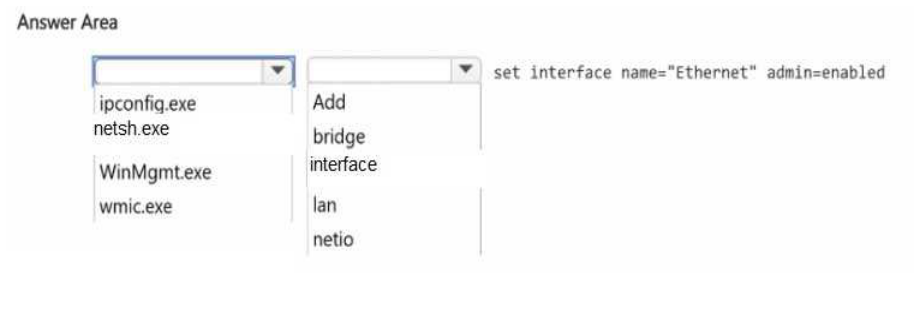
Question 39 D3 Manage VMs

You have an Azure subscription. The subscription contains a virtual machine named VM1 that runs Windows Server.

The network interface for VM1 is disabled in the operating system.

You need to enable the network interface by using the Azure Serial Console.

How should you complete the command? To answer, select the appropriate options in the answer area.

NOTE: Each correct selection is worth one point.

[Blank 1] [Blank 2] set interface name="Ethernet" admin=enabled
Question 40 D4 Implement and manage an on-premises and hybrid networking infrastructure

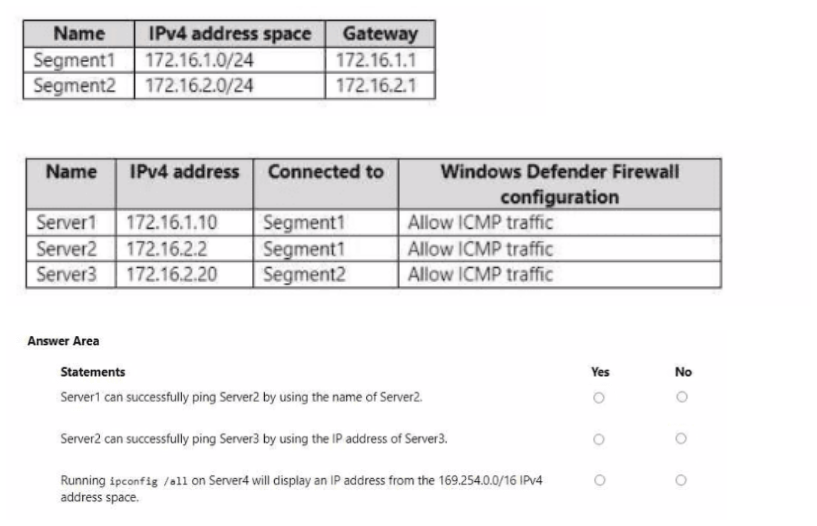
Your network contains the segments shown in the following table.

NameIPv4 address spaceGateway
Segment1172.16.1.0/24172.16.1.1
Segment2172.16.2.0/24172.16.2.1

You have servers that run Windows Server and are configured as shown in the following table.

NameIPv4 addressConnected toWindows Defender Firewall configuration
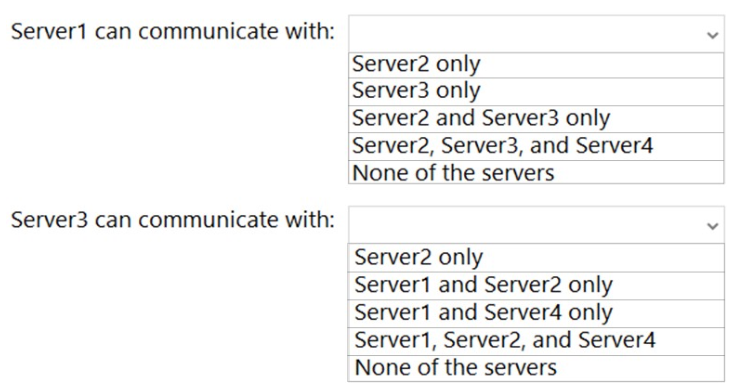
Server1172.16.1.10Segment1Allow ICMP traffic
Server2172.16.2.2Segment1Allow ICMP traffic
Server3172.16.2.20Segment2Allow ICMP traffic

You deploy a server named Server4 that runs Windows Server and has a static IP address of 172.16.1.1. You connect Server4 to Segment1.

For each of the following statements, select Yes if the statement is true. Otherwise, select No.

NOTE: Each correct selection is worth one point.

StatementYesNo
Server1 can successfully ping Server2 by using the name of Server2.
Server2 can successfully ping Server3 by using the IP address of Server3.
Running ipconfig /all on Server4 will display an IP address from the 169.254.0.0/16 IPv4 address space.
Question 41 D4 Implement and manage an on-premises and hybrid networking infrastructure

Your network contains an Active Directory Domain Services (AD DS) domain. The domain contains a server named DHCP1 that runs Windows Server and has the DHCP Server role installed. DHCP1 has a static IPv4 address of 10.10.10.5/24. DHCP1 is authorized in AD DS and contains an active scope for a subnet of 10.10.20.0/24. Client computers on the 10.10.20.0/24 subnet receive APIPA addresses. You verify that the DHCP Server service is running, and the scope has available IP addresses. You need to ensure that the computers on 10.10.20.0/24 can obtain IPv4 address leases from DHCP1. What should you do?

Question 42 D4 Implement and manage an on-premises and hybrid networking infrastructure

Your network contains an on-premises Active Directory Domain Services (AD DS) forest named contoso.com. The forest contains three domain controllers that have the DNS Server role installed and host an Active Directory-integrated zone for contoso.com. The DNS servers use existing forwarders for internet name resolution. You have a partner company that owns a DNS namespace named fabrikam.com and provides DNS servers at IP addresses 172.16.10.10 and 172.16.10.11 over a Site-to-Site (S2S) VPN. You need to configure the DNS servers in the contoso.com forest. The solution must meet the following requirements: - Send queries for fabrikam.com to the partner company's DNS servers. - Continue to use the existing forwarders for other external namespaces. - Apply the configuration to all the current and future DNS servers on the domain controllers in contoso.com.

What should you do?

Question 43 D4 Implement and manage an on-premises and hybrid networking infrastructure

You have a server named DHCP1 that runs Windows Server and has the DHCP Server role installed.

DHCP1 hosts an activated IPv4 scope for a subnet of 192.168.15.0/24. You have a CSV file named PrinterReservations.csv that contains the following columns: ClientId, ScopeId, IPAddress, MacAddress. All the IP addresses in PrinterReservations.csv are within the scope range and are currently available. You need to create DHCP reservations for 20 printers by using PrinterReservations.csv. The solution must minimize administrative effort. Which PowerShell command should you run?

Question 44 D4 Implement and manage an on-premises and hybrid networking infrastructure

Your on-premises network is connected to Azure. You have an Azure subscription. The subscription contains a virtual machine named VM1 that runs Windows Server. You need to identify the latency between the on-premises network and VM1. Which Azure Network Watcher setting should you use?

Question 45 D4 Implement and manage an on-premises and hybrid networking infrastructure

Your network contains an Active Directory Domain Services (AD DS) domain.

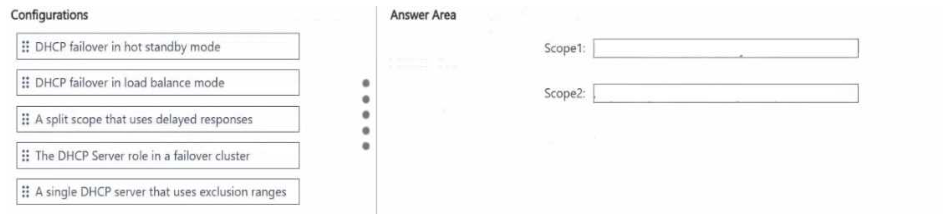
The domain contains three servers named DHCP1, DHCP2, and DHCP3 that run Windows Server and have the DHCP Server role installed. The servers host IPv4 scopes only. Shared storage is unavailable.

Your company has a main datacenter that contains DHCP1 and DHCP2. The company has a disaster-recovery datacenter that contains DHCP3 and connects to the main datacenter by using a WAN link.

You have two scopes named Scope1 and Scope2.

You need to provide DHCP service continuity for the scopes. The solution must meet the following requirements:

  • Scope1: DHCP3 must provide leases only if a DHCP server in the a main datacenter is unavailable.

  • Scope2: DHCP1 and DHCP2 must each lease from separate parts of the IP address range. DHCP2 must wait before responding to client computer requests.

How should you configure high availability for each scope? To answer, drag the appropriate configurations to the correct scopes. Each configuration may be used once, more than once, or not at all. You may need to drag the split bar between panes or scroll to view content.

NOTE: Each correct selection is worth one point.

Question 46 D4 Implement and manage an on-premises and hybrid networking infrastructure

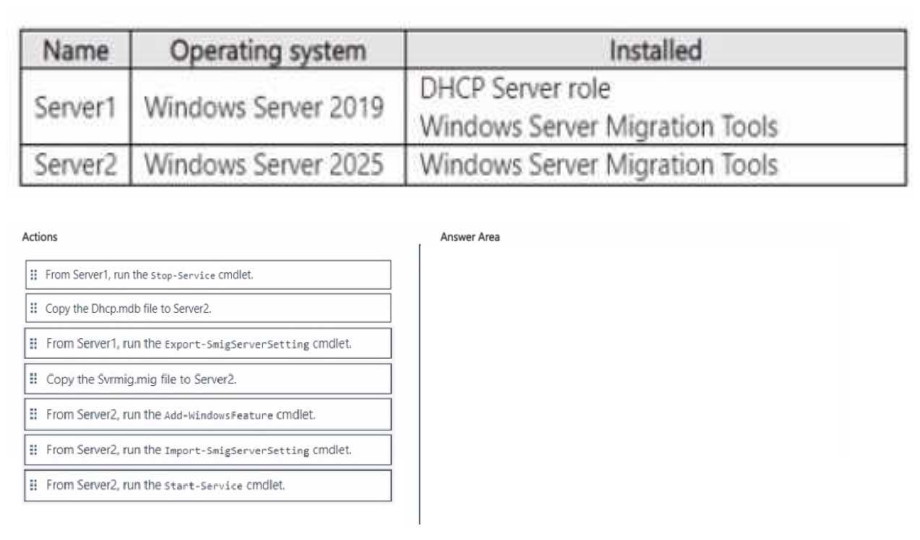
Your network contains an Active Directory Domain Services (AD DS) domain that contains the servers shown in the following table.

NameOperating systemInstalled
Server1Windows Server 2019DHCP Server role; Windows Server Migration Tools
Server2Windows Server 2025Windows Server Migration Tools

Server1 and Server2 are authorized as DHCP servers in the domain. You need to migrate the DHCP Server role from Server1 to Server2. Which five actions should you perform in sequence? To answer, move the appropriate actions from the list of actions to the answer area and arrange them in the correct order.

Actions:

  • From Server1, run the Stop-Service cmdlet.

  • Copy the Dhcp.mdb file to Server2.

  • From Server1, run the Export-SmigServerSetting cmdlet.

  • Copy the Svrmig.mig file to Server2.

  • From Server2, run the Add-WindowsFeature cmdlet.

  • From Server2, run the Import-SmigServerSetting cmdlet.

  • From Server2, run the Start-Service cmdlet.

Question 47 D5 Manage storage and file services

You are configuring storage for a Windows Server failover cluster that requires high-speed access to shared storage and must support live migration of virtual machines. Your organization has newer switches and network cards that support Remote Direct Memory Access (RDMA). You plan to use Storage Spaces Direct with three nodes. Which configuration changes must you implement to optimize performance for this environment?

Question 48 D5 Manage storage and file services

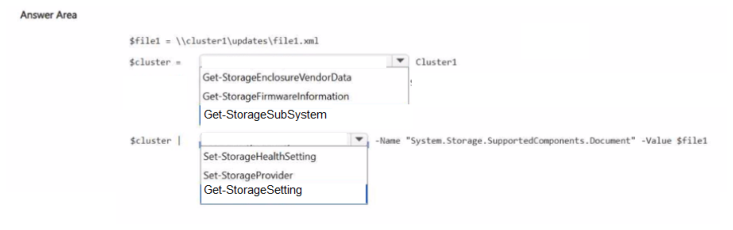
You have a Storage Spaces Direct cluster named Cluster1 that contains multiple nodes.

You have a firmware update for the hard disks attached to each node.

You create a configuration file named FileLxm1 for the update.
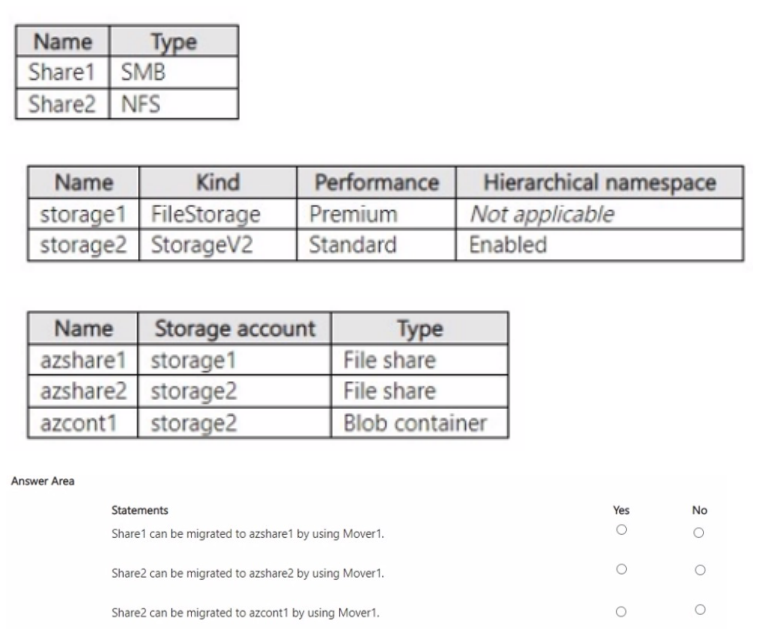
You need to automate the rollout of the firmware update to the nodes of Cluster1. The solution must minimize downtime of the workloads hosted in Cluster1.

How should you complete the PowerShell commands? To answer, select the appropriate options in the answer area.

NOTE: Each correct selection is worth one point.

$file1 = \\cluster1\updates\file1.xml
$cluster = [Blank 1] Cluster1
$cluster | [Blank 2] -Name "System.Storage.SupportedComponents.Document" -Value $file1
Question 49 D5 Manage storage and file services

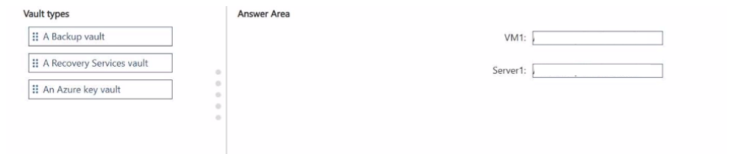
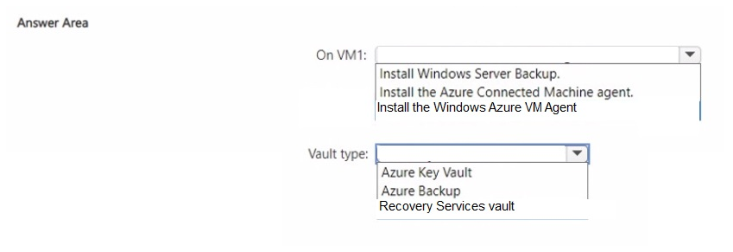
You have an on-premises server named Server1 that runs Windows Server and has the Hyper-V server role installed.

You have an Azure subscription that contains a virtual machine named VM1. VM1 runs Windows Server.

You plan to use Azure Backup.

Which type of vault should you configure for each resource? To answer, drag the appropriate vault types to the correct resources. Each vault type may be used once, more than once, or not at all. You may need to drag the split bar between panes or scroll to view content.

NOTE: Each correct selection is worth one point.

Question 50 D5 Manage storage and file services

You have a server named Server1 that runs Windows Server and is hosted in a VMWare environment.

Server1 contains an ASP.NET application named App1. Users access App1 by using the following URL: https://app1.contoso.com.

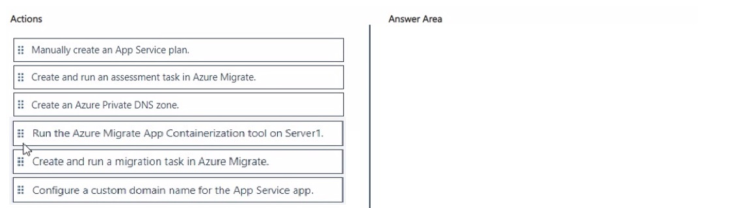
You need to use the integrated flow in Azure Migrate to migrate App1 to Azure App Service. After the migration, users must be able to access App1 by using the same URL.

Which three actions should you perform in sequence? To answer, move the appropriate actions from the list of actions to the answer area and arrange them in the correct order.

Actions:

  • Manually create an App Service plan.

  • Create and run an assessment task in Azure Migrate.
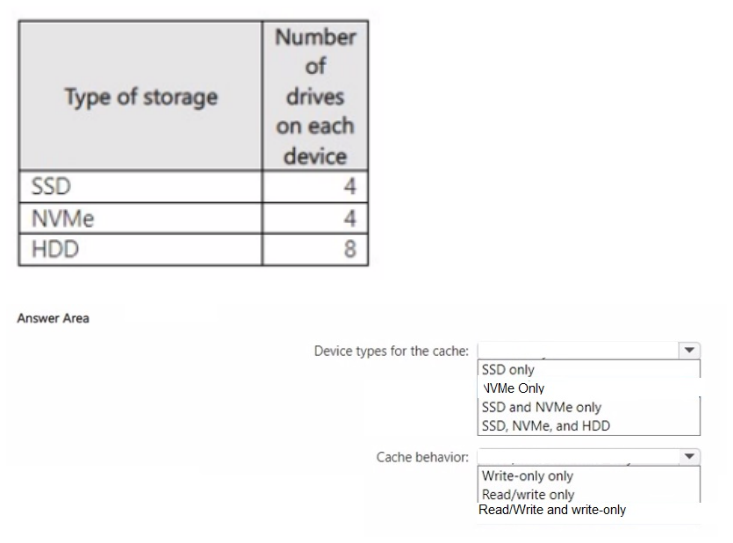
  • Create an Azure Private DNS zone.

  • Run the Azure Migrate App Containerization tool on Server1.

  • Create and run a migration task in Azure Migrate.
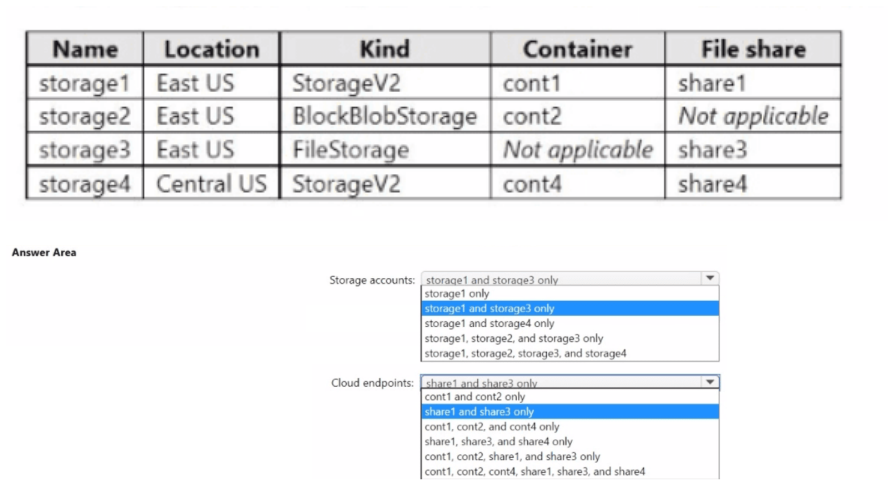
  • Configure a custom domain name for the App Service app.

Question 51 D5 Manage storage and file services

You have an on-premises server named Server 1 that runs Windows Server.

You have an Azure subscription.

You migrate Server1 to an Azure virtual machine named VM1.

You need to configure a backup solution for VM1. The solution must provide recovery points.

What should you do on VM1, and in which type of vault should you store the backups? To answer, select the appropriate options in the answer area.

NOTE: Each correct selection is worth one point.

Question 52 D5 Manage storage and file services

You have an on-premises server named Server1 that runs Windows Server and contains the shares shown in the following table.

NameType
Share1SMB
Share2NFS

You have an Azure subscription named Sub1 that contains an Azure Storage Mover resource named Mover1 and the storage accounts shown in the following table.
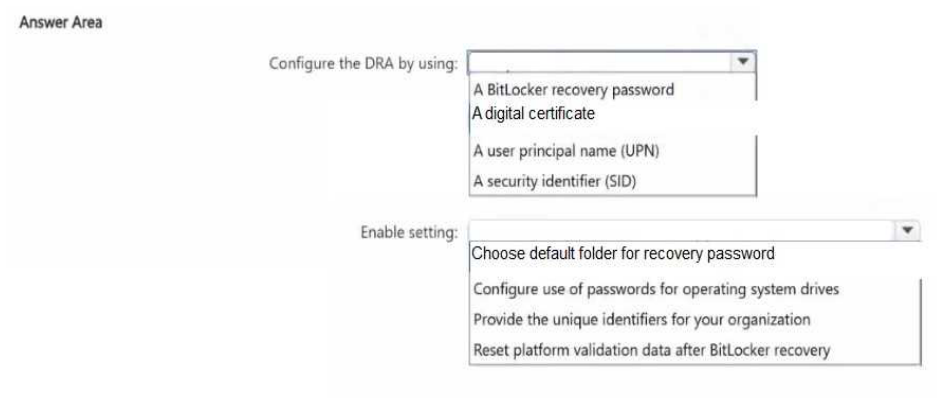
NameKindPerformanceHierarchical namespace
storage1FileStoragePremiumNot applicable
storage2StorageV2StandardEnabled

The storage accounts contain the resources shown in the following table.

NameStorage accountType
azshare1storage1File share
azshare2storage2File share
azcont1storage2Blob container

For each of the following statements, select Yes if the statement is true. Otherwise, select No.

NOTE: Each correct selection is worth one point.

StatementYesNo
Share1 can be migrated to azshare1 by using Mover1.
Share2 can be migrated to azshare2 by using Mover1.
Share2 can be migrated to azcont1 by using Mover1.
Question 53 D5 Manage storage and file services

You have four servers that run Windows Server. Each server has the direct-attached storage (DAS) devices shown in the following table.

You need to deploy Storage Spaces Direct.

Which types of devices will be used for the cache, and what will be the default cache behavior? To answer, select the appropriate options in the answer area.

NOTE: Each correct selection is worth one point.

Type of storageNumber of drives on each device
SSD4
NVMe4
HDD8

Exhibit

Question 54 D5 Manage storage and file services

You have an Azure subscription that contains the storage accounts shown in the following table. In the East US Azure region, you create a storage sync service named Sync.

NameLocationKindContainerFile share
storage1East USStorageV2cont1share1
storage2East USBlockBlobStoragecont2Not applicable
storage3East USFileStorageNot applicableshare3
storage4Central USStorageV2cont4share4
Question 55 D5 Manage storage and file services

You have a file server that runs Windows Server and contains a deduplicated NTFS volume named Volume01.

Volume01 contains file shares for a team at your company.

During a recent period of peak usage, the Data Deduplication default schedules paused. During the pause, administrators deleted many optimized files, and storage diagnostics reported bad sectors on the underlying disks.

You need to run Data Deduplication on Volume01 to meet the following requirements:

  • Reclaim free space.

  • Validate and repair data integrity issues.

Which job should you run for each requirement? To answer, drag the appropriate jobs to the correct requirements. Each job may be used once, more than once, or not at all. You may need to drag the split bar between panes or scroll to view content.

NOTE: Each correct selection is worth one point.

Question 56 D5 Manage storage and file services

Your network contains an on-premises Active Directory Domain Services (AD DS) domain. The domain contains servers that run Windows Server. The domain contains a group named Group1. You have an Azure Storage account that contains an Azure Files share named share1. Identity-based authentication for Azure Files is enabled by using the domain. Group1 syncs with a Microsoft Entra tenant. The members of Group1 can authenticate from the servers but cannot access the files in share1. Group1 has Modify NTFS permissions for the required folders in share1. You need to grant Group1 share-level access to meet the following requirements: - Allow the members to read, write, and delete files over SMB. - Prevent the members from modifying the NTFS permissions. - Follow the principle of least privilege. Which role should you assign to Group1 at the scope of share1?

Question 57 D5 Manage storage and file services

You have a file server named Server1 that runs Windows Server and hosts file shares. You need to enable SMB access to the shares from the internet without deploying a VPN. The solution must ensure that inbound TCP 445 is blocked from the internet. What should you configure?

Question 58 D5 Manage storage and file services

Note: This question is part of a series of questions that present the same scenario. Each question in the series contains a unique solution that might meet the stated goals. Your network contains an Active Directory Domain Services (AD DS) domain. The domain contains servers that run Windows Server and store BitLocker recovery keys in AD DS. A server named Server1 starts in BitLocker recovery mode. You need to identify the BitLocker recovery key for Server1. Solution: You run ntdsutil.exe on a domain controller. Does this meet the goal?

Question 59 D5 Manage storage and file services

You have a Windows Server Failover Cluster (WSFC) that contains four nodes. You need to configure the cluster to host a new file share for Hyper-V virtual machines. The solution must provide highly available, active-active SMB access to the share. Which cmdlet should you run?

Question 60 D5 Manage storage and file services

Your on-premises network contains an Active Directory Domain Services (AD DS) domain.

You plan to implement BitLocker Drive Encryption (BitLocker) for the domain.

You create a Group Policy Object (GPO) and enable the Choose how BitLocker-protected operating system drives can be recovered Group Policy setting.

You need to configure a data recovery agent (DRA) for drive recovery.

What should you use to configure the DRA, and which additional Group Policy setting should you enable? To answer, select the appropriate options in the answer area.

NOTE: Each correct selection is worth one point.

Question 61 D5 Manage storage and file services

Note: This question is part of a series of questions that present the same scenario. Each question in the series contains a unique solution that might meet the stated goals. Your network contains an Active Directory Domain Services (AD DS) domain. The domain contains servers that run Windows Server and store BitLocker recovery keys in AD DS. A server named Server1 starts in BitLocker recovery mode. You need to identify the BitLocker recovery key for Server1. Solution: You use ADSI Edit and view the properties of the Server1 computer object. Does this meet the goal?

Question 62 D6 Secure Windows Server infrastructure

You have two servers named Server1 and Server2 that run Windows Server. You perform the following actions: on Server1, you create an Application Control policy named Policy1 that contains a rule to allow all the executables in a folder named D:\Folder1; you add a rule to Policy1 to trust a folder named \Server2\Folder2; you deploy Policy1. You need to verify that Policy1 is applied to Server1. Which Event Viewer log should you review?

Question 63 D6 Secure Windows Server infrastructure

You have a server named Server1 that runs Windows Server and contains two volumes named C and D.

You connect a disk to Server1 that is encrypted by using BitLocker and contains a volume named E.

You need to ensure that after a restart, the data on volume E can be accessed without providing a password or a recovery key.

Which three actions should you perform on Server1 in sequence? To answer, move the appropriate actions from the list of actions to the answer area and arrange them in the correct order.

Question 64 D6 Secure Windows Server infrastructure

Your network contains an Active Directory Domain Services (AD DS) domain. You plan to protect high-privilege domain credentials by specifying the following:

  • The lifetime of the Kerberos Ticket Granting Ticket (TGT)

  • The conditions required for devices to request a TGT

What should you use, and what should you create? To answer, select the appropriate options in the answer area.

NOTE: Each correct selection is worth one point.

Question 65 D6 Secure Windows Server infrastructure

Your network contains an on-premises Active Directory Domain Services (AD DS) domain.

The domain contains the servers shown in the following table.

NameDomain joined
Server1Yes
Server2Yes
Server3Yes

Server1 has the connection security rule as shown in the Server1 exhibit. (Click the Server1 tab.)

Server2 has the connection security rule as shown in the Server2 exhibit. (Click the Server2 tab.)

Server1 has the inbound firewall rules as shown in the Server1 inbound rules exhibit. (Click the Server1 inbound rules tab.)

For each of the following statements, select Yes if the statement is true. Otherwise, select No.

Server1 and Server2 connection security rules:

NameEnabledProfileEndpoint 1Endpoint 2Authentication modeAuthentication methodEndpoint 1 portEndpoint 2 portProtocol
Rule1YesDomainAnyAnyRequire inbound and outboundComputer (Kerberos V5)AnyAnyTCP

Server1 inbound rules:

NameGroupProfileEnabledActionProgramLocal AddressRemote AddressProtocol
File and Printer Sharing (Echo Request - ICMPv4-In)File and Printer SharingDomainYesAllowSystemAnyAnyICMPv4
File and Printer Sharing (Echo Request - ICMPv6-In)File and Printer SharingDomainYesAllowSystemAnyAnyICMPv6
File and Printer Sharing (LLMNR-UDP-In)File and Printer SharingDomainYesAllow%Syste...AnyLocal subnetUDP
File and Printer Sharing (NB-Datagram-In)File and Printer SharingDomainYesAllowSystemAnyAnyUDP
File and Printer Sharing (NB-Name-In)File and Printer SharingDomainYesAllowSystemAnyAnyUDP
File and Printer Sharing (NB-Session-In)File and Printer SharingDomainYesAllowSystemAnyAnyTCP
File and Printer Sharing (SMB-In)File and Printer SharingDomainYesAllowSystemAnyAnyTCP
File and Printer Sharing (Spooler Service - RPC)File and Printer SharingDomainYesAllow%Syste...AnyAnyTCP
File and Printer Sharing (Spooler Service - RPC-EPMAP)File and Printer SharingDomainYesAllow%Syste...AnyAnyTCP

Statements:

  1. Server2 can ping Server1 successfully.

  2. Server2 can connect to a file share on Server1.

  3. Server3 can connect to a file share on Server1.

StatementYesNo
Server2 can ping Server1 successfully.
Server2 can connect to a file share on Server1.
Server3 can connect to a file share on Server1.
Question 66 D6 Secure Windows Server infrastructure

Your network contains an on-premises Active Directory Domain Services (AD DS) domain named contos.com.

The domain contains the accounts shown in the following table.

NameAccount typeIn organizational unit (OU)
Admin1UserOU1
Admin2UserOU2
Server1ComputerOU3
Server2ComputerOU4

The domain is configured to store BitLocker recovery keys in Active Directory.

  • Admin1 turns on BitLocker Drive Encryption (BitLocker) for volume C on Server1.

  • Admin1 moves Server1 to OU1.

  • Admin2 turns on BitLocker for removable volume E on Server2.

  • Admin2 moves removable volume E from Server2 to Server1 and unlocks the volume.

On which Active Directory object can you find each BitLocker recovery key? To answer, select the appropriate options in the answer area.

NOTE: Each correct selection is worth one point.

The BitLocker recovery key for volume C:

The BitLocker recovery key for volume E:

Question 67 D6 Secure Windows Server infrastructure

Your network contains an Active Directory Domain Services (AD DS) domain. The functional level of the domain is Windows Server 2012 R2. The domain contains an account named Admin1 that is used for only domain administration. You need to secure Admin1 against credential theft. The solution must prevent the domain accounts from using NTLM authentication, credential delegation, and cached offline sign-in. What should you do?

Question 68 D6 Secure Windows Server infrastructure

You have an Azure virtual machine named VM1 that runs Windows Server. You plan to deploy a new line-o-business (LOB) application to VM1. You need to ensure that the application can create child processes. What should you configure on VM1?

Question 69 D6 Secure Windows Server infrastructure
Case study

Case study

Overview

This is a case study. Case studies are not timed separately. You can use as much exam time as you would like to complete each case. However, there may be additional case studies and sections on this exam. You must manage your time to ensure that you are able to complete all questions included on this exam in the time provided.

To answer the questions included in a case study, you will need to reference information that is provided in the case study. Case studies might contain exhibits and other resources that provide more information about the scenario that is described in the case study. Each question is independent of the other questions in this case study.

Overview: Contoso, Ltd. is a manufacturing company that has a main office in Seattle and branch offices in Los Angeles and Montreal.

Existing Environment -- Active Directory Environment: Contoso has an on-premises Active Directory Domain Services (AD DS) domain named contoso.com that syncs with a Microsoft Entra ID tenant. The AD DS domain contains the domain controllers shown in the following table.

Domain controllers

Contoso recently purchased an Azure subscription.

The functional level of the forest is Windows Server 2012 R2. The functional level of the domain is Windows Server 2012. The forest has the Active Directory Recycle Bin enabled.

The contoso.com domain contains the users shown in the following table.

Users

The contoso.com domain has the Group Policy Objects (GPOs) shown in the following table.

Group Policy Objects

The contoso.com domain has the Password Settings Objects (PSOs) shown in the following table.

Password Settings Objects

Server Infrastructure: The contoso.com domain contains servers that run Windows Server 2022 as shown in the following table.

Servers

By using Windows Firewall with Advanced Security, the servers have isolation connection security rules configured as shown in the following table.

Isolation connection security rules

Server4 has no connection security rules.

Server4 Configurations: Server4 has the effective Group Policy settings for user rights as shown in the following table.

Server4 effective user rights

Server4 has the disk configurations shown in the following exhibit.

    • Disk 0 (127.00 GB, Basic, Online): System Reserved (100 MB, NTFS, Healthy System partition); C: (126.39 GB, NTFS, Healthy Boot/Page File/Crash Dump/Primary partition); a 523 MB Healthy Recovery partition.
    • Disk 1 (127.00 GB, Basic, Online): D: Data (127.00 GB, NTFS, Healthy Primary partition).
    • Disk 2 (127.00 GB, Basic, Online): E: Data (127.00 GB, ReFS, Healthy Primary partition).
    • Disk 3 (127.00 GB, Basic, Online): F: Data (127.00 GB, ReFS, Healthy Primary partition).

Virtualization Infrastructure: The contoso.com domain has the Hyper-V failover clusters shown in the following table.

Server4 disk configuration (Disk Management)

Hyper-V failover clusters

What is the effective minimum password length for User1 and Admin1? To answer, select the appropriate options in the answer area.

NOTE: Each correct selection is worth one point.

Question 70 D6 Secure Windows Server infrastructure
Case study

Case study

Overview

This is a case study. Case studies are not timed separately. You can use as much exam time as you would like to complete each case. However, there may be additional case studies and sections on this exam. You must manage your time to ensure that you are able to complete all questions included on this exam in the time provided.

To answer the questions included in a case study, you will need to reference information that is provided in the case study. Case studies might contain exhibits and other resources that provide more information about the scenario that is described in the case study. Each question is independent of the other questions in this case study.

Overview: Contoso, Ltd. is a manufacturing company that has a main office in Seattle and branch offices in Los Angeles and Montreal.

Existing Environment -- Active Directory Environment: Contoso has an on-premises Active Directory Domain Services (AD DS) domain named contoso.com that syncs with a Microsoft Entra ID tenant. The AD DS domain contains the domain controllers shown in the following table.

Domain controllers

Contoso recently purchased an Azure subscription.

The functional level of the forest is Windows Server 2012 R2. The functional level of the domain is Windows Server 2012. The forest has the Active Directory Recycle Bin enabled.

The contoso.com domain contains the users shown in the following table.

Users

The contoso.com domain has the Group Policy Objects (GPOs) shown in the following table.

Group Policy Objects

The contoso.com domain has the Password Settings Objects (PSOs) shown in the following table.

Password Settings Objects

Server Infrastructure: The contoso.com domain contains servers that run Windows Server 2022 as shown in the following table.

Servers

By using Windows Firewall with Advanced Security, the servers have isolation connection security rules configured as shown in the following table.

Isolation connection security rules

Server4 has no connection security rules.

Server4 Configurations: Server4 has the effective Group Policy settings for user rights as shown in the following table.

Server4 effective user rights

Server4 has the disk configurations shown in the following exhibit.

    • Disk 0 (127.00 GB, Basic, Online): System Reserved (100 MB, NTFS, Healthy System partition); C: (126.39 GB, NTFS, Healthy Boot/Page File/Crash Dump/Primary partition); a 523 MB Healthy Recovery partition.
    • Disk 1 (127.00 GB, Basic, Online): D: Data (127.00 GB, NTFS, Healthy Primary partition).
    • Disk 2 (127.00 GB, Basic, Online): E: Data (127.00 GB, ReFS, Healthy Primary partition).
    • Disk 3 (127.00 GB, Basic, Online): F: Data (127.00 GB, ReFS, Healthy Primary partition).

Virtualization Infrastructure: The contoso.com domain has the Hyper-V failover clusters shown in the following table.

Server4 disk configuration (Disk Management)

Hyper-V failover clusters

With which servers can Server1 and Server3 communicate? To answer, select the appropriate options in the answer area.

NOTE: Each correct selection is worth one point.

Question 71 D6 Secure Windows Server infrastructure

Your on-premises network contains an Active Directory Domain Services (AD DS) domain. The domain contains 100 servers that run Windows Server and are Azure Arc-enabled. You have an Azure subscription. You need to automatically change the password for the built-in local administrator account on each computer in the domain. The solution must meet the following requirements: the password must change automatically every 30 days; administrative effort must be minimized. What should you use?

Question 72 D7 Monitor and troubleshoot Windows Server environments

You are troubleshooting authentication failures in a Windows Server forest with three domains. Users in the child domain report intermittent Kerberos authentication errors when accessing resources in the parent domain, particularly after domain replication events. The forest has bidirectional transitive trusts configured correctly. You suspect the issue relates to Kerberos ticket validation across domain boundaries.

Which two of the following should you investigate or configure to resolve this issue?

Select 2 answers.

Question 73 D7 Monitor and troubleshoot Windows Server environments

Your network contains an Active Directory Domain Services (AD DS) domain. The domain contains a server named Server1 that runs Windows Server.

You add a user named Admin1 to the domain.

You need to ensure that Admin1 can create a Data Collector Set on Server1. The solution must follow the principle of least privilege.

To which security group should you add Admin1, and what should Admin1 use to create the Data Collector Set? To answer, select the appropriate options in the answer area.

NOTE: Each correct selection is worth one point.

Question 74 D7 Monitor and troubleshoot Windows Server environments

You have 50 on-premises servers that run Windows Server.

You have an Azure subscription that contains a Microsoft Sentinel workspace.

You plan to monitor the servers by using Microsoft Sentinel.

You need to perform the following actions in Microsoft Sentinel;

  • Add the Windows Forwarded Events data connector.

  • Create a playbook that has an incident trigger.

Which two settings should you use? To answer, select the appropriate settings in the answer area.

NOTE: Each correct selection is worth one point.

Select 2 answers.

Question 75 D7 Monitor and troubleshoot Windows Server environments

You have 100 Azure virtual machines that run Windows Server.

You plan to use Azure Monitor agents to track occurrences of event 10 1035 in the Application log of each virtual machine.

You need to ensure that the events will be available for analysis in Log Analytics. The solution must minimize the total volume of events stored in Azure.

What should you do? To answer, select the appropriate options in the answer area.

NOTE: Each correct selection is worth one point.

Question 76 D7 Monitor and troubleshoot Windows Server environments

You have a server named Server1 that runs Windows Server.

You need to capture the SYN packets exchanged between Server1 and an IP address of 192.168.0.100. How should you complete the command? To answer, select the appropriate options in the answer area.

NOTE: Each correct selection is worth one point.

[Blank 1] filter add -i 192.168.0.100 -t [Blank 2] syn
Question 77 D7 Monitor and troubleshoot Windows Server environments

Your network contains an Active Directory Domain Services (AD DS) domain named contoso.com.

You need to perform the following tasks:

  • Create a snapshot of contoso.com.

  • Expose the snapshot as a read-only AD DS instance.

What should you use for each task? To answer, drag the appropriate tools to the correct tasks. Each tool may be used once, more than once, or not at all. You may need to drag the split bar between panes or scroll to view content.

NOTE: Each correct selection is worth one point.

Question 78 D7 Monitor and troubleshoot Windows Server environments

Your network contains an Active Directory Domain Services (AD DS) domain. The domain contains two domain controllers named DC1 and DC2.

Active Directory Recycle Bin is disabled.

You discover that an organizational unit (OU) named Finance and its child objects were deleted from DC1. The deletion replicated to DC2. DC1 has a system state backup from before the deletion. Changes to other AD DS objects were made after the backup.

You need to recover only the Finance OU and its child objects. The solution must ensure that the recovered objects replicate to DC2, and the unrelated AD DS changes are preserved.

What should you configure? To answer, select the appropriate options in the answer area.

NOTE: Each correct selection is worth one point.

Question 79 D7 Monitor and troubleshoot Windows Server environments

Your network contains an Active Directory Domain Services (AD DS) domain. The domain contains two users named User1 and User2.

You use the following tools to manage Active Directory:

  • Active Directory Users and Computers

  • Active Directory Administrative Center

  • Ntdsutil

  • Ldp

You perform the actions shown in the following table.

TimeAction
10:05Delete User1.
10:10Enable Active Directory Recycle Bin.
10:15Delete User2.

What can you use to undelete each user? To answer, select the appropriate options in the answer area.

Question 80 D7 Monitor and troubleshoot Windows Server environments

Your network contains an Active Directory domain. The domain contains a domain controller named DC1 and a server named Server1 that runs Windows Server.

You need to enable event log subscriptions to forward events from DC1 to Server1.

Which command should you run to enable the Windows Event Collector service, and on which servers should you run the command? To answer, select the appropriate options in the answer area.

NOTE: Each correct selection is worth one point.