Home›Microsoft Exam Dumps›Latest GH-600 Practice Test | GitHub Certified: Agentic AI Developer Exam Questions & Study Guide
# Verified question bank

Latest GH-600 Practice Test | GitHub Certified: Agentic AI Developer Exam Questions & Study Guide

Prepare for the GH-600 exam with authentic, current practice questions reviewed by certified experts. Our verified answers include clear explanations covering agent architecture, tool use with MCP, memory management, evaluation, multi-agent orchestration, and guardrails. The exam simulator mirrors the real test so you build the skills needed for production SDLC workflows and pass the GitHub Certified: Agentic AI Developer exam on your first attempt with confidence.

$75.00 $30.00 60% OFF
Exam TitleGitHub Certified: Agentic AI Developer Exam
Certification NameGitHub Certified: Agentic AI Developer
Exam CodeGH-600
FREE DEMO
TRY DEMO EXAM
Last update Last Update Check November 5, 2026
100% Pass Guarantee
100% PassGuarantee
Secure Download
SecureDownload
100k+ satisfied students
100k+satisfied students
✔ 2026 Updated 🎧 24/7 Support 🛡 Pass Guarantee
100% Satisfaction Guaranteed

Your success comes first. Experts hand-select and verify authentic exam questions, delivering 98.99% pass rate. If your purchase isn’t as described or falls short, we’ll issue a full refund. Buy with confidence

What students say
★★★★★
“Incredible! The questions in this PDF were word-for-word identical to the actual exam.”
Christian Oyler (Verified Buyer)
★★★★★
“Passed first attempt — practice mirrored the exam and built my confidence.”
Keith Barnes (Verified Buyer)
★★★★★
“Clear explanations and realistic questions made studying fast and effective.”
Ananda Shrivastav (Verified Buyer)
★★★★★
“Accurate question bank, timely updates, and strong support — exactly what I needed.”
Shristi Gaur (Verified Buyer)
★★★★★
“Great value. I studied only with their PDF and passed the exam on my first try.”
Launa Taylor (Verified Buyer)
Mark Malloy
Reviewed by Mark Malloy
All the questions are reviewed by PassITExams team and Mark Malloy who is GitHub Certified: Agentic AI Developer working with PassITExams.

PassITExams: Your Ultimate Partner for GH-600 Success

When you’re ready to tackle the GH-600 practice test, PassITExams stands out as the clear choice for serious candidates. We focus on real exam-style practice questions and structured exam preparation that match what you’ll face on test day. Our materials help you turn study time into certification success without wasting effort on outdated or vague content.

Many people struggle with scattered resources, unclear explanations, and uncertainty about whether their practice matches the actual exam. Others worry about covering every domain evenly or building the practical judgment the questions demand. We solve those problems by giving you focused study resources, clear answer explanations, and a realistic practice environment. You get the tools to study smarter and walk into the exam knowing you’re prepared.

How PassITExams Prepares You for GH-600 Certification

Here’s how we help you prepare. Our full preparation approach starts with practice material that mirrors the style and depth of actual GH-600 exam questions. Every item goes through a quality check by professionals who understand the GitHub agentic AI workflow. We review each question for accuracy, relevance, and alignment with the official skills outline so you never waste time on filler.

You’ll work through real-world scenario-based questions that ask you to choose tools, set permissions, manage memory, evaluate outputs, and apply guardrails; the same decisions you’d make in a production environment. We also provide PDF practice questions you can download and review offline, plus interactive practice tests that simulate the timed exam setting. This mix of formats lets you build both knowledge and test-taking speed.

The practical learning approach means you don’t just memorize facts. You practice applying concepts to situations that look like the ones on the real exam. That combination of current questions, verified explanations, and exam-style practice is what helps candidates feel ready. 

For the official certification overview and skills measured, visit the Microsoft Learn GitHub Certified: Agentic AI Developer page.

GitHub Certified: Agentic AI Developer (GH-600) – Complete Exam Information

Target Audience

This intermediate certification is designed for professionals who operate, integrate, supervise, and govern AI agents inside production SDLC workflows using GitHub as the control plane. Typical roles include:

  • Software developers and application engineers who already use GitHub Copilot and want to move from coding assistants to full agent workflows.
  • Platform engineers and DevOps engineers responsible for CI/CD pipelines, branch protection, environments, and agent execution contexts.
  • AI engineers and solution architects who design multi-agent systems and need to keep them reliable and auditable.
  • Security engineers and Responsible AI practitioners focused on permissions, guardrails, and human-in-the-loop controls.
  • Technical product managers who define success criteria and evaluation signals for agent-driven features.

Most candidates have intermediate experience with GitHub workflows, code quality practices, and coding agents. The credential helps these professionals demonstrate they can ship agentic systems safely and at speed.

Exam Structure

The exam lasts 120 minutes. Candidates typically face around 40–60 questions. Question types include multiple-choice, scenario-based items, case studies, and possible interactive components. The exam is proctored and can be taken online or at a Pearson VUE testing center. A scaled score of 700 or higher out of 1000 is required to pass. Most questions cover generally available features; commonly used preview features may also appear. If the exam is not available in your preferred language, you may request an extra 30 minutes.

Exam Domains

The official skills measured on GH-600 are:

Domain 1: Prepare agent architecture and SDLC processes (15–20%)

  • Integrate agents into the software development lifecycle by identifying steps agents perform, mitigating common anti-patterns, and defining inputs, outputs, and success criteria.
  • Define clear boundaries between planning, reasoning, and action so agents produce structured plans that are validated before any execution.
  • Configure observability and control so agents produce inspectable artifacts and support human intervention without slowing delivery.
    Candidates often struggle with keeping planning separate from execution and with choosing the right level of autonomy.

Domain 2: Implement Tool Use and Environment Interaction (20–25%)

  • Select and configure agent tools with the minimum required permissions.
  • Configure MCP servers, including GitHub remote MCP servers, registries, and allow lists.
  • Integrate agents into development environments by scoping them to repositories, CI workflows, and branch-based contexts.
  • Implement safe execution paths with error handling, retries, rollbacks, escalation, and full traceability.
    This is the highest-weighted domain. Tool permission mistakes and MCP configuration issues are common weak spots.

Domain 3: Manage Memory, State, and Execution (10–15%)

  • Choose and implement short-term, long-term, and external memory strategies scoped to task-relevant information.
  • Persist agent state as durable artifacts, resume work without repeating steps, and detect context drift.
  • Keep memory and state consistent across tools and environments so agents do not conflict or use stale context.
    Memory scoping and drift detection trip up many candidates.

Domain 4: Perform Evaluation, Error Analysis, and Tuning (15–20%)

  • Define success criteria and both qualitative and quantitative evaluation signals, including signals generated by automated scanning tools.
  • Analyze failures using logs, plans, traces, and artifacts, then classify root causes such as reasoning errors, tool misuse, or environment issues.
  • Tune agent behavior by revising instructions, memory usage, and tool access based on evaluation results.
    Root-cause classification and turning evaluation data into concrete changes are frequent challenge areas.

Domain 5: Orchestrate Multi-Agent Coordination (15–20%)

  • Apply orchestration patterns, isolate agents for parallel work, and resolve conflicts such as overlapping code changes or contradictory outputs.
  • Configure observability so multi-agent workflows produce reviewable artifacts and documented handoffs.
  • Detect failed or stalled executions and apply recovery patterns including rollback and human-in-the-loop.
  • Manage the full lifecycle of agents within multi-agent workflows without breaking auditability.
    Coordination failures and conflict resolution are common pain points.

Domain 6: Implement Guardrails and Accountability (10–15%)

  • Classify agent actions by risk and assign autonomy levels that balance speed with security and Responsible AI standards.
  • Implement guardrails and human-in-the-loop workflows that block policy violations, enforce least-privilege access, and require authorization for irreversible changes while avoiding unnecessary friction.
    Right-sizing human intervention without slowing delivery is a frequent struggle.

For the complete official skills outline, see the GH-600 study guide on Microsoft Learn.

Cost and Eligibility

The exam currently costs $165 USD, with the final price based on the country or region where it is proctored. There are no formal prerequisites, but Microsoft recommends experience with the software development lifecycle, GitHub workflows and controls, code quality and security practices, and coding agents including GitHub Copilot, MCP servers, and agent customization. No required training path exists, though official Microsoft Learn modules and the one-day GH-600T00 course are available. If you fail, you may retake the exam 24 hours after the first attempt; later retakes follow the standard Microsoft retake policy. Certification is renewable annually through a free online assessment on Microsoft Learn.

Why GH-600 Certification Matters in 2026 

Agentic AI is no longer experimental. Organizations are embedding agents into real software delivery pipelines, and they need people who can operate those systems reliably. The GH-600 credential validates exactly that skill set: designing agent architectures, configuring tools and MCP servers, managing memory and state, evaluating performance, coordinating multiple agents, and enforcing guardrails; all inside GitHub as the control plane.

Job demand for professionals who can build and govern AI agents has risen sharply. Roles such as AI Agent Engineer, Agentic AI Developer, Platform Engineer with agent responsibilities, and Forward-Deployed Engineer frequently list agent orchestration, evaluation, and governance skills. Salary data for agent-focused engineering roles in 2026 commonly falls in the $185k–$320k total compensation range for mid-to-senior levels in the United States, with higher packages at frontier labs and specialized firms. The premium for proven agent skills continues to grow as more companies move from pilots to production.

Holding the certification signals that you can deliver agentic systems that are safe, observable, and maintainable rather than fragile prototypes. It opens doors to senior engineering tracks, platform roles, and consulting opportunities where teams need proven expertise in production agent workflows. As agentic patterns become standard in the SDLC, this credential helps you stay ahead of the curve and demonstrate practical value to employers.

Proven Study Strategies for GH-600 Success

Start by mapping your study time to the domain weights. Domain 2 (tool use and environment interaction) carries the most weight, so give it extra attention. A solid 4–6 week plan works well for most intermediate candidates:

  • Week 1–2: Focus on Domains 1 and 2. Work through agent architecture patterns, MCP configuration, tool permissions, and CI integration. Spend time in a real GitHub repository creating custom agents and testing allow lists.
  • Week 3: Cover Domains 3 and 4. Practice memory strategies, state persistence, evaluation signals, and root-cause analysis. Review logs and artifacts from your own agent runs.
  • Week 4: Tackle Domains 5 and 6. Build simple multi-agent handoffs and apply guardrails. Test human-in-the-loop flows.
  • Final 1–2 weeks: Take full timed practice tests, review weak areas, and refine your approach to scenario questions.

Use PassITExams practice questions and the exam simulator as the core of your preparation. Supplement with the official Microsoft Learn modules, GitHub documentation on custom agents and MCP, and hands-on labs in a sandbox repository. When you practice, treat every question as a real decision: explain why the correct option works and why the others fail. On exam day, read each scenario carefully, eliminate distractors that violate least-privilege or observability principles, and manage your time so you can review flagged items.

PassITExams Features That Guarantee Your Success

  • Real Exam Questions

Our bank reflects the style, depth, and domain balance of actual GH-600 questions so you practice the same reasoning the exam requires.

  • 3 Months Free Updates

When the exam outline changes, your materials update automatically at no extra cost.

  • Detailed Answer Explanations

Every question includes a clear explanation of the correct choice and why the other options fall short, helping you learn the underlying concepts.

  • 100% Money-Back Guarantee

If you do not pass after using our materials as directed, we refund your purchase in full.

  • Expert-Crafted Content

Certified professionals who work with GitHub agent workflows create and review every item.

  • Multiple Study Formats

Access PDF practice questions for offline review, online practice tests, and a mobile-friendly interface so you can study anywhere.

  • Verified Accuracy

Rigorous quality checks keep accuracy high so you can trust the material.

  • Interactive Practice Tests

Simulate the timed GH-600 environment, including the mix of question types you’ll encounter.

  • Performance Tracking

See your scores by domain so you know exactly where to focus next.

  • 24/7 Customer Support

Get help with technical issues or study questions whenever you need it.

Frequently Asked Questions About GH-600

How hard is the GH-600?

It’s intermediate. If you already work with GitHub Copilot, custom agents, and CI workflows, the concepts will feel familiar. The challenge is applying them correctly under time pressure and spotting subtle permission or observability mistakes.

How many questions are on the GH-600?

Expect roughly 40–60 questions in 120 minutes. The exact number can vary.

What’s the passing score?

You need a scaled score of 700 or higher out of 1000.

Is there a free practice test for GH-600?

We offer sample questions so you can see the style before you buy. Full coverage comes with the complete practice set.

Do I need formal training before the exam?

No required course exists. Hands-on experience with agents in GitHub plus solid practice questions is usually enough.

How long should I study for GH-600?

Most candidates with intermediate experience need 4–6 weeks of focused work. Adjust based on how comfortable you already are with MCP and multi-agent patterns.

Are the PassITExams questions up to date?

Yes. We keep the material current and provide three months of free updates if anything changes.

What happens if I fail the exam?

You can retake it after 24 hours for the first failure. Later retakes follow Microsoft’s standard policy. Our money-back guarantee covers you if you used our materials as directed and still didn’t pass.

Can I take the exam online?

Yes. It’s available as an online proctored exam or at a Pearson VUE center.

Does the certification expire?

It renews annually through a free online assessment on Microsoft Learn.

What topics trip people up most?

Tool permissions and MCP configuration in Domain 2, memory scoping and drift in Domain 3, and right-sizing human intervention in Domain 6 are common weak spots.

Is GH-600 worth it in 2026?

If you work with or plan to work with production AI agents in GitHub environments, yes. The credential shows you can operate those systems safely and effectively; skills employers are actively hiring for.

Disclaimer:

PassITExams  is an independent provider of exam preparation materials and is not affiliated with, endorsed by, or sponsored by Microsoft, GitHub, or Pearson VUE. Our practice questions and study resources are designed for educational purposes only to help candidates prepare for the GH-600 exam and do not guarantee identical questions on the actual certification test.
Reviews

There are no reviews yet.

Be the first to review “Latest GH-600 Practice Test | GitHub Certified: Agentic AI Developer Exam Questions & Study Guide”

Free demo

GH-600 practice questions

22 free questions with answers and explanations · the full exam has 106

Question 1 D1 Prepare agent architecture and SDLC processes

You want the GitHub Copilot coding agent to follow project-specific conventions (coding style, testing requirements, folder structure) on every task it performs in a repository. What should you create?

Question 2 D1 Prepare agent architecture and SDLC processes

You need finer control, selecting specific files and describing precise natural-language changes to apply, rather than letting the agent decide the full scope of changes. Which Copilot Chat mode should you use?

Question 3 D1 Prepare agent architecture and SDLC processes

You have a GitHub repository that uses GitHub Copilot code review on pull requests.

You plan to add repository-wide code review guidance that will apply to all files.

You need Copilot code review to consistently apply the guidance during pull request reviews.

What should you do?

Question 4 D1 Prepare agent architecture and SDLC processes

A developer uses the GitHub Copilot CLI in plan mode.

Copilot produces a plan.

What does Copilot do next?

Question 5 D2 Implement tool use and environment interaction

Your team wants Copilot's suggestions to reflect knowledge of internal library APIs that are not publicly documented and not present in the codebase being edited. What is the most appropriate solution?

Question 6 D2 Implement tool use and environment interaction

You are architecting an agentic AI system and need the agent's tool-calling behavior to be constrained so it can only call a specific allow-listed set of MCP tools, never arbitrary ones. What should you configure?

Question 7 D2 Implement tool use and environment interaction

You want to grant the Copilot coding agent access to only a narrowly scoped set of repository permissions (e.g., read code, write pull requests) rather than full admin access. What governs this scope?

Question 8 D2 Implement tool use and environment interaction

Your team uses a remote GitHub Model Context Protocol (MCP) server for workflows in the software development life cycle (SDLC).

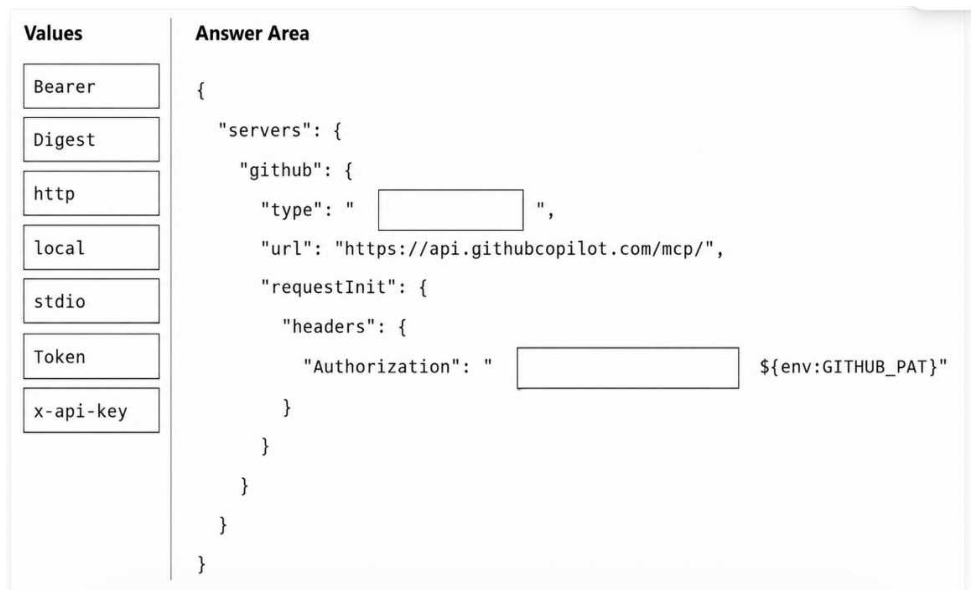
You need to commit a workspace-scoped MCP configuration to ensure that GitHub Copilot can connect to the GitHub-hosted MCP endpoint and authenticate by using a GitHub personal access token (PAT).

How should you complete the mcp.json configuration file? To answer, drag the appropriate values to the correct targets. Each value may be used once, more than once, or not at all. You may need to drag the split bar between panes or scroll to view content.

NOTE: Each correct selection is worth one point.

{
  "servers": {
    "github": {
      "type": "[Blank 1]",
      "url": "https://api.githubcopilot.com/mcp/",
      "requestInit": {
        "headers": {
          "Authorization": "[Blank 2]${env:GITHUB_PAT}"
        }
      }
    }
  }
}
Question 9 D2 Implement tool use and environment interaction

You have a GitHub repository that has a GitHub Actions workflow. The workflow runs an AI agent.

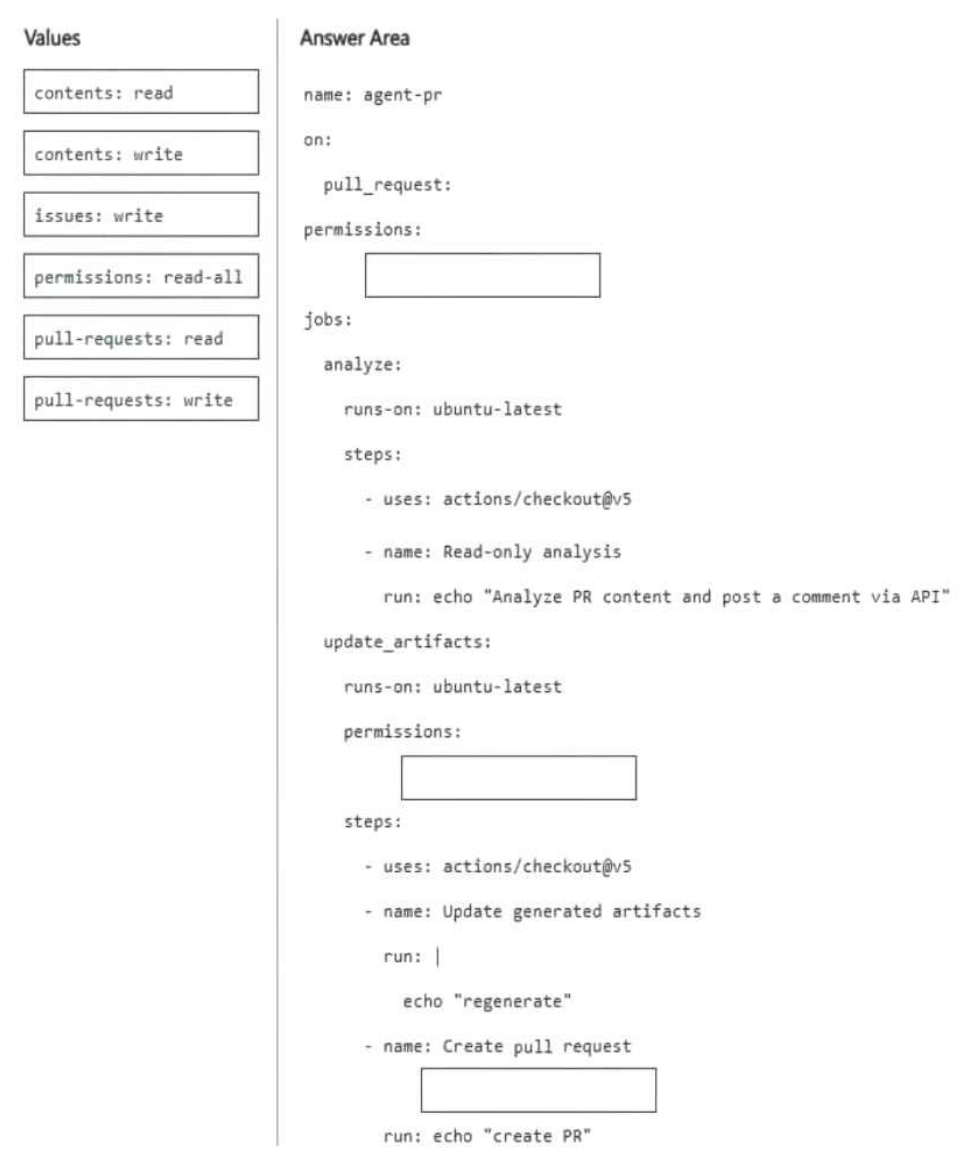
You need to ensure that the default GITHUB_TOKEN permissions are read-only, and write access is granted to only the job that performs repository write operations. The workflow must be able to create and approve pull requests only when explicitly enabled.

How should you complete the workflow? To answer, drag the appropriate values to the correct targets. Each value may be used once, more than once, or not at all. You may need to drag the split bar between panes or scroll to view content.

NOTE: Each correct selection is worth one point.

Values:

  • contents: read

  • contents: write

  • issues: write

  • permissions: read-all

  • pull-requests: read

  • pull-requests: write

name: agent-pr
on:
  pull_request:
permissions:
  [Blank 1]
jobs:
  analyze:
    runs-on: ubuntu-latest
    steps:
      - uses: actions/checkout@v5
      - name: Read-only analysis
        run: echo "Analyze PR content and post a comment via API"
  update_artifacts:
    runs-on: ubuntu-latest
    permissions:
      [Blank 2]
    steps:
      - uses: actions/checkout@v5
      - name: Update generated artifacts
        run: |
          echo "regenerate"
      - name: Create pull request
        [Blank 3]
        run: echo "create PR"
Question 10 D2 Implement tool use and environment interaction

While using agent mode in VS Code, you want Copilot to run a specific test suite as a validation step after making changes, without manually invoking the terminal each time. What feature enables this?

Question 11 D2 Implement tool use and environment interaction

You have a GitHub Enterprise Cloud repository that uses the GitHub Copilot coding agent to implement changes by creating draft pull requests in a firewalled GitHub Actions environment.

Repository administrators add a Model Context Protocol (MCP) server configuration so that the agent can query an external system while it executes issues. The MCP server requires an API key, and the key must be provided to the MCP server as an environment variable when the server starts.

You create an environment secret named copilot_mcp_api_key that contains the API key.

You need to configure the repository to ensure that the MCP server receives the API key at runtime.

The solution must ensure that only the intended secret is available to the MCP configuration.

What is the best option to use to achieve the goal?

Question 12 D3 Manage memory, state, and execution

You have a GitHub Enterprise organization that has Copilot memory enabled.

You create a new repository.

What are two ways that memories will be deleted from the repository? Each correct answer presents a complete solution.

NOTE: Each correct selection is worth one point.

Select 2 answers.

Question 13 D3 Manage memory, state, and execution

An agentic coding session in the terminal has grown too long, and you want to discard all prior conversation history and start clean, without summarization. Which slash command should you run?

Question 14 D3 Manage memory, state, and execution

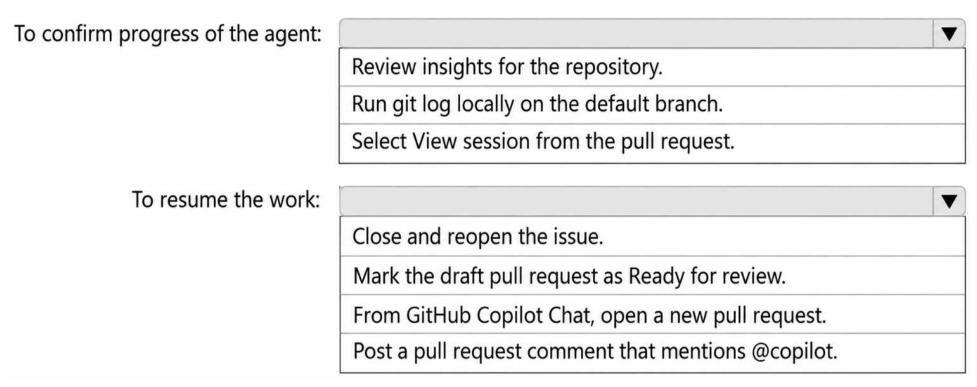
You have a GitHub repository that uses the GitHub Copilot coding agent to resolve issues and create draft pull requests.

You assign an issue to Copilot. Copilot creates a draft pull request. The pull request timeline shows Copilot started work, followed by status updates. The most recent status update is 55 minutes old.

You discover that the agent is no longer making progress.

You need to ensure that the work resumes without redoing the completed steps or changing the previously chosen approach.

What should you do? To answer, select the appropriate options in the answer area.

NOTE: Each correct selection is worth one point.

Question 15 D3 Manage memory, state, and execution

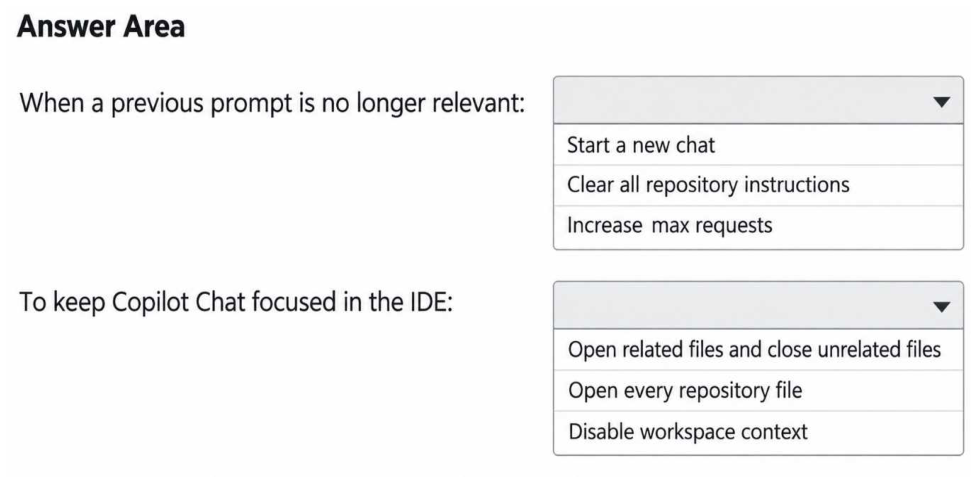
You have a GitHub Enterprise organization that uses GitHub Copilot.

You discover that GitHub Copilot Chat responses in Microsoft Visual Studio Code are influenced by earlier, unrelated troubleshooting prompts from the same conversation.

You need to ensure that the Copilot Chat conversation context is limited to information relevant to the current work item. The solution must minimize effort.

What should you do? To answer, select the appropriate options in the answer area.

Question 16 D4 Perform evaluation, error analysis, and tuning

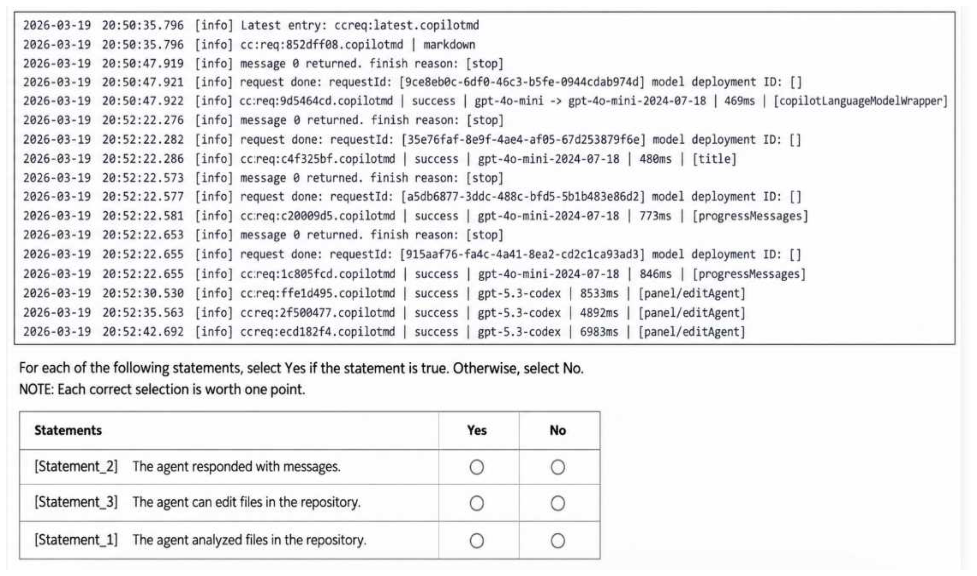
You have the following agent logs.

2026-03-19 20:50:35.796 [info] Latest entry: ccreq:latest.copilotmd
2026-03-19 20:50:35.796 [info] cc:req:852dff08.copilotmd | markdown
2026-03-19 20:50:47.919 [info] message 0 returned. finish reason: [stop]
2026-03-19 20:50:47.921 [info] request done: requestId: [9ce8eb0c-6df0-46c3-b5fe-0944cdab974d] model deployment ID: []
2026-03-19 20:50:47.922 [info] cc:req:9d5464cd.copilotmd | success | gpt-4o-mini -> gpt-4o-mini-2024-07-18 | 469ms | [copilotLanguageModelWrapper]
2026-03-19 20:52:22.276 [info] message 0 returned. finish reason: [stop]
2026-03-19 20:52:22.276 [info] request done: requestId: [35e76faf-8e9f-4ae4-af05-67d253879f6e] model deployment ID: []
2026-03-19 20:52:22.286 [info] cc:req:4cf325bf.copilotmd | success | gpt-4o-mini-2024-07-18 | 480ms | [title]
2026-03-19 20:52:22.573 [info] message 0 returned. finish reason: [stop]
2026-03-19 20:52:22.577 [info] request done: requestId: [a5db6877-3ddc-488c-bfd5-5b1b483e86d2] model deployment ID: []
2026-03-19 20:52:22.581 [info] cc:req:c20009d5.copilotmd | success | gpt-4o-mini-2024-07-18 | 773ms | [progressMessages]
2026-03-19 20:52:22.653 [info] message 0 returned. finish reason: [stop]
2026-03-19 20:52:22.655 [info] request done: requestId: [915aaf76-fa4c-4a41-8ea2-cd2c1c9a33ad] model deployment ID: []
2026-03-19 20:52:22.655 [info] cc:req:1c805cfd.copilotmd | success | gpt-4o-mini-2024-07-18 | 846ms | [progressMessages]
2026-03-19 20:52:30.530 [info] cc:req:ffe1d495.copilotmd | success | gpt-5.3-codex | 8533ms | [panel/editAgent]
2026-03-19 20:52:35.563 [info] cc:req:2f500477.copilotmd | success | gpt-5.3-codex | 4892ms | [panel/editAgent]
2026-03-19 20:52:42.692 [info] cc:req:ecd182f4.copilotmd | success | gpt-5.3-codex | 6983ms | [panel/editAgent]

For each of the following statements, select Yes if the statement is true. Otherwise, select No.

NOTE: Each correct selection is worth one point.

StatementYesNo
[Statement_2] The agent responded with messages.
[Statement_3] The agent can edit files in the repository.
[Statement_1] The agent analyzed files in the repository.
Question 17 D5 Orchestrate multi-agent coordination

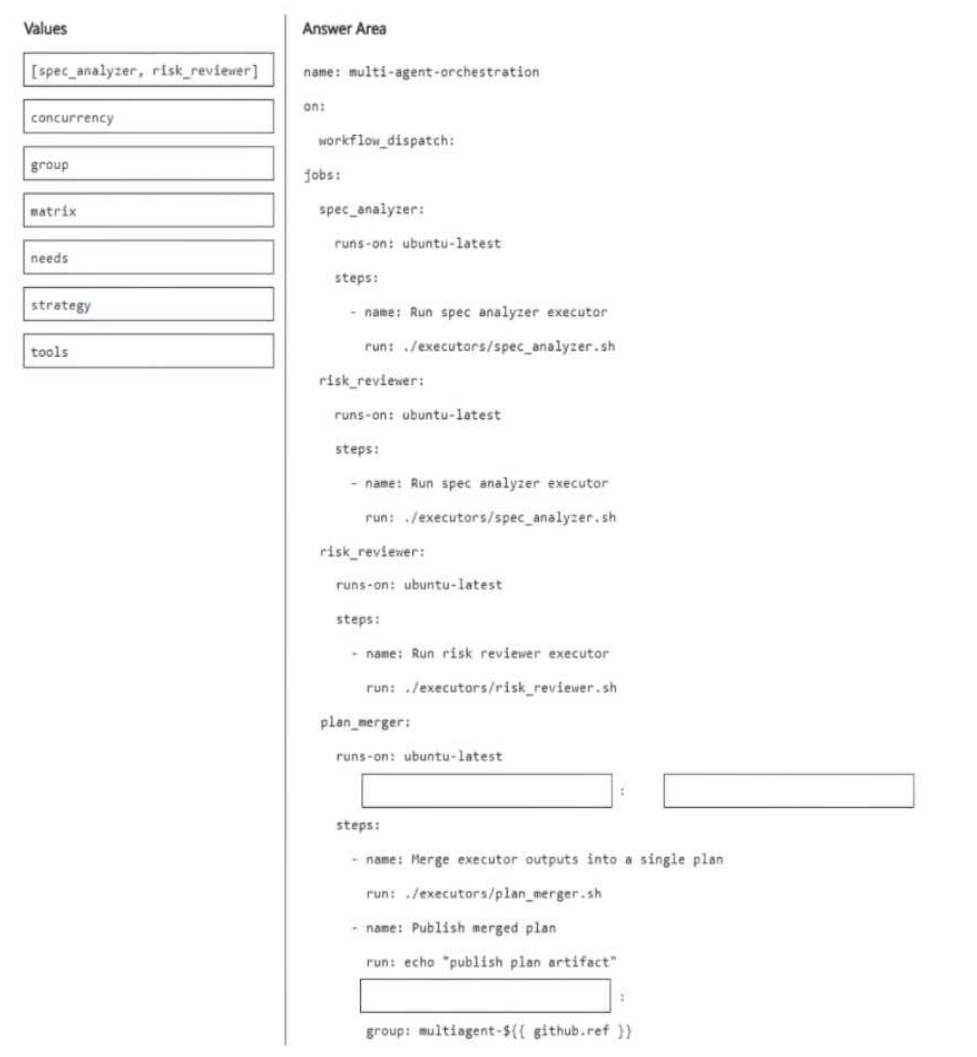
You have a GitHub repository that runs an agentic software development lifecycle workflow by using GitHub Actions. The workflow uses the following three executors implemented as scripts: spec_analyzer, risk_reviewer, and plan_merger.

You need to coordinate multiple specialized agents so that analysis and risk review run in parallel and then a final executor merges the outputs into a single plan. The orchestration pattern must fan out one request to multiple executors and then fan in the results to a final executor.

How should you complete the workflow definition? To answer, drag the appropriate values to the correct targets.

name: multi-agent-orchestration
on:
  workflow_dispatch:
jobs:
  spec_analyzer:
    runs-on: ubuntu-latest
    steps:
      - name: Run spec analyzer executor
        run: ./executors/spec_analyzer.sh
  risk_reviewer:
    runs-on: ubuntu-latest
    steps:
      - name: Run spec analyzer executor
        run: ./executors/spec_analyzer.sh
  risk_reviewer:
    runs-on: ubuntu-latest
    steps:
      - name: Run risk reviewer executor
        run: ./executors/risk_reviewer.sh
  plan_merger:
    runs-on: ubuntu-latest
    [Blank 1]: [Blank 2]
    steps:
      - name: Merge executor outputs into a single plan
        run: ./executors/plan_merger.sh
      - name: Publish merged plan
        run: echo "publish plan artifact"
    [Blank 3]:
      group: multiagent-${{ github.ref }}
Question 18 D5 Orchestrate multi-agent coordination

You use a GitHub Actions workflow to orchestrate a multi-agent draft-review process for pull requests. The workflow uploads a single combined review-package artifact at the end of each run.

You discover that the review-package artifact is occasionally missing from the workflow run history, and you suspect that a user deleted it.

You need to identify which user manually deleted a workflow run artifact and when the deletion occurred.

What should you use?

Question 19 D5 Orchestrate multi-agent coordination

You have a GitHub Enterprise Cloud organization that has Copilot agents enabled.

You discover activity in a repository.

You need to identify whether the activity was initiated by an agent.

Which two audit log fields can you use? Each correct answer presents a complete solution.

Select 2 answers.

Question 20 D6 Implement guardrails and accountability

You have a GitHub Enterprise repository.

An agent opens pull requests to the main branch.

You need to ensure that changes to .github/workflows/ and /infra/ require approval from designated reviewers before merge.

What should you configure?

Question 21 D6 Implement guardrails and accountability

You want to prevent GitHub Copilot from ever suggesting completions or making edits inside a directory containing sensitive credentials templates. What should you configure?

Question 22 D6 Implement guardrails and accountability

You have a GitHub repository that uses the GitHub Copilot coding agent to resolve issues and create draft pull requests. The repository has a ruleset named ruleset1 that enforces the following:

Signed commits Branch protections that require status checks to pass before merge The agent is blocked from operating in the repository because it fails to comply with the signedcommits rule.

You need to ensure that the agent can create and push changes to copilot/ branches. The solution must enforce the signed-commits rule for human developers on protected branches.

What should you do?