



PassITExams: Built for 1Z0-829 Candidates Who Want to Pass the First Time
Most candidates who fail the Java SE 17 Developer exam don’t fail because they don’t know Java. They fail because they’ve never seen how Oracle structures its questions, the subtle traps in code output problems, the edge cases in exception handling, the way module-related questions combine multiple concepts at once. PassITExams closes that gap.
Our 1Z0-829 study material is not recycled content dressed up with new formatting. It’s built question by question to match Oracle’s current exam pattern across all 11 topic areas. When you practice with us, you’re getting real scenario-based items, code analysis challenges, and multiple-choice questions that feel exactly like what you’ll face when you actually sit the test.
And if you want to understand the exam before you start practicing, you can head straight to Oracle’s official 1Z0-829 exam page to see everything directly from the source.
What Is the Oracle 1Z0-829 Exam?
The 1Z0-829 is Oracle’s professional-level certification exam for Java SE 17. Passing it earns you the Oracle Certified Professional: Java SE 17 Developer credential, one of the most recognized Java certifications worldwide, validated specifically for Java 17, Oracle’s Long-Term Support (LTS) release.
What makes this certification particularly valuable is that Java 17 LTS is what the majority of production environments run today. Banks, healthcare platforms, e-commerce systems, government infrastructure: a huge share of enterprise Java runs on this version. Holding the OCP Java SE 17 credential tells employers you understand the language at a production-ready depth, including its newer features like records, sealed classes, text blocks, and pattern matching with instanceof.
The certification is also a single-exam path. Unlike older Java certification tracks that required two or three separate exams, you earn the OCP Java SE 17 Developer title by passing just the 1Z0-829.
1Z0-829 Exam Details at a Glance
Here’s everything you need to know about the exam structure, confirmed directly from Oracle’s official exam page:
| Exam Detail | Information |
| Exam Code | 1Z0-829 |
| Exam Name | Java SE 17 Developer |
| Certification Awarded | Oracle Certified Professional: Java SE 17 Developer |
| Format | Multiple Choice |
| Number of Questions | 50 |
| Duration | 90 Minutes |
| Passing Score | 68% |
| Validated For | Java 17 |
| Prerequisites | None |
Once you complete the exam, your score is displayed on-screen immediately. You’ll also receive an email confirming whether you passed or failed. The full score breakdown, including your performance by topic area, is available through Oracle CertView, Oracle’s official scores and certification portal.
Ready to schedule? You can buy the Exam directly through Oracle University. Exam vouchers are purchased online and must be redeemed within six months of purchase.
Who Should Take the 1Z0-829 Exam?
The OCP Java SE 17 Developer certification is well-suited to a wide range of professionals. You don’t need a prior Oracle certification to sit it; there are no prerequisites, but you should be comfortable working in Java before attempting it.
- Mid-level Java developers with 2–4 years of hands-on coding experience will find this exam a natural next step. It validates exactly the skills you’re using daily while pushing you deeper into areas like the module system and concurrent programming.
- Java 8- or Java 11-certified developers who want to upgrade their credentials will find the 1Z0-829 covering the significant changes introduced across Java 12 through 17, particularly records, sealed hierarchies, text blocks, and pattern matching. This exam is your clearest path to demonstrating that your Java skills are current.
- Backend and enterprise developers working with Spring Boot, Jakarta EE, or any framework built on the Java SE foundation will benefit from the depth this exam requires. The module system, JDBC, and concurrency topics directly map to what enterprise Java developers deal with in production.
- Recent graduates and career changers entering software development will find the OCP Java SE 17 credential a strong opening signal to employers. It proves technical depth, not just familiarity.
- Senior engineers and technical leads who want to stay credentialed as their teams migrate to Java 17 will find the exam a structured way to confirm and document their expertise.
1Z0-829 Exam Topics, Full Syllabus Breakdown
Oracle’s 1Z0-829 exam covers 11 core topic areas drawn from the official exam blueprint. Here’s a plain-language breakdown of what each area tests, along with the sub-skills that appear on the exam.
1. Handling Date, Time, Text, Numeric, and Boolean Values
This section tests your practical knowledge of Java’s core data types and how you manipulate them. You’ll need to work confidently with primitive types and their wrapper class counterparts, apply the Math API, handle type promotion and casting rules, and evaluate expressions that mix arithmetic with boolean logic.
String handling gets serious attention too. You’ll be expected to use the String and StringBuilder APIs correctly, including the text block syntax introduced in Java 15 and carried into Java 17. Date and time manipulation covers the modern Date-Time API, including working with LocalDate, LocalTime, LocalDateTime, ZonedDateTime, Instant, Duration, and Period.
Candidates often underestimate the breadth of this section. The Date-Time API alone has a wide surface area, and the exam tests your ability to choose the right class for the right context, not just call a method.
2. Controlling Program Flow
This area covers how you direct the flow of logic through a Java program. That includes if/else branches, the full range of loop constructs (for, while, do-while, and enhanced for), and both switch statements and switch expressions, the latter being a Java 14+ feature that behaves differently from the traditional switch.
Knowing when to use break and continue, and understanding how labeled statements affect flow in nested loops, is also tested. Switch expressions with the arrow (->) syntax get particular attention, as does the ability to read code that mixes traditional and modern switch styles.
3. Utilizing the Java Object-Oriented Approach
This is the broadest section on the exam and one of the most heavily tested. It covers the full range of object-oriented programming in Java 17.
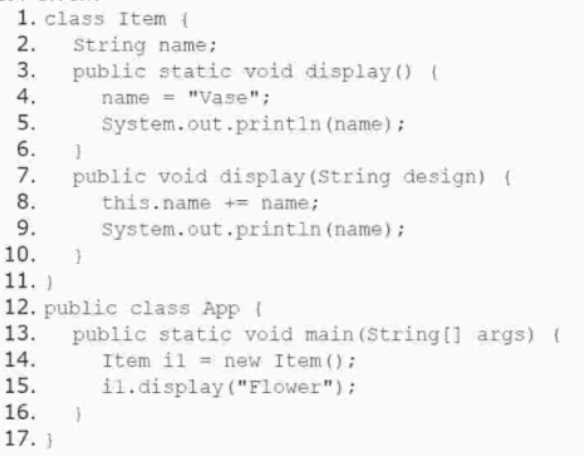
You’ll need to know how to declare and instantiate objects, understand the object lifecycle, and explain how garbage collection works. Creating classes, records (Java 16+), enums, and various types of nested classes, including static, inner, local, and anonymous, is all in scope. Instance and static fields, methods, constructors, and initializers are tested in detail.
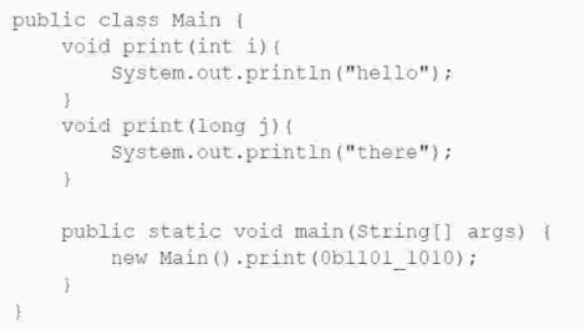
Overloading (including varargs methods), variable scoping, local variable type inference with var, encapsulation, and immutability are also part of this section.
Inheritance gets thorough coverage: abstract classes, sealed classes (Java 17), method overriding, including Object class methods, polymorphism, and type casting. The pattern matching form of instanceof (introduced in Java 16) is tested specifically here.
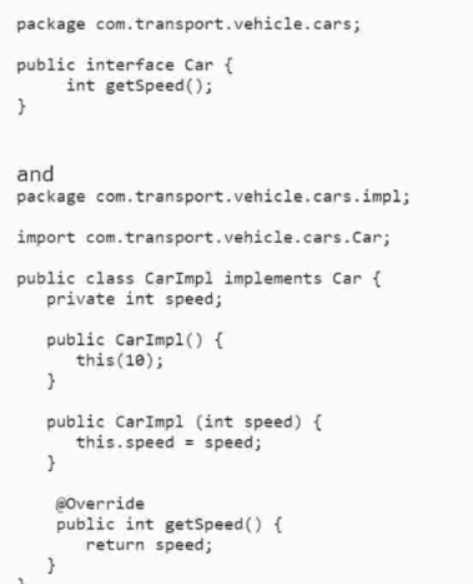
Interfaces, particularly their default, static, and private methods, and functional interfaces appear in this section and feed directly into the stream’s content later. Enums with custom fields, methods, and constructors round out this domain.
4. Handling Exceptions
The exam tests your ability to handle errors gracefully and correctly. You need to know the difference between checked and unchecked exceptions and when each type is used.
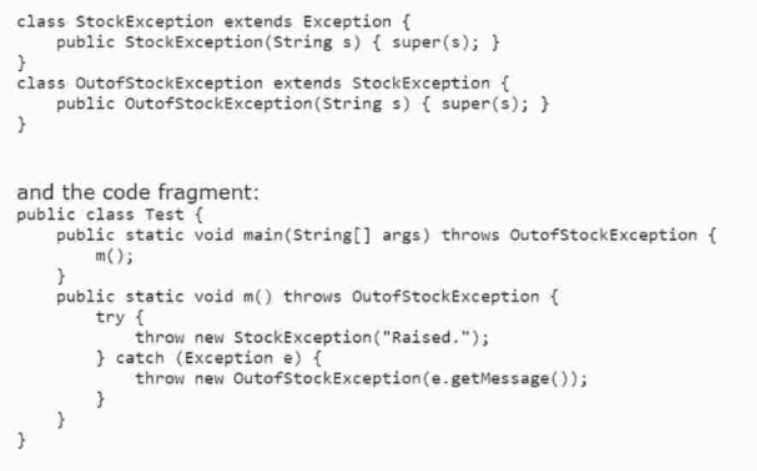
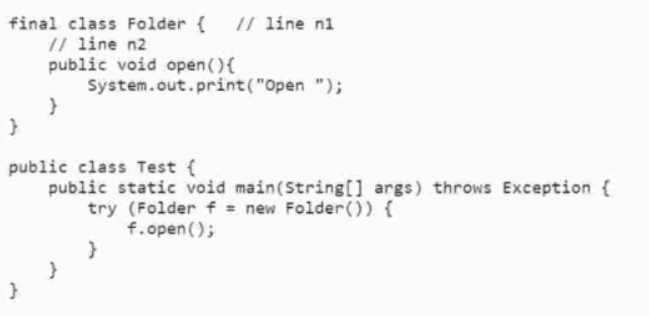
Specifically, you’ll work with try/catch/finally blocks, multi-catch syntax (using | to catch multiple exception types in one block), and try-with-resources, the construct that automatically closes resources implementing AutoCloseable. Writing and throwing custom exceptions by extending standard exception classes is also tested.
A common exam trap: understanding the exact behavior when exceptions are thrown inside finally blocks or when a try-with-resources suppresses exceptions.
5. Working with Arrays and Collections
This section tests your knowledge of Java’s core data structures. You’ll need to create and work with arrays (single- and multi-dimensional) and use the major Collections Framework types: List, Set, Map, and Deque.
For each collection type, the exam expects you to add, remove, update, retrieve, and sort elements, and to understand the behavioral differences between implementations. For example: ArrayList vs. LinkedList, HashSet vs. TreeSet, HashMap vs. TreeMap. Sorting with Comparator and Comparable is explicitly tested.
6. Working with Streams and Lambda Expressions
This is one of the most exam-heavy topic areas and the one where many candidates lose points. You need to be fluent with lambda expressions, method references, and the standard functional interfaces (Function, Predicate, Consumer, Supplier, UnaryOperator, etc.).
Using the Stream API, both object streams and primitive streams (IntStream, LongStream, DoubleStream) are tested across a wide range of operations: filtering, mapping, consuming, sorting, reducing, and collecting. Grouping and partitioning with collectors, parallel streams, and stream concatenation and decomposition all appear on the exam.
If there’s one area to invest extra time in during your preparation, this is it. Stream operations combine with lambda syntax in ways that create genuinely tricky questions.
7. Packaging and Deploying Java Code, Java Platform Module System (JPMS)
The module system is a topic many candidates skip until the last minute. Don’t do that. It shows up meaningfully on the 1Z0-829.
You’ll need to understand how to define a module using module-info.java, declare requires, exports, opens, uses, and provides directives, and understand what each one does. Reflection access to module content, service providers and consumers, and the difference between unnamed modules, automatic modules, and named modules are all in scope.
The build side matters too: compiling modular code, producing modular JARs, creating runtime images with jlink, and migrating existing non-modular applications to the module system are tested practically.
8. Managing Concurrent Code Execution
Concurrency is a topic where real understanding is required, not just syntax recall. The exam tests your ability to write code that behaves correctly when multiple threads are running.
You’ll work with Runnable and Callable for creating tasks, manage the thread lifecycle, and use ExecutorService and the higher-level concurrent API to automate thread management. Thread safety, including the use of synchronized blocks, Lock objects, atomic variables, and concurrent collections, is directly tested.
Parallel streams also appear here in the context of concurrent processing, connecting this topic back to the streams section. Spotting race conditions and identifying non-thread-safe code in given examples is a core exam skill.
9. Using the Java I/O API
This section covers reading from and writing to both console and file targets using the I/O Streams API. You’ll also need to handle object serialization and deserialization, including the role of serialVersionUID and the transient keyword.
The more modern NIO.2 API (java.nio.file) gets substantial attention: working with Path objects, navigating file system structures, reading file attributes, and performing standard operations like copying, moving, and deleting files are all tested.
10. Accessing Databases Using JDBC
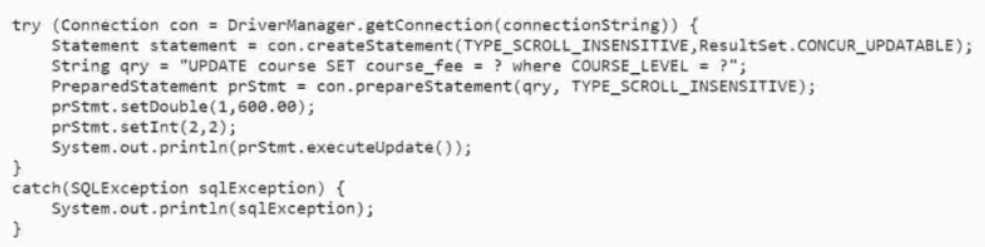
The JDBC section tests your ability to interact with a relational database from Java code. That means establishing database connections through DriverManager, writing and executing basic statements, prepared statements, and callable statements, processing ResultSet objects, and managing transactions, including commit, rollback, and savepoints.
Knowing the correct order of steps (establish connection → create statement → execute → process results → close) and how try-with-resources applies in the JDBC context is commonly tested.
11. Implementing Localization
The final section tests your ability to write Java applications that adapt to different locales. You’ll work with the Locale class, load locale-specific text from resource bundles, and format dates, times, numbers, currency, and percentages correctly for different regions using DateTimeFormatter, NumberFormat, and related APIs.
Parsing user input according to locale conventions and understanding how ResourceBundle loads and falls back through locale hierarchies are practical skills the exam directly targets.
Additional Exam Expectations
Oracle also expects candidates to demonstrate working knowledge of the Java Logging API, use standard annotations correctly, @Override, @FunctionalInterface, @Deprecated, @SuppressWarnings, and @SafeVarargs, and apply generics, including wildcards, in appropriate contexts.
How to Register for the 1Z0-829 Exam
Oracle now handles exam purchasing and scheduling entirely through its own platforms. Here’s how the process works:
You buy the Exam through Oracle University’s education portal. After purchasing, your exam attempt is credited to your Oracle account and must be redeemed within six months. You then schedule your actual test date through Oracle MyLearn or by visiting a Pearson VUE test center.
After completing the exam, your score appears on-screen immediately at the end of the session, and a full score report is accessible through Oracle CertView, Oracle’s official verification and scores portal.
If you want to explore the full Oracle certification catalog or see what credential the 1Z0-829 leads to, you can browse the Oracle Certification Catalog for the complete picture.
Preparing for the 1Z0-829: What Actually Works
The exam covers a genuinely wide range. Here are the strategies that make the most difference:
- Start by identifying your weak spots. Go through the 11 topic areas and rate your current confidence in each. Most developers are solid on OOP and exceptions, but weak on the module system, localization, or concurrency. Start your prep where you’re least comfortable, not where you’re most comfortable.
- Work through the Oracle learning path. Oracle offers a Java SE 17 Developer Learning Path through MyLearn. It’s the closest thing to an official study guide, aligned directly to exam objectives, and worth going through at least once. You can also subscribe to Oracle’s learning ecosystem for one year to access role- and topic-based digital courses that stay current with product updates.
- Practice with exam-style questions from the start. Reading and coding alone won’t prepare you for how Oracle writes questions. The earlier you introduce 1Z0-829 practice tests into your routine, the faster you’ll develop the right instincts for reading code scenarios and spotting incorrect answers.
- Give streams and the module system extra time. These two areas are technically demanding and consistently trip up candidates. Budget at least 25% of your total study time across just these two topics.
- Write and run actual Java 17 code. Install JDK 17, set up a local project, and run the kinds of examples you see in practice questions. Watching the actual output of a tricky streams chain or module configuration removes ambiguity that reading alone can’t resolve.
- Take timed practice exams before booking. The 90-minute window for 50 questions is less than 2 minutes per question. That’s tight when questions involve reading code blocks. Train yourself to keep pace before test day, not on it.
- Review your wrong answers at the explanation level. Every incorrect answer has a reason. When you miss a question, don’t just mark the right answer and continue; understand why the other choices fail. That’s where the real learning happens.
PassITExams Features That Set You Up to Pass
- Verified Exam Questions: Our 1Z0-829 practice tests are sourced from current exam patterns and cross-validated by Java professionals who’ve taken the real exam. Every question reflects the format, difficulty, and topic coverage of what Oracle actually tests.
- Full Answer Explanations: Each question comes with a detailed breakdown, not just the correct answer, but a clear explanation of why the wrong answers fail. For code-based questions, we walk through the logic line by line.
- 3 Months of Free Updates: When Oracle adjusts exam content, your PassITExams access updates automatically at no extra charge. Your purchase stays current for three full months, so you’re never studying against an outdated version of the exam.
- PDF practice tests + Online Practice Simulator: Study offline with our PDF practice tests, or practice in our timed online simulator that mirrors the real Oracle test environment. Both formats draw from the same verified question bank.
- Performance Tracking by Topic: After every practice session, you get a score breakdown by exam section. You can see exactly which of the 11 topic areas need more attention and track your improvement across sessions.
- 100% Money-Back Guarantee: If you prepare with PassITExams materials and don’t pass the 1Z0-829, we’ll refund you in full, with no complicated conditions. We stand behind our content completely.
- 24/7 Customer Support: Our team is available around the clock for order questions, access issues, or study guidance. Exam prep doesn’t follow business hours, and neither do we.
Frequently Asked Questions About the 1Z0-829 Exam
How hard is the Oracle 1Z0-829 exam?
It’s challenging but completely passable with the right preparation. The difficulty comes from the breadth of topics, 11 domain areas, and the way Oracle combines multiple concepts in a single question. You can’t just memorize definitions. You need to read code, reason about output, and apply knowledge across different contexts. Most people who prepare properly for 4–8 weeks clear it on the first attempt.
How many questions are on the 1Z0-829, and what score do you need to pass?
The exam has 50 multiple-choice questions, and you need to score at least 68% (34 correct answers) within the 90-minute time limit.
Do I need a prior Oracle certification to take the 1Z0-829?
No. There are no prerequisites. Anyone can register for and sit the 1Z0-829 without holding a previous Java or Oracle certification. That said, the exam assumes solid working knowledge of Java programming; this isn’t an entry-level test.
Where can I buy the exam and register?
You purchase your exam attempt through Oracle’s Buy Exam page. Once purchased, the attempt is tied to your Oracle account and must be redeemed within six months. Scheduling happens through Oracle MyLearn or a Pearson VUE test center.
Where do I find my exam results after the test?
Your score appears on-screen at the end of the exam. You’ll also receive an email from Oracle. Your full score report, including a breakdown by topic, is available through Oracle CertView, Oracle’s official scores and certification verification portal.
How long should I study before attempting the 1Z0-829?
For most people, 6–8 weeks of consistent daily study is enough. If you work in Java daily and are already comfortable with Java 17 features, you might be ready in 4 weeks. If you’re coming from a Java 8 background and haven’t used the newer language features, give yourself the full 8 weeks to cover records, sealed classes, text blocks, the module system, and functional programming properly.
Which topics are hardest on the 1Z0-829?
Based on candidate feedback, the Java Platform Module System (JPMS), concurrency, and streams with lambda expressions are consistently the most challenging. If you know those three areas well, the rest of the exam becomes much more manageable.
Are PassITExams’ 1Z0-829 questions up to date?
Yes. We continuously update our question bank based on feedback from recently certified candidates. Your purchase includes three months of free updates, so the material stays current even if Oracle adjusts the exam content after you buy.
What format do PassITExams study materials come in?
You get access to a downloadable PDF you can study anywhere, plus an online practice exam platform that runs timed simulations of the real test. Both use the same verified question set.
What happens if I fail the exam after using PassITExams?
We offer a 100% money-back guarantee. If you prepare with our 1Z0-829 materials and don’t pass, reach out to our support team, and we’ll process your refund without hassle.
Does Oracle offer any official training for the 1Z0-829?
Yes. Oracle provides an official Java SE 17 Developer Learning Path through MyLearn that aligns directly with the exam objectives. You can also subscribe to Oracle’s learning ecosystem for one year to access continuously updated digital courses alongside your 1Z0-829 exam prep.
Can I see my certification online after I pass?
Yes. Once you pass, your Oracle Certified Professional: Java SE 17 Developer credential is listed in your Oracle CertView profile. You can verify it, share it, and link it from your LinkedIn profile. The full certification catalog and credential details are visible on the Oracle Certification portal.





Reviews
There are no reviews yet.