

Application Architect Highlights You Should Know
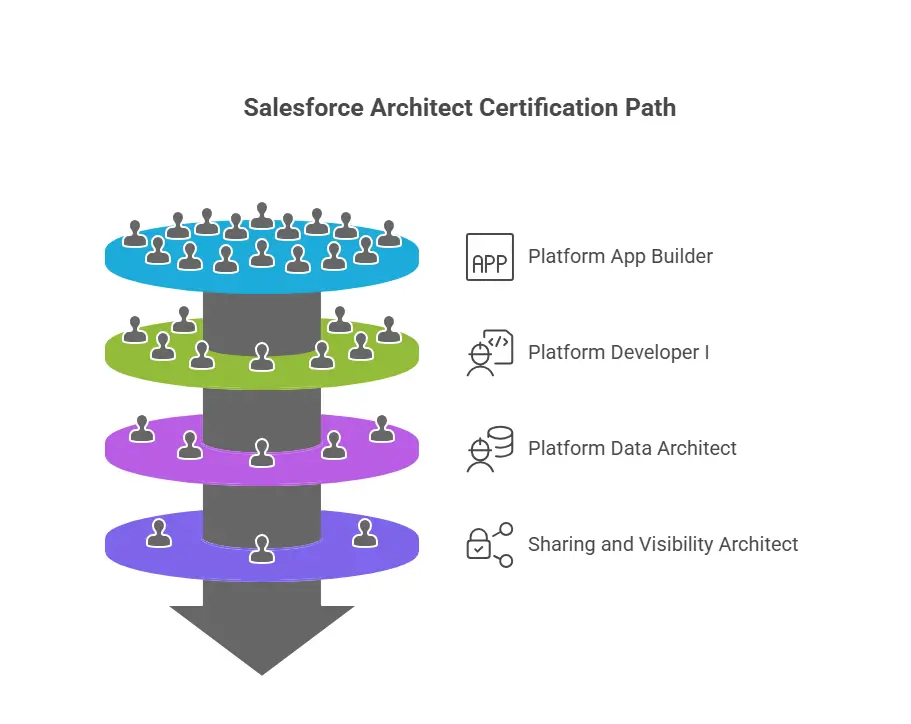
The Salesforce Certified Application Architect is not a standalone exam but rather a prestigious credential automatically awarded upon successfully passing four prerequisite certifications: Platform App Builder, Platform Developer I, Data Architecture and Management Designer (now Platform Data Architect), and Sharing and Visibility Designer (now Platform Sharing and Visibility Architect). In 2026, earning this credential demonstrates deep mastery of native Salesforce features, data modeling, role hierarchies, and sharing mechanisms. There is no separate Application Architect exam to schedule or additional fee beyond the four prerequisite exams. Platform App Builder costs $200 USD, Platform Developer I costs $200 USD, and the two Designer/Architect exams each cost $400 USD, totaling $1,200 USD for first attempts. A typical preparation timeline spans 8-18 months, depending on your experience level and study pace. The recommended path involves systematic progression through each prerequisite while building hands-on experience in production Salesforce environments. All four certifications must be renewed annually via free Trailhead maintenance modules. This guide details the complete roadmap, official resources, exam strategies, and career opportunities for aspiring Application Architects.
Introduction: What is the Salesforce Certified Application Architect and Why Does It Matter?
The Salesforce Certified Application Architect represents a significant milestone in the Salesforce certification pyramid. Unlike most Salesforce credentials, this is not a standalone exam you schedule. Instead, it’s a domain-level architect credential automatically granted when you successfully pass all four prerequisite certifications in any order you choose.
This unique structure reflects Salesforce’s recognition that true application architecture expertise requires mastery across multiple disciplines. You need declarative development skills to design solutions efficiently, programmatic capabilities to extend the platform when necessary, deep data modeling expertise to architect scalable data structures, and comprehensive security knowledge to implement appropriate sharing models.
Application Architects serve as the technical backbone of Salesforce implementations. You design custom applications using native Salesforce features, model complex business processes, architect role hierarchies that reflect organizational structures, and design sharing mechanisms that balance security with usability. Your decisions directly impact system performance, user experience, data integrity, and the organization’s ability to scale.
This credential positions you as an expert in on-platform Salesforce architecture, distinguishing you from System Architects who focus on integrations and external systems. Together, the Application Architect and System Architect credentials form the foundation for pursuing the prestigious Certified Technical Architect (CTA) designation—the pinnacle of Salesforce certifications held by fewer than 500 professionals worldwide.
For professionals serious about Salesforce architecture careers, this credential demonstrates commitment, breadth of knowledge, and readiness for complex enterprise challenges.
Quick Facts & Credential Details
| Detail | Information |
|---|---|
| Credential Name | Salesforce Certified Application Architect |
| Provider | Salesforce |
| Prerequisites | Four required certifications (in any order): 1. Platform App Builder2. Platform Developer I3. Platform Data Architect (formerly Data Architecture and Management Designer)4. Platform Sharing and Visibility Architect (formerly Sharing and Visibility Designer) |
| Separate Exam | None—credential is automatically granted upon completing all four prerequisites |
| Total Cost | $1,200 USD for first attempts ($200 + $200 + $400 + $400). Retakes cost 50% of original exam fees. Note: Prices vary by country and are subject to change. Always confirm the final cost during the registration process. |
| Typical Timeline | 8-18 months depending on experience level and study pace |
| Renewal | Each prerequisite certification requires annual maintenance via free Trailhead modules |
Is This Certification Right for You? (Target Audience)
Ask yourself: Do you architect Salesforce solutions that leverage native platform capabilities? Do you design data models, object relationships, and field-level security? Do you make decisions about when to use declarative automation versus custom code? Do you implement role hierarchies and sharing rules that align with business requirements?
The Application Architect credential is designed for experienced Salesforce professionals who have moved beyond basic administration into solution design. The ideal candidate has hands-on experience building custom applications on the Salesforce platform, typically 3-5 years of combined administrator and developer work.
This credential is particularly valuable for:
- Senior Administrators transitioning into architect roles who want to formalize their expertise in data modeling and security architecture
- Salesforce Developers who need to demonstrate broader platform knowledge beyond just Apex and Visualforce
- Solution Architects working primarily with Salesforce implementations who want to prove deep on-platform expertise
- Consultants and Implementation Specialists who design solutions for clients and need to validate their architectural decision-making capabilities
- Anyone pursuing the CTA credential, as Application Architect is one of two mandatory domain-level certifications required before attempting the CTA Review Board
If you’re currently working as a Salesforce Administrator or Developer but haven’t yet worked on complex data models or security architectures, consider gaining this experience before pursuing the Application Architect credential. The prerequisite certifications, particularly Data Architect and Sharing and Visibility Architect, assume significant real-world exposure to enterprise-scale challenges.
The Four Prerequisites: Complete Roadmap
1. Salesforce Certified Platform App Builder
Exam Details:
- Questions: 60 multiple-choice/multiple-select
- Duration: 105 minutes
- Passing Score: 63%
- Cost: $200 USD (first attempt), $100 USD (retake)
What It Tests: Platform App Builder validates your ability to design, build, and implement custom applications using Salesforce’s declarative (point-and-click) capabilities. You’ll demonstrate knowledge of data modeling, user interface design, business logic automation, security configuration, and app deployment.
Key Domains:
- Salesforce Fundamentals (8%)
- Data Modeling and Management (20%)
- Business Logic and Process Automation (27%)
- User Interface (18%)
- Reporting (7%)
- App Deployment (7%)
- Mobile (6%)
Strategic Preparation Tips: Focus heavily on Process Automation (27%) and Data Modeling (20%)—these two domains account for nearly half the exam. Master the differences between Workflow Rules, Process Builder, and Flow Builder. Understand when each automation tool is appropriate and their respective limitations.
Practice creating custom objects, fields, and relationships in a Developer Edition org. Build multiple data models that include master-detail relationships, lookup relationships, and roll-up summary fields. Understand the implications of each relationship type on sharing, deletion, and reporting.
Recommended Study Time: 4-8 weeks for candidates with 6-12 months of hands-on admin experience
2. Salesforce Certified Platform Developer I
Exam Details:
- Questions: 60 multiple-choice/multiple-select
- Duration: 105 minutes
- Passing Score: 65%
- Cost: $200 USD (first attempt), $100 USD (retake)
What It Tests: Platform Developer I assesses your ability to develop and deploy custom business logic and user interfaces using programmatic capabilities. You’ll need to understand Apex programming, Visualforce pages, Lightning Web Components basics, SOQL and SOSL queries, and when to use declarative versus programmatic approaches.
Key Domains:
- Developer Fundamentals (8%)
- Data Modeling and Management (13%)
- Process Automation and Logic (38%)
- User Interface (9%)
- Testing, Debugging, and Deployment (14%)
- Integration and Security (18%)
Strategic Preparation Tips: This is considered the most challenging of the four prerequisites for candidates without development backgrounds. Process Automation and Logic accounts for 38% of the exam—focus heavily on Apex triggers, classes, and best practices.
If you’re new to programming, invest time learning fundamental concepts like variables, loops, conditional statements, and object-oriented programming before diving into Apex-specific syntax. Understand Apex governor limits thoroughly, as questions about staying within these limits appear frequently.
Practice writing SOQL queries in the Developer Console. Build multiple Apex classes and triggers in your Developer Edition org. Learn to write test classes that achieve sufficient code coverage while also testing for bulk operations and negative scenarios.
Recommended Study Time: 8-16 weeks for candidates without prior programming experience; 4-8 weeks for those with development backgrounds
3. Salesforce Certified Platform Data Architect
Exam Details:
- Questions: 60 multiple-choice/multiple-select
- Duration: 105 minutes
- Passing Score: 58%
- Cost: $400 USD (first attempt), $200 USD (retake)
What It Tests: Data Architect evaluates your ability to design scalable, high-performing data solutions on the Salesforce platform. You’ll demonstrate expertise in large data volume management, data migration strategies, master data management, data governance, and performance optimization for complex data models.
Key Domains:
- Data Modeling (25%)
- Master Data Management (5%)
- Data Management (25%)
- Large Data Volume Considerations (20%)
- Data Quality (15%)
- Analytics (10%)
Strategic Preparation Tips: This exam emphasizes enterprise-scale data challenges. Three domains—Data Modeling, Data Management, and Large Data Volume—account for 70% of the exam. Understand how to design objects and relationships that perform well with millions of records.
Study skinny tables, custom indexes, and query optimization techniques extensively. Learn about data skew issues, particularly ownership skew and lookup skew, and how to mitigate them. Master the differences between Data Loader, Data Import Wizard, and external data integration tools.
Understand bulk API limits, parallel mode versus serial mode, and strategies for handling large data migrations. Practice creating data migration plans that account for dependencies between objects.
Recommended Study Time: 6-12 weeks with significant focus on hands-on scenarios involving large datasets
4. Salesforce Certified Platform Sharing and Visibility Architect
Exam Details:
- Questions: 60 multiple-choice/multiple-select
- Duration: 105 minutes
- Passing Score: 60%
- Cost: $400 USD (first attempt), $200 USD (retake)
What It Tests: Sharing and Visibility Architect assesses your ability to design secure, scalable security models. You’ll demonstrate deep knowledge of organization-wide defaults, role hierarchies, sharing rules, manual sharing, teams, implicit sharing, programmatic sharing, and how to balance security requirements with usability.
Key Domains:
- Declarative Sharing (38%)
- Programmatic Sharing (11%)
- Performance and Scalability (15%)
- Other Salesforce Security Capabilities (16%)
- Reports and Dashboards (8%)
- Enterprise and Platform Security Features (12%)
Strategic Preparation Tips: Many candidates consider this the most challenging prerequisite because it requires understanding subtle interactions between multiple security layers. Declarative Sharing accounts for 38% and is your highest priority.
Master the order of execution for sharing: organization-wide defaults → role hierarchy → sharing rules → manual sharing → teams → programmatic sharing. Understand when each mechanism grants access and how they interact.
Practice designing security models for complex scenarios in your Developer Edition org. Create role hierarchies, configure organization-wide defaults, build sharing rules, and test the results by logging in as different users.
Study implicit sharing thoroughly—understand how it applies to accounts, opportunities, cases, and custom objects with lookup relationships. Learn about external users and how guest user security differs from internal users.
Recommended Study Time: 8-12 weeks with extensive hands-on practice in multi-user scenarios
Your Strategic Study Plan for Success
Strategic Sequencing: Which Order Should You Take the Prerequisites?
While Salesforce allows you to complete the four prerequisites in any order, strategic sequencing can accelerate your learning and reduce total study time.
Recommended Path #1: Admin-Focused Background
- Platform App Builder (foundational declarative skills)
- Sharing and Visibility Architect (builds on App Builder security concepts)
- Data Architect (builds on data modeling from App Builder)
- Platform Developer I (adds programmatic capabilities last)
Recommended Path #2: Developer-Focused Background
- Platform Developer I (leverages existing coding skills)
- Platform App Builder (adds declarative context)
- Data Architect (combines both perspectives)
- Sharing and Visibility Architect (most complex, tackled last with full context)
Recommended Path #3: Balanced Approach
- Platform App Builder (establishes platform fundamentals)
- Platform Developer I (adds programmatic layer)
- Data Architect (synthesizes both for enterprise scale)
- Sharing and Visibility Architect (integrates all knowledge areas)
Choose the path that aligns with your current strengths while building systematically toward your weakest areas.
Phase 1: Foundation Building (Months 1-2)
Begin by assessing your current knowledge across all four domains. Take diagnostic practice exams for each prerequisite to identify strengths and gaps. Based on results, select your starting certification using the sequencing guidance above.
Focus all energy on your first certification for 4-8 weeks. Use the official Trailhead Trailmix curated for that credential. Complete every module, project, and superbadge in the trailmix. Don’t just read—build everything in your Developer Edition org.
Join the Salesforce Trailblazer Community. Follow relevant discussion groups for your chosen certification. Learning from others’ questions often reveals nuances you wouldn’t discover alone.
Schedule your first exam 4-6 weeks out to create accountability and urgency. Book the exam before you feel 100% ready—this prevents endless postponement and forces focused preparation.
Phase 2: Systematic Progression (Months 3-12)
After passing your first prerequisite, immediately begin the second certification within 1-2 weeks. Momentum is powerful—use the confidence and study habits from your first success.
For each subsequent certification, follow this cycle:
- Week 1-2: Complete the official Trailhead Trailmix, taking detailed notes organized by exam domain
- Week 3-4: Build hands-on examples in your Developer Edition org for every major concept
- Week 5-6: Take multiple practice exams, analyze incorrect answers, and strengthen weak domains
- Week 7-8: Final review of notes, retake weakest practice exam sections, and schedule your exam
Maintain overlap between certifications when possible. While studying for Data Architect, you’ll naturally reinforce Platform App Builder concepts. While preparing for Sharing and Visibility Architect, you’ll deepen your understanding of Developer I security topics.
Phase 3: The Two Designer/Architect Certifications (Months 8-16)
Data Architect and Sharing and Visibility Architect are significantly more challenging than the foundational Platform App Builder and Developer I exams. These $400 certifications assume enterprise-level experience and test your architectural decision-making.
Allocate extra preparation time for these certifications—typically 8-12 weeks each. The exam questions present complex, realistic scenarios with multiple plausible answers. You must choose the “best” solution considering performance, scalability, maintainability, and business requirements.
For Data Architect, invest heavily in understanding large data volume scenarios. Study case studies of organizations handling millions of records. Learn about archive strategies, external data sources, and data quality frameworks.
For Sharing and Visibility Architect, build complex role hierarchies with 10+ roles, create multiple sharing rules with different criteria, and test access by logging in as different users. This hands-on validation is essential for understanding subtle security interactions.
Phase 4: Practice Exams and Knowledge Synthesis (Throughout)
Integrate practice exams throughout your journey, not just at the end. Take your first practice exam for each certification after completing 30-40% of the study material. This early diagnostic reveals which domains need the most attention.
Use high-quality practice exam providers like Focus on Force, which offers certification-specific practice tests with detailed explanations. Many candidates credit Focus on Force with helping them pass on the first attempt, making the $20-40 investment worthwhile compared to $100-200 retake fees.
After each practice exam, spend time on incorrect answers. Don’t just memorize the right choice—understand the reasoning. Read the official documentation for any topics you missed. Build examples in your org to solidify understanding.
Aim for consistent scores of 75-80% on practice exams before scheduling your actual certification. This buffer accounts for exam-day pressure and ensures you’re truly ready.
Phase 5: Application Architect Achievement and Beyond
Once you pass all four prerequisites, the Application Architect credential automatically appears in your Webassessor account within 1-2 business days. You don’t need to request it or pay any additional fees—Salesforce’s system recognizes your completion and grants the credential.
Update your LinkedIn profile, resume, and Trailhead public profile immediately. Share your achievement with your network and employer. This credential represents significant investment and expertise worthy of recognition.
Consider whether to pursue the System Architect credential next. Like Application Architect, System Architect is automatically granted upon passing four different prerequisites focused on integration, identity and access management, and deployment lifecycle. Holding both domain architect credentials qualifies you to attempt the CTA Review Board.
Alternatively, pursue solution-specific architect certifications (B2B Solution Architect, B2C Solution Architect, Industries certifications) that build on your Application Architect foundation.
Career and Salary Opportunities
The Application Architect credential significantly enhances your career prospects and earning potential in the Salesforce ecosystem. This domain-level certification demonstrates expertise that goes far beyond basic administration or development—you’ve proven mastery across multiple disciplines essential for enterprise Salesforce implementations.
According to Glassdoor data from 2025, Salesforce Application Architects in the United States earn an average salary of approximately $152,956 annually. However, compensation varies significantly based on factors including experience, location, industry, and whether you work as an employee versus consultant.
Salary ranges typically span from $124,975 (25th percentile) to $189,428 (75th percentile), with top performers in the 90th percentile earning up to $228,507 annually. Geographic location plays a substantial role—Application Architects in major tech hubs like San Francisco, New York, Seattle, and Boston typically earn 15-25% above the national average.
ZipRecruiter reports similar figures, with Salesforce Architects (including Application Architects) averaging $153,568 annually, ranging from $138,000 (25th percentile) to $171,000 (75th percentile). These figures align closely with Glassdoor data, providing confidence in the salary estimates.
Job titles leveraging Application Architect skills include:
- Salesforce Application Architect (focusing specifically on on-platform solutions)
- Salesforce Solution Architect (broader scope including both application and system architecture)
- Salesforce Technical Lead (leading development teams with architectural oversight)
- Senior Salesforce Consultant (designing solutions for clients at consulting firms)
- Enterprise Architect – Salesforce (aligning Salesforce with broader enterprise architecture)
Beyond direct salary, this credential creates opportunities for career advancement. Many organizations require Application Architect certification for principal-level positions. Consulting firms like Deloitte, Accenture, Slalom, and Capgemini actively seek certified architects for client-facing roles.
The credential also positions you for the CTA journey. Certified Technical Architects command premium compensation—often $180,000-$250,000+ annually—and enjoy exceptional job security given fewer than 500 professionals worldwide hold this designation.
For independent consultants, the Application Architect credential enables premium billing rates. Salesforce architects with domain-level certifications commonly bill $150-$250 per hour depending on specialization and project complexity.
Exam Logistics: Policies You Need to Know
Registration and Scheduling
Register for each prerequisite exam separately through your Webassessor account . Create an account if you haven’t already, linking it to your Trailhead account for maintenance tracking.
Schedule exams at least one week in advance for your preferred date and time. Last-minute scheduling, particularly for online proctored exams, may have limited availability.
Delivery Options
Each exam offers two delivery methods:
Online Proctored: Take the exam from home or office using a webcam and stable internet connection. A proctor monitors you remotely throughout the exam. Online proctoring offers maximum flexibility in scheduling and eliminates travel time.
Testing Center: Visit a Kryterion testing center in your area. Testing centers provide a controlled environment and eliminate home-based distractions. Find locations at kryteriononline.com.
Retake Policy
If you don’t pass an exam, you can retake it following these timelines:
- After first attempt: Wait 24 hours before scheduling your second attempt
- After second attempt: Wait 14 days before scheduling your third attempt
- After three unsuccessful attempts: Wait until the next Salesforce release cycle before attempting again
Retake fees are 50% of the original exam cost. Platform App Builder and Developer I retakes cost $100 each. Data Architect and Sharing and Visibility Architect retakes cost $200 each.
Section-Level Feedback
After completing an exam, you receive immediate pass/fail notification plus section-level feedback. This feedback shows your performance (strong, above average, below average, or weak) in each exam domain without revealing exact scores.
Use this feedback strategically if you need to retake the exam. Focus additional study on domains marked “below average” or “weak” before attempting again.
Certification Maintenance
Each prerequisite certification requires annual maintenance to remain active. Maintenance modules are free and available on Trailhead following each Salesforce release (Spring, Summer, Winter).
Complete maintenance modules as soon as they’re available. Missing maintenance deadlines causes certifications to expire, forcing you to retake the full exam plus pay registration fees again.
For Application Architect, you must maintain all four prerequisites independently. Letting any single prerequisite expire doesn’t invalidate the Application Architect credential immediately, but you should restore it promptly.
Note: Designer/Architect-level certifications (Data Architect, Sharing and Visibility Architect) share combined maintenance modules covering both domains rather than separate modules for each.
Exam Resources and References
No reference materials are permitted during exams. You cannot access online documentation, notes, or other resources. The exams test your applied knowledge and decision-making abilities, not your ability to look up syntax or configuration steps.
Official Resources and Study Materials
Official Salesforce Resources
Each prerequisite certification has its own curated Trailmix on Trailhead containing modules, projects, and superbadges aligned with exam objectives. Access these resources for free:
- Platform App Builder Trailmix: Covers data modeling, business logic, user interface, and app deployment modules
- Platform Developer I Trailmix: Includes Apex programming, SOQL/SOSL, testing, and integration fundamentals
- Data Architect Trailmix: Features large data volumes, data migration, master data management, and data quality modules
- Sharing and Visibility Architect Trailmix: Contains declarative sharing, programmatic sharing, and security capabilities modules
Complete every module in each Trailmix before taking the corresponding exam. These curated paths are created by the exam development team and provide the most reliable alignment with actual exam content.
Exam Guides
Download the official Exam Guide PDF for each certification from the credential pages on Trailhead. Exam guides detail the weighted distribution across domains, provide sample questions, and list recommended training courses. Use exam guides as your study roadmap.
Developer Edition Org
Sign up for a free Developer Edition org at developer.salesforce.com. This full-featured Salesforce environment allows unlimited hands-on practice building everything you’ll encounter on exams. Unlike trial orgs, Developer Edition orgs never expire as long as you log in at least once every few months.
Third-Party Study Resources
While official Salesforce resources should form your foundation, several third-party providers offer valuable supplemental materials:
- Focus on Force: Provides comprehensive practice exams with detailed explanations for all four prerequisites
- Salesforce Ben: Offers study guides and certification preparation content
- Trailhead Academy: Paid instructor-led training courses for each certification if you prefer structured learning environments
Practical FAQs & Common Challenges
1. How much hands-on experience is truly necessary before pursuing Application Architect?
The official recommendation is 3-5 years of combined Salesforce administrator and developer experience, but this is flexible based on your learning approach and environment exposure. What matters more than calendar time is breadth of exposure to different scenarios.
Specifically, you should have experience with designing custom objects and relationships for real business requirements, implementing automation that handles bulk operations correctly, configuring sharing models for organizations with multiple business units, working with data migrations involving dependent objects, and making architectural decisions with real consequences for system performance or usability.
If your current role limits this exposure, create it artificially. Take on side projects, volunteer for non-profits through Salesforce.org’s Power of Us program, or build comprehensive applications in your Developer Edition org that simulate enterprise complexity. The key is experiencing decision-making with constraints—understanding why certain approaches work better than others in specific contexts.
Some candidates with strong technical backgrounds but limited Salesforce experience have achieved Application Architect in 12-18 months by intensive study combined with hands-on project work. Others with longer Salesforce tenure but narrower role focus may need 2-3 years. Assess your readiness based on skills, not just time served.
2. Which prerequisite certification is considered the hardest, and how should I prepare for it?
Candidate experiences vary, but Sharing and Visibility Architect consistently ranks as the most challenging prerequisite. This certification tests your understanding of subtle interactions between multiple security layers—organization-wide defaults, role hierarchies, sharing rules, teams, manual sharing, and programmatic sharing all work together in ways that aren’t always intuitive.
The difficulty stems from scenario complexity. Questions present realistic situations where multiple security mechanisms apply simultaneously. You must trace through the order of execution mentally, determining what access each user ultimately receives. Wrong answers often appear plausible because they correctly describe one security layer while missing interactions with other layers.
To prepare effectively, build complex security models in your Developer Edition org. Create a role hierarchy with 10+ roles representing different organizational levels and departments. Set organization-wide defaults to Private for accounts, opportunities, and cases. Then build sharing rules for various criteria. Finally, test access by logging in as different users and documenting what each user can see.
Study implicit sharing exhaustively—understand how account teams, opportunity teams, and case teams grant access automatically. Learn how portal and community users have different security considerations than internal users. Master external organization-wide defaults and their impact on guest users.
Practice tracing sharing calculations manually. When you see a scenario question, mentally draw out the role hierarchy, map the user’s position, apply org-wide defaults, then layer on sharing rules, teams, and manual sharing. This systematic approach reveals the correct answer.
3. Should I pursue Application Architect or System Architect first if my goal is CTA?
Both domain architect credentials are required for CTA eligibility, so you’ll ultimately need both. The choice depends on your background and current role focus.
Choose Application Architect first if you primarily work on on-platform solutions, have stronger declarative skills than integration experience, are more comfortable with data modeling and security than API integration, or work in organizations where Salesforce is the primary system with minimal external integrations.
Choose System Architect first if you frequently integrate Salesforce with external systems, have strong API and middleware experience, regularly work with identity and access management solutions, or are involved in Agile development and release management processes.
Most candidates pursue Application Architect first because its prerequisites (Platform App Builder, Platform Developer I) are also generally useful certifications that validate foundational skills. The System Architect prerequisites (Platform Developer I, Integration Architecture, Identity and Access Management, Development Lifecycle and Deployment) are more specialized and assume you’re already working in architect-level roles.
From a practical perspective, starting with Application Architect lets you tackle the more complex prerequisites (Data Architect, Sharing and Visibility Architect) earlier in your journey. These certifications require significant study time, and completing them first builds momentum and confidence.
4. How should I approach the $400 Designer/Architect exams differently than the $200 exams?
The Designer/Architect exams (Data Architect and Sharing and Visibility Architect) require fundamentally different preparation than Platform App Builder and Developer I. These are enterprise architect-level certifications that test your ability to make complex trade-off decisions.
First, recognize that correct answers often aren’t obvious. Questions present scenarios where multiple solutions would technically work. You must choose the “best” solution considering scalability, maintainability, performance, and business requirements. The exam is testing architectural judgment, not just feature knowledge.
Prepare by studying case studies and real-world implementations. Read Salesforce Architects blog posts describing how enterprise organizations solved specific challenges. Study the Salesforce Well-Architected framework documentation. Understand common patterns and anti-patterns.
For Data Architect specifically, immerse yourself in large data volume scenarios. Learn about data skew (ownership skew, lookup skew), custom indexes, skinny tables, and archive strategies. Understand when to use external objects versus native Salesforce objects. Study bulk API considerations for data loading and processing.
For Sharing and Visibility Architect, focus on understanding the performance implications of different security approaches. Learn how role hierarchies impact query performance, when to use programmatic sharing versus declarative sharing, and how to design security models that scale to tens of thousands of users.
Allocate more preparation time for these certifications—typically 8-12 weeks versus 4-8 weeks for the foundational exams. The additional investment pays dividends by reducing retake risk on the more expensive exams.
5. How long does it realistically take to earn the Application Architect credential?
Timeline varies dramatically based on your starting point, available study time, and whether you’re pursuing certifications consecutively or spacing them out.
Accelerated Path (8-12 months): This aggressive timeline works for candidates who already hold Platform Administrator or Developer certifications, have 2-3+ years of hands-on Salesforce experience, can dedicate 10-15 hours weekly to focused study, and take exams in rapid succession with minimal breaks between certifications.
Accelerated candidates typically tackle one certification every 6-10 weeks, completing all four prerequisites in under a year. This pace is intense but achievable if Salesforce is your daily work and study is treated as a priority commitment.
Standard Path (12-18 months): This represents the most common timeline for working professionals balancing certification study with job responsibilities and personal commitments. You’ll allocate 5-10 hours weekly for study, allow 8-12 weeks per certification, and include buffer time for retakes if needed.
Standard pace candidates space certifications strategically, often aligning exams with natural breaks in project work. This sustainable approach reduces burnout and allows knowledge to solidify between certifications.
Extended Path (18-24+ months): This timeline suits candidates who are building foundational experience while pursuing certifications, working in roles with limited Salesforce exposure requiring more study time, preparing for certifications outside standard work hours, or deliberately spacing learning to ensure deep understanding.
Extended path candidates may tackle one certification every 4-6 months, focusing heavily on hands-on practice and real-world application. While slower, this approach often results in deeper mastery that serves well in architect-level roles.
Remember that the Application Architect credential has no expiration date for how long you have to complete the prerequisites. Some candidates earn three certifications in one year, then take the fourth two years later when it aligns with their career needs. The credential is granted as soon as all four are active simultaneously.
6. What happens if one of my prerequisite certifications expires before I complete all four?
Salesforce certifications require annual maintenance via free Trailhead modules. If you fail to complete maintenance within the deadline, the certification becomes inactive. For Application Architect prerequisites, this creates a specific challenge.
The Application Architect credential is only granted when all four prerequisites are active simultaneously. If you’ve passed three prerequisites but the first one expires before you complete the fourth, you’ll need to restore that first certification before receiving the Application Architect credential.
To restore an expired certification, you must retake the full exam and pay the registration fee again. This can be costly and time-consuming, particularly for the $400 Designer/Architect exams.
Avoid this scenario by maintaining certifications proactively. As soon as maintenance modules become available (following each Salesforce release), complete them immediately. Don’t postpone maintenance until deadlines approach—life happens, and you might forget.
Set calendar reminders for Salesforce release dates (late January/early February, late May/early June, and late September/early October). Check Trailhead immediately after each release for new maintenance modules.
If you’re in the middle of pursuing Application Architect and realize a prerequisite is approaching its maintenance deadline, pause progress on new certifications temporarily. Complete the maintenance first, ensuring all current certifications remain active. Then resume progress toward remaining prerequisites.
7. Are there cost-saving strategies for the $1,200 total investment in Application Architect?
While the total first-attempt cost is $1,200 ($200 + $200 + $400 + $400), several strategies can reduce your investment:
Salesforce Certification Days: Salesforce regularly hosts free virtual events where attendees receive discount vouchers. These vouchers typically provide $40-$70 off exam registration fees. While vouchers more commonly apply to $200 exams (Platform App Builder, Developer I) than $400 Designer/Architect exams, attending multiple events can generate savings. Join the Salesforce Trailblazer Community and watch for announcements.
Employer Sponsorship: Many organizations sponsor certification costs for employees, recognizing the business value of certified professionals. Present a proposal to your manager explaining how each certification directly benefits current projects or company initiatives. Frame certifications as professional development investments that improve your ability to deliver quality solutions.
Avoid Retakes: The single most effective cost-saving strategy is passing each exam on the first attempt. Retakes cost $100-$200 each and add significantly to total expenses. Invest in quality preparation resources upfront—spending $20-$40 on Focus on Force practice exams can save you $100-$200 in retake fees.
Strategic Sequencing: Take Platform App Builder and Developer I first since they’re lower cost. If you encounter unexpected difficulty and need retakes, you’re only paying $100 rather than $200. Save the higher-cost Designer/Architect exams for when you have momentum and proven study strategies.
Tax Deductions: In many jurisdictions, professional certification costs are tax-deductible as employee business expenses or business development costs for self-employed consultants. Consult with a tax professional to understand applicable deductions in your situation.
8. How does the Application Architect credential integrate into the broader Salesforce certification ecosystem?
Application Architect sits in the middle tier of the Salesforce certification pyramid—above foundational certifications (Administrator, Developer) but below the prestigious CTA designation. Understanding where it fits helps you plan your certification journey strategically.
Foundation Layer: Platform Administrator, Platform App Builder, Platform Developer I, and various consultant/specialist certifications (Service Cloud, Sales Cloud, Marketing Cloud) form the base. These validate role-specific skills.
Designer/Specialist Layer: Data Architect, Sharing and Visibility Architect, Integration Architect, Identity and Access Management Architect, and Development Lifecycle and Deployment Architect represent deep specialization in specific domains.
Domain Architect Layer: Application Architect and System Architect combine multiple designer/specialist certifications to demonstrate comprehensive domain expertise. These are automatically granted credentials that recognize mastery across related specializations.
Technical Architect (CTA): The pyramid peak requires both domain architect credentials plus passing an intensive review board evaluation and presentation-based exam. Only 300-400 professionals worldwide hold this designation.
Application Architect serves multiple purposes in this ecosystem. First, it demonstrates comprehensive on-platform expertise valuable for architect roles even if you never pursue CTA. Second, it fulfills 50% of the CTA prerequisite requirements. Third, it validates knowledge across data, security, development, and declarative configuration—skills needed for solution-specific architect certifications.
Conclusion: Your Next Step
The Salesforce Certified Application Architect credential represents a significant achievement in your Salesforce career—one that demonstrates mastery across data modeling, security architecture, declarative development, and programmatic capabilities. Unlike most certifications, this isn’t earned through a single exam but through systematic mastery of four distinct domains, each validating essential architect competencies.
The 8-18 month journey requires dedication, strategic planning, and consistent effort. You’ll invest approximately $1,200 in exam fees, countless hours in focused study, and significant time building hands-on examples that solidify your understanding. But the return on this investment extends far beyond the credential itself.
You’ll develop architectural judgment that transforms how you approach Salesforce solutions. You’ll confidently design data models that scale to millions of records, security architectures that balance protection with usability, and automation strategies that combine declarative and programmatic approaches optimally. These skills directly impact the quality and sustainability of every Salesforce implementation you touch.
The credential opens doors to architect-level positions, consulting opportunities, and significantly higher compensation. It positions you as an expert who understands not just what the platform can do, but how to design solutions that meet complex enterprise requirements while maintaining performance, security, and long-term maintainability.
Perhaps most importantly, the Application Architect credential represents a milestone on the path to becoming a Salesforce Technical Architect—the pinnacle designation held by fewer than 500 professionals globally. Whether you ultimately pursue CTA or not, the knowledge and skills you gain through Application Architect will serve your entire career.
Your journey begins with selecting your first prerequisite certification. Review the strategic sequencing guidance earlier in this guide, assess your current strengths and experience, then commit to a specific starting point.
