
Databricks Certified Data Analyst Associate Facts
The Databricks Certified Data Analyst Associate exam evaluates proficiency with the Databricks Data Intelligence Platform. In 2026, it covers 9 domains: Understanding of Databricks Data Intelligence Platform (11%), Managing Data (8%), Importing Data (5%), Executing queries using Databricks SQL and SQL Warehouses (20%), Analyzing Queries (15%), Creating Dashboards and Visualizations (16%), Developing AI/BI Genie spaces (12%), Data Modeling with Databricks SQL (5%), and Securing Data (8%). A passing score is not publicly disclosed. Pricing is $200 USD plus applicable local taxes, with variations by country and region. A typical preparation window is 4–8 weeks, depending on your background and SQL experience. The recommended study path combines official Databricks Academy courses with consistent hands-on practice in Databricks SQL, Unity Catalog exploration, and dashboard creation. The certification must be renewed every two years by retaking the current version of the exam. This guide details official resources, including the exam guide, scheduling pages, and exam policies.
Introduction: What is the Databricks Certified Data Analyst Associate and Why Does It Matter?
The Databricks Certified Data Analyst Associate certification validates your ability to use the Databricks Data Intelligence Platform for essential data analysis tasks. This credential proves you can discover, query, clean, and manage data using Unity Catalog, execute optimized SQL queries, create meaningful visualizations and dashboards, and work with modern features like AI/BI Genie spaces. For data professionals transitioning to the lakehouse architecture or looking to demonstrate platform-specific expertise, this certification opens doors to roles in data analysis, business intelligence, and analytics engineering within organizations adopting Databricks.
In an industry rapidly moving toward unified data platforms, this certification distinguishes you as someone who understands not just SQL but how to leverage Delta Lake, Unity Catalog governance, and modern visualization tools within a single integrated environment. Whether you’re a business analyst learning technical skills or a SQL analyst upskilling to cloud-native platforms, this certification demonstrates you’re ready for modern data analysis challenges.
Quick Facts & Exam Details
| Detail | Information |
|---|---|
| Exam Name | Databricks Certified Data Analyst Associate |
| Provider | Databricks |
| Prerequisites | None required. However, 6+ months of hands-on experience performing data analysis tasks is highly recommended. |
| Passing Score | Not publicly disclosed by Databricks |
| Exam Duration | 90 minutes |
| Question Types | 45 scored multiple-choice questions |
| Exam Cost | $200 USD (excluding taxes). Note: Prices vary by country and are subject to change. Always confirm the final cost during the registration process. |
| Languages Available | English |
| Delivery Method | Online proctored or test center proctored |
| Validity Period | 2 years |
| Recertification | Required every two years by taking the current version of the exam |
Is This Certification Right for You? (Target Audience)
Ask yourself these questions: Are you working with data analysis tasks using SQL? Do you need to prove your ability to work within a modern lakehouse architecture? Are you responsible for creating dashboards and visualizations for business stakeholders? Do you need to understand data governance through Unity Catalog?
This certification is designed for data analysts, business analysts, SQL analysts, and business intelligence professionals who use or plan to use Databricks SQL as their primary tool. It’s particularly valuable if you’re transitioning from traditional data warehouses to lakehouse platforms, if your organization has adopted Databricks, or if you want to demonstrate platform-specific expertise to employers. If you already work with SQL but need to validate your skills in a cloud-native, unified analytics environment, this certification is your credential.
Exam Blueprint: Skills You’ll Be Tested On
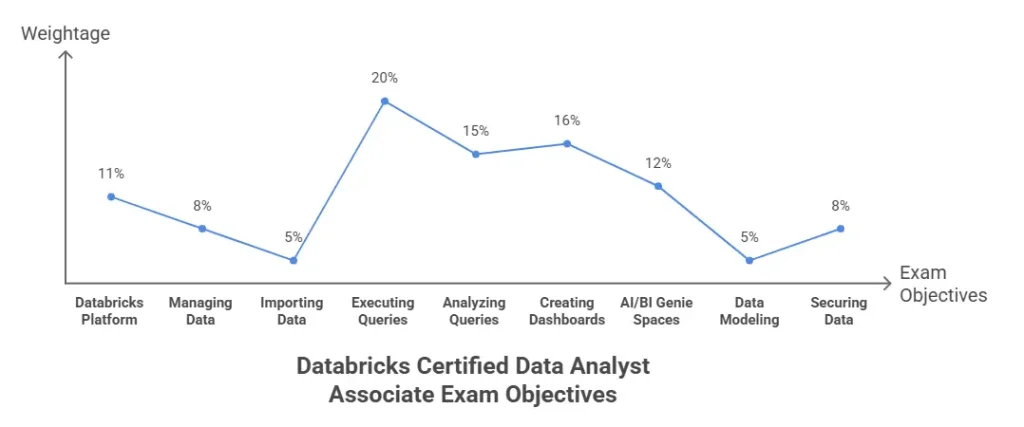
Section 1: Understanding of Databricks Data Intelligence Platform (11%)
You’ll demonstrate knowledge of the core platform components, including Mosaic AI, Delta Live Tables, Lakeflow Jobs, Data Intelligence Engine, Delta Lake, Unity Catalog, and Databricks SQL. This section tests your understanding of catalogs, schemas, managed and external tables, access controls, views, certified tables, lineage within Catalog Explorer, and the role of Databricks Marketplace in data discovery.
Section 2: Managing Data (8%)
This domain assesses your ability to use Unity Catalog to discover, query, and manage certified datasets. You’ll need to use Catalog Explorer to tag data assets and view lineage. Additionally, you must perform data cleaning operations on Unity Catalog tables using SQL, including removing invalid data and handling missing values appropriately.
Section 3: Importing Data (5%)
You’ll explain various approaches for bringing data into Databricks, covering ingestion from S3, data sharing with external systems via Delta Sharing, API-driven data intake, Auto Loader features, and Marketplace. You’ll also demonstrate how to upload data files through the Databricks Workspace UI to create tables quickly.
Section 4: Executing Queries Using Databricks SQL and SQL Warehouses (20%)
This is the largest domain. You’ll utilize Databricks Assistant within notebooks or SQL Editor to facilitate query writing and debugging. You’ll explain the role SQL Warehouses play in query execution and perform cross-system analytics by joining data from Delta tables and federated data sources. You’ll create materialized views and understand when to use Streaming Tables versus Materialized Views, differentiating between dynamic and materialized views. This section covers aggregate operations, joins with single or multiple keys, set operations like union and union all, sorting and filtering, creating managed and external tables from multiple sources, and using Delta Lake’s time travel to access historical data versions.
Section 5: Analyzing Queries (15%)
You’ll understand Photon’s features, benefits, and supported workloads. This section tests your ability to identify poorly performing queries using Query Insights, Query Profiler logs, and other tools. You’ll utilize Delta Lake to audit and view history, validate results, and compare historical trends. You’ll use query history and caching to reduce development time and query latency, apply Liquid Clustering to improve query speed when filtering large tables, and fix queries to achieve desired results.
Section 6: Working with Dashboards and Visualizations in Databricks (16%)
You’ll build dashboards using AI/BI Dashboards, including multi-tab layouts, multiple data sources, and widgets like visualizations, text, and images. You’ll create visualizations in notebooks and SQL Editor, work with parameters in SQL queries and dashboards, configure permissions to share dashboards with workspace users, external users, and embed dashboards in external apps. You’ll schedule automatic dashboard refreshes, configure alerts with thresholds and destinations, and identify effective visualization types to communicate insights clearly.
Section 7: Developing, Sharing, and Maintaining AI/BI Genie Spaces (12%)
You’ll describe the purpose, key features, and components of AI/BI Genie spaces. You’ll create Genie spaces by defining sample questions and domain-specific instructions, choosing SQL warehouses, curating Unity Catalog datasets, and vetting queries as Trusted Assets. You’ll assign permissions and distribute Genie spaces using embedded links and external integrations. You’ll optimize spaces by tracking user questions, response accuracy, and feedback, updating instructions based on stakeholder input, validating accuracy with benchmarks, and refreshing Unity Catalog metadata.
Section 8: Data Modeling with Databricks SQL (5%)
You’ll apply industry-standard data modeling techniques such as star, snowflake, and data vault schemas to analytical workloads. You’ll understand how these models align with the Medallion Architecture (Bronze, Silver, Gold layers) used throughout the Databricks ecosystem.
Section 9: Securing Data (8%)
You’ll use Unity Catalog roles and sharing settings to ensure workspace objects are secure. You’ll understand how the 3-level namespace (Catalog / Schema / Tables or Volumes) works in Unity Catalog. You’ll apply best practices for storage and management to ensure data security, including proper table ownership and PII protection strategies.
Your Strategic Study Plan for Success
Phase 1: Foundation (Week 1-2)
Begin with the official Databricks Academy courses. Take “Data Analysis with Databricks” (self-paced version), or the newer modules “AI/BI for Data Analysts” and “SQL Analytics on Databricks” as they become available. If you’re new to Databricks, spend time understanding the platform architecture, Unity Catalog structure, and how Delta Lake differs from traditional tables. Get comfortable navigating the Databricks workspace, SQL Editor, and Catalog Explorer.
Download and thoroughly review the official exam guide from Databricks. This October 2025 version contains the exact domains, objectives, and sample questions you need. Create a checklist of every objective listed and assess your current knowledge level for each.
Phase 2: Hands-On Deep Dive (Week 3-5)
This is where you build real competency. Sign up for a Databricks Community Edition account or request workspace access if your organization uses Databricks. Practice creating tables from CSV and Parquet files. Write SQL queries that use joins, aggregations, window functions, and subqueries. Experiment with Delta Lake’s time travel feature by querying historical versions of tables.
Focus heavily on Unity Catalog operations: create catalogs and schemas, understand managed versus external tables, practice setting permissions, tag data assets, and explore lineage. This governance layer is critical to the exam.
Build at least three complete dashboards from scratch. Use different visualization types, add parameters, configure refresh schedules, and set up alerts. Understanding the practical workflow of dashboard creation will prepare you for scenario-based questions.
Create a Genie space and practice curating datasets, writing sample questions, and vetting queries. This newer feature is a significant exam component, so hands-on experience is essential.
Phase 3: Performance and Optimization (Week 6)
Study query performance concepts deeply. Learn how Photon accelerates queries, how query caching works, and how to use Query History and Query Profiler to diagnose slow queries. Practice applying Liquid Clustering to improve filter performance on large tables. Understand when to use materialized views versus dynamic views, versus streaming tables.
Work through data modeling exercises. Create star schema examples in your workspace. Map how Bronze, Silver, and Gold layers in the Medallion Architecture relate to traditional data warehouse layers.
Phase 4: Practice and Assessment (Week 7-8)
Review the 10 sample questions in the official exam guide and make sure you understand not just the correct answer, but why the other options are wrong. Create flashcards for key concepts like when to use different join types, the difference between managed and external tables, and Unity Catalog’s 3-level namespace structure.
Take timed practice sessions where you write SQL queries under pressure. Many questions will present scenarios requiring you to choose the correct SQL statement or identify errors in existing code.
Two days before your exam, review the exam guide one final time. Focus on any areas where you still feel uncertain. Get a good night’s sleep before exam day—mental clarity is just as important as knowledge.
Official Learning Paths:
- Databricks Academy: “Data Analysis with Databricks” (self-paced)
- Emerging courses: “AI/BI for Data Analysts” and “SQL Analytics on Databricks.”
- Databricks’ official documentation on Unity Catalog, Databricks SQL, and Delta Lake
Career and Salary Opportunities
The demand for data analysts with lakehouse platform expertise continues to grow as organizations modernize their data infrastructure. Professionals with Databricks certification demonstrate they can work with cutting-edge unified analytics platforms, making them valuable to employers in technology, finance, healthcare, retail, and manufacturing sectors.
According to ZipRecruiter, data analysts in the United States earn an average of $82,640 per year, with the majority of salaries ranging between $62,500 (25th percentile) and $97,000 (75th percentile). Top earners in the 90th percentile make approximately $120,500 annually. Glassdoor reports slightly higher figures, with an average salary of $92,606 per year, and a typical pay range between $71,616 (25th percentile) and $120,914 (75th percentile).
Roles that benefit from this certification include Data Analyst, Business Intelligence Analyst, SQL Analyst, Analytics Engineer, and BI Developer. Salaries vary significantly by location, with major tech hubs like San Francisco, New York, Seattle, and Washington D.C. offering compensation 20-50% above the national average. Industry also matters—data analysts in financial services, technology, and healthcare typically earn more than those in retail or non-profit sectors.
The Databricks certification specifically can differentiate you in job searches as organizations increasingly adopt lakehouse architectures. Employers value platform-specific skills, and certified professionals often report faster interview processes and stronger negotiating positions for salary discussions.
Exam Logistics: Policies You Need to Know
Registration and Scheduling
Register for the exam through the official Databricks exam delivery platform at webassessor.com/databricks. You’ll need to create an account if you don’t already have one. Once registered, you can choose between online proctored testing (taken from your home or office) or test center proctored testing at an approved location.
Before scheduling, review the technical requirements for online proctored exams and run a system check at Kryterion. Ensure you have a working webcam, a stable internet connection, and a quiet, private space. The proctor will verify your identity and monitor you throughout the 90-minute exam.
Retake Policy
If you don’t pass on your first attempt, you must wait 14 days before retaking the exam. Each retake requires the full registration fee of $200 USD plus applicable taxes. There is no limit to the number of attempts you can make, but Databricks recommends thorough preparation before attempting again. Use the 14-day waiting period to identify your weak areas and study specifically those domains.
Certification Validity and Renewal
Your certification is valid for two years from the date you pass the exam. Databricks requires recertification to ensure certified professionals maintain current knowledge as the platform evolves. To recertify, you must take the current version of the exam available at that time. Exam content updates regularly to reflect new features and best practices, so review the latest exam guide when preparing for recertification.
Unscored Questions
Your exam may include unscored questions used for statistical analysis and future exam development. These questions are not identified, and they don’t impact your score. Additional time is built into the 90-minute duration to account for these items, so don’t worry about them affecting your ability to complete the scored questions.
Practical FAQs & Common Challenges
1. How much hands-on experience is truly necessary before taking this exam?
Databricks officially recommends 6+ months of hands-on experience performing data analysis tasks. While you can technically take the exam without this experience, practical familiarity with Databricks SQL, Unity Catalog, and dashboard creation significantly improves your chances of passing. If you’re new to Databricks, plan for 6-8 weeks of intensive study that includes daily hands-on practice. If you already use Databricks regularly at work, you may need only 3-4 weeks to review specific exam domains and fill knowledge gaps. The exam tests practical application, not just theory, so hands-on time is your best investment.
2. Which exam domains or topics do candidates find most challenging?
Based on the exam structure, the “Executing Queries Using Databricks SQL and SQL Warehouses” domain at 20% weight requires the deepest technical knowledge. Many find the distinctions between materialized views, dynamic views, and streaming tables conceptually difficult. Understanding when to use each requires both theoretical knowledge and practical experience. Query optimization topics—particularly Liquid Clustering, Photon acceleration, and query caching—also challenge candidates who haven’t worked extensively with performance tuning. The AI/BI Genie spaces section at 12% is a newer functionality that many practitioners haven’t used regularly, making hands-on practice essential. Finally, Unity Catalog’s 3-level namespace and permission model can be confusing if you’re coming from traditional database environments where security works differently.
3. Should I have SQL experience before attempting this exam?
Absolutely. This exam heavily tests SQL knowledge, including complex queries with joins, aggregations, window functions, subqueries, and set operations. While Databricks SQL is ANSI SQL-compliant and similar to other SQL dialects, you need solid foundational SQL skills before adding Databricks-specific features on top. If your SQL is rusty, spend 2-3 weeks refreshing fundamentals before diving into Databricks-specific study. Focus on understanding different join types (inner, left, right, full outer, cross), aggregate functions with GROUP BY, window functions for analytics, and common table expressions (CTEs). The exam doesn’t explicitly test non-Databricks SQL, but strong SQL fundamentals make Databricks SQL concepts much easier to grasp.
4. What is the best strategy for questions about dashboard features and visualizations?
For dashboard and visualization questions, hands-on experience is irreplaceable. Create multiple dashboards yourself, experimenting with different visualization types, parameters, and sharing settings. Understand the practical workflow: when do you use a bar chart versus a line chart versus a pivot table? How do dashboard parameters differ from query parameters? How do you configure scheduled refreshes versus manual refreshes? The exam tests decision-making—given a specific business requirement, which approach is correct? These scenarios are easiest to answer when you’ve actually faced similar decisions during dashboard creation. Practice questions often describe a business requirement and ask you to choose the correct implementation approach, so think in terms of “why” rather than just “what.”
5. How long should I realistically study for this exam?
Study duration depends entirely on your current experience level. If you use Databricks SQL daily and have 6+ months of experience with Unity Catalog, dashboards, and query optimization, you might need only 2-3 weeks of focused review to fill specific gaps. If you’re new to Databricks but have a strong SQL and data analysis background, plan for 6-8 weeks of study with consistent hands-on practice. If you’re relatively new to both SQL and Databricks, consider 10-12 weeks to build both foundational SQL skills and Databricks-specific knowledge. Quality of study time matters more than quantity—one hour of hands-on practice is worth three hours of reading documentation. Set a target date 6-8 weeks out, create a weekly study schedule, and stick to it.
6. Are there any prerequisites I need to complete before registering?
No formal prerequisites exist—you can register and take the exam immediately. However, Databricks strongly recommends completing related training and having 6+ months of hands-on experience. The practical recommendation is to complete at least one official Databricks Academy course (“Data Analysis with Databricks” or its newer module replacements) before attempting the exam. These courses provide structured learning paths covering all exam domains. Some candidates wonder if they should earn the Databricks Lakehouse Platform Fundamentals accreditation first. While not required, that foundational accreditation can help if you’re completely new to Databricks and need to understand basic platform concepts before diving into analyst-specific skills.
7. Is it better to focus more on practice exams or on hands-on labs?
Prioritize hands-on labs first, practice exams second. The exam tests your ability to apply knowledge in realistic scenarios, which requires practical experience. Spend 70% of your study time working in Databricks: writing queries, creating dashboards, configuring Unity Catalog permissions, building Genie spaces. Spend 30% on practice questions and reviewing exam objectives. Practice exams help identify knowledge gaps and familiarize you with question formats, but they can’t replace hands-on experience. Many questions present scenarios like “A data analyst needs to accomplish X—which approach should they use?” These are easiest to answer when you’ve actually accomplished similar tasks yourself. Use practice questions to identify weak areas, then immediately do hands-on exercises in those domains before moving forward.
8. What role does Unity Catalog play in the exam, and how deeply do I need to understand it?
Unity Catalog is absolutely central to this exam. It appears explicitly in multiple domains (Managing Data at 8%, Securing Data at 8%) and implicitly throughout others. You need to understand Unity Catalog’s 3-level namespace structure (catalog.schema.table), the difference between managed and external tables, how to set permissions at each level, how to tag data assets, how to view lineage, and what certified tables are. You should be able to navigate Catalog Explorer confidently, understand how to discover data across your organization, and explain how Unity Catalog enables governance. Practice creating catalogs and schemas, granting and revoking permissions, and exploring metadata. Unity Catalog is Databricks’ answer to data governance challenges, and the exam expects you to understand both the “what” and the “why” of its design.
Conclusion: Your Next Step
Earning the Databricks Certified Data Analyst Associate certification demonstrates you possess the modern skills organizations need as they adopt lakehouse architectures. You’ll validate your ability to work with Unity Catalog governance, execute optimized SQL queries, create meaningful visualizations, and leverage AI-powered features like Genie spaces—all within a unified analytics platform that’s reshaping how companies handle data.
This certification opens doors to roles in data analysis, business intelligence, and analytics engineering at organizations using Databricks. With salaries for data analysts ranging from $62,500 to over $120,000 depending on experience and location, this credential represents a valuable investment in your career growth.
Your journey starts with a single decision: commit to the certification. Visit the official Databricks certification page today to review the complete exam guide, explore recommended training courses, and register for your exam. The lakehouse revolution is here—prove you’re ready to be part of it.
Take Action Now: Visit the official certification page at Databricks’ official page to download the latest exam guide and schedule your exam.
