

Databricks Certified Machine Learning Associate Exam Guide
The Databricks Certified Machine Learning Associate certification validates foundational machine learning skills on the Databricks platform. In 2026, it covers 4 domains: Databricks Machine Learning (38%), ML Workflows (19%), Model Development (31%), and Model Deployment (12%). The exam consists of 48 multiple-choice questions with a 90-minute time limit. The registration fee is USD 200 plus applicable taxes. A passing score is not publicly disclosed. A typical preparation window is 4-6 weeks for candidates with 6+ months of hands-on Databricks ML experience. The recommended study path combines the official Machine Learning with Databricks course, self-paced modules on Data Preparation, Model Development, Model Deployment, and MLOps, plus extensive hands-on practice with AutoML, Unity Catalog Feature Store, and MLflow. All machine learning code in the exam uses Python, while data manipulation tasks may use SQL. The certification must be renewed every two years by retaking the current version of the exam. This guide details official resources, domain breakdowns, strategic study approaches, career opportunities, exam logistics, and practical preparation strategies for success.
Introduction: What is the Databricks Certified Machine Learning Associate and Why Does It Matter?
The Databricks Certified Machine Learning Associate certification validates your ability to perform fundamental machine learning tasks using the Databricks platform. This entry-level certification demonstrates that you understand how to leverage Databricks’ powerful ML capabilities—including AutoML, Unity Catalog Feature Store, and MLflow—to build, evaluate, and deploy machine learning models in a collaborative, production-ready environment.
This certification matters because machine learning has become central to business decision-making across every industry. Organizations need professionals who can operationalize ML models, not just build them in isolation. Databricks has emerged as the leading unified platform for data and AI, enabling teams to collaborate on the entire ML lifecycle from data preparation to model deployment. The certification proves you can work effectively within this ecosystem, making you a valuable asset to any data-driven organization.
For your career, this certification opens doors to roles in data science, machine learning engineering, and ML operations. It validates that you understand not just ML theory but practical implementation on a platform used by thousands of enterprises globally. Whether you’re transitioning into ML from data analytics, advancing from traditional data science roles, or entering the field as a new graduate, this certification provides a concrete credential that employers recognize and value. It demonstrates you can contribute immediately to ML projects without extensive onboarding on platform-specific tools.
Quick Facts & Exam Details
| Detail | Information |
|---|---|
| Exam Name | Databricks Certified Machine Learning Associate |
| Provider | Databricks |
| Prerequisites | None required, but 6+ months of hands-on experience performing machine learning tasks outlined in the exam guide is highly recommended |
| Passing Score | Not publicly disclosed. Candidates receive a pass/fail result. |
| Exam Duration | 90 minutes |
| Number of Questions | 48 scored multiple-choice or multiple-selection questions (some candidates have reported seeing additional unscored items) |
| Question Types | Multiple-choice and multiple-selection only (no performance-based labs or coding questions) |
| Exam Cost | USD 200 plus applicable taxes. Note: Prices vary by country and are subject to change. Always confirm the final cost during the registration process. |
| Delivery Method | Online proctored or test center proctored |
| Test Aides | None allowed |
| Languages Available | English, Japanese (日本語), Portuguese (Português BR), Korean (한국어) |
| Validity Period | 2 years |
| Recertification | Required every two years by taking the current version of the exam |
| Code Languages | All machine learning code uses Python. Data manipulation tasks may use SQL. |
Is This Certification Right for You? (Target Audience)
Evaluate your readiness by considering these questions:
Do you have basic machine learning knowledge? This exam assumes you understand fundamental ML concepts like supervised versus unsupervised learning, classification versus regression, overfitting, cross-validation, and common evaluation metrics. If you’re completely new to ML, spend time with foundational courses before attempting this certification.
Have you worked with Python for data science? The exam requires familiarity with Python libraries commonly used in ML workflows, particularly scikit-learn, pandas, and Spark ML. You should be comfortable reading and understanding Python code for data manipulation, model training, and evaluation.
Do you have hands-on experience with Databricks? Databricks recommends at least six months of practical experience with the platform. This includes working with notebooks, clusters, jobs, and Databricks-specific features like AutoML and MLflow. Simply reading documentation won’t prepare you adequately—you need actual implementation experience.
Are you comfortable with both Spark and traditional ML frameworks? The exam tests your understanding of when to use distributed computing with Spark ML versus single-node frameworks like scikit-learn. You should understand the trade-offs and appropriate use cases for each approach.
Can you navigate the full ML lifecycle? Beyond building models, you need to understand data preparation, feature engineering, hyperparameter tuning, model evaluation, model registry, and deployment strategies. This certification validates end-to-end ML workflow competency.
If you answered yes to most of these questions, you’re a strong candidate for this certification. If you have gaps, particularly in Databricks hands-on experience, allocate extra time for practical labs before scheduling your exam.
Exam Blueprint: Skills You’ll Be Tested On
The exam covers four major domains with specific percentage weights. Understanding these distributions helps you allocate study time effectively.
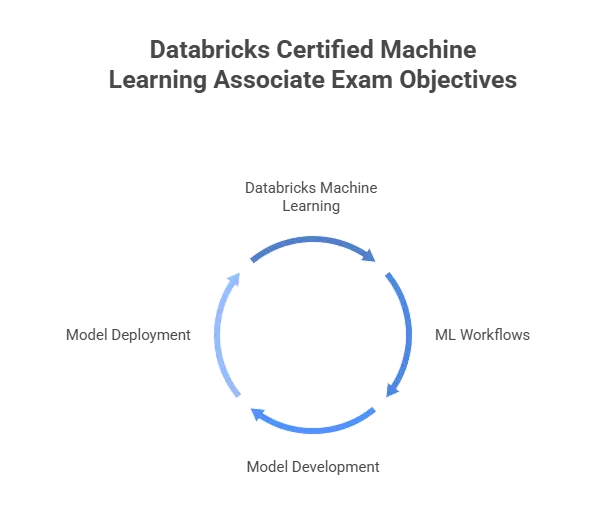
1. Databricks Machine Learning – 38%
This is the largest domain and focuses heavily on Databricks-specific ML tools and features. You’ll need to understand MLOps best practices and how they apply in Databricks. The domain covers ML runtimes and their advantages, including which libraries come pre-installed and when to use ML versus standard runtimes.
A significant portion addresses AutoML, including how it facilitates model and feature selection, and the advantages it brings to model development. You’ll work extensively with Unity Catalog Feature Store, understanding the benefits of account-level versus workspace-level feature tables, creating feature store tables, writing data to them, training models using features from feature stores, and scoring models with those features. You should also understand the differences between online and offline feature tables.
MLflow knowledge is critical. You must identify the best runs using the MLflow Client API, manually log metrics, artifacts, and models in MLflow runs, understand what information is available in the MLflow UI, and register models using the MLflow Client API in the Unity Catalog registry. Understanding the benefits of Unity Catalog registry over the workspace registry is essential. You’ll also need to know when to promote code versus promoting models, how to set or remove model tags, and how to promote challenger models to champion models using aliases.
2. ML Workflows – 19%
This domain emphasizes data processing tasks that prepare data for machine learning. You’ll compute summary statistics on Spark DataFrames using methods like .summary() or dbutils data summaries. Understanding how to remove outliers based on statistical methods like standard deviation or interquartile range (IQR) is important.
You should be able to create visualizations for both categorical and continuous features and know the appropriate methods to compare two categorical features or two continuous features. The domain tests your understanding of imputation strategies—when to use mean, median, or mode for missing values, and the practical implementation of these strategies.
Feature engineering topics include one-hot encoding for categorical features and understanding when it’s appropriate or inappropriate for specific model types or datasets. You’ll also need to identify scenarios where log scale transformation is appropriate for improving model performance.
3. Model Development – 31%
This substantial domain covers the core of machine learning model building and evaluation. You must use ML foundations to select appropriate algorithms for given scenarios, understanding which algorithms suit classification, regression, clustering, or other tasks based on problem requirements.
Data imbalance presents a common challenge, so you’ll need to identify methods to mitigate it in training data, such as oversampling, undersampling, or cost-sensitive learning. Understanding the distinction between estimators and transformers in ML pipelines is crucial. You should be able to develop complete training pipelines that chain together multiple transformation and modeling steps.
Hyperparameter tuning receives significant attention. You’ll use Hyperopt’s fmin operation to tune model hyperparameters, perform random search, grid search, or Bayesian search, and understand how to parallelize single-node models for hyperparameter tuning to speed up the process. Cross-validation knowledge includes describing the benefits and downsides compared to train-validation splits, performing cross-validation as part of model fitting, and identifying how many models are trained when combining grid search with cross-validation.
Model evaluation requires familiarity with common classification metrics including F1 score, log loss, ROC/AUC curves, and when to use each. For regression, you should understand RMSE, MAE, and R-squared metrics. The exam tests your ability to choose the most appropriate metric for a given scenario objective. You’ll also need to understand when to exponentiate log-transformed variables before calculating evaluation metrics or interpreting predictions. Finally, assessing the impact of model complexity and the bias-variance tradeoff on model performance is essential.
4. Model Deployment – 12%
Though the smallest domain by percentage, deployment knowledge is critical for production ML. You must identify the differences and advantages of model serving approaches including batch, real-time, and streaming inference, and understand when each approach is most appropriate.
You’ll need practical skills like deploying custom models to model endpoints, using pandas to perform batch inference, and identifying how streaming inference is performed with Delta Live Tables. Real-time inference topics include deploying and querying models for real-time serving and splitting data between endpoints for real-time interference, enabling techniques like A/B testing or canary deployments.
Your Strategic Study Plan for Success
Phase 1: Foundation Assessment and Official Materials (Week 1)
Begin by downloading the latest exam guide from the Databricks certification page and reading it thoroughly. This document contains sample questions that reveal how concepts translate into exam questions. Take an honest self-assessment of your current ML knowledge and Databricks experience. Identify domains where you feel weakest.
Enroll in the instructor-led “Machine Learning with Databricks” course or begin the self-paced equivalent in Databricks Academy. This course provides structured coverage of all exam domains. If you’re new to Databricks, prioritize understanding the workspace, notebooks, clusters, and jobs before diving into ML-specific features. Review Python ML fundamentals if needed, particularly scikit-learn syntax, pandas operations, and basic Spark DataFrame manipulation.
Phase 2: Deep Dive into Databricks ML Features (Week 2-3)
These weeks focus on hands-on practice with Databricks-specific ML tools—the features that differentiate this exam from general ML certifications.
Start with AutoML. Create a Databricks workspace (use the free trial if you don’t have access) and run AutoML experiments on sample datasets. Understand what AutoML automates, what it doesn’t, and how to interpret the generated notebooks. Practice with both classification and regression tasks. Pay attention to the feature importance analysis and model explanations AutoML provides.
Next, master Unity Catalog Feature Store. This is heavily tested. Create feature tables at both workspace and account levels to understand the differences. Write features to the tables using different methods. Practice training models that consume features from the store, and understand how feature lookups work during scoring. Create both online and offline feature tables and understand their architectural differences and appropriate use cases.
MLflow deserves dedicated attention. Log metrics, parameters, and artifacts manually in various scenarios. Practice using the MLflow Client API to search for the best runs based on different metrics. Register models to both the workspace registry and Unity Catalog registry to understand the differences. Experiment with model aliases and understand how to promote models from staging to production. Create nested runs and understand parent-child run hierarchies.
Phase 3: Data Processing and Feature Engineering (Week 3-4)
Work through data preparation scenarios systematically. Load datasets with various data quality issues and practice generating summary statistics using .summary() and dbutils. Implement outlier detection and removal using both standard deviation and IQR methods, understanding when each is appropriate.
Create visualizations for categorical and continuous variables using Databricks visualization capabilities. Practice comparing features using correlation analysis, chi-square tests, and other appropriate statistical methods. Implement multiple imputation strategies for missing values. Don’t just use scikit-learn’s SimpleImputer—understand when mean, median, and mode imputation each make sense based on data distribution and domain knowledge.
Implement one-hot encoding for categorical variables and understand why it’s appropriate for algorithms like linear models but problematic for tree-based models with many categories. Practice log transformations on skewed data and observe how they impact model performance and metric interpretation.
Phase 4: Model Development and Evaluation (Week 4-5)
This phase covers the core ML skills that comprise 31% of your exam. Build end-to-end ML pipelines using both scikit-learn and Spark ML. Understand when to use each framework—single-node sklearn for smaller datasets, distributed Spark ML for big data scenarios.
Practice addressing class imbalance using techniques like SMOTE, random undersampling, class weights, and cost-sensitive learning. Implement these in your pipelines and compare their effectiveness. Build pipelines that chain together data preprocessing, feature engineering, and model training steps, using both transformers and estimators correctly.
Implement comprehensive hyperparameter tuning scenarios. Use Hyperopt with fmin to optimize model hyperparameters, trying different search spaces and algorithms. Compare random search, grid search, and Bayesian optimization approaches. Parallelize tuning jobs using Spark’s capabilities and measure the speedup. Implement k-fold cross-validation within your tuning processes, understanding the computational cost. Calculate exactly how many models are trained when combining 5-fold cross-validation with a grid of 10 hyperparameter combinations (answer: 50 models).
Evaluate models using appropriate metrics for each problem type. For classification, calculate and interpret precision, recall, F1, log loss, and ROC/AUC. For regression, work with RMSE, MAE, R-squared, and understand their different interpretations. Practice selecting metrics based on business objectives—when is recall more important than precision? When is MAE preferred over RMSE?
Phase 5: Model Deployment and Production Concepts (Week 5-6)
Focus on deployment scenarios, though they represent only 12% of the exam. Understand the architectural differences between batch, real-time, and streaming inference. Batch inference processes data in scheduled intervals, real-time serves individual predictions on demand, and streaming handles continuous data flows.
Deploy a custom model to a Databricks model serving endpoint. Practice invoking the endpoint with test data and measuring response times. Implement batch inference using pandas DataFrames for scored outputs. Configure streaming inference with Delta Live Tables, understanding how the streaming engine handles model predictions at scale.
Practice A/B testing scenarios where traffic splits between multiple model versions. Understand how to route requests to different model endpoints for canary deployments or shadow mode evaluation.
Phase 6: Practice Exams and Gap Analysis (Week 6)
Take full-length practice exams under timed conditions. Aim for at least 85% accuracy before attempting the real exam. Several vendors offer practice tests that mirror the exam format and difficulty. After each practice test, thoroughly analyze every question—both those you answered correctly and incorrectly. Understand the reasoning behind correct answers and why distractors are wrong.
Create a personal reference sheet summarizing key concepts, decision frameworks, and common pitfalls for each domain. Focus particularly on concepts you’ve found challenging. Two days before the exam, do a final review of the official exam guide and your reference sheet. Verify your testing environment meets all technical requirements.
Key Resources:
- Official Exam Guide (PDF from Databricks certification page)
- Machine Learning with Databricks (instructor-led or self-paced)
- Self-paced courses: Data Preparation for Machine Learning, Machine Learning Model Development, Machine Learning Model Deployment, Machine Learning Ops
- Databricks Official Documentation (ML sections)
- Databricks Community Edition (for free hands-on practice)
- Practice exams from Udemy, Whizlabs, or similar reputable providers
- Databricks Community forums for technical questions
Career and Salary Opportunities
The Databricks Certified Machine Learning Associate certification significantly enhances your career prospects in the rapidly growing fields of machine learning and AI. The demand for ML professionals continues to outpace supply, creating excellent opportunities for certified candidates.
- Salary Expectations (United States Market, 2025):
According to DataCamp’s analysis, Machine Learning Engineers with Databricks certification earn between $98,000 and $148,000 annually in base compensation, with an average of approximately $120,000. Additionally, ML Engineers typically receive average bonuses of $44,775 per year, bringing total cash compensation to $165,000 or higher at senior levels.
For Data Scientists with Databricks certification, Glassdoor reports salary ranges from $91,000 to $141,000 annually, with average bonuses of $44,542 per year. Entry-level positions for those with the Associate certification typically start around $90,000-$100,000, while experienced professionals with additional certifications or specialized skills can command $150,000 or more.
At Databricks itself, Data Engineers earn between $102,000 and $169,000 in total compensation, demonstrating the premium the company places on certified professionals who understand its platform deeply. Geographic location significantly impacts these figures, with major tech hubs like San Francisco, Seattle, New York, and Boston offering 20-30% premiums over national averages.
- Career Paths and Roles:
The Associate certification opens several career pathways. Machine Learning Engineers implement and deploy ML models in production environments, working at the intersection of data science and software engineering. This role involves building scalable ML pipelines, monitoring model performance, and collaborating with data scientists to operationalize research. ML Engineers with Databricks certification are particularly valued because they can implement solutions efficiently on an enterprise-scale platform.
Data Scientists focus on extracting insights from data and building predictive models. With Databricks certification, you demonstrate ability to work in a collaborative, production-oriented environment rather than just in isolated notebooks. This makes you more attractive to employers seeking data scientists who can deliver business value, not just research.
ML Operations (MLOps) Engineers specialize in the infrastructure and automation that supports machine learning systems at scale. They build CI/CD pipelines for ML models, implement monitoring and alerting, and ensure models perform reliably in production. The certification’s focus on MLflow, model registry, and deployment strategies aligns perfectly with this role.
Analytics Engineers bridge data engineering and analytics, building data transformations and models that support both ML and business intelligence use cases. The certification’s emphasis on data preparation and feature engineering makes you well-suited for this hybrid role.
- Market Demand:
The machine learning field is experiencing explosive growth. According to recent industry projections, data engineering and ML roles are expected to see salary increases of 15-25% in 2026, driven by AI adoption across industries. Healthcare organizations use ML for diagnostics and drug discovery, financial institutions deploy models for fraud detection and risk assessment, retail companies leverage ML for personalization and demand forecasting, and manufacturing adopts predictive maintenance solutions.
Databricks’ acquisition of MosaicML and its leadership in generative AI and large language models has only increased demand for certified professionals. Organizations recognize that successful AI initiatives require not just data scientists but entire teams proficient in the tools and platforms that enable ML at scale.
- Long-Term Value:
Beyond immediate salary benefits, the certification provides long-term career security. As AI becomes more central to business operations, professionals who understand production ML systems will remain in high demand. The two-year recertification requirement ensures you stay current with platform evolution, maintaining your competitive advantage. Combined with continuous learning and hands-on experience, this certification forms a strong foundation for advancement into senior ML roles, solution architecture, or technical leadership positions.
Exam Logistics: Policies You Need to Know
Registration and Scheduling:
Register for the exam at webassessor.com/databricks, Databricks’ official exam delivery platform. Create an account if you don’t have one already, then search for “Machine Learning Associate” to find the certification. After paying the exam fee, you can schedule your exam date and time, choosing between online proctoring (most flexible) or test center proctoring (if you prefer a formal environment).
Online proctoring allows you to take the exam from home or office, provided you meet all technical requirements. Schedule your exam at least one week in advance to secure your preferred date. Consider your energy levels and focus when choosing a time—many candidates perform best during morning hours.
Retake Policy:
If you don’t pass on your first attempt, you can retake the exam after paying the full fee again. Databricks doesn’t mandate a waiting period between attempts, but strategic candidates take time to address weak areas revealed in the first attempt before rescheduling. Most successful candidates pass within their first two attempts when following a structured study plan. Review the score report provided after your exam to identify which domains need more focus.b
Certification Validity and Renewal:
Your certification remains valid for two years from the date you pass. To maintain certified status, you must recertify by taking the current version of the exam before expiration. Databricks updates exam content to reflect platform evolution, new features, and industry best practices, so expect changes when recertifying. Plan your recertification 6-8 weeks before expiration to allow adequate preparation time and potential retakes if needed.
Technical Requirements:
For online proctored exams, your system must meet specific requirements. Run a system check at kryterion.com/systemcheck well before exam day to verify compatibility. You need a reliable internet connection (minimum 1 Mbps upload and download), a functioning webcam, a working microphone, and an updated web browser (Chrome recommended).
Your testing environment must be private, quiet, and free from interruptions. Clear your desk of everything except your computer—no papers, phones, books, or additional monitors. Ensure good lighting so the proctor can see you clearly via webcam. Close all applications except the exam software. You cannot leave your seat during the 90-minute exam, so plan accordingly.
During the Exam:
No test aids are permitted, including documentation, notes, or additional screens. You cannot access Databricks documentation, Google, or any external resources. The proctor monitors you continuously via webcam and will intervene if they observe suspicious behavior like looking away frequently, talking, or covering your mouth.
If technical issues occur, use the chat function to contact technical support immediately. Don’t panic—proctors can pause your exam timer while resolving technical problems. For content questions, the proctor cannot help, but they can clarify unclear instructions.
Exam Strategy:
With 48 questions in 90 minutes, you have approximately 1.9 minutes per question—ample time if you’re well-prepared. Read each question carefully, as wording can be subtle. Eliminate obviously incorrect answers before selecting your choice. If you’re unsure about a question, mark it for review and move on rather than getting stuck. After completing all questions, use remaining time to review marked items.
Multiple-selection questions (choose two or more correct answers) often appear. Read carefully to determine how many answers the question requires. Don’t second-guess yourself excessively on review—your first instinct is usually correct unless you notice something you clearly misread initially.
- Official Scheduling Link:
Schedule your exam at webassessor.com/databricks
Practical FAQs & Common Challenges
How much hands-on experience is truly necessary before taking this exam?
Databricks’ recommendation of six months hands-on experience is realistic and important for this exam. Unlike certifications that can be passed primarily through memorization, the Machine Learning Associate exam tests practical understanding of how things work in real scenarios. You need to have actually built models using AutoML, registered models with MLflow, created feature store tables, and deployed models to fully grasp the nuanced questions. If you have less than six months experience, extend your preparation timeline and focus heavily on hands-on labs. Using Databricks Community Edition for free practice is essential if you lack workplace access.
Which exam domains or topics do candidates find most challenging?
Three areas consistently challenge candidates. First, Unity Catalog Feature Store concepts and implementation. Many data scientists are accustomed to traditional feature engineering in notebooks but unfamiliar with centralized feature management. Understanding the distinction between account-level and workspace-level tables, online versus offline tables, and the proper syntax for feature lookups requires hands-on practice. Second, the mathematical understanding of hyperparameter tuning scenarios, particularly calculating the number of models trained during grid search combined with cross-validation. This requires multiplying combinations correctly. Third, knowing when to use Spark ML versus scikit-learn, and understanding the trade-offs. Many candidates default to familiar scikit-learn without recognizing scenarios where distributed Spark ML is necessary.
Should I pursue other Databricks certifications before attempting the Machine Learning Associate certification?
This certification is designed as an entry-level credential in the ML track, so you don’t need other Databricks certifications first. However, if you’re completely new to Databricks, having exposure through the Data Engineer Associate certification can help you understand core platform concepts like clusters, notebooks, jobs, and Unity Catalog. That said, if you already have ML experience and just need to learn Databricks-specific features, you can succeed with the Machine Learning Associate as your first Databricks certification. The key is ensuring you have both ML fundamentals and Databricks practical experience, regardless of whether you hold other credentials.
What’s the best approach for learning MLflow if I’m new to experiment tracking?
MLflow is central to Databricks ML workflows and heavily tested on the exam. Start by implementing a simple end-to-end ML project—load data, train a model, log metrics manually using mlflow.log_metric() and mlflow.log_param(). Then enable autologging to see what MLflow captures automatically. Next, practice registering models to the Unity Catalog registry, understanding the difference between the workspace and Unity Catalog registries. Implement model aliases to promote models through staging and production. Finally, use the MLflow Client API to programmatically search for best runs and retrieve model information. Hands-on practice with real models makes MLflow concepts concrete rather than abstract.
How long should I realistically study for this exam?
Study duration depends on your experience level. Candidates with 6-12 months of Databricks ML experience typically need 4-6 weeks of focused study, spending 10-15 hours per week on coursework, hands-on labs, and practice exams. If you’re newer to ML or Databricks, plan 6-8 weeks. The critical factor isn’t calendar time but ensuring you’ve practiced all exam objectives hands-on. Someone with extensive ML experience but no Databricks exposure might need 6 weeks to learn platform-specific features. Conversely, a Databricks expert new to ML needs time for foundational ML concepts. Consistent, daily practice produces better results than weekend cramming sessions.
What’s the relationship between this certification and the Professional level?
The Machine Learning Associate certification covers fundamental tasks—building models, using AutoML, basic MLflow operations, and simple deployment. The Professional certification (which requires significantly more experience) focuses on advanced production ML at enterprise scale, including distributed training, complex MLOps workflows, comprehensive monitoring with Lakehouse Monitoring, advanced Feature Store concepts, custom model serving, and deployment strategies for large-scale systems. Complete the Associate certification first to build foundations, then gain 1-2 years of production ML experience before attempting Professional. The Associate prepares you for day-to-day ML tasks, while Professional validates ability to architect and maintain enterprise ML platforms.
How should I approach questions about model evaluation metrics?
Evaluation metrics questions often present a business scenario and ask which metric is most appropriate. Your strategy should focus on understanding the business objective and costs of different error types. For example, in fraud detection, false negatives (missing fraud) are typically more costly than false positives (flagging legitimate transactions), suggesting recall or F1 score is more important than precision alone. In medical diagnosis, the cost structure might be similar or reversed depending on the disease and treatment. Practice mapping business scenarios to metric priorities. Understand that accuracy alone is misleading for imbalanced datasets. Know when ROC-AUC is appropriate (balanced classes, probability calibration matters) versus precision-recall curves (imbalanced classes, focus on positive class).
How important is understanding Spark versus pandas for this exam?
Very important, and a common gap for candidates from traditional data science backgrounds. The exam tests your understanding of when to use distributed Spark DataFrames versus pandas DataFrames. General principle: use Spark for large datasets that don’t fit in memory on a single machine, require distributed processing, or benefit from lazy evaluation for optimization. Use pandas for smaller datasets, when you need specific pandas operations not available in Spark, or for final result manipulation after Spark aggregation. You should understand that Spark ML operates on Spark DataFrames while scikit-learn operates on pandas DataFrames or numpy arrays. Questions might ask about the most appropriate compute option (single-node cluster versus multi-node) based on data size and processing requirements.
Conclusion: Your Next Step
The Databricks Certified Machine Learning Associate certification represents an important milestone in your machine learning career, validating your ability to implement practical ML solutions using industry-leading tools and platforms. This certification demonstrates not only ML knowledge but also the platform-specific skills that enable you to contribute productively to real-world projects from day one.
Throughout your preparation journey, remember that hands-on practice yields far greater results than passive reading. The concepts tested—MLflow, AutoML, Feature Store, model deployment—become clear through implementation, not memorization. Each lab you complete, each model you register, each feature store table you create builds the practical understanding that translates to exam success and career competence.
You now have a complete roadmap: clear domain breakdowns, a phased study plan, practical FAQs addressing real challenges, and career insights showing the value of your investment. The certification requires focused effort, but it’s achievable for anyone willing to commit time to hands-on practice and structured study.
Visit the official Databricks certification page to register for your exam
Schedule your exam date, commit to your study schedule, and begin working toward becoming a Databricks Certified Machine Learning Associate. The skills you build during preparation will serve you throughout your career in this exciting and rapidly evolving field of machine learning and AI.
Your journey to becoming a certified ML professional starts today. Good luck!
