
Your Complete CKS Snapshot
CKS is the Cloud Native Computing Foundation (CNCF) Certified Kubernetes Security Specialist exam. In 2026, it covers six domains: Minimize Microservice Vulnerabilities (20%), Supply Chain Security (20%), Monitoring, Logging and Runtime Security (20%), Cluster Setup (15%), Cluster Hardening (15%), and System Hardening (10%). A passing score is not publicly specified for this 2-hour, performance-based exam, which has 15-20 tasks. The key prerequisite is an active Certified Kubernetes Administrator (CKA) certification. The standard price is $445 USD, which varies by location. A typical preparation window is 6-12 weeks after passing the CKA. The recommended study path combines the official CNCF course, Kubernetes Security Essentials (LFS260), with intensive, hands-on practice using security tools like AppArmor, seccomp, and Falco, and completing the included Killer.sh practice exams. The certification is valid for two years.
Introduction: What is the CKS and Why Does It Matter?
The Certified Kubernetes Security Specialist (CKS) is the premier certification for professionals who secure container-based applications and Kubernetes platforms. Developed by the Cloud Native Computing Foundation (CNCF) and The Linux Foundation, the CKS is an advanced, hands-on exam that proves you can secure a Kubernetes cluster during build, deployment, and runtime. This is not a theoretical test; it is a performance-based challenge where you will solve complex security tasks on the command line in a live, multi-cluster environment.
Earning the CKS demonstrates to employers that you possess the specialized skills to harden clusters, mitigate vulnerabilities, and establish robust security best practices. It validates your expertise beyond administration and into the critical domain of security. For any professional serious about a career in cloud security, DevSecOps, or platform engineering, the CKS is a top-tier credential that signals elite competence and unlocks the most demanding and rewarding career opportunities.
Quick Facts & Exam Details
| Detail | Information |
| Exam Name | Certified Kubernetes Security Specialist (CKS) |
| Provider | Cloud Native Computing Foundation (CNCF) / The Linux Foundation |
| Prerequisites | A current, non-expired Certified Kubernetes Administrator (CKA) certification is required to sit for the CKS exam. |
| Passing Score | Not publicly stated. Results are provided via email 24 hours after exam completion. |
| Exam Duration | 120 minutes (2 hours) |
| Question Types | 15-20 performance-based tasks requiring solutions from the command line. |
| Exam Cost | $445 USD. Note: Prices vary by country and are subject to change. Always confirm the final cost during the registration process. |
| Software Version | The exam currently uses Kubernetes v1.34 and various third-party security tools. |
Is This Certification Right for You? (Target Audience)
This certification is designed for active Kubernetes practitioners who want to specialize in security. You should pursue the CKS if you:
- Are an accomplished Kubernetes administrator (as proven by your CKA certification) ready to focus on security.
- Are in a role like Cloud Security Engineer, DevSecOps Engineer, or Platform Engineer responsible for hardening Kubernetes clusters.
- Want to demonstrate a deep, practical understanding of securing every layer of the cloud-native stack, from the container image to the cluster API.
- Thrive on complex, hands-on challenges that require using multiple tools to solve security problems.
The CKS is an advanced certification. You must have already passed the CKA exam and should possess a strong understanding of Kubernetes architecture and administration before attempting to prepare for the CKS.
Exam Blueprint: Skills You’ll Be Tested On
The CKS exam tests your ability to apply security principles across the entire Kubernetes ecosystem, including the use of third-party security tools.
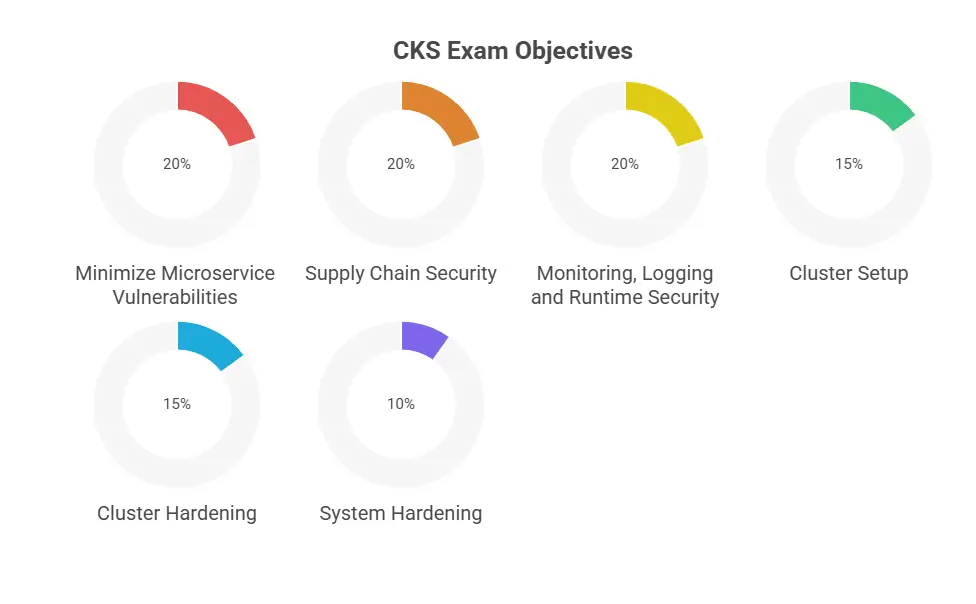
- Minimize Microservice Vulnerabilities (20%)
This domain focuses on securing the workloads running on the cluster. You’ll need to apply Pod Security Standards, manage Kubernetes Secrets, implement sandboxing techniques, and use service mesh capabilities for pod-to-pod encryption. - Supply Chain Security (20%)
You will be tested on your ability to secure the software supply chain. This includes minimizing base image footprints, using static analysis tools like Kubesec or KubeLinter to find issues in manifests and images, and securing the image supply chain with signed and validated artifacts from trusted registries. - Monitoring, Logging and Runtime Security (20%)
This section covers detecting and responding to threats in a live environment. You must be able to perform behavioral analysis of processes, ensure container immutability, use tools like Falco to detect threats, and configure and analyze Kubernetes audit logs. - Cluster Setup (15%)
This domain focuses on securing the cluster from its foundation. You’ll need to use NetworkPolicies to restrict access, audit cluster components against CIS benchmarks, configure Ingress with TLS, and protect node metadata. - Cluster Hardening (15%)
Here, you will harden a running cluster’s configuration. This involves using RBAC to enforce least privilege, securing service accounts, restricting access to the Kubernetes API, and managing cluster upgrades to patch vulnerabilities. - System Hardening (10%)
This domain covers securing the underlying nodes of the cluster. Tasks include reducing the host OS attack surface and using Linux kernel hardening tools like AppArmor and seccomp to restrict container permissions.
Your Strategic Study Plan for Success
The CKS requires not just kubectl mastery, but also fluency with several open-source security tools. Your preparation must be intensely hands-on.
Step 1: Solidify Your CKA Knowledge (Week 1)
You must have an active CKA to even schedule the CKS. Refresh your knowledge of RBAC, NetworkPolicies, and cluster administration. The CKS builds directly on these concepts, and you will not have time to re-learn them during the exam.
Step 2: Master the Security Tooling (Weeks 2-7)
Set up a multi-node cluster with kubeadm. Install and configure the key third-party tools you will need for the exam.
- For System Hardening: Practice creating and applying seccomp and AppArmor profiles to Pods. Understand how to load them onto the cluster nodes and reference them in a Pod’s securityContext.
- For Runtime Security: Install Falco and learn its rule syntax. Practice writing custom rules to detect suspicious activity (like a shell running in a container or a sensitive file being read) and configuring alerts.
- For Supply Chain Security: Get comfortable with static analysis tools like KubeLinter and Trivy. Practice scanning container images for vulnerabilities and YAML files for security misconfigurations.
- For Observability: Configure Kubernetes Audit Logging by modifying the API server manifest. Practice writing audit policies and using jq to parse the log files for specific events.
The official Kubernetes Security Essentials (LFS260) course is designed to cover these topics and is an excellent guide.
Step 3: Simulate Exam Conditions (Weeks 8-10)
The two included sessions with the Killer.sh CKS simulator are non-negotiable for success.
- First Attempt (2-3 weeks before the exam): This session will likely feel overwhelming. The goal is to understand the complexity and multi-step nature of CKS questions. Use it to identify which tools and concepts you are slowest with. The simulator is harder than the real exam, so focus on the detailed solutions provided.
- Focused Practice: Spend the next two weeks drilling your weak areas. If you struggled with Falco rules, spend days writing them. If AppArmor was confusing, build and apply profiles until it’s second nature.
- Second Attempt (3-4 days before the exam): This is your final check. Focus on speed, accuracy, and your strategy. You must be fast not just with kubectl, but also with the documentation for Falco, AppArmor, and other tools.
Career and Salary Opportunities
The demand for security professionals who understand Kubernetes is skyrocketing. As more companies move critical workloads to Kubernetes, the need for experts who can secure these environments has become a top priority.
- Common Job Roles: Cloud Security Engineer, DevSecOps Engineer, Platform Security Engineer, Site Reliability Engineer (Security Focus).
- Salary Expectations: Professionals holding the CKS certification are in an elite group and can command premium salaries. According to industry data, salaries for roles requiring these skills in the United States often start between $150,000 and $190,000 per year. Senior and principal-level positions can easily exceed $200,000.
Exam Logistics: Policies You Need to Know
Being prepared for the exam logistics is just as important as knowing the material.
- Prerequisite: You MUST have an active (non-expired) CKA certification to schedule and sit for the CKS exam. You can purchase the CKS voucher, but you cannot schedule the exam until your CKA is validated.
- Retake Policy: The exam purchase includes one free retake.
- Certification Validity: The CKS certification is valid for two years. You must pass the current version of the CKS exam again to renew it.
- Allowed Resources: You are permitted one additional browser tab to access resources at kubernetes.io/docs, kubernetes.io/blog, and the documentation for the third-party tools covered in the exam (like Falco, AppArmor, and Trivy). Knowing where to find information quickly is a critical skill.
- Scheduling the Exam: You can schedule your remotely proctored exam via the Linux Foundation’s portal within 12 months of purchase.
Practical FAQs & Common Challenges
How much hands-on experience is truly necessary before taking this exam?
Beyond your CKA-level knowledge, you should have at least 3-6 months of intensive, hands-on practice with the specific security tools and concepts on the exam. This is not a test you can pass by just reading; you need significant keyboard time with Falco, AppArmor, seccomp, and static analysis tools.
Which exam domains or topics do most candidates find the most challenging?
The most challenging areas are typically System Hardening (AppArmor, seccomp) and Runtime Security (Falco). These tools have their own syntax and require practice to master. Tasks involving multi-step problem solving, like diagnosing a security issue and then implementing a fix across different resources, are also considered very difficult.
What is the best strategy for the performance-based lab questions?
Time management is even more critical on the CKS than on the CKA. Read the entire question first to understand the end goal. Many questions require you to use multiple tools or edit files on the nodes themselves. Use the provided documentation bookmarks, but don’t rely on them to teach you a concept. You should already know what you need to do; use the docs to confirm how to do it (e.g., exact syntax for a Falco rule).
How long should I realistically study for this exam?
After achieving your CKA, plan for an additional 2-3 months of dedicated study for the CKS. This assumes you can commit several hours per week to focused, hands-on lab work. Rushing your CKS preparation is a common mistake.
What are the official prerequisites for this certification?
You must have an active Certified Kubernetes Administrator (CKA) certification. You cannot sit for the CKS exam without it.
Is it better to focus more on practice exams or on hands-on labs?
For the CKS, the line is blurry. Your hands-on labs should be practice exam scenarios you create for yourself. Spend 80% of your time in a terminal, configuring security tools, hardening clusters, and fixing what you break. The Killer.sh simulator is essential for the final 20% of your prep to test your skills under extreme pressure and identify any remaining gaps.
Conclusion: Your Next Step
Earning the Certified Kubernetes Security Specialist certification places you in the top tier of cloud-native professionals. It is a testament to your ability to protect and defend the complex, dynamic environments that power modern business. The path is challenging, but the reward—in both career opportunities and expertise—is immense.
You have already proven your administrative skills with the CKA. Now it’s time to become a security expert. Your next step begins with a deep dive into the CKS curriculum.
