

DevOps Exam Essentials
The DevOps Foundation (DOFD) is the DevOps Institute (now managed by PeopleCert) entry-level certification validating foundational knowledge of DevOps culture, principles, and practices. In 2026, it covers 8 core domains: Exploring DevOps fundamentals, Core DevOps Principles (Three Ways, Theory of Constraints, Chaos Engineering, Learning Organizations), Key DevOps Practices (CI/CD, SRE, DevSecOps, ChatOps, Monitoring, VSM, Platform Engineering), Business and Technology Frameworks (Agile, Lean, ITSM, VSM, SRE, Safety Culture), Culture/Behaviors/Operating Models (Organizational Culture, Cultural Debt, Behavioral Models, Maturity Models), Automation and Architecting DevOps Toolchains (IaC, Cloud, Containers, Microservices, ML, GenAI), Measurement/Metrics/Reporting (Speed, Quality, Stability, Culture, Change Lead Time, Value Metrics, AIOps), and Sharing/Shadowing/Evolving (DevOps leadership, implementation challenges, critical success factors). A passing score of 65% (26 out of 40 questions) is required. The exam is 60 minutes, consists of 40 multiple-choice questions, and is open book (official training materials from authorized organizations only). The standalone exam voucher costs $270 USD. A typical preparation window is 2-3 weeks for IT professionals with development or operations experience, or 3-5 weeks for those new to DevOps concepts. The recommended study path combines the official DevOps Foundation course materials (self-study PDF or instructor-led training), the certification blueprint, consistent practice exams, and an understanding of CALMS values. The certification is valid for 3 years and can be renewed through PeopleCert Plus membership (earning 60 CPD points) or by earning another DevOps Institute certification. This guide details official resources, exam logistics, and practical strategies for success.
Introduction: What is the DevOps Foundation Certification and Why Does It Matter?
The DevOps Foundation certification validates your understanding of the cultural transformation that’s revolutionizing how software is developed, deployed, and maintained. DevOps isn’t just a set of tools or a job title; it’s a fundamental shift in how IT organizations operate, breaking down the traditional silos between development and operations teams to deliver value faster, more reliably, and with higher quality.
This certification addresses a critical industry need. Organizations implementing digital transformation require professionals who understand not just the technical aspects of automation and continuous delivery, but the cultural and organizational changes required for DevOps success. Traditional IT approaches, where developers “throw code over the wall” to operations, who then struggle to maintain systems they didn’t build, simply cannot keep pace with modern business demands.
For IT professionals, this certification proves you understand the foundational principles driving modern software delivery. Whether you’re a developer wanting to understand operational concerns, an operations professional learning to embrace automation and continuous delivery, a project manager overseeing DevOps transformation, or an IT leader implementing cultural change, the DevOps Foundation certification establishes your expertise in this high-demand field.
The DevOps Foundation is the most widely recognized entry-level DevOps certification globally. It provides the common vocabulary and conceptual framework that enables cross-functional teams to collaborate effectively. This isn’t just theory; organizations implementing DevOps practices achieve measurably better outcomes: faster deployment frequency, shorter lead times, lower change failure rates, and faster recovery from incidents.
Quick Facts & Exam Details
| Detail | Information |
|---|---|
| Exam Name | DevOps Foundation (DOFD) |
| Provider | DevOps Institute, managed by PeopleCert |
| Prerequisites | None required. Familiarity with IT terminology and basic software development or IT operations experience recommended. |
| Passing Score | 26 out of 40 questions correct (65%) |
| Exam Duration | 60 minutes |
| Question Types | 40 multiple-choice questions |
| Exam Format | Open book (official training materials from authorized training organizations only) |
| Exam Cost | $270 USD for a standalone exam voucher. Bundled with training courses for varying prices. Note: Prices vary by country and training provider. Always confirm the final cost during the registration process. |
| Certification Validity | $270 USD for a standalone exam voucher. Bundled with training courses for varying prices. Note: Prices vary by country and training provider. Always confirm the final cost during the registration process. |
| Renewal Options | Join PeopleCert Plus membership (earn 60 CPD points over 3 years) OR earn another DevOps Institute certification within 3 years |
| Exam Languages | English, Chinese, French, German, Japanese, Polish, Portuguese (Brazil), Spanish |
| Delivery Method | Online proctored exam via PeopleCert platform |
| Extra Time | 25% additional time provided if English is not your native language |
Is This Certification Right for You?
Ask yourself:
- Are you working in software development, IT operations, or related fields, and want to understand how DevOps transforms delivery?
- Do you need a common vocabulary to collaborate effectively across development and operations teams?
- Are you involved in digital transformation initiatives that require cultural and process changes?
If you answered yes, this certification targets you. The DevOps Foundation certification is specifically designed for:
- IT Professionals seeking foundational knowledge of DevOps culture, principles, and practices
- Software Developers who want to understand operational concerns and deployment best practices
- System Administrators and Operations Engineers are learning to embrace automation, infrastructure as code, and continuous delivery
- QA and Testing Professionals transitioning to continuous testing and quality built-in approaches
- Project Managers and Scrum Masters are overseeing teams implementing DevOps practices
- Business Stakeholders and Product Owners who need to understand DevOps to make informed decisions
- Consultants and Architects guiding organizations through DevOps transformation
- IT Managers and Leaders responsible for implementing cultural change and breaking down silos
This is a foundation-level certification with no prerequisites. You don’t need prior DevOps experience, specific technical skills, or other certifications. However, general IT familiarity significantly accelerates your learning. If you’re completely new to IT, expect to invest extra time understanding foundational concepts before diving into DevOps specifics.
The DevOps Foundation is an excellent starting point for any DevOps learning path. It provides the conceptual foundation upon which more specialized certifications built, such as DevOps Leader, Site Reliability Engineering Foundation, DevSecOps Foundation, Continuous Testing Foundation, and others in the DevOps Institute portfolio.
Exam Blueprint: Skills You’ll Be Tested On
The DevOps Foundation exam validates your understanding across 8 core learning domains:
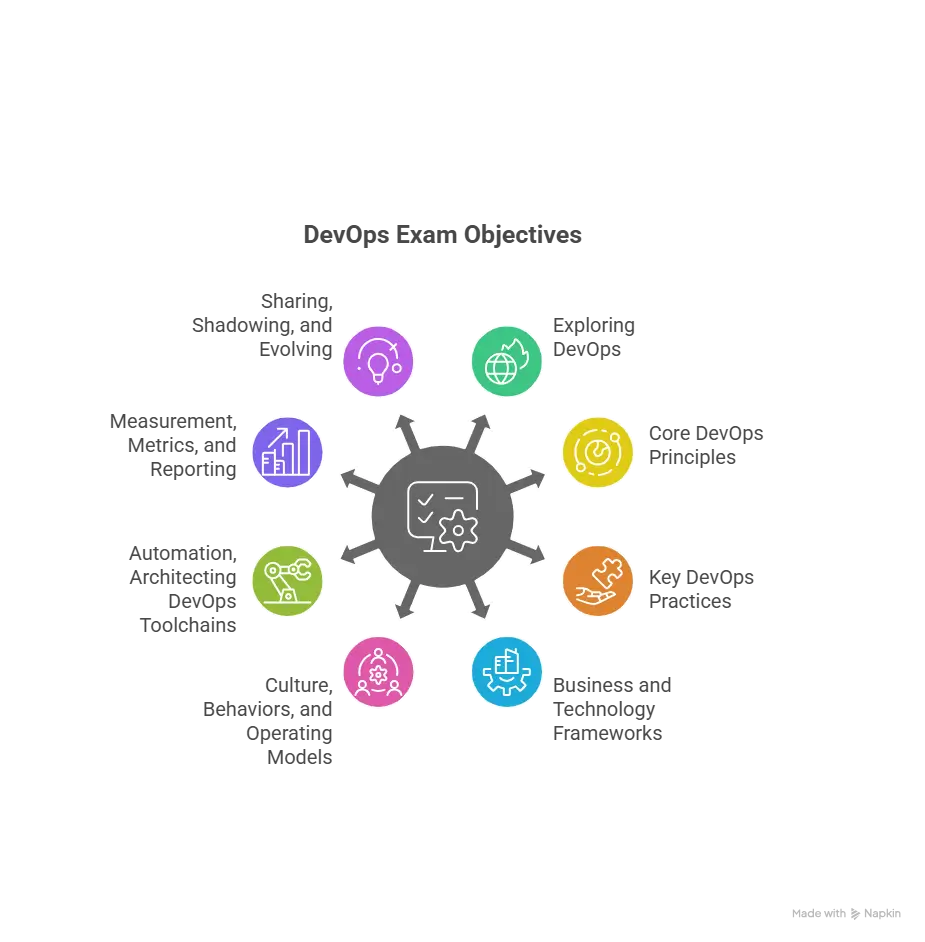
1. Exploring DevOps
You’ll demonstrate understanding of what DevOps is, its historical context, and why it’s increasingly significant today. This includes understanding the problems DevOps solves (slow delivery, poor quality, siloed teams, manual toil) and the business benefits it delivers (faster time to market, improved reliability, better employee satisfaction, competitive advantage).
2. Core DevOps Principles
This domain tests your knowledge of fundamental DevOps principles, including the Three Ways (Flow, Feedback, Continuous Learning and Experimentation), the Theory of Constraints (identifying and removing bottlenecks), Chaos Engineering (deliberately introducing failures to build resilience), and Learning Organizations (creating a culture of continuous improvement and psychological safety).
3. Key DevOps Practices
You’ll be evaluated on your understanding of essential DevOps technical practices including Continuous Testing, Continuous Integration (CI), Continuous Delivery (CD), Continuous Deployment, Site Reliability Engineering (SRE), Resilience Engineering, DevSecOps (security integrated throughout), ChatOps (collaboration through chat tools), Monitoring and Observability, Value Stream Management (VSM), and Platform Engineering (providing self-service infrastructure capabilities).
4. Business and Technology Frameworks
This section covers how DevOps integrates with and enhances other frameworks including Agile and Lean methods, IT Service Management (ITSM), Value Stream Management, Site Reliability Engineering, Safety Culture concepts, Learning Organizations theory, and Continuous Funding models that enable iterative delivery.
5. Culture, Behaviors, and Operating Models
You’ll demonstrate understanding of how to define and shape Organizational Culture, what Cultural Debt means (legacy mindsets that slow transformation), various Behavioral Models (Westrum’s organizational typology, Tuckman’s team development stages), and Organizational Maturity Models (assessing DevOps adoption levels).
6. Automation, Architecting DevOps Toolchains
This domain tests your knowledge of CI/CD pipelines, Infrastructure as Code (IaC), Cloud computing platforms, Containers and orchestration, Microservices architecture, Machine Learning and AI in operations, Automation strategies, DevOps Toolchain design principles, Value Stream Management platforms, Platform Engineering approaches, and Generative AI use cases in DevOps.
7. Measurement, Metrics, and Reporting
You’ll be assessed on your understanding of DevOps metrics including Speed metrics (deployment frequency, lead time), Quality metrics (change failure rate, escaped defects), Stability metrics (MTTR, availability), Culture metrics (employee satisfaction, psychological safety), Change Lead Time and Cycle Time, Value-Driven Metrics (business impact measures), DevOps Dashboards design, and AIOps (AI-powered operations) for metrics analysis.
8. Sharing, Shadowing, and Evolving
This final domain covers DevOps in the enterprise, including DevOps leadership responsibilities, common challenges and risks during implementation (resistance to change, tooling complexity, skills gaps), critical success factors (executive sponsorship, incremental approach, measuring outcomes), and how to get started with DevOps transformation in your organization.
Your Strategic Study Plan for Success
Phase 1: Foundation and Core Concepts (Week 1)
Goal: Understand DevOps fundamentals and the CALMS framework
- Download the official DevOps Foundation Certification Blueprint from PeopleCert. This document outlines exactly what you’ll be tested on and should guide your entire study approach.
- Study the CALMS framework thoroughly:
- Culture: Shared vision, collaboration, communication, learning, continuous improvement
- Automation: CI/CD toolchains, AI, and Infrastructure as Code, enabling velocity and consistency
- Lean: Maximize customer value while minimizing waste and improving flow
- Measurement: Value-driven metrics for people, process, and technology
- Sharing: Leaders and teams sharing ideas, skills,and improving collaboration
- Master the Three Ways:
- First Way (Flow): System thinking, making work visible, reducing batch sizes, limiting WIP, continuous integration
- Second Way (Feedback): Creating fast feedback loops from production to development, monitoring, and telemetry
- Third Way (Continuous Learning and Experimentation): Culture of experimentation, learning from failures, practicing to create mastery
- Understand the core problem DevOps solves. Traditional IT created conflict between development (wanting change) and operations (wanting stability). DevOps resolves this by making developers accountable for operational results and giving operations tools to manage change safely.
- Study real-world case studies from high-performing organizations (ING Bank, Disney, Capital One, Target, etc.). Understand how DevOps principles translate into measurable business outcomes.
Phase 2: Technical Practices and Frameworks (Week 2)
Goal: Deep dive into CI/CD, automation, and DevOps practices
- Study Continuous Integration (CI):
- Developers integrate code multiple times daily into a shared repository
- Automated builds and tests provide fast feedback
- Reduces integration problems and enables rapid detection of defects
- Learn Continuous Delivery and Continuous Deployment:
- Continuous Delivery: Code is always in a deployable state; deployment requires manual approval
- Continuous Deployment: Every change that passes automated tests is deployed to production automatically
- Understand deployment patterns (blue-green, canary, feature flags)
- Master Infrastructure as Code (IaC):
- Infrastructure defined in version-controlled code (Terraform, CloudFormation, Ansible)
- Enables consistent, repeatable infrastructure provisioning
- Infrastructure changes follow the same process as application code
- Understand DevSecOps:
- Security is integrated throughout the delivery pipeline, not added at the end
- Automated security testing and compliance checks
- Shared responsibility for security across all teams
- Study Site Reliability Engineering (SRE):
- Google’s approach to operating large-scale systems
- Service Level Objectives (SLOs) and Error Budgets balance reliability and velocity
- Toil reduction through automation
- Learn Value Stream Management (VSM):
- End-to-end view of value delivery from idea to customer
- Identifying waste, bottlenecks, and improvement opportunities
- Measuring flow efficiency and cycle time
Phase 3: Culture, Metrics, and Organizational Change (Week 3)
Goal: Understand the people and culture aspects of DevOps
- Study organizational culture models:
- Westrum’s Organizational Typology: Pathological (power-oriented), Bureaucratic (rule-oriented), Generative (performance-oriented)
- Cultural characteristics that predict DevOps success: information flow, collaboration, trust, and psychological safety
- Master DevOps metrics and measurement:
- Four Key Metrics (DORA research): Deployment Frequency, Lead Time for Changes, Change Failure Rate, Time to Restore Service
- Value metrics vs. vanity metrics
- Designing effective DevOps dashboards
- Understand Cultural Debt:
- Legacy mindsets, behaviors, and assumptions that slow transformation
- How Cultural Debt accumulates and its impact on change initiatives
- Strategies for paying down Cultural Debt
- Learn about Learning Organizations:
- Peter Senge’s concepts: systems thinking, personal mastery, mental models, shared vision, team learning
- Creating psychological safety for experimentation
- Blameless post-mortems and learning from failures
- Study DevOps leadership:
- Transformational vs. transactional leadership
- Servant leadership in DevOps context
- Breaking down silos and enabling cross-functional collaboration
Phase 4: Advanced Topics and Exam Preparation (Week 4)
Goal: Cover emerging topics and validate readiness
- Study emerging practices:
- Platform Engineering: Building internal developer platforms that provide self-service capabilities
- AIOps: Applying AI and machine learning to operations (anomaly detection, predictive analytics)
- Generative AI use cases: Code generation, documentation, automated testing, incident response
- Chaos Engineering: Netflix’s approach to building resilient systems through controlled experiments
- Understand DevOps toolchains:
- No specific tools are tested, but understand tool categories: source control, build automation, testing frameworks, deployment tools, monitoring platforms, and collaboration tools
- Toolchain design principles: avoid tool sprawl, ensure integration, maintain visibility
- Take multiple practice exams:
- Use PeopleCert practice materials or authorized training provider resources
- Aim for consistently scoring 70%+ (above the 65% pass threshold)
- Review all incorrect answers to understand why you missed them
- Organize your open-book materials:
- Create a reference index: “Three Ways – Page 12,” “CALMS – Page 8,” “Four Key Metrics – Page 87”
- Use digital PDF search functions for quick lookup
- Practice finding information in under 15 seconds
- Study implementation guidance:
- Starting DevOps transformation: begin with pilot teams, measure outcomes, expand incrementally
- Common pitfalls: treating DevOps as purely a tooling problem, neglecting culture, lack of executive support
- Critical success factors: leadership commitment, incremental approach, measuring business outcomes
Official Learning Resources
- Official PeopleCert DevOps Foundation Page: https://www.peoplecert.org/browse-certifications/devops/DevOps-13/devops-foundation-2457
- Download the Certification Blueprint from PeopleCert
- Authorized Training Options: Self-study PDF materials ($200-400), eLearning courses with exam ($500-800), instructor-led training ($1,200-1,800)
- DevOps Institute Website: Visit devopsinstitute.com for additional resources, SKILup Days (free training events), and community content
Career and Salary Opportunities
DevOps skills are among the most in-demand in technology. Organizations across every industry require professionals who can bridge development and operations, automate delivery pipelines, and foster a collaborative culture.
Market Demand
The 2024 State of DevOps Report shows that high-performing organizations deploy code 973 times more frequently and recover from incidents 6,570 times faster than low performers. These dramatic differences drive intense demand for DevOps expertise. Companies are competing aggressively for talent that can implement the practices delivering these results.
DevOps roles span the entire IT organization. You’re not limited to “DevOps Engineer” positions. DevOps knowledge enhances careers in development, operations, QA, security, architecture, project management, and leadership.
Salary Expectations
Based on 2026 data from multiple sources including PayScale, Glassdoor, ZipRecruiter, Salary.com, Indeed, and Built In, DevOps professionals command strong compensation:
- DevOps Engineer (overall average): $113,000 – $142,000 annually in the United States, with most sources clustering around $125,000-$135,000
- Entry-Level DevOps Engineer (0-1 years): $75,000 – $100,000, with PayScale reporting $81,494 average for entry-level
- Mid-Level DevOps Engineer (3-5 years): $110,000 – $150,000
- Senior DevOps Engineer (7+ years): $140,000 – $180,000+, with top performers reaching $200,000-$220,000
Salary range specifics:
- 25th percentile: $105,000-$114,000
- Median/Average: $125,000-$142,000
- 75th percentile: $145,000-$179,000
- 90th percentile: $160,000-$218,000
Geographic location significantly impacts compensation. Top-paying states and cities include:
- California (especially San Francisco, San Jose): $140,000-$160,000 average
- Washington (Seattle): $140,000-$145,000
- New York City: $135,000-$145,000
- Massachusetts (Boston): $130,000-$140,000
- Texas (Austin): $125,000-$135,000
Top-paying companies for DevOps Engineers include Meta, Cruise, Airbnb, Amazon, Google, and major financial services firms, where total compensation (including bonuses and equity) can exceed $200,000-$250,000 for mid-level positions.
Career Progression
The DevOps Foundation certification opens doors to multiple career paths:
- Technical track: DevOps Engineer → Senior DevOps Engineer → Principal DevOps Engineer / DevOps Architect
- Specialized roles: Site Reliability Engineer, Platform Engineer, DevSecOps Engineer, Release Manager, Automation Architect
- Management track: DevOps Team Lead → DevOps Manager → Director of DevOps / VP of Engineering
- Consulting: DevOps Consultant → Senior Consultant → Principal Consultant specializing in transformation
Complementary Certifications
Build on DevOps Foundation with these credentials:
- DevOps Leader – Leadership and organizational transformation focus
- Site Reliability Engineering (SRE) Foundation – Google’s approach to operating systems at scale
- DevSecOps Foundation – Security integration throughout delivery pipeline
- Continuous Testing Foundation – Quality built into delivery process
- Cloud certifications – AWS, Azure, or Google Cloud to complement DevOps practices
- Kubernetes/Container certifications – CKA, CKAD for container orchestration expertise
Exam Logistics: Policies You Need to Know
Scheduling Your Exam
DevOps Foundation exams are delivered online via PeopleCert’s proctoring platform. You can schedule your exam 24/7 based on availability. Purchase options include:
- Standalone exam voucher – $270 USD, valid for 12 months
- Self-study bundle – Official PDF materials + exam voucher ($400-500)
- eLearning bundle – Video training + exam voucher ($600-800)
- Instructor-led training – 2-day course + exam voucher ($1,200-1,800)
Visit the PeopleCert certification page to register and select your preferred exam date and time.
Retake Policy
If you don’t pass on your first attempt:
- First retake: Can be taken immediately after the first attempt
- Second retake: Requires a 10-day waiting period
- Third retake: Requires a 30-day waiting period
- Retake cost: Varies by provider; some bundles include “Take2” (one free retake)
Check your exam voucher terms to understand whether a retake is included.
Rescheduling Fees
- Free rescheduling: Up to 48 hours before your scheduled exam time
- $60 USD fee: Rescheduling between 48-4 hours before exam time (amounts vary by currency: EUR 70, GBP 60, AUD 85, JPY 6815)
- $120 USD fee: Rescheduling less than 4 hours before exam time (amounts vary by currency: EUR 135, GBP 115, AUD 170, JPY 13635)
Open Book Format
The DevOps Foundation exam is open book, but with important restrictions. You may only use official training materials from an authorized DevOps Institute training organization. Third-party study guides, internet searches, or communication with others during the exam are strictly prohibited.
With 60 minutes for 40 questions, you have an average of 90 seconds per question. Organize your materials before the exam so you can quickly reference specific topics without wasting precious time.
Language Options and Extra Time
The exam is available in 8 languages: English, Chinese, French, German, Japanese, Polish, Portuguese (Brazil), and Spanish. If you take the exam in a language other than your native language, you receive 25% additional time (75 minutes total instead of 60).
Certification Validity and Renewal
Your DevOps Foundation certification is valid for 3 years from the date of issue. To maintain your certification, you have two options:
- Join PeopleCert Plus – This membership program allows you to earn 60 Continuing Professional Development (CPD) points over 3 years (20 per year) through professional activities, training, courses, conference attendance, and learning. Accumulating the required CPDs automatically renews your certification.
- Earn Another DevOps Institute Certification – If you obtain any other DevOps Institute certification (such as DevOps Leader, SRE Foundation, DevSecOps Foundation, or other specialties) within your 3-year window, all your DevOps Institute certifications automatically renew.
Plan your renewal strategy early to maintain your certified status.
Practical FAQs & Common Challenges
1. How much hands-on technical experience is necessary before taking this exam?
You don’t need hands-on DevOps implementation experience to pass the DevOps Foundation exam. This is a foundational knowledge certification testing conceptual understanding, not technical skills or tool proficiency. There are no hands-on labs or performance-based questions.
However, having general IT experience significantly helps you contextualize concepts. If you’ve worked in software development, IT operations, quality assurance, or related roles, you’ll find the material immediately relevant to your work experiences. If you’re completely new to IT, you’ll need extra study time to understand foundational concepts like version control, deployment pipelines, and infrastructure management before DevOps principles make full sense.
The key is understanding the “why” behind DevOps practices and how they solve real business problems. Real-world experience helps but isn’t mandatory for certification.
2. Which exam domains or topics do most candidates find the most challenging?
Based on candidate experiences, the most difficult areas typically include:
The Three Ways and how they interconnect – Understanding not just what each Way is, but recognizing when specific practices exemplify each Way. For example, is automated testing part of the First Way (Flow) or Second Way (Feedback)? The answer is both, depending on context. Practice scenario-based questions extensively.
Distinguishing between Continuous Delivery and Continuous Deployment – Delivery means code is always deployable but requires manual approval; Deployment means every change automatically goes to production. Questions test whether you can identify which approach a scenario describes.
Cultural concepts and organizational models – Westrum’s organizational typology (Pathological, Bureaucratic, Generative), Cultural Debt, and psychological safety concepts can be abstract. Connect these to real workplace examples to internalize them.
Metrics and measurement – Questions about which metrics measure what can be tricky. Is “number of deployments” a Speed metric or a Quality metric? (Speed – deployment frequency). Memorize the Four Key Metrics and what each measures.
Framework integration – How DevOps relates to Agile, Lean, ITSM, and SRE requires understanding subtle distinctions. DevOps isn’t a replacement for these frameworks, it complements and enhances them.
3. Should I take instructor-led training or use self-study materials?
Both approaches work, but they suit different learning styles and situations:
Instructor-led training ($1,200-1,800):
- Best for visual/auditory learners who benefit from expert explanation
- Provides real-time Q&A with experienced instructors
- Networking with peers facing similar challenges
- Structured 2-day schedule keeps you focused
- Often includes post-class support
Self-study materials ($400-600):
- Best for independent learners with self-discipline
- Learn at your own pace on your own schedule
- More affordable option
- Requires strong reading comprehension skills
- Good for those already familiar with IT concepts
Middle ground: eLearning courses ($600-800) offer video instruction you can pause and replay, combining some benefits of both approaches.
Most candidates find that completing some form of training (not just reading the blueprint) significantly improves pass rates and practical understanding. Self-study alone works but requires more time and discipline.
4. How should I use my open-book access during the exam?
The open-book format is both an advantage and a potential trap. Here’s how to use it effectively:
Before the exam:
- Create a detailed index: “CALMS framework – p.8,” “Three Ways – p.12,” “Four Key Metrics – p.87”
- Use PDF search functions (Ctrl+F / Cmd+F) to quickly locate terms
- Highlight or bookmark the most important frameworks and definitions
- Practice finding information in under 10 seconds
During the exam:
- Read each question completely before searching for answers
- Use materials to verify answers you’re 80% confident about, not to learn concepts
- If you can’t find an answer within 20 seconds of searching, mark the question for review and move on
- Don’t waste time looking up information you already know confidently
Critical strategy: Answer all questions you know first (probably 25-30 of them), then use remaining time to research the uncertain ones. This ensures you don’t run out of time before answering questions you know.
Time management: With 60 minutes for 40 questions (90 seconds average per question), you can’t afford to spend 3-5 minutes searching materials per question. Your open-book resources should confirm knowledge, not teach you concepts during the exam.
5. How long should I realistically study for this exam?
Study time varies based on your background and experience:
Fast track (1-2 weeks, 15-25 hours total):
- For professionals already working in DevOps environments
- Familiar with CI/CD, automation, and collaborative culture
- Focus on formalizing knowledge and memorizing frameworks
Standard track (2-3 weeks, 30-40 hours total):
- For IT professionals (developers, operations, QA) with no formal DevOps exposure
- Understand IT concepts but need to learn DevOps specifically
- Take official training course and supplement with 1-2 hours daily review
Extended track (4-5 weeks, 50-70 hours total):
- For professionals transitioning from non-IT backgrounds
- Need to build foundational IT knowledge before DevOps concepts make sense
- Consider foundational IT courses before tackling DevOps
Recommended approach: Complete some form of official training (2-day instructor-led, self-study PDF, or eLearning), then dedicate 1-2 hours daily for 2-3 weeks reviewing concepts and taking practice exams. Consistency matters more than cramming.
6. Does the exam test specific tools like Jenkins, Docker, or Kubernetes?
No. The DevOps Foundation exam is tool-agnostic and focuses on principles and practices, not specific technologies. You won’t see questions like “What is the Jenkins pipeline syntax?” or “How do you configure a Docker container?”
However, you should understand:
- Tool categories and their purposes: What do CI tools do? What problems do containers solve?
- General capabilities: Understand that IaC tools make infrastructure repeatable and version-controlled, regardless of whether you use Terraform, CloudFormation, or Ansible
- Integration concepts: How tools work together in a DevOps toolchain
This approach makes the certification valuable regardless of which specific tools your organization uses. DevOps principles apply whether you’re using GitHub Actions or GitLab CI, AWS or Azure, Kubernetes or another orchestration platform.
7. How does DevOps Foundation relate to ITIL certifications?
DevOps and ITIL are complementary, not competitive. Understanding their relationship is important:
ITIL (IT Infrastructure Library) focuses on IT Service Management, how to deliver stable, reliable IT services following standardized processes (Incident Management, Change Management, Problem Management, etc.).
DevOps focuses on cultural transformation, collaboration, automation, and fast flow of value from development to production.
Integration points:
- Modern ITIL 4 incorporates Agile and DevOps concepts
- DevOps accelerates ITIL processes through automation
- Change Management becomes faster and safer through DevOps practices
- Both emphasize continuous improvement (ITIL Continual Service Improvement, DevOps Third Way)
If you have ITIL Foundation or higher, the DevOps Foundation complements it perfectly. Together, they provide comprehensive understanding of modern IT operations. Neither replaces the other, they work together.
8. What’s the difference between DevOps Foundation and SRE Foundation?
Both are DevOps Institute certifications but with different focus:
DevOps Foundation:
- Broad overview of DevOps culture, principles, and practices
- Covers organizational transformation, CI/CD, metrics, leadership
- Best starting point for anyone new to DevOps
- Foundation for all other DevOps Institute certifications
SRE Foundation:
- Focuses specifically on Site Reliability Engineering (Google’s approach to operations)
- Deep dive into Service Level Objectives (SLOs), Error Budgets, Toil Reduction
- Emphasizes reliability, resilience, and operational excellence
- Best for operations engineers, platform engineers, and those focused on production systems
Which to take first? DevOps Foundation provides the broad cultural and organizational context. SRE Foundation builds on DevOps Foundation with deeper technical practices for running production systems at scale.
Many professionals earn both: DevOps Foundation first for comprehensive understanding, then the SRE Foundation for specialized operational expertise.
9. How practical is this certification? Will it help me in real work?
DevOps Foundation is highly practical when you apply the concepts, not just collect the credentials. Here’s the value:
Immediate benefits:
- Common vocabulary enabling effective collaboration across teams
- Understanding the “why” behind practices your organization implements
- Framework for evaluating your organization’s DevOps maturity
- Ability to contribute meaningfully to DevOps transformation discussions
Career benefits:
- Demonstrates commitment to modern IT practices
- Differentiates you in job searches (DevOps skills are high demand)
- Foundation for advanced certifications and specializations
- Credibility when proposing process improvements
Practical application: The certification teaches frameworks like the Three Ways and CALMS that you can immediately apply:
- Use the Three Ways to identify bottlenecks in your delivery pipeline
- Apply CALMS values to assess cultural readiness for DevOps adoption
- Implement the Four Key Metrics to measure your team’s performance
- Leverage Value Stream Mapping to find waste in your processes
Limitation: The certification validates knowledge, not experience. Real value comes from applying DevOps principles to achieve measurable improvements in your organization. Use DevOps Foundation as a roadmap for transformation, not just a certificate to frame.
Conclusion: Your Next Step
The DevOps Foundation certification validates your understanding of the cultural and technical transformation revolutionizing software delivery. This isn’t just another IT certification; it represents a fundamental shift in how modern organizations operate, breaking down silos, accelerating delivery, and improving quality simultaneously.
You now have a complete roadmap for exam success: understand the CALMS framework and Three Ways, master CI/CD and automation concepts, learn how culture and metrics enable DevOps, study framework integration with Agile/Lean/ITSM/SRE, practice with scenario-based questions, and prepare your open-book materials strategically.
The investment you make in DevOps knowledge will pay dividends throughout your career. Whether you’re a developer, operations engineer, QA professional, manager, or consultant, DevOps skills are essential for modern IT delivery. Organizations implementing DevOps achieve dramatically better outcomes, faster delivery, higher quality, better reliability, and improved employee satisfaction.
Ready to get started? Visit the official PeopleCert certification page to download the certification blueprint.
