
Your Complete GES-C01 Snapshot
GES-C01 is the Snowflake SnowPro Specialty: Gen AI exam. In 2026, it covers 4 domains: Snowflake for Gen AI Overview (26%), Snowflake Gen AI & LLM Functions (40%), Snowflake Gen AI Governance (22%), and Snowflake Document AI (12%). A passing score of 750 on a scale of 0-1000 is required. The exam costs $225 USD per attempt. A typical preparation window is 6-10 weeks, depending on your background in AI/ML and Snowflake. The recommended study path combines official Snowflake learning materials with consistent hands-on labs using Cortex features and full-length practice exams. Prerequisites include an active SnowPro Associate: Platform or SnowPro Core certification, plus one or more years of Gen AI experience with Snowflake. The certification is valid for two years and requires recertification before expiration. This guide details official resources, including the study guide available at Snowflake’s certification portal, scheduling through Pearson VUE, and exam policies.
Introduction: What is the SnowPro Specialty: Gen AI and Why Does It Matter?
The SnowPro Specialty: Gen AI certification addresses a critical gap in the market. As organizations race to integrate generative AI into their data platforms, they need professionals who can build production-ready AI solutions with enterprise-grade governance and security. This certification validates your ability to leverage Snowflake’s native AI capabilities—specifically Snowflake Cortex—to implement real-world Gen AI applications.
This credential proves you can work with Large Language Models, build retrieval-augmented generation systems, implement vector search, manage AI governance, and deploy Document AI solutions within the Snowflake Data Cloud. For data engineers transitioning into AI/ML roles, data scientists looking to productionize models, and ML engineers building scalable AI systems, this certification demonstrates specialized expertise that employers are actively seeking in 2026.
Quick Facts & Exam Details
| Detail | Information |
|---|---|
| Exam Name | SnowPro Specialty: Gen AI (GES-C01) |
| Provider | Snowflake Inc. |
| Prerequisites | Active SnowPro Associate: Platform OR SnowPro Core certification required. Additionally, 1+ years of Gen AI experience with Snowflake, proficiency in Python coding, and foundational knowledge in data engineering and SQL. |
| Passing Score | 750 on a scale of 0-1000 |
| Exam Duration | 85 minutes |
| Number of Questions | 55 questions |
| Question Types | Multiple-choice, multiple-select, and interactive scenario-based questions |
| Exam Cost | $225 USD standard price. Note: Prices vary by country and are subject to change. India receives a 20% regional discount. Always confirm the final cost during the registration process. |
| Exam Delivery | Online proctored or at authorized Pearson VUE test centers |
| Validity Period | 2 years from date of passing |
Is This Certification Right for You? (Target Audience)
This certification is designed for professionals who work at the intersection of data engineering and artificial intelligence.
- Ask yourself: Do I build AI-driven applications on Snowflake?
- Am I responsible for implementing LLM-based solutions in production environments?
- Do I need to demonstrate expertise in Gen AI governance and security?
The ideal candidate has hands-on experience with Snowflake Cortex features, understands RAG patterns and vector databases, and has deployed AI models in enterprise settings. This includes AI/ML engineers building intelligent data applications, data scientists productionizing machine learning models, data engineers integrating Gen AI workflows, and application developers creating AI-powered features. If you’re working with generative AI technologies and need to prove your specialized Snowflake skills, this certification validates your expertise.
Exam Blueprint: Skills You’ll Be Tested On
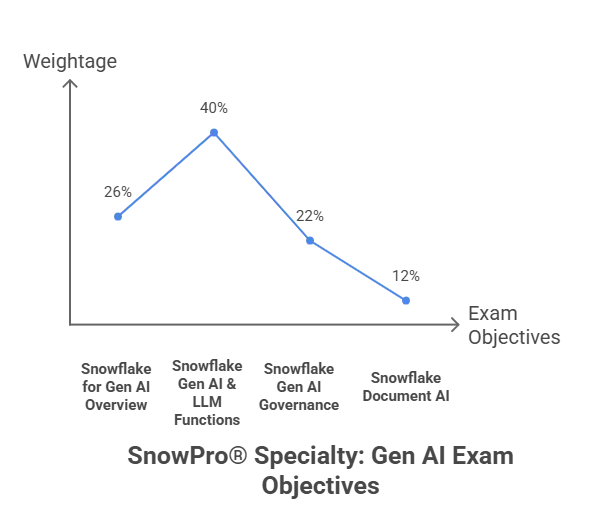
Domain 1: Snowflake for Gen AI Overview (26%)
This foundational domain tests your understanding of Snowflake’s Gen AI ecosystem. You must demonstrate knowledge of Snowflake Cortex components, including LLMs, Cortex Search, Cortex Analyst, Fine-tuning capabilities, and Cortex Agents. Key areas include understanding Snowflake Copilot functionality, implementing security controls through RBAC and guardrails, managing the CORTEX_MODELS_ALLOWLIST, and working with different interfaces like the Cortex LLM Playground, SQL, and REST APIs. You’ll also need to know how to bring custom models into Snowflake using the Model Registry and Snowpark Container Services.
Domain 2: Snowflake Gen AI & LLM Functions (40%)
This is the most heavily weighted domain, focusing on practical implementation skills. You must master Snowflake Cortex functions including COMPLETE (with structured outputs), task-specific functions like CLASSIFY_TEXT, EXTRACT_ANSWER, PARSE_DOCUMENT, SENTIMENT, SUMMARIZE, TRANSLATE, and EMBED_TEXT. Critical topics include building Cortex Search services for RAG applications, implementing Cortex Analyst for semantic model generation and text-to-SQL, fine-tuning models on proprietary data, orchestrating multi-step workflows with Cortex Agents, and working with vector functions like VECTOR_INNER_PRODUCT, COSINE_SIMILARITY, and distance calculations. You’ll also need proficiency with helper functions such as COUNT_TOKENS and SPLIT_TEXT_RECURSIVE_CHARACTER.
Domain 3: Snowflake Gen AI Governance (22%)
This domain evaluates your ability to implement enterprise-grade AI governance. Key skills include setting up model access controls through CORTEX_MODELS_ALLOWLIST and REST API authentication, establishing guardrails using Cortex Guard to filter harmful responses, reducing hallucinations and bias in LLM outputs, monitoring and optimizing Snowflake Cortex costs across Search, Analyst, and LLM functions, understanding token-based pricing, tracking usage via system views, and utilizing AI observability tools including evaluation metrics, tracing, logging, event tables, and the TruLens SDK for comprehensive monitoring.
Domain 4: Snowflake Document AI (12%)
The final domain covers Document AI setup and troubleshooting. You must know how to configure Document AI including virtual warehouses, databases, schemas, roles, and privileges, prepare documents for processing including upload procedures and training requirements, optimize questions for better extraction accuracy, extract values from documents using Document AI functions, and troubleshoot common issues including query errors, using GET_PRESIGNED_URL for document access, understanding cost implications, and applying best practices for optimal performance.
Your Strategic Study Plan for Success
Phase 1: Build Your Foundation (Weeks 1-2)
Begin by ensuring your prerequisite certification is active. If you need to obtain SnowPro Associate: Platform or Core, prioritize this first. Next, download the official GES-C01 Study Guide from the Snowflake certification page. Read through the entire guide to understand the scope and depth of each domain. Familiarize yourself with Snowflake’s Gen AI architecture by reviewing the official documentation on Snowflake Cortex, understanding how LLMs integrate with the Data Cloud, and learning about the separation between compute, storage, and AI services.
Set up your hands-on practice environment by creating a Snowflake trial account if you don’t have access to an enterprise account, enabling Cortex features, and familiarizing yourself with Snowsight, the web interface for Snowflake.
Phase 2: Deep Dive into Each Domain (Weeks 3-6)
Domain 1 – Gen AI Overview: Study Snowflake Cortex documentation thoroughly. Practice using Cortex LLM functions via SQL and the LLM Playground. Understand RBAC implementation for AI features, including role hierarchies and privilege management. Learn how to configure CORTEX_MODELS_ALLOWLIST to control model access. Explore Snowflake Model Registry for bringing external models. Study Snowpark Container Services for custom model deployment.
Domain 2 – Gen AI & LLM Functions: This is your most critical study area. Build hands-on projects using COMPLETE function for text generation, implement structured outputs for JSON responses, and create classification workflows with CLASSIFY_TEXT. Practice document processing with PARSE_DOCUMENT, implement sentiment analysis pipelines, build translation services, and generate embeddings with EMBED_TEXT. Most importantly, build a complete RAG application using Cortex Search, including creating search services, querying with semantic search, and integrating results with LLMs. Implement Cortex Analyst for text-to-SQL generation and explore Cortex Fine-tuning capabilities for model customization. Work with vector functions to calculate similarity scores. Practice using COUNT_TOKENS and SPLIT_TEXT_RECURSIVE_CHARACTER for text processing.
Domain 3 – Governance: Implement access controls on Cortex features, configure Cortex Guard to filter harmful outputs, and study techniques to reduce hallucinations. Practice monitoring Cortex usage through CORTEX_SEARCH_DAILY_USAGE_HISTORY and other system views. Learn token-based cost calculation and optimization strategies. Implement logging and tracing for AI workloads and explore TruLens SDK integration for observability.
Domain 4 – Document AI: Set up a complete Document AI environment from scratch, including all required objects and permissions. Practice uploading documents for training, extract values from various document types, troubleshoot failed extractions, and optimize query patterns for better results. Understand GET_PRESIGNED_URL for document access and learn cost optimization strategies for Document AI workloads.
Phase 3: Practice Exams and Refinement (Weeks 7-10)
Take your first full-length practice exam to establish a baseline. Review incorrect answers thoroughly, understanding not just the right answer but why other options were incorrect. Identify your weakest domains based on practice exam results. Dedicate extra study time to these areas, revisiting documentation and building additional hands-on labs. Take additional practice exams, aiming for consistent scores above 85%. Each practice session should simulate real exam conditions with the 85-minute time limit. In the final week, review key concepts daily, focusing on domain-specific objectives. Practice writing SQL code for Cortex functions from memory. Review governance and security concepts, as these are commonly tested. Rest well the day before your exam.
Official Learning Resources
Snowflake provides comprehensive training materials. Enroll in Snowflake University courses specifically targeting Gen AI topics. Complete the free mini-workshops including “Snowflake x Gen AI: A Cool Collab” and “Snowflake X Gen AI: LLM Functions” for interactive hands-on experience. Explore Snowflake’s Coursera offerings, particularly “Introduction to Generative AI with Snowflake” and “Building Generative AI Apps to Talk to Your Data,” which are free to audit. Access on-demand webinars filtered by “AI” category from the Snowflake Webinars page. Study community-created content, including Medium blog posts from Snowflake developers detailing real-world implementation patterns.
Career and Salary Opportunities
The market demand for professionals with combined Snowflake and Gen AI expertise is experiencing explosive growth. Organizations across industries are implementing AI-powered data solutions, creating strong demand for certified specialists who can build these systems securely and efficiently.
Target Job Roles: Machine Learning Engineer, AI Engineer, Data Scientist (focused on LLMs), Data Engineer (AI/ML pipeline focus), AI Application Developer, ML Operations Engineer, and Gen AI Solutions Architect.
Salary Expectations (2025 US Market): Entry-level professionals with this certification can expect salaries ranging from $120,000 to $155,000 annually. Mid-level specialists with 3-5 years of experience typically earn $155,000 to $210,000. Senior professionals and architects command $210,000 to $280,000 or higher. According to recent industry data, Machine Learning Engineers in the United States earn an average of $158,000 to $183,000 per year, with top earners in major tech hubs reaching $245,000. AI Engineers average $175,000 to $210,000 in total compensation. Data Scientists specializing in Gen AI and working with platforms like Snowflake report salaries between $150,000 and $240,000 depending on experience and location.
Major tech companies and enterprises implementing Snowflake’s AI capabilities offer even higher compensation packages, particularly in markets like San Francisco, Seattle, New York, and Austin. The combination of Snowflake certification and Gen AI expertise positions you competitively for roles that command premium salaries due to the specialized nature of the skill set.
Exam Logistics: Policies You Need to Know
Registration and Scheduling
Register through the Snowflake Certification Portal at Pearson VUE. You must create an account using the same email associated with your prerequisite certification. Payment is required at registration. Schedule your exam at least 24 hours in advance for the best time slot availability.
Retake Policy
If you do not pass on your first attempt, you must wait 7 days before retaking the exam. Each retake requires full payment of the exam fee. You are limited to 4 exam attempts within any 12 months. If you fail three times, Snowflake recommends completing additional training before your fourth attempt.
Certification Validity and Renewal
Your certification is valid for 2 years from the date you pass the exam. To maintain your credential, you must retake the current version of the exam before expiration. Snowflake does not currently offer a reduced-price recertification exam for specialty certifications, so plan to pay the full exam fee upon renewal.
Rescheduling and Cancellations
You can reschedule or cancel your exam up to 24 hours before your scheduled appointment without penalty through the Pearson VUE portal. If you miss this window, you will forfeit your exam fee. Emergencies should be reported directly to Snowflake support for potential consideration.
Exam Day Requirements
For online proctored exams, ensure you have a reliable internet connection, a computer with webcam and microphone, a clean, well-lit testing area, and government-issued identification. The proctor will verify your identity and monitor you throughout the exam via webcam. You may not use notes, additional monitors, or any reference materials during the exam.
Practical FAQs & Common Challenges
1. How much hands-on experience is truly necessary before taking this exam?
The official prerequisite states 1+ years of Gen AI experience with Snowflake, and this is not merely a suggestion. You need substantial practical experience working with Cortex features in real or simulated production environments. Simply reading documentation will not prepare you adequately. Plan to spend at least 40-60 hours in hands-on labs building RAG applications, implementing Cortex functions, and troubleshooting real scenarios. The exam includes interactive questions that test your ability to solve actual implementation problems, not just theoretical knowledge.
2. Which exam domains do most candidates find the most challenging?
Domain 2 (Gen AI & LLM Functions) at 40% weighting is the most challenging for most candidates because it requires deep hands-on proficiency with multiple Cortex functions. Many candidates struggle with vector operations, understanding when to use specific functions, and building complete RAG workflows. Domain 3 (Governance) also presents difficulty because it requires understanding cost optimization strategies and observability tools that may not be covered in basic tutorials. Focus extra study time on these areas, particularly practicing with Cortex Search and vector functions.
3. Should I take SnowPro Core before attempting this specialty exam?
While both SnowPro Associate: Platform and SnowPro Core satisfy the prerequisite, most successful candidates report that Core certification provides better preparation. Core covers the foundational Snowflake architecture, security model, and SQL capabilities that you’ll leverage when working with Cortex features. If you’re choosing between the two prerequisites, invest in Core if you have limited Snowflake experience. However, if you already have strong production Snowflake experience, Associate: Platform is sufficient.
4. What is the best strategy for the interactive and scenario-based questions?
These questions simulate real-world implementation challenges. You might be asked to debug a failing Cortex Search query, optimize token usage for cost efficiency, or implement proper RBAC for AI features. The best strategy is to approach them methodically: read the entire scenario carefully, identify what the question is actually testing, eliminate obviously incorrect answers first, and apply your hands-on experience. If you’ve built these solutions yourself in practice, you’ll recognize the patterns. This is why hands-on labs are more valuable than passive reading for this exam.
5. How long should I realistically study for this exam?
Study duration depends heavily on your current experience level. If you have 1+ years working daily with Snowflake Cortex features, you might be ready in 4-6 weeks with focused review. If you meet the prerequisite requirements but have limited Gen AI hands-on experience, plan for 8-12 weeks of dedicated study including substantial lab work. Career changers or those new to AI/ML should expect 12+ weeks. The key factor is not just reading time but hands-on practice building complete Gen AI solutions.
6. What are the most commonly tested Cortex functions I must master?
Based on the 40% weighting of Domain 2, prioritize these functions: COMPLETE (including structured outputs), EMBED_TEXT for generating embeddings, Cortex Search for RAG implementations, CLASSIFY_TEXT for classification tasks, PARSE_DOCUMENT for document processing, and vector similarity functions (COSINE_SIMILARITY, VECTOR_INNER_PRODUCT, L1_DISTANCE, L2_DISTANCE). You should be able to write working SQL queries using these functions from memory and understand their parameters, return types, and common use cases.
7. How important is understanding cost optimization and monitoring?
Very important. Domain 3 (Governance) at 22% weighting includes substantial focus on cost monitoring and optimization. You must understand token-based pricing for LLM calls, how to use CORTEX_SEARCH_DAILY_USAGE_HISTORY and similar views to track consumption, strategies to reduce token usage, and how different Cortex features consume credits. Many scenario questions involve identifying cost inefficiencies or implementing monitoring solutions. This reflects real-world priorities where cost management is critical for production AI systems.
8. Is it better to focus more on practice exams or hands-on labs?
For this exam specifically, hands-on labs should be your primary focus, with practice exams serving as assessment tools. The exam tests practical implementation skills, not just conceptual knowledge. Build multiple complete projects: a RAG application with Cortex Search, a document classification pipeline, a text-to-SQL solution with Cortex Analyst, and a governance framework with monitoring. Once you’ve built these, use practice exams to identify remaining knowledge gaps and validate your readiness. Aim to consistently score 85% or higher on practice exams before scheduling your real attempt.
Conclusion: Your Next Step
Earning the SnowPro Specialty: Gen AI certification positions you at the forefront of enterprise AI implementation. As organizations worldwide accelerate their Gen AI adoption, your verified expertise in building production-grade AI solutions on Snowflake becomes increasingly valuable. This certification proves you can leverage cutting-edge LLM capabilities while maintaining enterprise governance, security, and cost efficiency.
Your journey begins with solid preparation. Download the official study guide, set up your hands-on practice environment, and commit to building real Gen AI solutions with Snowflake Cortex. Remember that practical experience building RAG applications, implementing LLM workflows, and managing AI governance will serve you far better than memorization alone.
Ready to take the next step? Visit the official SnowPro Specialty: Gen AI certification page to access the study guide, review detailed exam objectives, and register for your exam through Pearson VUE. Your specialized expertise in Gen AI and Snowflake awaits validation—start your preparation today.
