
KCSA Key Facts & Overview
KCSA is the Linux Foundation/CNCF Kubernetes and Cloud Native Security Associate exam. In 2026, it covers six domains: Kubernetes Cluster Component Security (22%), Kubernetes Security Fundamentals (22%), Kubernetes Threat Model (16%), Platform Security (16%), Overview of Cloud Native Security (14%), and Compliance and Security Frameworks (10%). A passing score of 75% is required. Pricing is based on the exam’s proctoring location. A typical preparation window is 4–8 weeks, depending on your background. The recommended study path combines the official CNCF curriculum with a focus on foundational security concepts and practice questions. The certification must be renewed every two years. This guide details official resources, including the study guide, scheduling pages, and exam policies.
Introduction: What is the KCSA and Why Does It Matter?
The Kubernetes and Cloud Native Security Associate (KCSA) certification is your first step into the critical field of cloud native security. As organizations increasingly rely on Kubernetes, securing these complex environments has become a top priority. The KCSA exam validates that you possess the foundational knowledge of security best practices, enabling you to identify risks, implement basic controls, and understand the security posture of a Kubernetes cluster. Earning this certification demonstrates to employers that you understand the principles required to protect modern applications, making you a valuable asset to any team operating in the cloud native ecosystem. It is the ideal starting point for a career in cloud security, DevSecOps, or platform engineering.
Quick Facts & Exam Details
| Detail | Information |
| Exam Name | Kubernetes and Cloud Native Security Associate (KCSA) |
| Provider | Cloud Native Computing Foundation (CNCF) & The Linux Foundation |
| Prerequisites | None, but foundational knowledge of Kubernetes (such as that covered by the KCNA) is highly recommended. |
| Passing Score | 75% |
| Exam Duration | 90 minutes |
| Question Types | Multiple-choice |
| Exam Cost | $250 USD. Note: Prices vary by country and are subject to change. Always confirm the final cost during the registration process. |
Is This Certification Right for You? (Target Audience)
This certification is designed for you if you have a foundational understanding of Kubernetes and want to specialize in its security. Are you a system administrator, junior developer, or IT professional looking to pivot into a security-focused role? If you need to learn how to evaluate cluster security, harden controls, and assist in identifying vulnerabilities, the KCSA provides the perfect curriculum. It is intended for individuals who want to build a career in cloud security and plan to advance toward more senior certifications like the Certified Kubernetes Security Specialist (CKS).
Exam Blueprint: Skills You’ll Be Tested On
The KCSA exam is broken down into six security-focused domains.
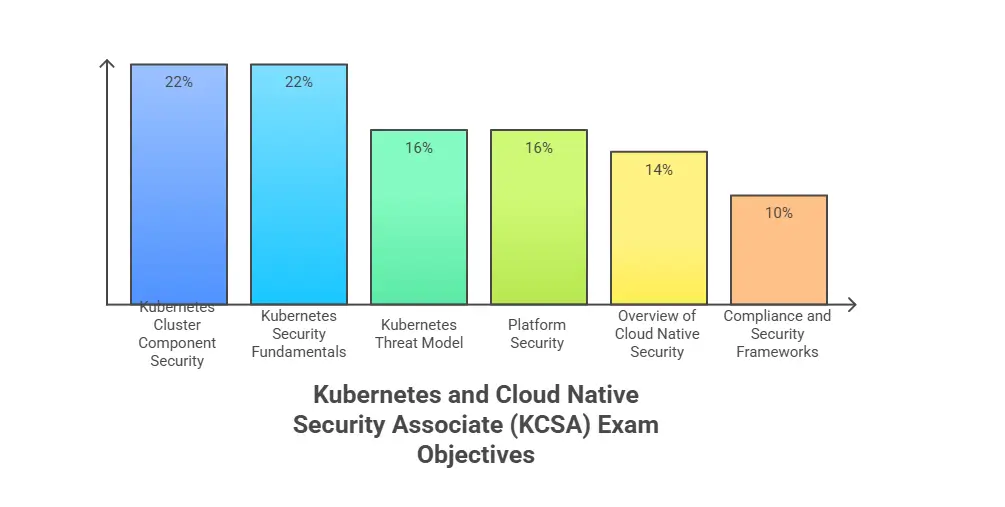
- Kubernetes Cluster Component Security (22%)
This domain covers securing the core components of a Kubernetes cluster. You will need to understand how to protect the control plane, worker nodes, and etcd database, as well as concepts like network policies. - Kubernetes Security Fundamentals (22%)
This section tests your knowledge of fundamental security constructs within Kubernetes. It includes topics like authentication, authorization (RBAC), Pod Security Standards, and managing secrets. - Kubernetes Threat Model (16%)
Here, you will demonstrate your understanding of common threats and attack vectors against a Kubernetes cluster. This involves knowing about container escape vulnerabilities, man-in-the-middle attacks, and other security risks. - Platform Security (16%)
This domain broadens the scope to the underlying platform. It covers security for the host OS, container images, and the software supply chain, including scanning images for vulnerabilities. - Overview of Cloud Native Security (14%)
This section provides a high-level view of security in the cloud native ecosystem. It covers the 4C’s of Cloud Native Security (Cloud, Cluster, Container, Code) and general security principles. - Compliance and Security Frameworks (10%)
This final domain focuses on adhering to industry standards. You will be tested on your knowledge of security benchmarks (like CIS Benchmarks) and the importance of monitoring, logging, and runtime security.
Your Strategic Study Plan for Success
A successful KCSA strategy involves layering security concepts on top of your existing Kubernetes knowledge.
- Solidify Kubernetes Fundamentals: Before tackling security, ensure you are comfortable with the topics covered in the KCNA exam. You cannot secure a system you do not understand.
- Follow the Official KCSA Curriculum: The CNCF provides an open-source curriculum for the KCSA which should be your main guide. Systematically go through each point to ensure complete coverage of all testable topics.
- Focus on the “Why”: The KCSA is a multiple-choice exam that tests your conceptual understanding. For each topic, focus on why a specific security control is important. For example, instead of just knowing what a NetworkPolicy is, understand why it is used to limit pod-to-pod communication.
- Use a Dedicated Course: Consider enrolling in a training course designed for the KCSA, such as the official Kubernetes and Cloud Native Security Essentials (LFS260) from the Linux Foundation. These courses are structured to align directly with the exam blueprint.
- Review and Reinforce: In the final weeks, review the 4C’s of Cloud Native Security and how each exam domain fits within that model. Use practice questions to test your knowledge and identify weak areas for a final review.
Career and Salary Opportunities
The KCSA certification immediately makes your profile more attractive for security-conscious roles. It is a stepping stone for positions like Cloud Security Analyst, Junior DevSecOps Engineer, or Platform Engineer. Professionals with validated cloud native security skills are in high demand. While the KCSA is an associate-level credential, it opens the door to roles where salaries in the US market typically range from $95,000 to $140,000 annually, with significant growth potential as you gain experience and further certifications.
Exam Logistics: Policies You Need to Know
Be prepared for exam day by understanding the official policies.
- Scheduling: After purchasing the exam from the Linux Foundation, you have 12 months to schedule and take your online, proctored test.
- Retake Policy: The exam purchase includes one free retake. If you don’t pass on your first try, you can schedule a second attempt without an additional fee.
- Certification Validity and Renewal: The KCSA certification is valid for two years. To maintain the credential, you will likely need to retake the exam, though you should always check the official policy for updates.
- Exam Environment: This is a multiple-choice, closed-book exam. You will not have access to a terminal or any outside resources.
You can find more information and register for the exam on the official KCSA certification page.
Practical FAQs & Common Challenges
- How much hands-on experience is truly necessary before taking this exam?
While the exam is multiple-choice, a conceptual understanding derived from some hands-on practice is very beneficial. You should be familiar with kubectl and have a basic idea of how to inspect resources like Roles, RoleBindings, and NetworkPolicies to better understand the theory. - Which exam domains or topics do most candidates find the most challenging?
Candidates often find the “Kubernetes Threat Model” and “Compliance and Security Frameworks” domains challenging. These require an understanding of abstract security concepts and external standards (like CIS) that go beyond just configuring Kubernetes resources. - Should I take the KCNA exam before attempting this one?
It is highly recommended. The KCSA assumes you already have the foundational Kubernetes knowledge that the KCNA validates. Taking the KCNA first will provide a much smoother learning path for the KCSA. - What is the best strategy for the multiple-choice questions?
Focus on the security principle being tested. Many questions will present a scenario and ask for the best security practice. Use the process of elimination and choose the answer that most directly addresses the security risk described. - How long should I realistically study for this exam?
If you already have a KCNA-level understanding of Kubernetes, a study period of 4 to 8 weeks should be sufficient. If you are learning both Kubernetes and its security concepts simultaneously, plan for a longer period. - What are the official prerequisites for this certification?
There are no official prerequisites, but a solid understanding of fundamental Kubernetes concepts is an unofficial requirement for success. - Is it better to focus more on practice exams or on hands-on labs?
A balanced approach is best. Use hands-on labs to understand the concepts (e.g., create a NetworkPolicy to see how it works), then use practice exams to test your theoretical knowledge and exam-taking strategy.
Conclusion: Your Next Step
Securing cloud native workloads is no longer optional, and the KCSA is your validated entry into this essential field. By passing this exam, you prove that you have the skills to think defensively and apply foundational security principles to Kubernetes environments. This certification is a clear signal that you are ready to help build and maintain secure, resilient systems.
