
Why the MLA-C01 Certification Transforms Your Career
The AWS Certified Machine Learning Engineer – Associate (MLA-C01) validates your expertise in building, deploying, and maintaining machine learning solutions on AWS. In an era where machine learning drives business innovation, this certification positions you at the forefront of technological transformation.
You’re entering a field experiencing explosive growth. According to the World Economic Forum Future of Jobs Report, demand for AI and Machine Learning Specialists is expected to grow by 40%, creating unprecedented opportunities for certified professionals. This certification doesn’t just validate your skills—it opens doors to roles that shape the future of technology.
Who Should Pursue This Certification
The MLA-C01 explicitly targets MLOps engineers, data engineers building ML pipelines, DevOps engineers extending into ML deployment, and backend software developers transitioning to ML engineering. If you’re already working with AWS services and want to specialize in machine learning operations, this certification aligns perfectly with your career trajectory.
You don’t need to be a data scientist or ML researcher. The ideal candidate has at least one year of experience using Amazon SageMaker and other AWS services for machine learning, plus one year in a related technical role. This practical focus makes the certification accessible to experienced developers and engineers ready to expand their expertise.
Comprehensive Exam Overview
Exam Structure and Format
The MLA-C01 exam consists of 65 questions to be completed in 170 minutes (2 hours and 50 minutes). You’ll encounter multiple question types designed to test real-world application skills:
- Traditional Multiple Choice: Single correct answer from four options
- Multiple Response: Two or more correct answers from five or more options
- Case Study Questions: Scenario-based problems testing end-to-end solution design
- Ordering Questions: Arranging steps in the correct sequence for ML workflows
The exam includes 50 scored questions and 15 unscored questions that AWS uses for future exam development. There’s no penalty for guessing, so answer every question.
Scoring System and Passing Requirements
Your results are reported as a scaled score from 100 to 1,000, with 720 as the minimum passing score. AWS uses scaled scoring to ensure fairness across different exam versions, adjusting for variations in difficulty level.
The exam uses a compensatory scoring model—you don’t need to pass each domain individually, only achieve the overall passing score. This means you can compensate for weakness in one area with strength in another, though comprehensive preparation across all domains remains essential.
Registration and Costs
Associate-level AWS exams cost $150 USD, with regional pricing available in Australian dollars, euros, Korean won, and Japanese yen. You can schedule your exam through Pearson VUE testing centers or as an online proctored exam from your home or office.
Rescheduling or cancellation is free up to 24 hours before your scheduled appointment. Missing your exam forfeits the fee, though medical exceptions may apply. After failing, you must wait 14 days before retaking.
Prerequisites and Recommended Experience
Official Requirements
There are no mandatory prerequisites for taking the MLA-C01 exam—you don’t need the Cloud Practitioner or any other certification first. However, succeeding requires substantial practical experience.
Recommended Background
AWS recommends at least one year of hands-on experience building, deploying, and maintaining ML solutions using Amazon SageMaker and core AWS ML services. You should understand:
- Data Engineering Fundamentals: Working with various data formats, building ingestion pipelines, and performing transformations for ML workflows
- Software Engineering Practices: Writing modular, reusable code with proper version control and debugging techniques
- ML Algorithm Basics: Understanding when to apply different algorithms and their use cases
- Cloud Infrastructure: Provisioning and monitoring resources in distributed environments
If you lack this experience, AWS Skill Builder provides structured learning paths to bridge knowledge gaps systematically.
Deep Dive into Exam Domains
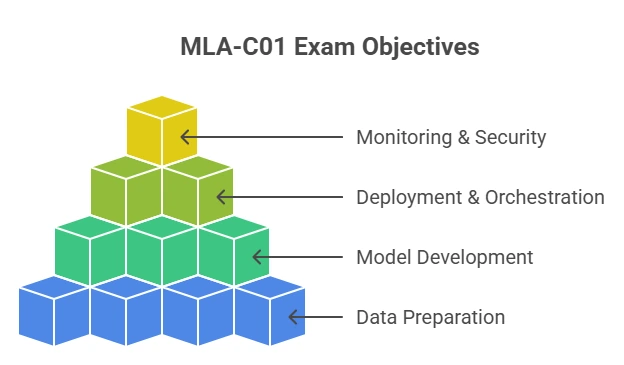
Domain 1: Data Preparation for Machine Learning (28% of exam)
This domain holds the highest weight at 28%, making it crucial for exam success. You’ll demonstrate expertise in:
Data Ingestion and Storage
- Implementing data pipelines using AWS Glue, Kinesis, and Data Pipeline
- Optimizing storage solutions with S3, DynamoDB, and Redshift
- Managing streaming data for real-time ML applications
- Implementing data versioning and lineage tracking
Data Transformation and Feature Engineering
- Performing ETL operations using SageMaker Processing Jobs
- Creating feature stores with SageMaker Feature Store
- Implementing data validation and quality checks
- Handling missing values, outliers, and data imbalance
Data Security and Governance
- Implementing encryption at rest and in transit
- Managing data access with IAM policies and S3 bucket policies
- Ensuring compliance with data privacy regulations
- Implementing data lifecycle policies
Domain 2: ML Model Development (26% of exam)
This domain covers selecting modeling approaches, training models, tuning hyperparameters, analyzing performance, and managing model versions.
Model Selection and Training
- Choosing appropriate algorithms for business problems
- Implementing distributed training with SageMaker
- Using built-in algorithms vs. custom containers
- Optimizing training infrastructure for cost and performance
Hyperparameter Optimization
- Implementing automatic model tuning with SageMaker
- Defining hyperparameter ranges and optimization strategies
- Using Bayesian optimization for efficient tuning
- Monitoring and analyzing tuning jobs
Model Evaluation and Validation
- Implementing proper train/validation/test splits
- Using appropriate metrics for different problem types
- Detecting and mitigating overfitting
- Implementing cross-validation strategies
Domain 3: Deployment and Orchestration of ML Workflows (22% of exam)
Community feedback consistently identifies this as one of the most challenging domains, testing precise configuration knowledge.
Model Deployment Strategies
- Implementing real-time endpoints with SageMaker
- Configuring batch transform jobs for offline inference
- Setting up multi-model endpoints for cost optimization
- Implementing edge deployment with SageMaker Edge Manager
Infrastructure and Scaling
- Configuring auto-scaling policies based on metrics
- Implementing A/B testing and canary deployments
- Using Elastic Inference for cost optimization
- Managing endpoint configurations and variants
Workflow Automation
- Building ML pipelines with SageMaker Pipelines
- Implementing CI/CD with CodePipeline and CodeBuild
- Using Step Functions for complex orchestration
- Integrating with Lambda for serverless workflows
Domain 4: ML Solution Monitoring, Maintenance, and Security (24% of exam)
This domain focuses on monitoring models, data, and infrastructure to detect issues, plus securing ML systems through access controls and compliance.
Model Monitoring and Maintenance
- Implementing model quality monitoring with SageMaker Model Monitor
- Detecting data drift and model degradation
- Setting up alerting with CloudWatch
- Implementing model retraining strategies
Security and Compliance
- Configuring VPC endpoints for private connectivity
- Implementing least-privilege access with IAM
- Using AWS Key Management Service for encryption
- Ensuring audit compliance with CloudTrail
Cost Optimization
- Using Spot Instances for training workloads
- Implementing resource tagging for cost allocation
- Analyzing costs with AWS Cost Explorer
- Right-sizing instances based on utilization metrics
Strategic Preparation Roadmap
- Phase 1: Foundation Building (2-3 weeks)
Start with comprehensive video courses that provide high-level coverage of all domains. Popular instructors Stéphane Maarek and Frank Kane offer a 23-hour course covering all essential topics. Focus on understanding concepts before diving into hands-on practice.
- Phase 2: Hands-On Practice (3-4 weeks)
Successful candidates emphasize practical experience over memorization. Create a dedicated AWS account for experimentation:
- Build end-to-end ML pipelines using SageMaker
- Implement different deployment patterns
- Configure monitoring and security features
- Practice cost optimization techniques
Use AWS Free Tier and SageMaker Studio Lab for cost-effective practice.
- Phase 3: Knowledge Assessment (2 weeks)
Use high-quality practice exams as diagnostic tools, with Tutorials Dojo widely considered the gold standard for challenging questions with detailed explanations.
Practice until you consistently score 80-90% on randomized tests. Review every question—both correct and incorrect—to understand underlying concepts.
- Phase 4: Gap Remediation (1 week)
Focus intensively on weak areas identified through practice exams. Return to AWS documentation for deep dives into specific services. AWS Skill Builder’s Enhanced Exam Prep Plan includes 100+ practice questions with 65 forming an official pretest.
Career Impact and Opportunities
Job Roles and Responsibilities
This certification validates your ability to handle complex ML tasks including data accuracy, model optimization, and secure workflow implementation. Certified professionals typically pursue roles such as:
- ML Engineer: Design and implement production ML systems
- MLOps Engineer: Automate ML workflows and maintain model pipelines
- Data Engineer (ML Focus): Build robust data pipelines for ML applications
- Cloud Solutions Architect (ML Specialty): Design enterprise ML architectures
Salary Expectations
The financial rewards for AWS-certified ML engineers are substantial:
Machine Learning Engineers with AWS skills earn an average of $128,413 in 2026 However, compensation varies significantly based on experience and location:
- Entry Level (1-4 years): $113,432 average total compensation
- Mid-Career (5-9 years): $157,460 average total compensation
- Senior Level: Senior Machine Learning Engineers average $157,186 base salary
At Amazon specifically, ML Engineer compensation ranges from $191K for L4 to $391K for L6 positions, demonstrating significant growth potential within organizations.
Market Demand and Growth
The average ML engineer salary of $162,509 is more than double the national average of $59,428, reflecting intense market demand. Major technology hubs offer even higher compensation, with Silicon Valley and Seattle leading the market.
Industries actively hiring certified ML engineers include:
- Technology and software development
- Financial services and fintech
- Healthcare and biotechnology
- E-commerce and retail
- Autonomous vehicles and robotics
Essential Exam Tips for Success
Time Management Strategies
- Allocate approximately 2.5 minutes per question
- Flag complex questions for review rather than getting stuck
- Complete all questions—there’s no penalty for wrong answers
- Reserve 15 minutes for reviewing flagged items
Question Approach Tactics
- Eliminate obviously incorrect options first
- Look for AWS-specific terminology and best practices
- Consider cost optimization in solution selection
- Think about scalability and security implications
- Remember that AWS often tests the “most appropriate” solution, not just technically correct ones
Common Pitfalls to Avoid
- Don’t overthink simple questions
- Avoid selecting overly complex solutions when simpler options exist
- Remember that newer services aren’t always the right answer
- Consider regional availability of services
- Pay attention to specific requirements like “real-time” vs. “batch”
Exam Day Best Practices
- Arrive early or test your online proctoring setup in advance
- Read each question completely before reviewing options
- Trust your preparation—first instincts are often correct
- Use the scratch pad for complex calculations or diagrams
- Stay calm if you encounter unfamiliar scenarios
Frequently Asked Questions
How difficult is the MLA-C01 compared to other AWS certifications?
Community feedback places MLA-C01 firmly at associate level—more challenging than Cloud Practitioner but less demanding than ML Specialty or Professional certifications. The scenario-based questions require deep understanding of service configurations rather than surface-level knowledge.
How long should I prepare for this exam?
With one year of relevant experience, most candidates report needing 6-8 weeks of dedicated preparation. Without prior ML experience, plan for 3-4 months including hands-on practice time.
Is prior AWS certification required?
No prerequisites exist—you can take MLA-C01 as your first AWS certification. However, having Cloud Practitioner or Solutions Architect Associate provides helpful foundational knowledge.
How often does the exam content update?
AWS regularly updates exam content to reflect new services and best practices. The MLA-C01 launched in June 2025, making it one of AWS’s newest certifications with current, relevant content.
What’s the pass rate for this exam?
AWS doesn’t publish official pass rates, and third-party claims should be viewed skeptically. Focus on thorough preparation rather than statistics.
Can I use dumps or brain dumps to prepare?
Avoid exam dumps entirely. They violate AWS certification agreements, provide outdated information, and don’t prepare you for real-world application. Invest in legitimate practice resources that explain concepts thoroughly.
How does MLA-C01 differ from the ML Specialty certification?
MLA-C01 focuses on operational aspects of ML engineering, while ML Specialty covers broader ML concepts including algorithm theory and statistical foundations. MLA-C01 is more practical and implementation-focused.
What if I fail the exam?
You must wait 14 days before retaking and pay the full fee again. Use this time to identify knowledge gaps through your score report and focus preparation accordingly.
How long is the certification valid?
The certification remains valid for 3 years, after which you must recertify by passing the current version of the exam.
Are there any discounts available?
After earning your first AWS certification, you receive 50% off your next exam. Some employers also provide exam vouchers or reimburse certification costs.
Should I get hands-on experience with Bedrock for generative AI questions?
Yes, AWS increasingly emphasizes generative AI capabilities. Understanding SageMaker, Bedrock, and AI services is crucial for current exam versions.
What resources does AWS provide directly?
AWS Skill Builder offers the Enhanced Exam Prep Plan with role-based training, hands-on labs, and official practice questions for $30/month. This includes access to the official pretest for accurate readiness assessment.
How important are the new question types?
New question formats including case studies and ordering questions test practical application skills. Practice with various question types to avoid surprises on exam day.
Can I switch between questions during the exam?
Yes, you can navigate freely between questions, flag items for review, and change answers until you submit the exam.
What identification do I need for the exam?
Bring government-issued photo ID matching your registration name exactly. Online proctored exams require additional identity verification through the testing platform.
Conclusion: Your Path to ML Engineering Excellence
The AWS Certified Machine Learning Engineer – Associate (MLA-C01) represents more than a credential—it’s your entry into one of technology’s most dynamic and rewarding fields. You’re positioning yourself at the intersection of cloud computing and artificial intelligence, where innovation happens daily and career opportunities abound.
Success requires dedication, hands-on practice, and strategic preparation. Focus on understanding concepts deeply rather than memorizing facts. Build real solutions using AWS services. Learn from your mistakes in practice exams. Most importantly, approach this certification as the beginning of your ML engineering journey, not the destination.
The investment you make in earning this certification—both time and financial—pays dividends through enhanced career opportunities, higher earning potential, and the ability to solve complex business problems using cutting-edge technology. In a world increasingly driven by data and automation, your expertise in deploying and managing ML solutions on AWS makes you invaluable.
Take the first step today. Create your AWS account, begin exploring SageMaker, and start building the practical experience that transforms theoretical knowledge into real-world expertise. Your future in machine learning engineering awaits.
Remember: every ML engineering expert started exactly where you are now. The difference between aspiration and achievement is action. Begin your preparation today, and in a few months, you’ll join the ranks of AWS-certified ML engineers shaping the future of technology.
