

Introduction: What is the CompTIA PenTest+ and Why Does It Matter?
In the ongoing battle of cybersecurity, the best defense often comes from understanding the offense. The CompTIA PenTest+ certification is the definitive credential for IT professionals who want to master offensive security. It validates your skills as a penetration tester, proving you have the hands-on ability to plan, scope, and conduct a full penetration test, and then report on the findings to help an organization strengthen its defenses.
This is not a theoretical exam. PenTest+ is an intermediate-level certification that demonstrates you can think like an attacker. It covers the entire pen testing process, from passive information gathering and active vulnerability scanning to launching exploits, pivoting through a network, and communicating the results in a professional report. In an industry desperate for proactive security professionals, earning the PenTest+ shows you have the practical, in-demand skills to find vulnerabilities before the real attackers do.
Quick Facts & Exam Details
| Detail | Information |
| Exam Name | CompTIA PenTest+ (Exam Code: PT0-003) |
| Provider | CompTIA |
| Prerequisites | None. However, CompTIA recommends having Network+, Security+, or equivalent knowledge, plus a minimum of 3-4 years of hands-on information security experience. |
| Passing Score | 750 on a scale of 100-900. |
| Exam Duration | 165 minutes. |
| Question Types | Multiple-choice questions (MCQs) and performance-based questions (PBQs). |
| Exam Cost | $392 USD. Note: Prices vary by country and are subject to change. Always confirm the final cost during the registration process. |
Is This Certification Right for You? (Target Audience)
This certification is designed for you if you are a cybersecurity professional looking to move into, or advance within, the field of offensive security. You are the ideal candidate if you work as a:
- Penetration Tester or Ethical Hacker
- Security Analyst or Vulnerability Tester
- Network Security Engineer
- Security Consultant
If your career goal is to proactively find and exploit vulnerabilities to help organizations improve their security posture, then the PenTest+ is the certification that will validate your skills and open doors to those roles.
Exam Blueprint: Skills You’ll Be Tested On
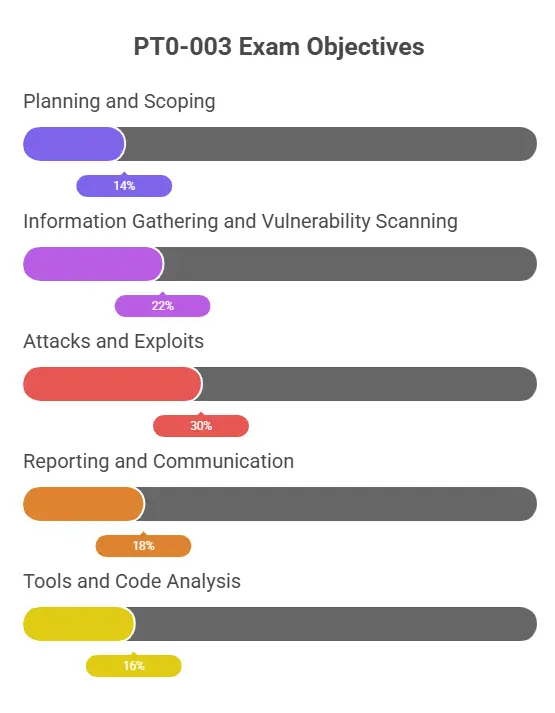
The PT0-003 exam is structured around the complete penetration testing workflow, broken into five domains.
- Planning and Scoping (14%)
This domain proves you are a professional, not just a hacker. It covers the critical initial phase of any engagement, including understanding legal concepts, defining the rules of engagement, and documenting the scope of the test. You’ll be tested on your ability to plan a test that meets the client’s objectives while remaining compliant with laws and regulations. - Information Gathering and Vulnerability Scanning (22%)
This section focuses on the reconnaissance phase. You must demonstrate your ability to perform passive information gathering using open-source intelligence (OSINT) and active reconnaissance by scanning networks with tools like Nmap. This also covers identifying vulnerabilities using various scanning tools and analyzing the results to plan your attack path. - Attacks and Exploits (30%)
As the most heavily weighted domain, this is the core of the exam. It tests your hands-on ability to exploit vulnerabilities across a wide range of systems. This includes attacking networks, wireless, cloud environments, and applications (e.g., SQL injection, cross-site scripting), as well as performing social engineering and post-exploitation techniques like privilege escalation and lateral movement. - Reporting and Communication (18%)
A penetration test is useless without a clear and actionable report. This domain validates your ability to communicate your findings effectively. You must know how to write a professional report that details the vulnerabilities you found, assesses their risk, and provides clear recommendations for remediation. - Tools and Code Analysis (16%)
This domain tests your understanding of the penetration tester’s toolkit. You will be tested on your ability to use essential tools like Metasploit, Nmap, Wireshark, and Burp Suite. Crucially, it also requires you to analyze basic scripts written in Bash, PowerShell, Python, and Ruby to understand what they do, without necessarily needing to write complex code from scratch.
Your Strategic Study Plan for Success
- Phase 1: Build Your Foundation (Weeks 1-3)
- Validate Your Prerequisites: Be honest about your background. The recommendation for Network+ and Security+ knowledge is not a suggestion; it’s a requirement for success. You cannot pass PenTest+ if you don’t have a rock-solid understanding of TCP/IP, common network protocols, DNS, and fundamental security concepts.
- Master the Objectives: Your study plan must be built on the official CompTIA PT0-003 Exam Objectives. Download this PDF from the CompTIA website. It is your definitive guide to every topic on the exam.
- Build Your Lab: This is non-negotiable. You must have a hands-on lab. The standard setup is a virtualization platform (like VMware Workstation Player or VirtualBox) running a Kali Linux VM. Kali comes pre-loaded with most of the tools you’ll need.
- Phase 2: Master Each Domain with Hands-On Hacking (Weeks 4-12)
- Use Practical Learning Platforms: The best way to study for PenTest+ is to practice legally and safely. Subscribe to a platform like TryHackMe. Their “Offensive Pentesting” learning path aligns extremely well with the PenTest+ curriculum. HackTheBox is another excellent, though more challenging, option.
- Learn the Methodology: As you go through the domains, focus on the process, not just the tools. For Information Gathering (Domain 2), spend days practicing with Nmap and learning its different scan types. For Attacks and Exploits (Domain 3), use your lab and platforms like TryHackMe to practice specific attacks against vulnerable machines (e.g., Metasploitable).
- Script Analysis: For Domain 5, don’t just read about scripting. Find simple Python or Bash scripts for penetration testing on GitHub. Read through them line by line and figure out what each command does. This is exactly what the exam will ask you to do.
- Write a Report: After you successfully compromise a machine on TryHackMe or in your lab, practice writing a report (Domain 4). Document the steps you took, the vulnerability you exploited, and what the machine’s owner should do to fix it.
- Phase 3: Final Prep and Practice (Weeks 13-14)
- Use High-Quality Practice Exams: Invest in a reputable set of practice exams, such as those from Jason Dion on Udemy or the official CompTIA CertMaster Practice. These are crucial for getting used to the question wording and the intense time pressure of the exam.
- Prepare for the PBQs: The performance-based questions are hands-on simulations. They will likely give you a terminal or a tool interface and ask you to perform a task. Your lab work and practice on platforms like TryHackMe are the best preparation for this.
- Review and Remediate: Analyze your practice test results. For every question you get wrong, go back to the source material and your lab to solidify the concept. In your final week, review the Nmap flags, common port numbers, and the five stages of the penetration testing methodology.
Career and Salary Opportunities
- Market Demand: The demand for skilled offensive security professionals is at an all-time high. Companies are shifting from a reactive to a proactive security posture, and penetration testers are on the front lines of that effort. The PenTest+ is a respected credential that proves to employers you have the practical skills they need.
- Salary Expectations: A career in penetration testing is not only exciting but also financially rewarding.
- ZipRecruiter reports that the average salary for a “Penetration Tester” in the United States is approximately $124,000 per year, with a typical range falling between $103,000 and $145,500.
- Glassdoor data shows an estimated total pay for a “Penetration Tester” in the US is around $118,000 annually.
Exam Logistics: Policies You Need to Know
- Retake Policy: If you fail on your first attempt, there is no waiting period. For your third attempt (and any subsequent attempts), you must wait at least 14 calendar days from the date of your last attempt.
- Certification Validity & Renewal: Your CompTIA PenTest+ certification is valid for three years. To renew it, you must earn 60 Continuing Education Units (CEUs) during this period and pay a renewal fee.
- Scheduling Your Exam: You can schedule your exam through Pearson VUE, to be taken either at a testing center or online. To register, visit the CompTIA scheduling page.
Common Questions and Sticking Points
Here are answers to some of the most common challenges and questions that candidates for the PenTest+ exam face.
- How is PenTest+ (PT0-003) different from CySA+?
This is the most frequent question. Think of them as two sides of the same coin. PenTest+ is offensive (Red Team). It’s about simulating attacks to find vulnerabilities. CySA+ is defensive (Blue Team). It’s about analyzing data, logs, and traffic to detect and respond to attacks. They are complementary, and many professionals eventually get both. - How much scripting and coding do I actually need to know?
You do not need to be a developer. However, you absolutely must be able to read and understand basic scripts. The exam will give you a block of code (in Bash, PowerShell, Python, or Ruby) and ask you what it does. You need to be able to identify loops, variables, and common commands to deduce the script’s purpose. - What are the Performance-Based Questions (PBQs) like?
The PBQs are simulations designed to test your hands-on skills. You might be given a command-line terminal and asked to:- Run an Nmap scan with specific flags to find open ports.
- Analyze the output of a vulnerability scan to identify the most critical issue.
- Correct a simple script that has an error in it.
- Craft a command to exploit a known vulnerability.
- Which tools are the most important to focus on?
While you should be familiar with many tools, you must have a deep, practical understanding of a core few:- Nmap: For scanning and enumeration. Know the common flags (-sS, -sV, -O, -A, -p-).
- Metasploit: Understand the basic workflow (search, use, set options, exploit).
- Wireshark: Know how to apply basic filters and analyze packet captures.
- Directory Brute-Forcers: Tools like DirBuster, Gobuster, or Dirb.
- Password Crackers: John the Ripper and Hashcat.
- Is this exam more about memorization or hands-on skills?
It’s about 20% memorization (tools, port numbers, legal concepts) and 80% hands-on application and methodology. You cannot pass this exam by simply reading a book. The questions are scenario-based and require you to apply your knowledge to solve a problem, making hands-on lab work the most critical part of your preparation.
Conclusion: Your Next Step
The CompTIA PenTest+ is a challenging but incredibly valuable certification that will launch your career in the exciting field of offensive security. It proves you have the mindset, the methodology, and the hands-on skills to be an effective ethical hacker. By building a solid lab, committing to practical exercises, and understanding the entire pen testing lifecycle, you can successfully conquer this exam.
Your mission starts now. Go to the official CompTIA PenTest+ certification page to download the exam objectives and begin your journey.
