
Everything You Need to Know About Agentforce Specialist
The Salesforce Certified Agentforce Specialist exam validates expertise in managing and optimizing Agentforce with deep knowledge of both Salesforce platform configuration and AI capabilities. In 2026, it covers five domains: Prompt Engineering (20%), AI Agents (30%), Agentforce and Data Cloud (20%), Development Lifecycle and Observability (15%), and Multi-Agent Interoperability (15%). A passing score of 73% is required, with a $100 USD retake fee. A typical preparation window is 4-8 weeks, depending on your existing Salesforce and AI experience. The recommended study path combines official Salesforce Trailhead modules with extensive hands-on practice in a developer org and rigorous practice exams. The certification must be renewed annually via release maintenance modules. This guide details official resources, exam strategies, and career opportunities in the rapidly growing AI-powered Salesforce ecosystem.
Introduction: What is the Salesforce Certified Agentforce Specialist and Why Does It Matter?
The Salesforce Certified Agentforce Specialist certification represents the cutting edge of AI integration within the Salesforce ecosystem. This credential validates your ability to design, configure, and optimize AI-powered agents that deliver measurable business value through autonomous customer interactions, intelligent workflow automation, and data-driven decision making.
This certification matters because artificial intelligence is fundamentally transforming how organizations interact with customers and manage operations. Companies implementing Agentforce need professionals who can bridge the gap between AI capabilities and business requirements. Earning this certification proves you can configure prompt templates, build intelligent agents, integrate Data Cloud for enhanced accuracy, manage security and adoption, and deploy agents across multiple channels while maintaining ethical AI practices.
For professionals, this certification opens doors to emerging roles in AI implementation, customer service automation, and intelligent system design. For organizations, certified specialists bring the expertise needed to maximize return on investment from Salesforce’s AI platform and stay competitive in an increasingly AI-driven marketplace.
Quick Facts & Exam Details
| Detail | Information |
| Exam Name | Salesforce Certified Agentforce Specialist (AI-201) |
| Provider | Salesforce |
| Prerequisites | None required, though foundational Salesforce knowledge is strongly recommended. Certifications like Salesforce Certified Administrator or Platform App Builder provide valuable context. |
| Passing Score | 73% (approximately 44 out of 60 questions correct) |
| Exam Duration | 105 minutes |
| Question Types | Multiple-choice and multi-select questions (60 scored questions plus up to 5 unscored) |
| Exam Cost | Exam Cost will be $75 USD. Retake fee: $100 USD. Note: Prices vary by country and are subject to applicable local taxes. Always confirm the final cost during the registration process at the Pearson VUE Salesforce Exam Voucher Store. |
| Delivery Options | Online proctored exam or onsite at a testing center |
| Reference Materials | No external materials permitted during the exam |
Is This Certification Right for You? (Target Audience)
This certification is designed for professionals who are responsible for managing and optimizing Agentforce within their organizations. You should consider pursuing this credential if you:
- Currently work as a Salesforce Administrator seeking to expand your skill set into AI-powered automation and intelligent agent configuration
- Serve as a Salesforce Consultant or Implementation Specialist who needs to deploy and customize Agentforce solutions for clients
- Hold a role in Customer Service or Support Management and want to leverage AI to enhance agent productivity and customer experience
- Work as a Salesforce Developer looking to integrate AI capabilities into custom solutions and workflows
- Are a Business Analyst or Solution Architect responsible for designing AI-driven customer engagement strategies
- Want to future-proof your career by gaining expertise in one of the fastest-growing areas within the Salesforce ecosystem
The exam assumes you can navigate Salesforce tools, understand platform configuration, and have the technical aptitude to work with AI concepts like prompt engineering, grounding techniques, and agent reasoning. While there are no formal prerequisites, hands-on experience with Salesforce is essential for success.
Exam Blueprint: Skills You’ll Be Tested On
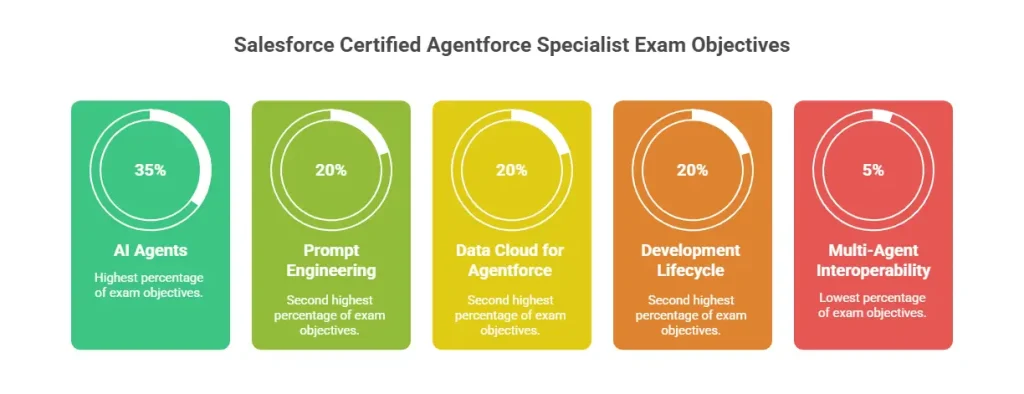
Domain 1: Prompt Engineering (20%)
This domain evaluates your ability to create, optimize, and manage AI-generated responses using Salesforce Prompt Builder. You’ll need to identify appropriate use cases for Prompt Builder based on business requirements, understand which user roles should manage versus execute prompt templates, and know the considerations for creating templates using field generation and flex types. You must be able to select appropriate grounding techniques for different scenarios and explain the complete process for creating, activating, and executing prompt templates. Additionally, you should understand best practices for writing effective prompts that produce accurate, relevant, and contextually appropriate AI responses.
Domain 2: AI Agents (30%)
This is the largest and most heavily weighted section of the exam. You’ll need to demonstrate how to manage deterministic behavior for agents using filters and variables, and explain how an agent works including how the reasoning engine powers Agentforce. You must know how to select and configure standard topics, custom topics, standard agent actions, and custom agent actions based on different agent types (Employee Agent, Service Agent, Sales Agent). Security management is critical, you need to explain the Agent User concept and how it applies to each agent type. You should be able to identify when to use each specific agent type based on business scenarios and understand the process for connecting agents to various channels including digital experience platforms, email, and Slack.
Domain 3: Agentforce and Data Cloud (20%)
This domain focuses on leveraging data to improve agent accuracy and personalization. You need to understand the different types of Agentforce Data Library content and how to use them effectively. You must know how to improve agent response accuracy and personalize answers using the Data Library. Understanding Data Cloud retrievers is essential, you should know the differences between individual and ensemble retrievers, and when to use keyword, vector, or hybrid search types. You’ll also need to explain how unstructured data is processed through chunking and indexing, and how these techniques affect agent performance.
Domain 4: Development Lifecycle and Observability (15%)
This domain validates your ability to build, test, deploy, and monitor agents throughout their lifecycle. You need to understand how to test agents using the Agentforce Testing Center, including creating test cases and evaluating agent responses. You must identify the considerations and best practices for deploying agents from sandbox to production environments. Additionally, you should be able to explain the process for managing and monitoring agent adoption, including tracking usage metrics, analyzing performance data, and identifying opportunities for optimization.
Domain 5: Multi-Agent Interoperability (15%)
This section represents Salesforce’s vision of connected, intelligent systems. You need to explain the purpose of Model Context Protocol (MCP) and its use cases for securely sharing context with external models while maintaining Salesforce’s trusted framework. You should understand the agent-to-agent protocol and how multiple agents can collaborate to deliver seamless customer experiences. You must also be able to identify scenarios where using the Agent API is appropriate for extending Agentforce across custom applications, external systems, or headless automation environments.
Your Strategic Study Plan for Success
Phase 1: Foundation Building (Weeks 1-2)
Begin by thoroughly reviewing the official Salesforce Agentforce Specialist Exam Guide available on Trailhead. This document outlines exactly what you need to know. Start with the official Trailhead learning path “Become an Agentblazer” to earn Agentblazer status. This pathway provides interactive modules covering Agentforce fundamentals, Prompt Builder basics, agent configuration, and Data Cloud integration.
Focus your initial study on Prompt Engineering since it represents 20% of the exam. Complete the Trailhead modules on Prompt Builder, learn how to create effective prompts, understand grounding techniques, and practice with different field generation scenarios. Use the official Salesforce documentation to deepen your understanding of prompt template architecture.
Set up a dedicated Salesforce Developer Edition org that includes Agentforce and Data Cloud capabilities. This hands-on environment is absolutely critical for success. Many candidates report that practical experience is the single most important factor in passing this exam.
Phase 2: Deep Domain Mastery (Weeks 3-5)
Dedicate Week 3 to AI Agents (30% of exam weight). This is your heaviest domain, so allocate sufficient time. Build multiple agent types in your developer org, create an Employee Agent, Service Agent, and Sales Agent. Configure standard and custom topics, experiment with standard and custom actions using Apex, Flow, and Prompt Templates. Practice managing agent security and permissions, and deploy agents to different channels.
In Week 4, focus on Agentforce and Data Cloud (20%). Set up the Data Library, upload different types of content, and experiment with retrievers. Compare keyword, vector, and hybrid search results to understand their practical differences. Practice chunking and indexing unstructured data. Create test scenarios where you need to improve agent response accuracy through better data grounding.
Week 5 should cover Development Lifecycle and Observability (15%) plus Multi-Agent Interoperability (15%). Use the Agentforce Testing Center to create comprehensive test cases. Practice deploying agents from sandbox to production while noting the migration considerations. Explore MCP capabilities and experiment with the Agent API to understand external integration patterns.
Phase 3: Integration and Practice Testing (Weeks 6-8)
Complete the “Cert Prep: Agentforce Specialist” module on Trailhead, which provides scenarios specifically designed for exam preparation. This module includes flashcards and interactive challenges that mirror exam question formats.
Take your first full-length practice exam to establish a baseline score. Quality practice exams from providers like Focus on Force, Your Cloud Coach, or saasguru closely mirror the actual exam format and difficulty. Aim for 85% or higher on practice exams before attempting the real certification.
Analyze your practice exam results to identify weak areas. Create a focused review plan targeting domains where you scored below 80%. Return to your developer org and practice the specific features you struggled with. This targeted remediation is far more effective than general review.
In your final week, take 2-3 more full-length practice exams under timed conditions. Review every question, both those you got right and wrong, to understand the reasoning. Many questions are scenario-based and test your ability to recommend the best Salesforce approach, not just what technically works.
Phase 4: Final Preparation (Days Before Exam)
Review your notes, flashcards, and any study guides you’ve created. Focus on memorizing key concepts like the differences between agent types, when to use each search type, and the deployment process. Ensure you understand the Agent User security model thoroughly as this concept appears frequently.
Get adequate rest the night before. Many candidates report that time management is crucial, with 105 minutes for 60+ questions, you have less than two minutes per question. Practice pacing yourself during your mock exams so you’re comfortable with the timing.
Career and Salary Opportunities
The Agentforce Specialist certification positions you at the intersection of two high-demand skill areas: Salesforce administration and artificial intelligence. The job market for AI-skilled Salesforce professionals is experiencing rapid growth as organizations rush to implement intelligent automation and AI-powered customer experiences.
According to current job market data, Salesforce professionals with Agentforce and AI skills can expect competitive compensation. Entry-level positions such as Salesforce AI Administrator or Junior Consultant typically offer salaries ranging from $70,000 to $90,000 annually in the United States. Mid-level roles including Salesforce Agentforce Specialist, AI Implementation Consultant, or Agentforce Developer command salaries between $90,000 and $120,000 per year.
Senior-level positions such as Agentforce Architect, AI Solutions Architect, or Lead Agentforce Consultant can earn $120,000 to $160,000 or more annually, especially when combined with other advanced certifications. Specialized roles at major consulting firms or Fortune 500 companies implementing enterprise-scale AI solutions may offer even higher compensation.
Job listings on platforms like Indeed and ZipRecruiter show increasing demand for professionals with Agentforce expertise. Current openings frequently request knowledge of Agentforce alongside Service Cloud, Data Cloud, and integration capabilities. Companies are specifically seeking professionals who can design AI-powered sales enablement solutions, implement AI-driven customer service experiences, and integrate Agentforce with external systems.
The career path typically progresses from Administrator roles to Developer or Consultant positions, then to Architect or Strategic roles. Specializing in Agentforce while maintaining strong foundational Salesforce knowledge creates a powerful combination. Many professionals report that AI-related certifications differentiate them in a saturated Salesforce job market, with the Agentforce credential becoming increasingly valuable as organizations prioritize AI initiatives.
Beyond direct Agentforce roles, this certification demonstrates your ability to work with emerging technologies and adapt to platform evolution, qualities that employers highly value in the rapidly changing Salesforce ecosystem.
Exam Logistics: Policies You Need to Know
Registration and Scheduling: Register through the Pearson VUE Salesforce Exam Voucher Store starting July 21, 2025. You’ll purchase a voucher valid for 12 months for the specific exam. Vouchers are non-refundable, non-transferable, and cannot be extended. You can choose between online proctored exams (taken from your location with remote supervision) or onsite testing at a Pearson VUE center.
Retake Policy: If you don’t pass on your first attempt, you can retake the exam immediately (after 24 hours). The retake fee is $100 USD. There’s no limit to the number of times you can attempt the exam, but each retake requires payment of the retake fee.
Certification Validity and Maintenance: Once you earn the Agentforce Specialist certification, you must maintain it by completing release maintenance modules. Salesforce releases three major platform updates annually (Spring, Summer, Winter). You’re required to complete maintenance modules for your certification once per year to keep it active. These modules are free online assessments covering new features and functionality.
If you don’t complete your maintenance modules by the deadline, your certification will expire. You can view your specific maintenance requirements and deadlines in your Salesforce Certification dashboard on Trailhead.
Important Note for Existing AI Specialist Holders: If you earned the Salesforce AI Specialist credential before March 3, 2025, your credential was automatically updated to Agentforce Specialist. You don’t need to retake the exam. However, you must complete the Agentforce Specialist Summer ’25 maintenance module to keep your certification current.
Exam Security: Salesforce maintains strict exam security protocols. During online proctored exams, you’ll need a webcam, stable internet connection, and a quiet private space. The proctor will verify your identity and monitor you throughout the exam. No reference materials, notes, or electronic devices are permitted during the exam.
Scheduling Your Exam: Visit the official Salesforce Certification page to access registration through Pearson VUE.
Practical FAQs & Common Challenges
1. How much hands-on experience is truly necessary before taking this exam?
Hands-on experience is not just helpful, it’s essential. Multiple certification holders report that this exam is significantly more challenging than it appears on paper. You cannot pass by memorizing concepts alone. You must understand how Agentforce features work together in practice. Set up a dedicated Agentforce-enabled developer org and spend at least 20-30 hours building agents, creating prompt templates, configuring Data Cloud, and deploying solutions across different channels. Practice creating custom actions using Flow and Apex, experiment with different grounding techniques, and test agent behavior in various scenarios. The exam includes many scenario-based questions where practical experience helps you quickly identify the correct Salesforce-recommended approach.
2. Which exam domains or topics do most candidates find the most challenging?
The AI Agents domain (30%) causes the most difficulty despite being the most heavily weighted section. Specifically, candidates struggle with understanding the nuances between agent types, knowing when to use standard versus custom actions, and properly configuring agent security through the Agent User concept. The relationship between topics and actions can be confusing without hands-on practice.
Agentforce and Data Cloud integration (20%) is another challenging area, particularly understanding the differences between keyword, vector, and hybrid search types and knowing which retriever strategy to use in specific scenarios. Many candidates underestimate the importance of data grounding and how chunking and indexing affect agent performance.
The Multi-Agent Interoperability domain (15%), while smaller, introduces concepts like Model Context Protocol and Agent API that are relatively new and may not be covered extensively in all study materials. Focus extra attention on these areas during your preparation.
3. Should I earn the Salesforce Administrator certification before attempting Agentforce Specialist?
While there are no formal prerequisites, having the Salesforce Administrator certification provides tremendous value. The Administrator cert ensures you understand Salesforce’s core platform, security model, data architecture, and automation capabilities, all foundational to successfully implementing Agentforce. Many exam questions assume you understand how Salesforce profiles, permission sets, sharing rules, and record access work.
However, if you already have significant Salesforce experience (even without certification), you may be ready for Agentforce Specialist. Assess your comfort level with Flow, Apex basics, Salesforce security, and platform navigation. If these areas feel uncertain, consider studying Administrator-level content or earning that certification first. This investment will make your Agentforce preparation more efficient and effective.
4. What is the best strategy for the scenario-based questions?
The Agentforce Specialist exam heavily relies on scenario-based questions that present business situations and ask you to recommend solutions. Read each question carefully and identify the business requirement versus technical constraints. Salesforce often has multiple ways to solve a problem, but the exam seeks the “best” or “most appropriate” solution according to Salesforce best practices.
When answering, think about what Salesforce would recommend rather than what you might personally prefer or what you’ve implemented at your organization. Consider factors like scalability, maintainability, security, and user experience. Eliminate obviously incorrect answers first, then evaluate remaining options based on the specific scenario requirements. Many questions include distractors that could technically work but aren’t optimal.
Don’t rush. With approximately 1.75 minutes per question, you have time to read carefully and think through your answer. Flag difficult questions and return to them after completing easier ones, ensuring you don’t leave questions unanswered.
5. How long should I realistically study for this exam?
Study time varies significantly based on your background. If you’re an experienced Salesforce Administrator with some AI knowledge, expect 4-6 weeks of dedicated study (15-20 hours per week). If you’re newer to Salesforce or have limited platform experience, plan for 8-12 weeks with similar weekly time commitment.
The exam recently evolved from the AI Specialist exam with updated objectives focusing more heavily on Agentforce content. Even experienced Salesforce professionals who passed the AI Specialist exam report needing substantial preparation for the updated version. Don’t underestimate this certification based on it being categorized as a “specialist” rather than “architect” credential, it requires deep practical knowledge.
Create a realistic study calendar that includes time for Trailhead modules, hands-on practice, documentation review, and practice exams. Most successful candidates spend at least 60-80 total hours preparing, with hands-on practice comprising 40-50% of that time.
6. What are the official prerequisites for this certification?
There are no mandatory prerequisites for the Agentforce Specialist exam. You can register and attempt the exam without holding any other Salesforce certifications. However, Salesforce strongly recommends that candidates have:
- Solid understanding of Salesforce platform fundamentals including objects, fields, relationships, security, and automation
- Familiarity with Service Cloud, Sales Cloud, or Experience Cloud depending on your agent implementation needs
- Basic understanding of AI concepts and how machine learning models generate responses
- Experience working in Salesforce in an administrative, developer, or consultant capacity
While not required, many successful candidates hold the Salesforce Administrator or Platform App Builder certifications before attempting Agentforce Specialist. These provide the foundational knowledge that makes Agentforce concepts easier to grasp.
7. Is it better to focus more on practice exams or hands-on labs?
The most effective preparation strategy balances both, but if you must prioritize, hands-on labs provide greater long-term value. This exam tests your ability to apply knowledge to realistic business scenarios, which requires practical understanding of how features work together.
Use practice exams strategically: take one early to identify weak areas, focus on hands-on practice and study for those domains, then take additional practice exams as you approach exam day to assess readiness and build confidence. Aim for consistently scoring 85% or higher on practice exams before attempting the real certification.
During hands-on practice, don’t just follow step-by-step tutorials. Create your own scenarios and solve problems independently. Build an agent from scratch without instructions, troubleshoot why a prompt template isn’t producing expected results, and experiment with different Data Cloud configurations. This exploratory learning builds the problem-solving skills the exam tests.
8. Can I pass this exam by only studying Trailhead modules?
Trailhead modules provide excellent foundational knowledge and are absolutely essential for your preparation. However, Trailhead alone is typically insufficient for passing this exam. Many candidates report studying 70% of recommended Trailhead content and still feeling underprepared.
Supplement Trailhead with official Salesforce documentation, especially for deeper technical concepts. Review release notes to understand recent platform updates. Join the Trailblazer Community and the Agentblazer Slack community to learn from others’ experiences and ask questions about challenging concepts.
Most importantly, combine Trailhead learning with extensive hands-on practice. The exam doesn’t test whether you completed modules, it tests whether you can apply that knowledge to solve real business problems. Build confidence through practical experience, not just passive learning.
Conclusion: Your Next Step
The Salesforce Certified Agentforce Specialist certification represents a significant professional achievement that validates your expertise in one of technology’s most transformative areas. By earning this credential, you demonstrate your ability to harness AI capabilities within the world’s leading CRM platform, positioning yourself at the forefront of business innovation.
This certification opens doors to exciting career opportunities, higher earning potential, and the professional satisfaction of working with cutting-edge technology that delivers measurable business impact. As organizations increasingly adopt AI-powered automation, your specialized knowledge becomes more valuable each day.
Your path to success begins with commitment and a strategic study plan. Leverage official Salesforce resources, invest time in hands-on practice, connect with the Trailblazer Community, and approach this certification with the seriousness it deserves. While challenging, this exam is absolutely achievable with proper preparation and dedication.
The AI revolution is here, and Salesforce is at its center. Take the first step toward becoming an Agentforce specialist today. Visit the official certification page at to begin your journey. Your future in AI-powered Salesforce starts now.
