

B2C Commerce Architect Key Facts & Overview
Arch-303 is the Salesforce B2C Commerce Architect exam. In 2026, it covers 5 domains: Design and Discovery (28%), Build (23%), Monitoring and Troubleshooting (16%), Integrations and Customization (23%), and Launch (10%). A passing score of 65% (39 out of 60 scored questions) is required. The exam costs USD 400 plus applicable taxes, with a USD 200 retake fee. A typical preparation window is 8–12 weeks for experienced developers with 5+ years of B2C Commerce experience and the prerequisite B2C Commerce Developer certification. The recommended study path combines official Salesforce documentation, hands-on SFCC platform experience, and understanding of Storefront Reference Architecture (SFRA). The certification must be maintained annually via free online release maintenance modules. This guide details official resources, scheduling procedures, and exam policies.
What is the Salesforce B2C Commerce Architect Certification and Why Does It Matter?
The Salesforce Certified B2C Commerce Architect credential validates your expertise in designing and implementing scalable, high-performance eCommerce solutions on the Salesforce Commerce Cloud (formerly Demandware) platform. This certification proves you can architect global sites supporting multiple brands, channels, and locales using industry-standard design patterns.
Unlike the B2C Commerce Developer certification that focuses on implementation and coding, this architect-level credential demonstrates your ability to make strategic technical decisions, lead development teams, design system integrations, and ensure solutions follow best practices for security, performance, and scalability. You’ll prove you can bridge business requirements with technical architecture across the entire Software Development Lifecycle (SDLC).
This certification matters because B2C Commerce implementations involve complex technical challenges: integrating with CRM, ERP, OMS, PIM, and WMS systems, managing multi-site architectures, optimizing performance for high-traffic scenarios, ensuring PCI compliance, and designing for future growth. Organizations need architects who understand not just how to build features, but how to design robust, maintainable, and scalable commerce platforms that support business growth.
As an architect, you’ll guide teams through implementation decisions, conduct code reviews, evaluate third-party integrations, design data architectures, and ensure alignment with Salesforce best practices. This certification opens doors to technical leadership roles commanding premium compensation in the thriving e-commerce industry.
Quick Facts & Exam Details
| Detail | Information |
|---|---|
| Exam Name | Salesforce Certified B2C Commerce Architect (Arch-303) |
| Provider | Salesforce |
| Prerequisites | Required: Salesforce Certified B2C Commerce Developer. Recommended: 5+ years of eCommerce experience, technical team leadership experience, and familiarity with retail IT system integration. |
| Passing Score | 65% (39 out of 60 scored questions correct) |
| Exam Duration | 105 minutes |
| Question Types | 60 multiple-choice/multiple-select questions plus up to 5 non-scored questions |
| Exam Cost | USD 400 plus applicable taxes. Note: Prices vary by country and are subject to change. Always confirm the final cost during the registration process. |
| Retake Fee | USD 200 plus applicable taxes |
| Delivery Options | Online proctored or onsite at Pearson VUE testing center |
| Language | English |
Is This Certification Right for You? (Target Audience)
Ask yourself these questions:
- Do you have the B2C Commerce Developer certification?
This is a hard prerequisite enforced during registration. You cannot attempt the Architect exam without first earning the Developer credential.
- Do you have 5+ years of eCommerce experience?
The exam assumes deep practical knowledge gained from multiple full-cycle Commerce Cloud implementations. If you’ve only worked on one project or lack exposure to complex integrations, you’ll struggle with scenario-based questions.
- Have you led technical teams or architecture design?
This certification targets Technical Leads, Solution Architects, Senior Developers, and Technical Directors. You should have experience making architectural decisions, conducting design reviews, and guiding implementation teams.
- Are you familiar with integrating retail IT systems?
The exam tests your knowledge of connecting Commerce Cloud with CRM systems like Service Cloud, ERP platforms, Order Management Systems, Product Information Management tools, and Warehouse Management Systems.
- Do you understand SFRA and SFCC best practices deeply?
You need hands-on experience with Storefront Reference Architecture, not just surface-level knowledge. Can you explain the cartridge path resolution, controller architecture, caching strategies, and ISML template rendering?
If you answered yes to these questions and want to validate your expertise in designing enterprise-scale B2C Commerce solutions, this certification will accelerate your career into high-paying architect roles.
Exam Blueprint: Skills You’ll Be Tested On
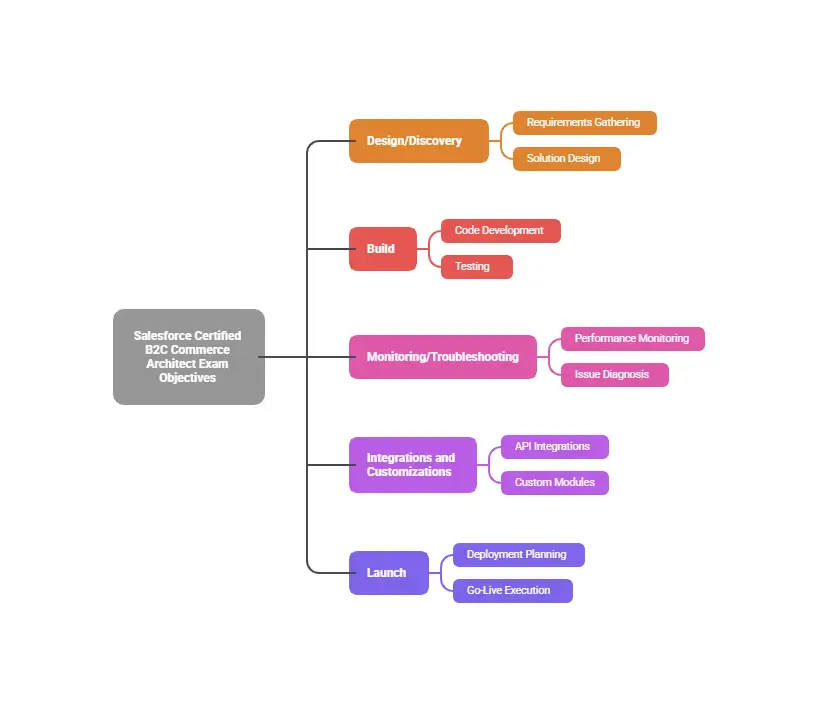
Design and Discovery — 28% (Largest Domain)
This domain tests your ability to translate business requirements into technical specifications and architectural designs. You’ll create technical artifacts, review implementation specifications for scalability and gaps, evaluate AppExchange solutions and third-party APIs, analyze integration points and data volumes, and diagram system architectures. Expect questions on creating data flow diagrams, assessing migration approaches, conducting site readiness assessments, and documenting technical decisions for stakeholders.
Build — 23%
Here you’ll demonstrate expertise in guiding implementation teams through development. Topics include validating that implementations follow Salesforce best practices for security, performance, and modularity, resolving complex technical issues, supporting load testing to meet key performance indicators, and defining processes for compiling and deploying cartridges and data to different environments. You must understand code review practices, development methodologies, and quality assurance strategies.
Monitoring and Troubleshooting — 16%
This domain assesses your ability to maintain operational excellence post-launch. You’ll need to evaluate custom logging configurations using Log Center, leverage diagnostic tools to identify issues, implement performance optimization strategies, identify and address quota violations, optimize cache utilization, manage service timeouts, troubleshoot integration failures, and create monitoring frameworks. Understanding SFCC’s Health Check tools, log analysis, and performance profiling is critical.
Integrations and Customization — 23%
This section tests your knowledge of connecting Commerce Cloud with external systems. Topics include choosing appropriate protocols (SOAP vs REST), selecting integration approaches (real-time vs batch), applying security strategies for web service integrations, leveraging the Job Framework for batch processing, evaluating legacy LINK cartridges using Pipelines versus Controllers, designing custom cartridge architectures, and implementing service framework best practices. You must understand circuit breakers, service timeouts, and error handling.
Launch — 10%
The smallest but important domain focuses on successfully going live. You’ll set up SEO-compliant aliases for domains, locales, and currencies, create rollback plans for launch failures, monitor system health indicators during launch, define data replication schedules and job dependencies, plan post-production activities, and support data migration processes. Understanding blue-green deployments, gradual traffic shifting, and launch checklists is essential.
Your Strategic Study Plan for Success
Phase 1: Foundation Assessment (Week 1-2)
Before diving into study, honestly assess your B2C Commerce experience. Have you worked with SFRA? Do you understand the cartridge layering model? Have you integrated SFCC with external systems? Have you conducted performance optimization or troubleshooting?
Review the official Salesforce exam guide (available through Trailhead) to understand the exam objectives. For any areas where you lack hands-on experience, prioritize setting up sandbox environments to gain practical knowledge.
Phase 2: Core Platform Mastery (Week 3-5)
Focus on deepening your understanding of B2C Commerce architecture:
- SFCC Platform Architecture: Study the multi-layered architecture (client, server, CDN), understand caching strategies at each layer (browser, CDN, page, content, remote include), and learn how requests flow through the platform.
- Storefront Reference Architecture (SFRA): Master the cartridge structure, controller patterns (replacing legacy Pipelines), ISML template rendering, JavaScript controllers, server-side JavaScript APIs, and the model-view-controller architecture.
- Business Manager Configuration: Understand site preferences, jobs and scheduling, search configuration and tuning, category management, promotions and pricing, SEO configuration, and OCAPI (Open Commerce API) setup.
- Security and Compliance: Study PCI compliance requirements, certificate management, firewall rules for integrations, content security policies, and secure payment processing.
Phase 3: Integration and System Design (Week 6-8)
This is where architect-level thinking becomes critical:
- Integration Patterns: Study real-time service calls vs batch processing, understand when to use SOAP vs REST, learn middleware considerations, and master the Service Framework for external callouts.
- Data Architecture: Design data models across systems, understand system-of-record concepts, learn data synchronization strategies, plan data migration approaches, and handle large data volumes.
- Third-Party Systems: Study integration patterns for CRM (Service Cloud, Sales Cloud), ERP systems, Order Management Systems, Product Information Management tools, and Warehouse Management Systems.
Phase 4: Performance and Operational Excellence (Week 9-10)
Focus on non-functional requirements:
- Performance Optimization: Study page caching strategies, content caching, remote includes, cache warming, CDN configuration, and front-end optimization techniques.
- Monitoring and Logging: Master Log Center configuration, understand different log levels and categories, learn quota monitoring, implement custom logging for integrations, and use diagnostic tools.
- Load Testing: Understand how to plan load tests, interpret results, identify bottlenecks, optimize based on findings, and ensure KPI targets are met.
Phase 5: Launch and Governance (Week 11)
Study the end-to-end launch process:
- Launch Planning: Understand site readiness assessments, launch checklists, rollback procedures, traffic management during launch, and blue-green deployment strategies.
- Aliases and Configuration: Learn SEO-friendly alias setup, domain and locale management, currency configuration, and DNS configuration.
- Post-Launch: Study monitoring strategies, performance tuning post-launch, handling incidents, and continuous improvement processes.
Phase 6: Practice and Review (Week 12)
Take practice exams under timed conditions. The ARC300 instructor-led course includes practice questions, though it’s expensive (3,100+ EUR). Focus instead on:
- Official Salesforce documentation
- Trailhead modules on B2C Commerce
- Community-shared study guides
- Real-world scenario analysis
Key Official Resources
- Salesforce B2C Commerce Documentation (developer.salesforce.com/docs/commerce)
- B2C Commerce Architect Exam Guide (available through Trailhead credentials page)
- Trailhead Modules: Search for “B2C Commerce” modules covering architecture, performance, and integration
- B2C Commerce Developer Center (developer.salesforce.com/developer-centers/commerce-cloud)
- Storefront Reference Architecture (SFRA) Documentation
Career and Salary Opportunities
The demand for Salesforce B2C Commerce Architects is strong, driven by the continued growth of e-commerce and digital transformation initiatives. Organizations implementing or expanding commerce platforms need architects who can design scalable, secure, and high-performing solutions.
According to recent salary data, Salesforce B2C Commerce Architects in the United States earn competitive compensation:
- National Average: $136,000 – $160,000 per year
- Entry-Level Architects (5-7 years experience): $120,000 – $140,000
- Mid-Level Architects (7-10 years experience): $140,000 – $160,000
- Senior Architects (10+ years experience): $160,000 – $188,000+
- Hourly Rate Equivalent: $65 – $90 per hour
The typical salary range falls between $120,000 (25th percentile) and $188,000+ (90th percentile) annually. Salaries vary significantly based on location, with major tech hubs commanding premium rates:
- San Francisco Bay Area: 20-30% above national average
- New York City: 15-25% above national average
- Seattle: 10-20% above national average
- Austin, Denver, Boston: 5-15% above national average
Additional factors that drive higher compensation include:
- Certifications: Holding both Developer and Architect certifications significantly increases earning potential
- Industry Specialization: Experience in high-value sectors (luxury retail, B2B commerce) commands premium rates
- Integration Expertise: Deep knowledge of complex system integrations (MuleSoft, SAP, Oracle) increases value
- Multi-Cloud Experience: Familiarity with both B2C and B2B Commerce Cloud platforms
Job titles you’ll qualify for include:
- Salesforce B2C Commerce Architect
- Commerce Cloud Solution Architect
- Technical Architect – eCommerce
- Senior Commerce Cloud Developer
- eCommerce Technical Lead
- Commerce Cloud Consultant
- Solution Architect – Digital Commerce
The certification opens opportunities with Salesforce implementation partners (Accenture, Deloitte Digital, EPAM), pure-play commerce agencies, enterprise retailers implementing commerce transformations, and direct employment at Salesforce itself.
Exam Logistics: Policies You Need to Know
Registration and Scheduling
As of July 2025, Salesforce certification exams transitioned to Trailhead Academy (powered by Pearson VUE). To register:
- Visit Trailhead Academy and log in with your Trailblazer credentials
- Verify you hold the B2C Commerce Developer certification (enforced prerequisite)
- Search for “B2C Commerce Architect” in the certification catalog
- Click “Register Now” and select online proctored or testing center
- Complete registration through Pearson VUE
- Schedule your exam date and time
- Pay the exam fee
Direct link: Search “B2C Commerce Architect” onSalesforce Certifications
Retake Policy
If you don’t pass on your first attempt, you may retake the exam. The retake fee is USD 200 plus applicable taxes. There is no mandatory waiting period, but Salesforce recommends addressing knowledge gaps before rescheduling.
Certification Validity and Maintenance
The B2C Commerce Architect certification remains valid as long as you complete annual maintenance requirements. Each year, Salesforce releases maintenance modules covering new platform features and best practices. These free online assessments must be completed by the specified deadline.
Maintenance modules typically align with major B2C Commerce releases (three times per year). Check your Trailhead profile regularly for maintenance deadlines. If you miss the deadline, your certification will expire and you’ll need to retake the full exam.
View maintenance requirements: Log into Trailhead > Profile > Certifications > Maintenance
Exam Day Requirements
For Online Proctored Exams:
- Quiet, private room with no interruptions
- Desktop or laptop with webcam and microphone
- Reliable internet connection
- Government-issued photo ID
- Clear desk workspace with no study materials
For Testing Center Exams:
- Two forms of government-issued ID
- Arrive 15 minutes early
- No personal items allowed in testing room
- Testing center provides whiteboard or scratch paper
What’s Not Allowed:
- Any study materials, notes, or documentation
- Additional monitors (single monitor only for online exams)
- Mobile devices or smartwatches
- Bathroom breaks (plan accordingly)
- Access to Business Manager or any Salesforce orgs
Practical FAQs & Common Challenges
1. How much B2C Commerce experience is essential before taking this exam?
You need substantial hands-on SFCC experience—not just theoretical knowledge from documentation. Most successful candidates have 5+ years of B2C Commerce implementation experience spanning multiple projects. You should have worked with SFRA, integrated external systems, conducted performance optimization, troubleshot production issues, and participated in at least one full-cycle implementation following the Site Readiness Assessment process. If you only have Developer certification without deep platform experience, expect to struggle with architect-level scenario questions that test judgment and decision-making. Spend 6-12 months gaining diverse project experience before attempting this exam.
2. Which exam domains do most candidates find the most challenging?
Monitoring and Troubleshooting (16%) consistently ranks as the hardest domain. Many developers focus on building features but lack experience with operational concerns like Log Center configuration, quota management, performance profiling, and diagnosing production issues. The questions require practical troubleshooting experience you won’t gain from documentation alone. Integrations and Customization (23%) also challenges candidates, particularly around choosing the right integration approach (real-time vs batch), understanding service framework nuances, evaluating LINK cartridges, and implementing proper error handling. To succeed, gain hands-on experience with these operational aspects, not just feature development.
3. Should I take the ARC300 instructor-led course offered by Trailhead Academy?
The ARC300 course costs 3,100+ EUR (approximately USD 3,300) for four days of training. While comprehensive, many candidates pass without taking this expensive course. If your employer covers training costs and you benefit from structured instructor-led learning, it provides valuable insights. However, if self-funding, you can achieve success using free official documentation, Trailhead modules, hands-on lab practice, and real-world project experience. The money saved could be invested in practice environments or exam retakes if needed. Prioritize hands-on experience over classroom training—architect skills come from solving real problems, not lectures.
4. What is the best strategy for scenario-based questions?
Architect exam questions present detailed business scenarios (4-8 sentences) describing client requirements, constraints, and technical context. Read carefully and identify the core problem being solved and any constraints mentioned (budget, timeline, existing systems, performance requirements). Many questions offer multiple technically correct answers—you must select the BEST option considering all factors. Look for keywords like “most scalable,” “least development effort,” “following best practices,” or “future-proof solution.” These signal the evaluation criteria. Draw mental architecture diagrams for complex integration scenarios. If unsure, eliminate obviously wrong answers first, then evaluate remaining options against Salesforce best practices. Your real-world experience will guide you to the architect-level answer.
5. How long should I realistically study for this exam?
Study duration depends heavily on your experience level. Experienced architects (5+ years SFCC, multiple projects): 8-10 weeks with 10-15 hours weekly of focused study and hands-on practice. Developers transitioning to architecture (3-5 years SFCC experience): 10-12 weeks with 15-20 hours weekly. Recently certified Developers without architecture experience: 12-16 weeks with intense hands-on practice. You cannot cram for this exam in 2-3 weeks—it tests judgment developed through experience. If you’ve never troubleshot quota violations, designed multi-site architectures, or integrated external systems, allocate extra time for hands-on learning. Quality of experience matters more than quantity of study hours.
6. How important is understanding legacy Pipelines vs modern Controllers?
Very important, despite Pipelines being deprecated. Many enterprise clients still have legacy implementations using Pipelines, and LINK cartridges often use Pipeline-based architectures. You need to understand both paradigms: how Pipelines worked, why Controllers replaced them, migration strategies from Pipelines to Controllers, and how to evaluate whether LINK cartridges need updates. Exam questions specifically address scenarios involving legacy LINK integrations still using Pipelines. Understand the architectural differences, performance implications, and migration considerations. This knowledge demonstrates your ability to work with real-world enterprise implementations, not just greenfield SFRA projects.
7. What’s the difference between this exam and the B2C Commerce Developer exam I already passed?
The Developer exam focuses on implementation skills: coding JavaScript controllers, creating ISML templates, using SFCC APIs, building cartridges, and configuring Business Manager. It tests your ability to build features. The Architect exam operates at a higher level—you’re designing system-level solutions that span multiple components and integrations. You’ll make strategic decisions about integration approaches, evaluate third-party solutions, design for scalability and performance, guide development teams through complex problems, and ensure solutions align with best practices. Think of it as the difference between being an expert builder versus being the person who designs what gets built and ensures it’s constructed properly. Architects need developer skills PLUS strategic thinking, system design expertise, and leadership abilities.
8. How heavily does the exam test Business Manager configuration vs coding?
The exam balances both aspects, reflecting real architect responsibilities. You’ll face questions on Business Manager configuration (jobs, search, SEO, OCAPI, site preferences, replication, aliases) alongside coding architecture questions (controller design, service framework, custom cartridges, ISML templates). Approximately 40% tests configuration knowledge, 40% tests architectural design and coding practices, and 20% tests operational concerns (monitoring, troubleshooting, launch). Many developers focus exclusively on coding and struggle with Business Manager configuration questions. Ensure you have hands-on experience with Job Framework scheduling, search indexing, site preferences, promotion configuration, and other Business Manager administrative tasks.
9. Should I memorize specific API classes and methods?
No, don’t waste time memorizing specific API signatures. The exam tests conceptual understanding and architectural decision-making, not rote memorization of API syntax. You should understand which API packages solve which problems (dw.system, dw.order, dw.catalog, dw.customer, dw.net, dw.io), general capabilities of each package, and when to use which approach. Questions focus on “which API package would you use to solve this problem” rather than “what are the exact parameters for this method call.” Spend time understanding API capabilities through hands-on coding rather than memorizing documentation. Your practical experience using APIs will serve you better than memorization.
10. How should I prepare if I don’t have access to a B2C Commerce environment?
This presents a significant challenge since hands-on experience is crucial. Options include: (1) Request sandbox access through your employer or consulting partner, (2) Work on freelance SFCC projects through platforms like Upwork to gain experience, (3) Join Salesforce partner organizations that provide training environments, (4) Study official documentation extensively and use mental simulation to work through scenarios, (5) Watch B2C Commerce video tutorials and conference sessions showing real implementations. Without hands-on access, focus intensively on official documentation, architecture diagrams, case studies, and community content. However, be realistic—passing without any hands-on SFCC experience is extremely difficult. The exam tests practical knowledge gained from solving real problems, not theoretical understanding from reading documentation.
Conclusion: Your Next Step
The Salesforce Certified B2C Commerce Architect credential represents mastery of enterprise-scale eCommerce architecture. It validates your ability to design scalable, secure, high-performance commerce solutions, lead technical teams, make strategic architectural decisions, and ensure implementations follow industry best practices.
This journey requires significant commitment—earning the prerequisite Developer certification, gaining 5+ years of hands-on SFCC experience, mastering SFRA and platform architecture, understanding complex integrations, and developing architect-level judgment. But the reward is substantial: career advancement into technical leadership, significant salary increases, and the capability to design commerce solutions that power global brands.
You have the roadmap. You understand the domains. You know what’s required. The only remaining step is to commit to the journey and put in the focused preparation time.Ready to begin? Visit the official certification page to review the exam guide, verify your prerequisite certification, and schedule your exam.
